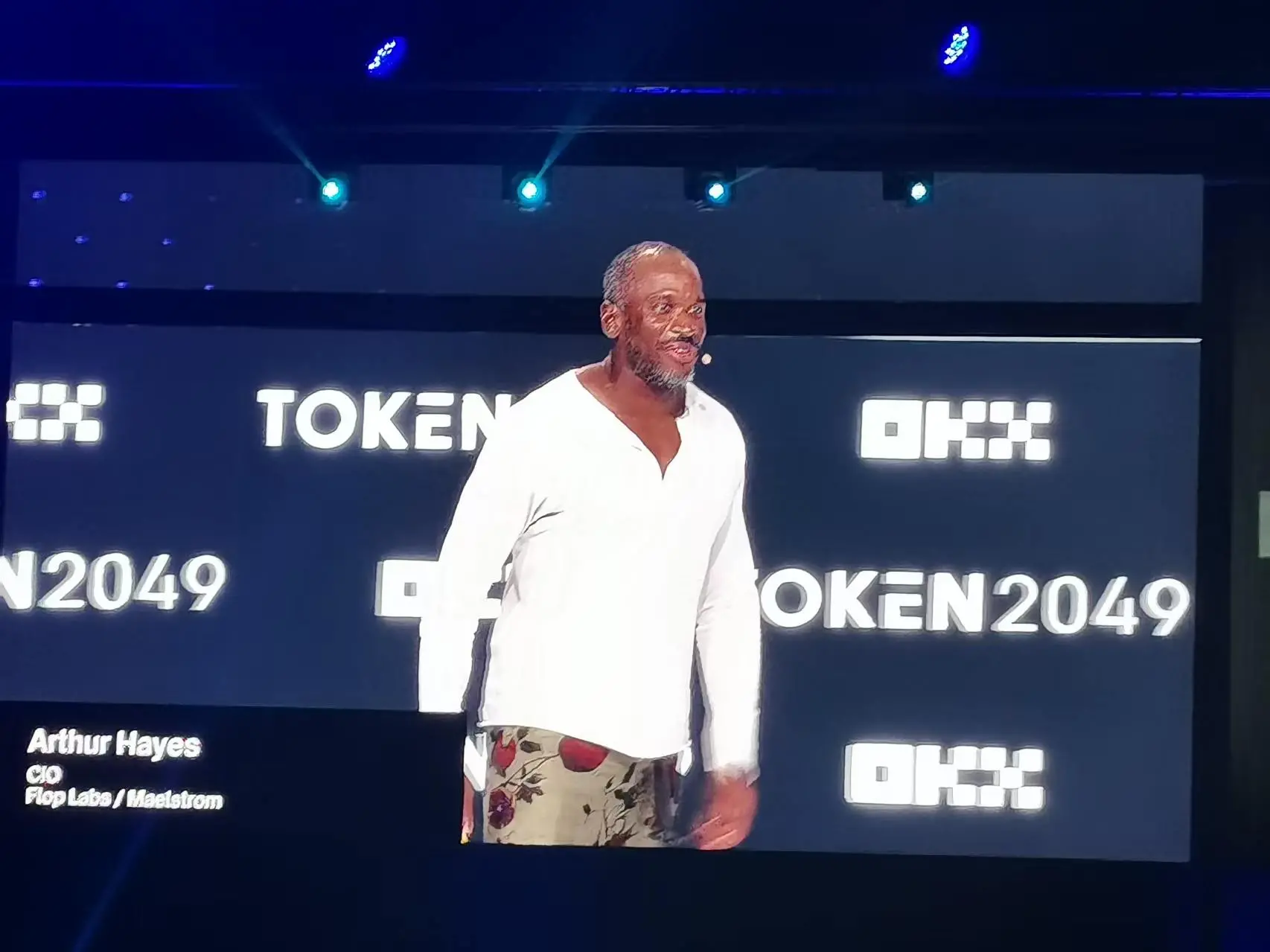
Arthur Hayes' latest interview: Fiat currencies will continue to depreciate, and user growth is the core challenge faced by Web3 companies

 Hayes shared his unique perspective on wealth, risk, and the freedom that travel brings.
Original Title: Tokened EP.5: Conversation with Arthur Hayes
Guest: Arthur Hayes, Co-founder of BitMEX
Compiled by: LenaXin, ChainCatcher
ChainCatcher Editor's Summary
This article is compiled from a deep conversation between the Tokened Podcast and cryptocurrency billionaire, Arthur Hayes, co-founder of BitMEX. Hayes shares his unique views on wealth, risk, and the freedom that travel brings. From navigating market volatility to exploring the world, Hayes shares core insights from his journey. These experiences apply not only to the cryptocurrency field but also reflect a philosophy of life.
ChainCatcher has organized and compiled this content.
(1) Hayes's Entry into the Industry: Transitioning from Traditional Finance to the Crypto World
Tokened: What initially drew you into the Bitcoin space, and how did you get involved?
Arthur Hayes: I worked as an ETF market maker at Deutsche Bank and Citibank in Hong Kong. After being laid off by Citibank in 2013, I decided to leave the traditional finance industry.
At that time, I read articles about Bitcoin on Zero Hedge during my unemployment and began researching it. Satoshi Nakamoto's white paper deeply fascinated me, especially as it resonated with my interest in gold investment.
By the spring and summer of 2013, I fully embraced the idea of Bitcoin. As a trader, I started studying how the cryptocurrency market operates, how to go long and short, and how to trade derivatives. I gained practical experience through arbitrage trading between Icybit and Mt.Gox.
This experience prompted me to decide to create a derivatives exchange. Between the end of 2013 and 2014, I co-founded the company with my partners Ben Delo and Sam Reid. Twelve years later, I am still deeply engaged in this field.
(2) Hayes's Perspective on Current Trends in the Cryptocurrency Field
Tokened: How do you view the current trends in the cryptocurrency field? Is there excessive hype? Is cryptocurrency being used as a means of payment? For underlying blockchain development? Or for asset tokenization? Which areas do you think are at risk of a bubble?
Arthur Hayes: I believe the core trend is the continuous devaluation of fiat currencies. For example, Japan's debt-to-GDP ratio has reached an all-time high, exemplifying large-scale money printing. Inflation concerns are increasingly prominent, with people struggling to afford housing and food, and wage growth lagging far behind the rate of money supply expansion. This constitutes the most fundamental economic trend.
In this context, Bitcoin always has intrinsic value. Unless it can be proven that countries have stopped money printing, holding Bitcoin remains a rational choice. Despite price volatility, Bitcoin has maintained the best asset performance record in human history over the 15 years since the creation of the genesis block in 2009. Its fundamental driving force lies in the global continuous devaluation of currencies.
Tokened: But I think if you look at any media outlet now, you'll find it overly focused on trading rather than the real world.
Arthur Hayes: People always have a demand for trading. They are acutely aware that the dollars, yen, and euros they hold are continuously devaluing, yet they still need to make a living and fulfill family responsibilities. This is the fundamental reason why Bitcoin always has intrinsic value.
(3) Hayes's Travel Philosophy: Exploring the World and Enhancing Communication
Tokened: You mentioned that many wealthy individuals currently reside in Singapore, but can it truly be called home?
Arthur Hayes: I am passionate about skiing and spend a lot of time in Hokkaido and Japanese ski resorts. I also love outdoor activities like surfing and kitesurfing, always pursuing a lifestyle that coexists with nature.
Tokened: Does travel change the way you view freedom, power, and money?
Arthur Hayes: The ability to travel globally 24/7 has become an important privilege for modern people. The travel restrictions during the pandemic made us realize that some people are content to stay put while others yearn for movement, depending on their geographical environment and personal preferences.
The global trend is evident: travel demand continues to grow, and airline mileage and fuel consumption are rising year by year. Humanity has an eternal desire to explore the world and enhance communication, which is the everlasting value of travel.
Tokened: What is your daily life like now? Can you describe a typical daily routine?
Arthur Hayes: During the ski season, I usually go to bed around 7-8 PM and wake up at 4 AM. I start with stretching exercises and prepare food for the day since I need to hike for eight hours on the slopes every day.
(4) Industry Changes: From Talent Shortages to Attention Wars
Tokened: Do you think starting a business was easier back then, or is it more challenging now?
Arthur Hayes: Challenges always exist, but they take different forms. The core issue BitMEX faced was talent recruitment. At that time, many qualified individuals were unwilling to enter the field, which forced us to hire some candidates who might not be considered today at high salaries.
Now the situation has fundamentally changed; cryptocurrency has become a standard career path. For example, at Maelstrom, we can attract excellent graduates from top universities who are not only well-trained but also enter the crypto ecosystem with the right mindset and career planning. This evolution of the talent environment is a reflection of the industry's maturity.
Tokened: Have you noticed changes in the financing needs of startups?
Arthur Hayes: I believe the core challenge for Web3 startups is gaining user attention. While the cost of technology development has indeed decreased, the cost of breaking through the attention barrier continues to rise. Whether it's advertising or paying KOL alliance fees, acquiring traffic requires significant financial investment.
Tokened: When investing, do you also provide strategic advice to the companies you invest in?
Arthur Hayes: Yes, we are big corporate advisors.
Tokened: If you could give advice to your early entrepreneurial self, what do you think needs the most adjustment?
Arthur Hayes: Hire better talent.
(5) The Digital Nomad's Dilemma: Disconnecting, Einstein, and Antarctic Dreams
Tokened: A whole year completely off the internet, or a whole year banned from traveling. Which would you choose?
Arthur Hayes: A whole year completely off the internet.
Tokened: If you could choose a historical figure as a travel companion, who would you choose?
Arthur Hayes: Einstein.
Tokened: Not Satoshi Nakamoto?
Arthur Hayes: Satoshi Nakamoto should remain a mystery. Not meeting or revealing their identity is the ideal way to protect this legend.
Tokened: You travel often; is there a destination you have yet to visit but always long for?
Arthur Hayes: Antarctica.
Tokened: When you travel, do you often bring books or watch movies? Are there any works that particularly inspire you?
Arthur Hayes: My favorite sci-fi series is "The Three-Body Problem."
(6) Hayes's Advice for Entrepreneurs
Tokened: If you were to give any entrepreneur one piece of advice, what would be your main suggestion?
Arthur Hayes: The core is to create products that users are truly willing to pay for. Many entrepreneurs today focus on creating products that appeal to venture capital rather than market needs. While they may secure funding, even if they are acquired or go public, the founding team may lose ownership, essentially just piling up free services that no one truly needs.
Web2 companies often require long-term accumulation to reach a $50 million valuation, while Web3 companies can achieve the same valuation in just a few hours after issuing tokens. This difference reflects the fundamental valuation logic distinction between the two business models.
Tokened: Do you primarily invest in Web3 or a combination of Web2 and Web3?
Arthur Hayes: Maelstrom focuses on token investments rather than equity. We are familiar with the high liquidity characteristics of the crypto market and can typically achieve cost recovery within two years.
In contrast, equity investment cycles can last 7-10 years, which does not match our liquidity needs. This does not negate the value of equity but is a strategic choice based on capital efficiency.
I like this flexibility. Cryptocurrency is a field I am familiar with, and we understand the successful models of token economics, so we stick to focusing on our own track. We only do things within our capability circle and do not blindly cross over.
(7) Could Decentralized Media Be the Key Breakthrough?
Tokened: In the BlackFree project, what type of key project do you think is currently missing?
Arthur Hayes: I look forward to achieving decentralized social media. Current mainstream platforms like X, Instagram, and TikTok monopolize the value of community interaction, and breaking this centralized barrier is the key breakthrough.
Tokened: Are you referring to data and content?
Arthur Hayes: Your data and content can be banned by authorities at any time, whether it's Elon Musk or at the national level. This kind of centralized control is contrary to the core ideals of the cryptocurrency movement; we pursue data ownership and economic autonomy, aiming to eliminate the intermediary monopolies of governments and large financial institutions through disruptive technology. The current structure clearly conflicts with this vision.
Tokened: Why put your data on the blockchain?
Arthur Hayes: Founders should focus on underserved niche markets. There’s no need to pursue star users; instead, build a dedicated social credit system for specific groups. By starting from the grassroots community, gradually establishing low-cost network effects, we can ultimately achieve ecological expansion. This is the effective path to breaking the social media monopoly.
Tokened: Are you still active in the NFT space?
Arthur Hayes: I don't like CryptoPunks.
Tokened: Are we missing a key project? Perhaps one that is driven directly by oneself, developed personally, and specifically serves one's follower community?
Arthur Hayes: While I do not have the commercial or technical capability to lead a social media revolution, I am convinced that a focused group of entrepreneurs needs to tackle this problem, and no one has truly broken through yet. The key is to promote the decentralization of social media and gain the support of the entire crypto community.
As for Musk? He clearly has different ambitions. His goal is to strengthen the centralization of the X platform, using data to train AI and integrate it into robotic systems. This has its own logic but is completely contrary to the idea of decentralization.
(8) Where is the Future of Cryptocurrency Heading?
Tokened: How do you view the development prospects of cryptocurrency in the next 5-10 years? What are your expectations for its evolution?
Arthur Hayes: I expect prices to rise significantly, but more importantly, the user base. I hope to achieve a truly applied ecosystem with 2 billion active wallets. This means the current user base needs to grow a hundredfold.
Tokened: How can we clearly explain the value of joining Web3 to potential users?
Arthur Hayes: I suggest beginners start with a small allocation of Bitcoin, read Satoshi Nakamoto's white paper, and share it with friends. This process will naturally form polarized perceptions: either recognizing its revolutionary value or deeming it a scam. Based on this foundation, individuals can then explore the crypto space further according to their needs.
 Risk warning
 Risk warning