What is Tether's co-founder re-employment project, the "second-generation stablecoin" STBL?

 In one night, it surged over 20 times, STBL has sparked another wave of "new stablecoin fever."
Author: Wenser, Odaily Planet Daily
Last night, after the official announcement of STBL, which focuses on the concept of "second-generation stablecoin + Tether co-innovation project," the price surged, reaching around $0.22 at its peak, and later exceeding $0.3 this afternoon before falling back to around $0.17. On the other hand, Tether CEO Paolo Ardoino recently stated emphatically: "The total number of USDT users is nearly 500 million, with a daily trading volume of about $45 billion, and an average of 17 million daily traders, with Tether's profit margin reaching 99%."
What exactly is SBTL? Is it related to the stablecoin public chain Stable launched by Tether? Is the identity of Tether co-founder legitimate? What is the background of STBL? Odaily Planet Daily will provide a detailed introduction and brief analysis of these questions in this article.
SBTL: The "Second-Generation Stablecoin" Led by Tether's Former CEO
First, it is important to clarify that STBL is not related to Tether's previously launched stablecoin L1 public chain Stable: the former is prepared and launched by Reeve Collins, former co-founder and CEO of Tether, president of ReserveOne, CEO of M3-Brigade Acquisition V Corp, and Avtar Sehra, founder of KAIO. STBL is an ecological governance token, and will subsequently launch the consumption stablecoin USST and the yield token YLD; the latter is launched by Tether, the issuer behind USDT, supported by Bitfinex and USDT 0, with Tether CEO Paolo Ardoino as an advisor, using USDT as the on-chain native Gas, allowing users to initiate transactions without holding platform tokens, and P2P (peer-to-peer) USDT transfers are completely gas-free.
Therefore, contrary to the many users who mistakenly believe that "STBL is a new stablecoin launched by the stablecoin L1 public chain Stable," in fact, the only connection between STBL and Tether may be that its chairman and co-founder Reeve Collins was involved in the operation of Realcoin (the predecessor of USDT) from 2013 to 2014 and briefly served as CEO of the issuing company Tether.

According to the long article previously published by Reeve Collins and information from the STBL official website, the main components of the STBL ecosystem are:
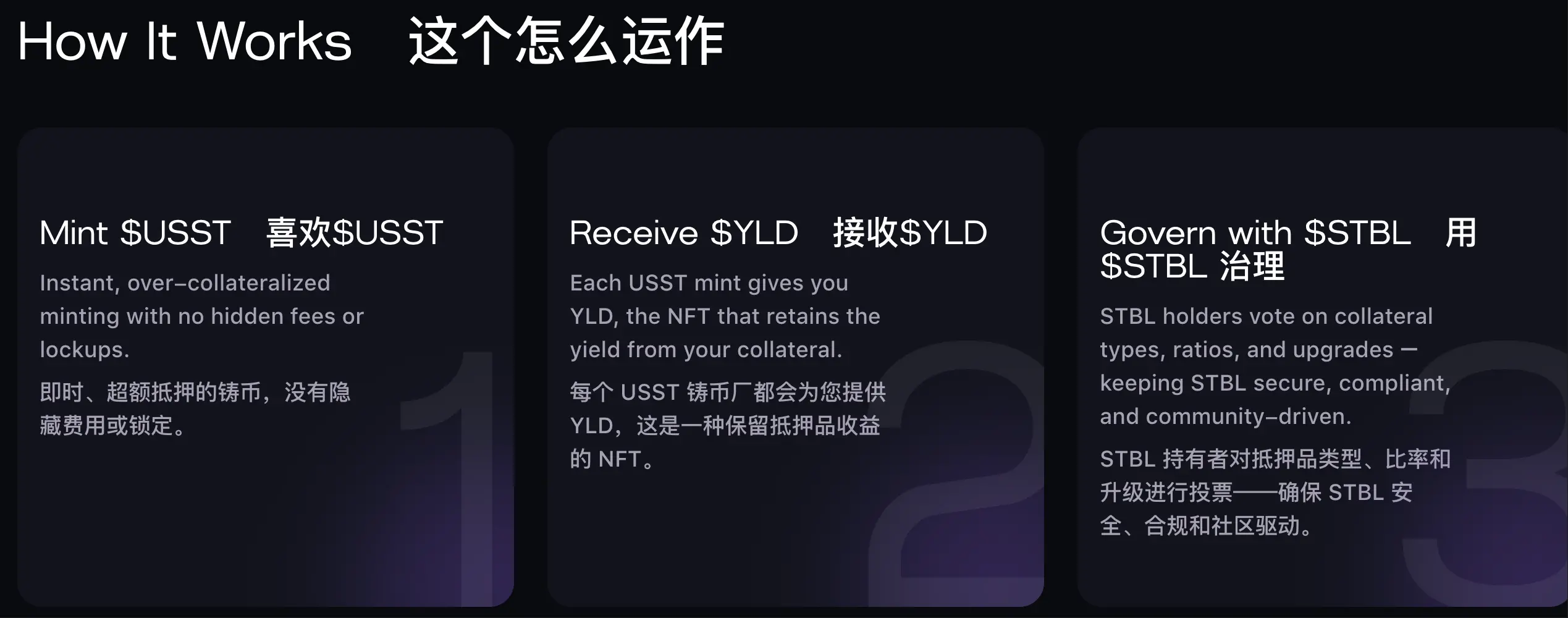
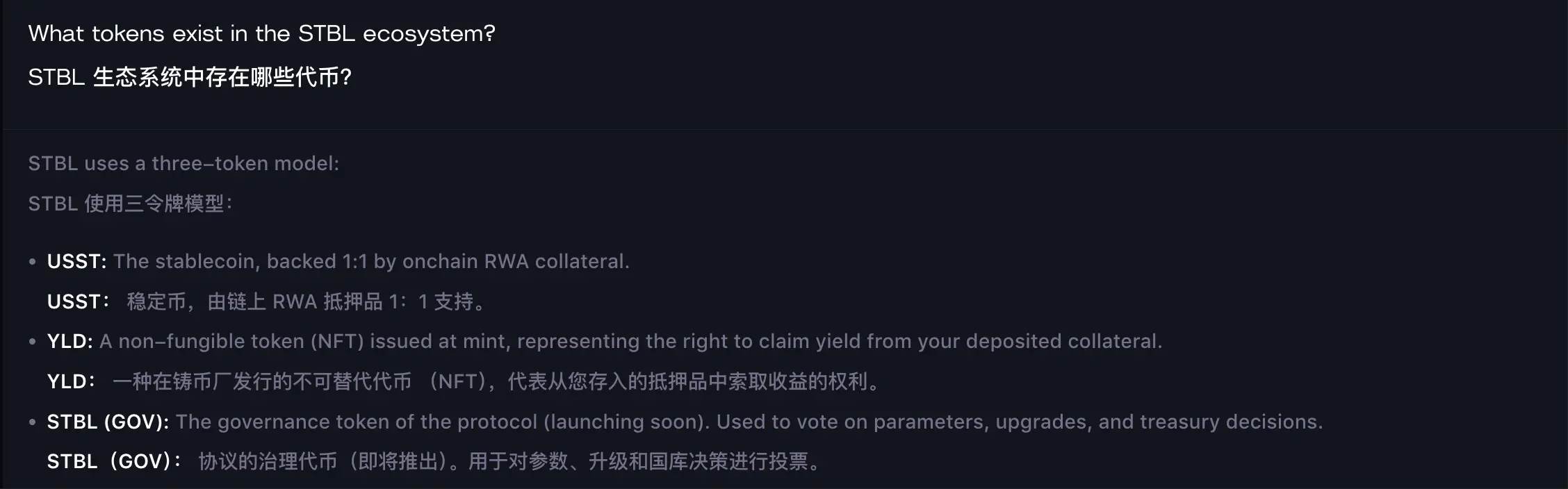
- STBL is a governance token, allowing holders to vote on collateral types, ratios, and upgrades, ensuring that STBL is secure, compliant, and community-driven. It is worth mentioning that this token is completely non-custodial.
- USST is a consumption stablecoin, supported 1:1 by on-chain RWA collateral, which can be instantly and over-collateralized, with no hidden fees or lock-ups, and can be used for supported partner agreements and exchanges for trading, DeFi protocols, cross-chain bridging, and fund management. Currently supported collateral includes USDY and OUSG from ONDO, as well as BUIDL from BlackRock.
- YLD is an NFT that users can use to receive predetermined yields, primarily used to retain collateral yields and increase over time.
In other words, unlike the operating model of "first-generation stablecoins" such as Tether and Circle—where the issuer monopolizes the interest or income generated from the reserve funds corresponding to the stablecoins—STBL aims to "redistribute wealth to the people" through the YLD NFT. Thus, if the first-generation stablecoins (like USDT and USDC) solved the problem of "how to establish a reliable digital dollar on the blockchain," then the goal of the second-generation stablecoin (i.e., USST) is to financialize the dollar. Reeve's original words were—"Yields are no longer limited to the issuer's balance sheet. The principal and yield are split into two programmable cash flows."
In addition, SBTL has the support of Wave Digital Assets, an investment company based in Los Angeles and registered with the SEC in the U.S., which reportedly has asset management scale exceeding $1 billion, having previously spun off from a venture capital firm with a scale of up to $400 million, and has gained attention for its risk-aware and regulated investments.
STBL's Ambition: Detract from Issuers, Benefit Multiple Parties
Currently, STBL's ambition is significant, and its core lies in one sentence—distributing the business profits generated from reserve collateral such as U.S. Treasury bonds and gold to users, while institutions, governments, and DeFi protocols gain broader liquidity assets.
Specifically, the USST stablecoin and YLD NFT's "growth flywheel" in the STBL ecosystem provides certain benefits to different groups and roles:
- For consumers, holding USST stablecoins ultimately contributes to serving the entire ecological network rather than just the interests of the issuer;
- For institutions, USST and YLD can transform idle cash assets into transparent, compliant, and revenue-generating assets and cash flows;
- For sovereign governments, the issuance of USST will become a significant case study, meaning they can produce a digital stablecoin linked to their national debt, thereby maintaining national sovereignty; and they can also release new value sources that traditional fiat currencies cannot provide—namely, realizing the preservation and appreciation of their national currency.
- For DeFi protocols, the built-in yield combinable modules of the USST and YLD system will provide more diverse and flexible support for various businesses such as derivatives and transfers.
Conclusion: The Future of STBL Depends on the Issuance Volume of USST
Although currently, the "STBL-USST-YLD" ecosystem can operate smoothly, in the long run, the price performance of STBL as a governance token will still be primarily determined by the issuance scale of USST and the corresponding yield from collateral. If YLD yields are substantial, USST will undoubtedly open up a new development path for the stablecoin market—a path distinct from Tether and Circle's monopolization of collateral yield; however, given the current scale of the stablecoin market, the issuance of USST undoubtedly faces fierce competition and an uncertain future.
Click to learn about job openings at ChainCatcher
Recommended Reading:
NAKA's stock price plummeted 54% in one day, is the market starting to tire of DAT?
Is the Base chain about to launch its token? 6 projects worth paying attention to
 Risk warning
 Risk warning