The rise of stablecoins: Can Bitcoin's "payment dream" still be realized?
 Core Viewpoint

 The centralized design of the dollar and its dependence on American politics ultimately determine its fate as a currency, but if we are realistic, its demise may not be seen in 10, 50, or even 100 years.
Author: Juan Galt, Original Compilation: AididiaoJP, Foresight News
As the GENIUS Act solidifies the status of stablecoins backed by U.S. Treasury bonds, Bitcoin's decentralized network makes it a more suitable blockchain for global adoption, responding to the trend of declining demand for U.S. bonds in a multipolar world.
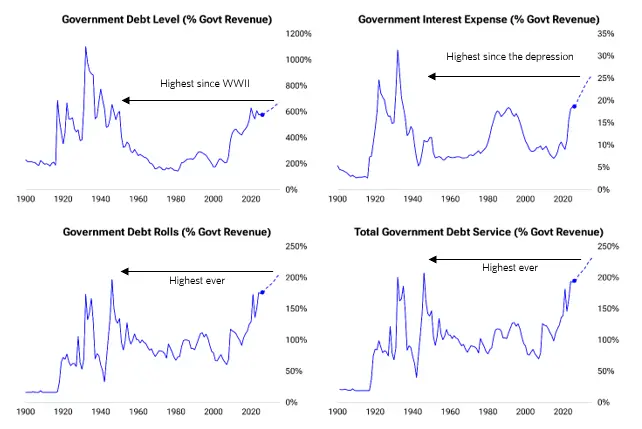
As the world transitions from a U.S.-dominated unipolar order to a multipolar landscape led by BRICS nations, the dollar faces unprecedented pressure due to declining bond demand and rising debt costs. The GENIUS Act, passed in July 2025, marks a bold strategy by the U.S. to address this situation by legislating the recognition of stablecoins backed by U.S. Treasury bonds, thereby unleashing massive overseas demand for U.S. bonds.
The blockchain that supports these stablecoins will shape the global economy for decades to come. With its unparalleled decentralization, privacy of the Lightning Network, and robust security, Bitcoin emerges as the superior choice to drive this digital dollar revolution, ensuring lower conversion costs when fiat currencies inevitably decline. This article explores why the dollar must and will be digitized through blockchain, and why Bitcoin must become its operating track for the U.S. economy to achieve a soft landing from its global empire high.
The End of the Unipolar World
The world is transitioning from a unipolar world order (where the U.S. was the sole superpower capable of influencing markets and dominating global conflicts) to a multipolar world, where Eastern alliances can organize independently of U.S. foreign policy. This Eastern alliance is known as BRICS, comprising major countries like Brazil, Russia, China, and India. The inevitable result of the rise of BRICS is a geopolitical restructuring that challenges the hegemony of the dollar system.
There are many seemingly isolated data points indicating this restructuring of world order, such as the military alliance between the U.S. and Saudi Arabia. The U.S. no longer defends the petrodollar agreement, which stipulated that Saudi oil would only be sold in dollars in exchange for U.S. military defense of the region. The petrodollar strategy has been a major source of dollar demand and has been considered key to U.S. economic strength since the 1970s, but it has effectively ended in recent years, at least since the onset of the Ukraine war, as Saudi Arabia has begun accepting currencies other than the dollar for oil-related trade.
Weakness in the U.S. Bond Market
Another key data point in the geopolitical transformation of the world order is the weakness of the U.S. bond market, with growing skepticism about the long-term creditworthiness of the U.S. government. Some are concerned about political instability within the country, while others doubt whether the current government structure can adapt to the rapidly changing high-tech world and the rise of BRICS.
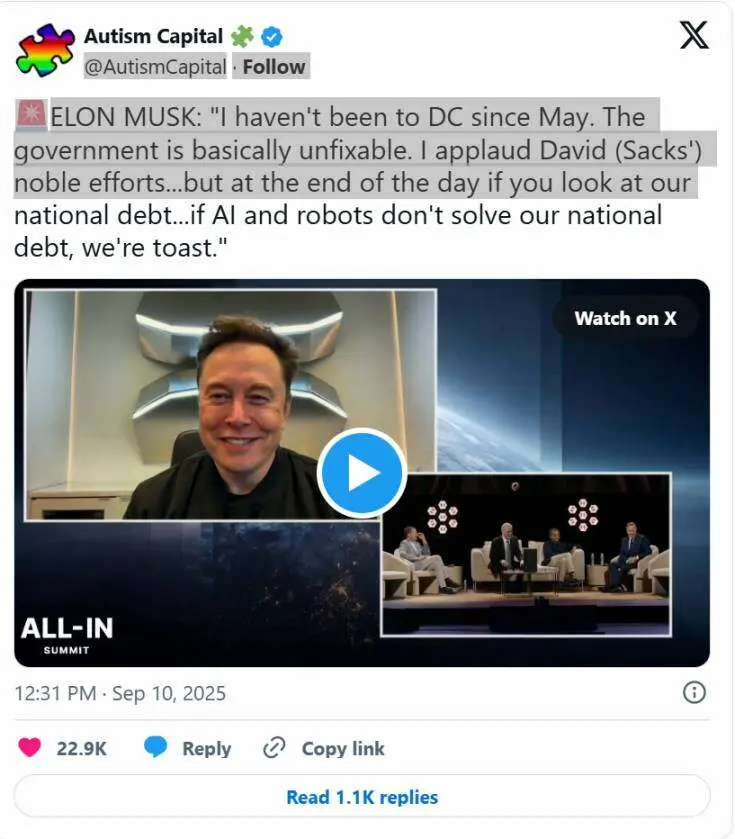
Elon Musk is reportedly one of the skeptics. Musk recently spent months working with the Trump administration to attempt to restructure the federal government and the country's finances through the Department of Efficiency, but he abruptly exited the political scene in May.
When Musk recently appeared at a summit, he shocked the internet by saying, "I haven't been to Washington since May. The government is basically hopeless. I appreciate David Sacks' noble efforts… but ultimately, if you look at our national debt… if AI and robotics can't solve our national debt problem, we're doomed."
If even Musk cannot save the U.S. government from financial doom, who can?
Such concerns are reflected in the low demand for U.S. long-term bonds, which manifests in the need to raise interest rates to attract investors. Today, the yield on U.S. 30-year Treasury bonds stands at 4.75%, a 17-year high. According to Reuters, demand for long-term bonds like the U.S. 30-year Treasury auction is also on the decline, with 2025 demand being "disappointing."
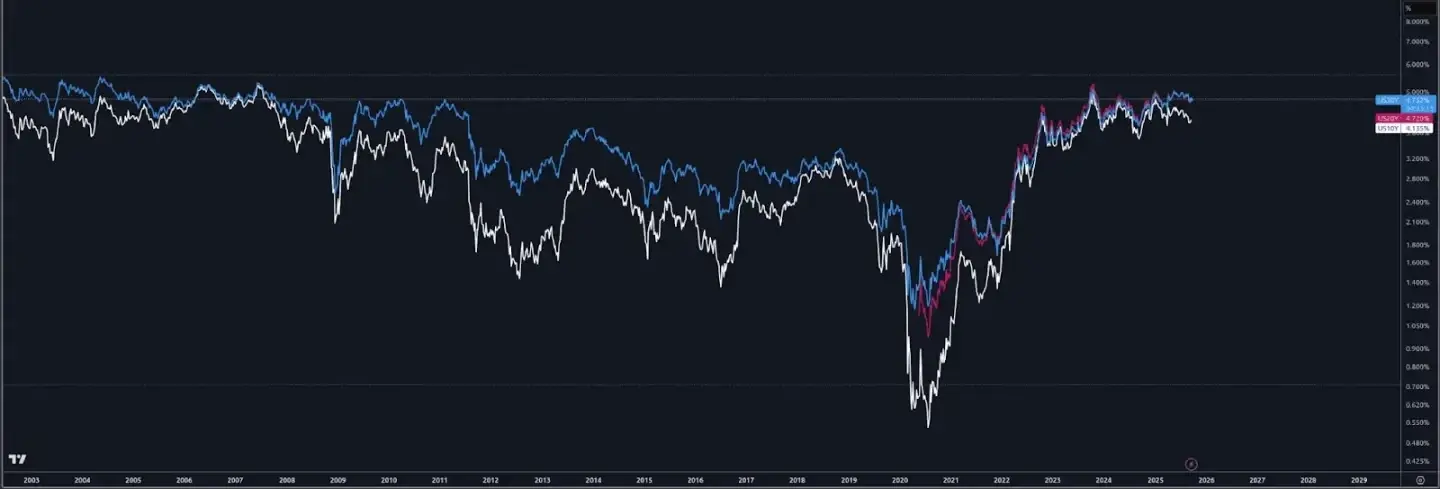
The weakening demand for U.S. long-term bonds has significant implications for the U.S. economy. The U.S. Treasury must offer higher interest rates to attract investors, which in turn increases the interest payments the U.S. government must make on its national debt. Today, U.S. interest payments are nearing one trillion dollars annually, exceeding the entire military budget of the country.
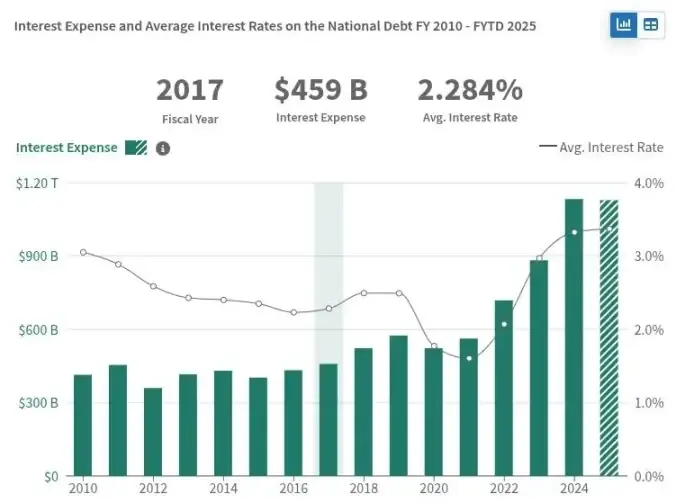
If the U.S. fails to find enough buyers for its future debt, it may struggle to pay its current bills, turning instead to the Federal Reserve to purchase this debt, which would expand its balance sheet and money supply. The effects, while complex, are likely to lead to dollar inflation, further harming the U.S. economy.
How Sanctions Devastated the Bond Market
Further weakening the U.S. bond market was the U.S. manipulation of its controlled bond market to deal with Russia in response to its invasion of Ukraine in 2022. During the invasion, the U.S. froze Russia's overseas Treasury reserves, which were intended to repay its debts to Western investors. Reports indicate that to force Russia into default, the U.S. also began blocking Russia's attempts to repay all debts to foreign bondholders.
A female spokesperson for the U.S. Treasury confirmed at the time that certain payments would no longer be allowed.
"Today is the deadline for another debt payment from Russia," the spokesperson said.
"Starting today, the U.S. Treasury will not allow any dollar debt payments from the Russian government’s accounts at U.S. financial institutions. Russia must choose to either deplete its remaining dollar reserves or new sources of income, or default."
By weaponizing the bond market through its foreign policy sanctions mechanism, the U.S. effectively targeted Russia. But sanctions are a double-edged sword: since then, foreign demand for U.S. bonds has weakened as countries that do not align with U.S. foreign policy seek to diversify their risks. China has led this trend away from U.S. bonds, with its holdings peaking at over $1.25 trillion in 2013 and accelerating downward since the onset of the Ukraine war, now nearing $750 billion.
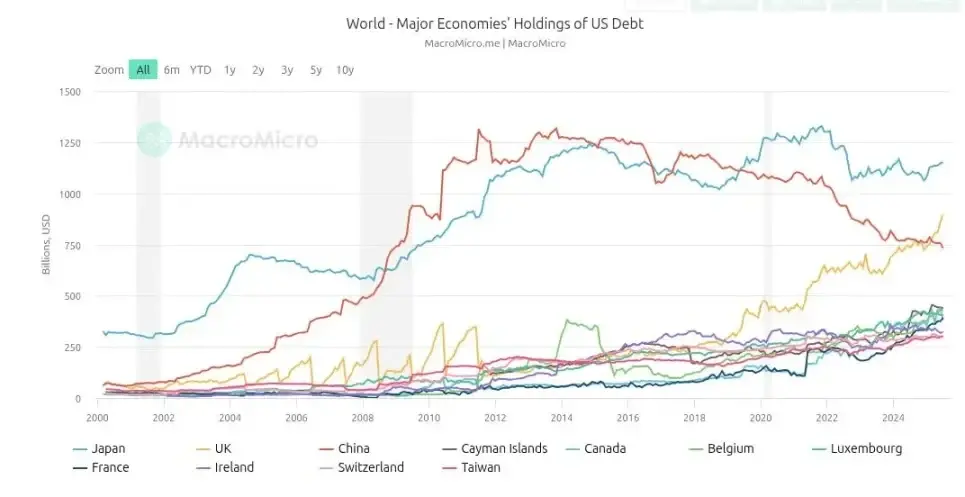
While this event showcased the devastating effectiveness of sanctions, it also deeply harmed confidence in the bond market. Not only was Russia blocked from repaying its debts under Biden administration sanctions, but investors were also harmed as a collateral damage, and the freezing of its foreign Treasury reserves signaled to the world that if you, as a sovereign nation, defy U.S. foreign policy, all bets are off, including in the bond market.
The Trump administration has since moved away from sanctions as a primary strategy, as they harm the U.S. financial sector, and has shifted to a tariff-based diplomatic approach. These tariffs have had mixed results so far. While the Trump administration boasts record tax revenues and private sector infrastructure investments domestically, Eastern nations have accelerated their cooperation through the BRICS alliance.
The Stablecoin Strategy Handbook
While China has reduced its holdings of U.S. bonds over the past decade, a new buyer has emerged, quickly rising to the top. Tether, a fintech company born in the early days of Bitcoin, now holds $171 billion in U.S. bonds, nearly a quarter of China's holdings, and surpasses most other countries.
Tether is the issuer of the most popular stablecoin, USDT, which has a circulating market cap of $171 billion. The company reported a profit of $1 billion in the first quarter of 2025, with a simple yet outstanding business model: buying short-term U.S. bonds, issuing USDT tokens backed 1:1, and pocketing the interest income from U.S. government bonds. Tether, which started the year with 100 employees, is reportedly one of the most profitable companies per capita in the world.
Circle, the issuer of USDC, the second most popular stablecoin, also holds nearly $50 billion in short-term Treasury bills. Stablecoins are used worldwide, particularly in Latin America and developing countries, as alternatives to local fiat currencies, which suffer from far worse inflation than the dollar and are often hindered by capital controls.
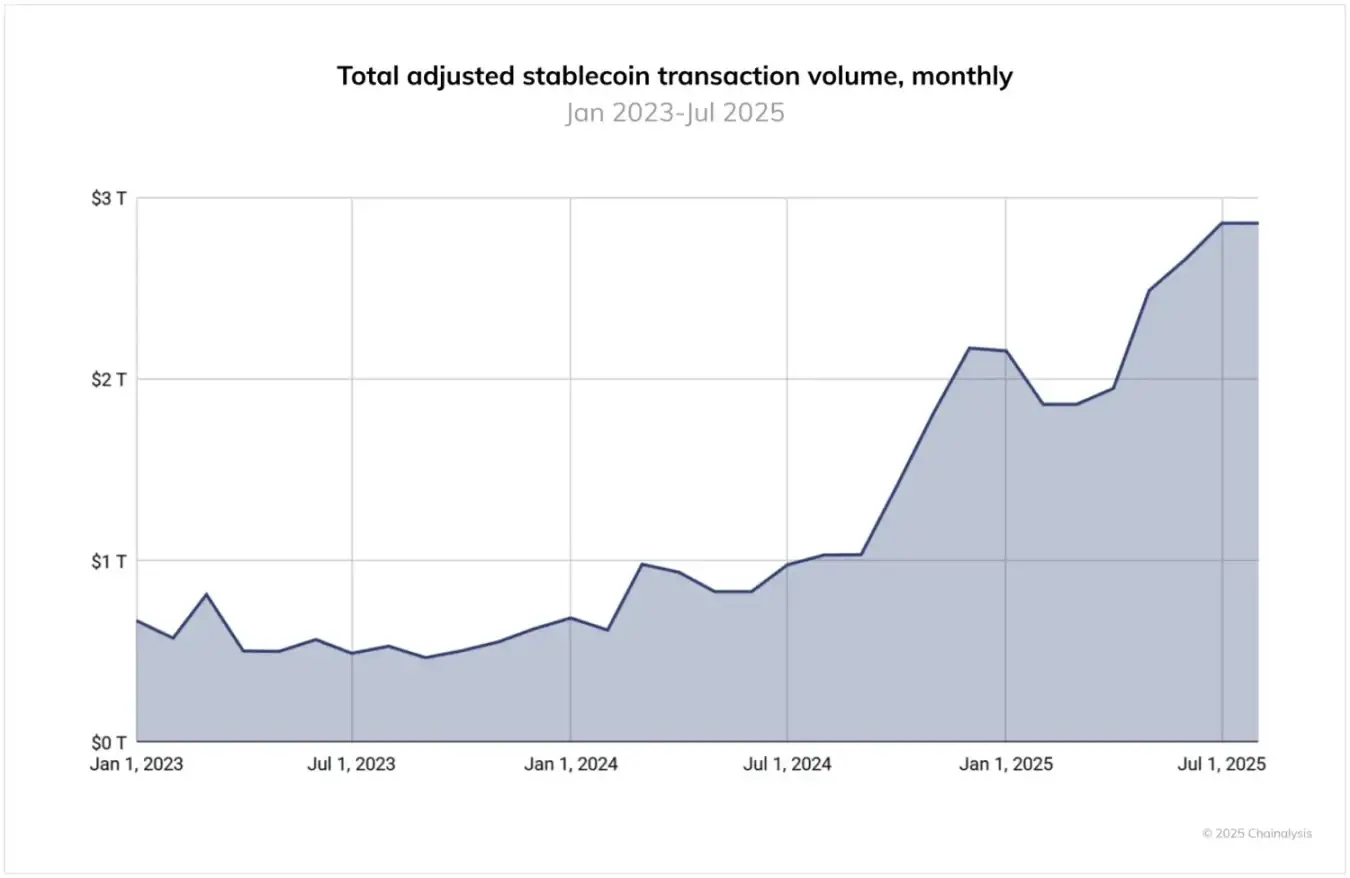
Today, the transaction volume handled by stablecoins is no longer a niche, geeky financial toy; it has reached trillions of dollars. A 2025 Chainalysis report states: "Between June 2024 and June 2025, USDT processed over $1 trillion monthly, peaking at $1.14 trillion in January 2025. Meanwhile, USDC's monthly processing volume ranged between $1.24 trillion and $3.29 trillion. These transaction volumes highlight the sustained core position of Tether and USDC in the crypto market infrastructure, particularly in cross-border payments and institutional activities."
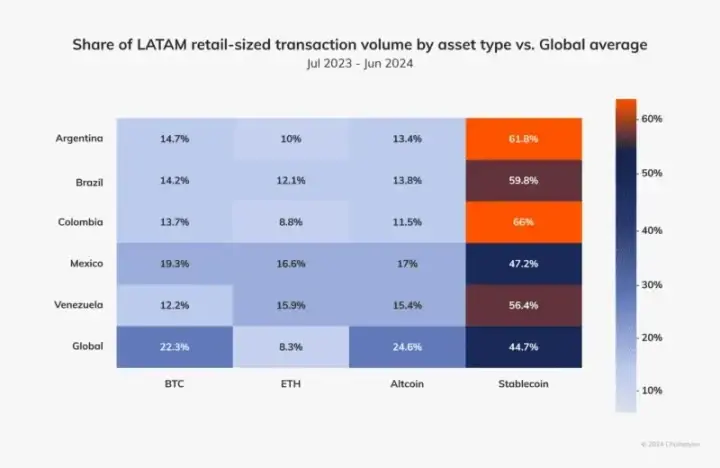
For example, according to a Chainalysis report focusing on Latin America in 2024, Latin America accounted for 9.1% of the total crypto value received between 2023 and 2024, with an annual usage growth rate between 40% and 100%, of which over 50% was stablecoins, demonstrating the strong demand for alternative currencies in the developing world.
The U.S. needs new demand for its bonds, and this demand exists in the form of demand for dollars, as most people in the world are trapped in fiat currencies that are far inferior to the U.S. dollar. If the world shifts to a geopolitical structure that forces the dollar to compete on equal terms with all other fiat currencies, the dollar may still be the best among them. Despite its flaws, the U.S. remains a superpower with astonishing wealth, human capital, and economic potential, especially when compared to many small countries and their questionable pesos.
Latin America has shown a deep yearning for the dollar, but there are supply issues, as local countries resist traditional banking dollar channels. In many countries outside the U.S., obtaining dollar-denominated accounts is not easy. Local banks are often tightly regulated and beholden to local governments, which also have an interest in maintaining their pesos. After all, the U.S. is not the only government that understands how to print money and maintain the value of its currency.
Stablecoins solve both of these problems; they create demand for U.S. bonds and can transmit dollar-denominated value to anyone anywhere in the world.
Stablecoins leverage the censorship-resistant features of their underlying blockchain, a capability that local banks cannot provide. Thus, by promoting stablecoins, the U.S. can reach untapped foreign markets, expanding its demand and user base while also exporting dollar inflation to countries that have no direct influence from U.S. politics, a long-standing tradition in the history of the dollar. From a strategic perspective, this sounds ideal for the U.S. and is a simple extension of how the dollar has operated for decades, just built on new financial technology.
The U.S. government understands this opportunity. According to Chainalysis, "The regulatory landscape for stablecoins has changed significantly in the past 12 months. While the GENIUS Act in the U.S. has yet to take effect, its passage has sparked strong institutional interest."
Why Stablecoins Should Surpass Bitcoin
The best way to ensure Bitcoin escapes the mediocre fiat currencies of the developing world is to ensure that the dollar uses Bitcoin as its operating track. Every dollar stablecoin wallet should also be a Bitcoin wallet.
Critics of the Bitcoin dollar strategy argue that it contradicts Bitcoin's libertarian roots, asserting that Bitcoin should replace the dollar rather than enhance it or bring it into the 21st century. However, this concern is largely U.S.-centric. It is easy to condemn the dollar when you are paid in dollars and your bank account is denominated in dollars. It is easy to criticize it when a 2-8% dollar inflation rate is your local currency. In too many countries outside the U.S., an annual inflation rate of 2-8% is a blessing.
A large portion of the world's population suffers from far worse fiat currencies, with inflation rates ranging from low double digits to high double digits, even triple digits, which is why stablecoins have gained massive adoption in the third world. The developing world needs to leave this sinking ship first. Once they board a stable ship, they may begin to look for ways to upgrade to a Bitcoin yacht.
Unfortunately, although most stablecoins initially started on Bitcoin, they do not currently operate on Bitcoin, and this technological reality creates significant friction and risk for users. Today, most stablecoin transaction volumes operate on the Tron blockchain, a centralized network run by Justin Sun on a few servers, making it easy for foreign governments that dislike the spread of dollar stablecoins in their territories to target him.
Moreover, the blockchains that most stablecoins rely on are also completely transparent. The public addresses of user accounts are publicly traceable, often linked by local exchanges to users' personal data, and easily accessible by local governments. This is a lever that foreign entities can use to push back against the spread of dollar-denominated stablecoins.
Bitcoin does not have these infrastructure risks. Unlike Ethereum, Tron, Solana, and others, Bitcoin is highly decentralized, with tens of thousands of nodes worldwide, and has a robust peer-to-peer network for transmitting transactions, easily bypassing any bottlenecks or obstacles. Its proof-of-work layer provides a separation of powers that other proof-of-stake blockchains lack. For example, Michael Saylor, despite holding a significant amount of Bitcoin, accounting for 3% of the total supply, has no direct voting rights in the network's consensus politics. The same cannot be said for Vitalik and Ethereum's proof-of-stake consensus or Justin Sun and Tron.
Additionally, the Lightning Network built on Bitcoin unlocks instant transaction settlements, benefiting from the security of the underlying Bitcoin blockchain. It also provides users with significant privacy, as all Lightning Network transactions are designed to be off-chain and leave no trace on its public blockchain. This fundamental difference in payment methods allows users to gain privacy when sending money to others. This reduces the number of potential threats that could infringe on user privacy from anyone who can view the blockchain to a few entrepreneurs and tech companies, at worst.
Users can also run their own Lightning nodes locally and choose how to connect to the network; many do so, taking privacy and security into their own hands. These features are not seen in the blockchains that most people use for stablecoins today.
Compliance policies and even sanctions can still be applied to dollar stablecoins, whose governance is anchored in Washington, using the same analytics and smart contract-based methods currently used to prevent stablecoins from being used for criminal purposes. Fundamentally, something like the dollar cannot be decentralized; after all, it is designed to be centralized. However, if most stablecoin value is transferred via the Lightning Network, user privacy can be maintained, protecting users in developing countries from organized crime and even their local governments.
Ultimately, users care about transaction fees, the cost of transferring funds, which is why Tron has dominated the market to date. However, with USDT launching on the Lightning Network, this situation may change quickly. In a Bitcoin dollar world order, the Bitcoin network will become the medium of exchange for the dollar, while the dollar will remain the unit of account for the foreseeable future.
Can Bitcoin Handle All This?
Critics of the strategy also worry that the Bitcoin dollar strategy may impact Bitcoin itself. They wonder whether placing the dollar on top of Bitcoin will distort its underlying structure. The most obvious way a superpower like the U.S. might want to manipulate Bitcoin is to force it to comply with sanctions regimes, which theoretically they could do at the proof-of-work layer.
However, as mentioned earlier, the sanctions regime has arguably peaked, giving way to a tariff era, which attempts to control the flow of goods rather than the flow of money. This post-Trump, post-Ukraine war shift in U.S. foreign policy strategy has, in fact, alleviated pressure on Bitcoin.

As Western companies, such as BlackRock, and even the U.S. government, continue to view Bitcoin as a long-term investment strategy, or in the words of President Trump, as a "strategic Bitcoin reserve," they also begin to align themselves with the future success and survival of the Bitcoin network. Attacking Bitcoin's censorship-resistant features would not only undermine their investments in the asset but also weaken the network's ability to deliver stablecoins to the developing world.
In a Bitcoin dollar world order, the most obvious compromise Bitcoin must make is to relinquish the unit of account dimension of currency. This is bad news for many Bitcoin enthusiasts, and rightly so. The unit of account is the ultimate goal of hyperbitcoinization, and many of its users live in that world today, making economic decisions based on the ultimate impact of the number of satoshis they hold. However, for those who understand Bitcoin as the soundest currency in history, nothing can truly take that away. In fact, the belief in Bitcoin as a store of value and medium of exchange will be strengthened by this Bitcoin dollar strategy.
Sadly, after 16 years of trying to make Bitcoin a ubiquitous unit of account like the dollar, some have come to realize that in the medium term, the dollar and stablecoins are likely to fulfill that use case. Bitcoin payments will never disappear, and companies led by Bitcoin enthusiasts will continue to rise and should continue to accept Bitcoin as a payment method to build their Bitcoin reserves, but in the coming decades, stablecoins and dollar-denominated value are likely to dominate crypto trade.
Nothing Can Stop This Train
As the world continues to adapt to the rise of the East and the emergence of a multipolar world order, the U.S. may have to make difficult and critical decisions to avoid a lasting financial crisis. Theoretically, the U.S. could cut spending, pivot, and restructure to become more efficient and competitive in the 21st century. The Trump administration is certainly attempting to do so, as evidenced by the tariff regime and other related efforts aimed at bringing manufacturing back to the U.S. and nurturing local talent.
While several miracles might resolve America's fiscal dilemmas, such as sci-fi levels of labor and intelligent automation, or even the Bitcoin dollar strategy, ultimately, even placing the dollar on the blockchain will not change its fate: to become a collectible for history enthusiasts, a rediscovered ancient imperial token fit for a museum.
The centralized design of the dollar and its dependence on U.S. politics ultimately doom its fate as a currency, but if we are realistic, its demise may not be seen in 10, 50, or even 100 years. When that moment truly arrives, if history repeats itself, Bitcoin should be there as the operating track, ready to pick up the pieces and fulfill the prophecy of hyperbitcoinization.
 Risk warning
 Risk warning

Popular articles