








A Korean company that hoarded coins through strategy, from a bull market to delisting?
 Core Viewpoint

 When the overall momentum of the Korean stock market is strong, these cryptocurrency concept stocks, which are branded as the "Korean version of Strategy," find themselves at a crossroads of life and death.
Author: Chloe, ChainCatcher
The KOSPI index has surged about 95% since the beginning of the year, nearly doubling. Just as the South Korean stock market is booming, another group of South Korean listed companies is gradually being squeezed out of the market.
According to the Chosun Ilbo, South Korea's revised listing regulations that raise the market capitalization threshold for maintaining a listing took effect on July 1. Some KOSDAQ DAT listed companies that profited from investing in cryptocurrency assets are facing delisting risks. They are dealing with plummeting cryptocurrency prices while suffering from capital outflows in the KOSDAQ market, with their market values repeatedly falling below the new thresholds, making them susceptible to being kicked out of the market at any time.
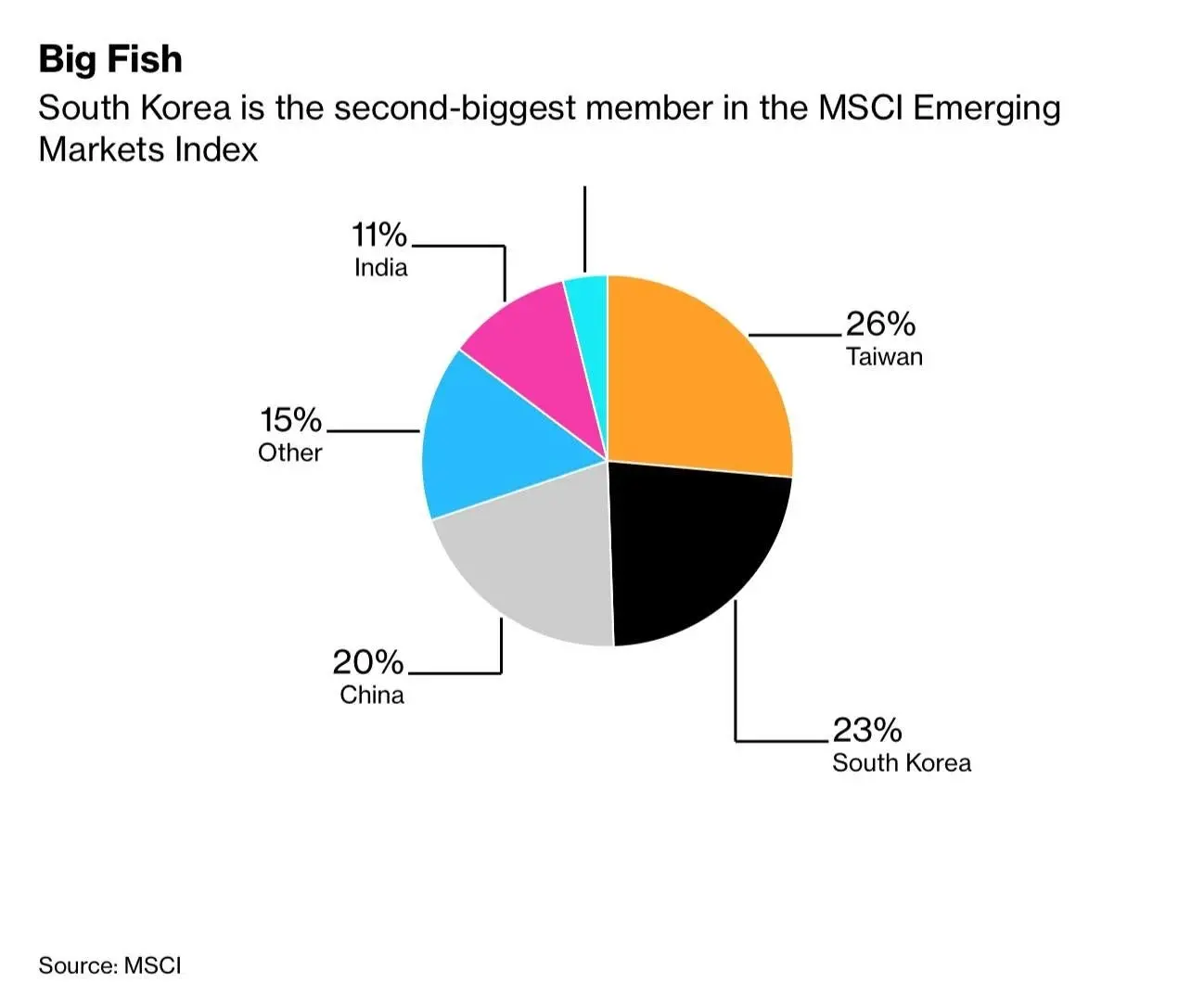
South Korean Government Tightens Policies, Listing Status Will Be Hard to Maintain
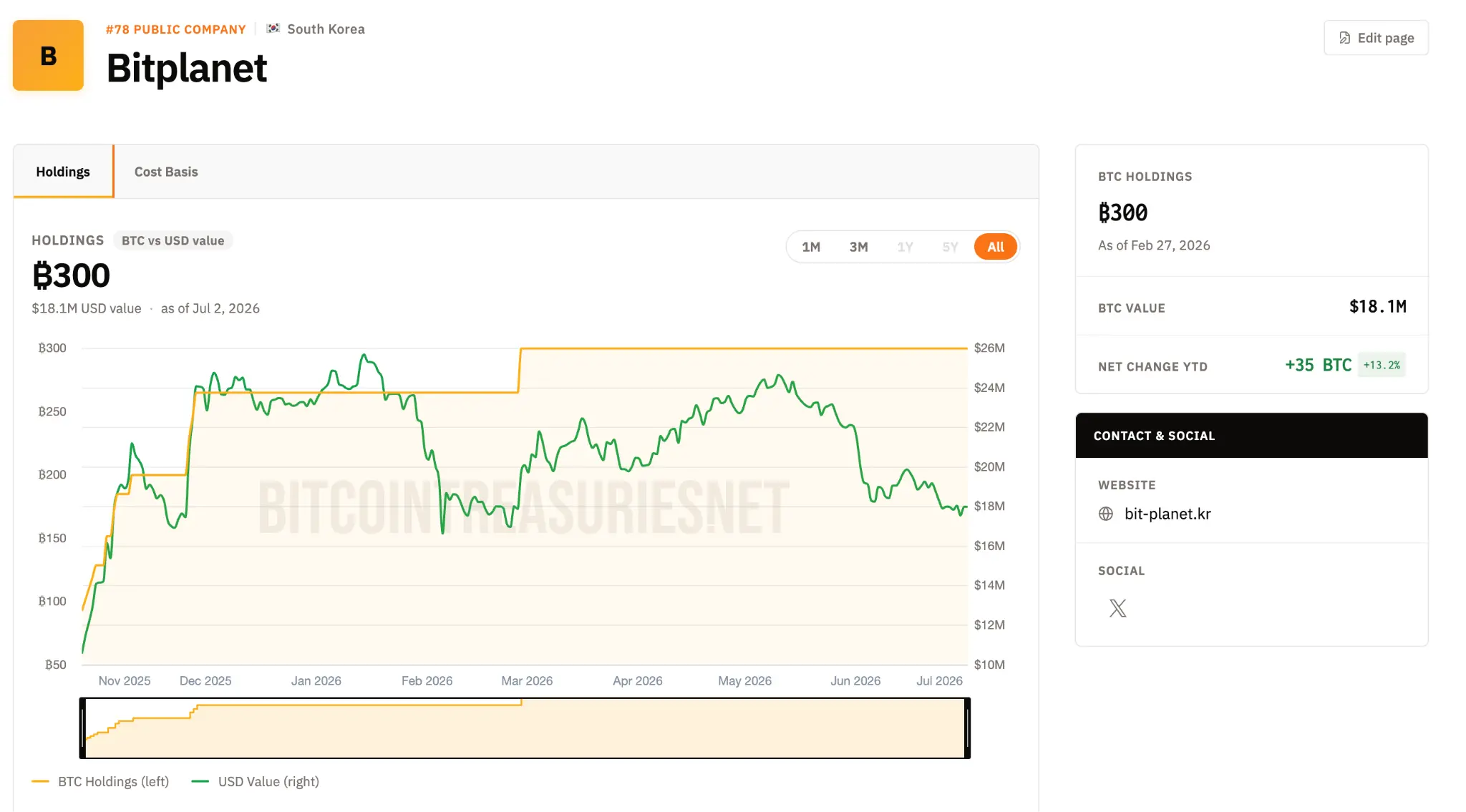
DAT was initiated by Strategy, followed by Japan's Metaplanet in the capital market, and South Korean DAT companies have replicated the same script. Taking BitPlanet as an example, this company was acquired in July 2025 by a consortium led by Asia Strategy and Sora Ventures and currently holds 300 bitcoins, with a long-term goal of accumulating 10,000; its CEO Lee Seong-hoon publicly stated that the inspiration for the company's model came from Strategy and Metaplanet.
The problem is that this "issuing shares to raise funds, buying coins, and rising stock prices" flywheel heavily relies on rising cryptocurrency prices; once the prices reverse, these mostly small and medium-sized DAT companies in South Korea must first face the question of "can they maintain their listing status" rather than financing.
According to the Herald Business, this reform has tightened the four major delisting criteria comprehensively, with the market capitalization threshold being the most lethal for DAT companies. The market capitalization standard for maintaining a listing on KOSDAQ has increased from the current 15 billion won to 20 billion won (over 13 million USD), and will jump again to 30 billion won in January next year.
The new determination mechanism is quite strict: if a stock's price falls below 1,000 won for 30 consecutive trading days, or if its market capitalization falls below 20 billion won for 30 consecutive trading days, it will be designated as "caution stock"; once designated, there is a 90 trading day recovery period, and if it cannot meet the standards for 45 consecutive trading days during this period, it will officially enter the delisting process. The key is that both the stock price and market capitalization criteria must be met "simultaneously"; if either one fails, it is sufficient to constitute a delisting reason.
At the same time, the past common practice of "manipulating stock prices" has also been blocked. In the past, when stock prices were too low and nearing the delisting line, companies could consolidate several shares into one, causing the price per share to immediately surge, but the overall value of the company remained unchanged. The Herald Business explains that the new regulations aim to close this loophole: for example, a company with a stock price of 300 won, even if it raises the price to 1,200 won through consolidation, will still be classified as a delisting target if the adjusted per-share value remains low. Additionally, companies that have already undergone a consolidation or capital reduction in the past year are not allowed to use the same tactic again once placed on the watch list; even if allowed, the consolidation ratio cannot exceed 10 to 1.
Other criteria have also been tightened: the timing for assessing whether a company has completely lost its capital has expanded from only looking at year-end financial reports to also including semi-annual reports; the delisting penalty point threshold accumulated due to false financial reports or violations has been reduced from 15 points to 10 points, and a single significant or intentional violation is sufficient to trigger a review; after being placed under delisting review, the longest improvement period a company can seek has been shortened from 18 months to 1 year.
KOSDAQ Itself Weakens, Along with the Decline of the Cryptocurrency Market
According to the Chosun Ilbo, the risk of delisting is no longer hypothetical. Currently, many companies are in a temporarily "compliant but unsafe" situation: Parataxis Ethereum has a market capitalization of about 26.8 billion won, and BitPlanet about 33.1 billion won, both above the 20 billion won threshold for the second half of the year, but Parataxis Ethereum faces potential risks when compared to the 30 billion won standard set for January next year. The worst situation is for Parataxis Korea, which was already placed under substantial review for listing eligibility due to capital loss back in April, and its stock has been suspended. The Chosun Ilbo points out that if the trend of declining market capitalization continues, these DAT companies may face delisting procedures starting from BitMax in early next year.
Looking back, the direct trigger for this crisis is the weakening of cryptocurrency prices. According to Bloomingbit, Bitcoin once broke through $120,000 last July under the influence of the pro-crypto policies of the Trump administration; however, it has fallen back since October last year, when the US-China trade friction became a turning point, and has dropped to the latter part of $50,000 this month. Due to the decline in cryptocurrency prices in both the first and second quarters of this year, DAT companies must recognize large-scale valuation losses on their books, and the impact on stock prices during the earnings season may be even greater.
Adding to the woes is the inherent weakness of KOSDAQ itself. While the KOSPI has nearly doubled (up about 95%) this year, KOSDAQ has instead declined by about 10%, with capital concentrated in KOSPI heavyweight stocks like Samsung Electronics and SK Hynix, marginalizing KOSDAQ and the DAT companies within it. These companies had attempted to fill funding gaps by issuing convertible bonds (CB) and preferred shares, but could not withstand the overall decline in cryptocurrency asset prices.
The overall weakness of KOSDAQ is evident in the numbers. The Herald Business reports that the KOSDAQ index fell from 945.57 at the beginning of January to 851.37 last Friday, a decline of nearly 10%, dragging down the market capitalization of constituent stocks. As of last week, excluding SPACs and special stocks, there were 178 KOSDAQ companies with a market capitalization of less than 20 billion won, accounting for about 10% of the total 1,748 companies, a nearly threefold increase from 66 companies at the beginning of the year; there are also 180 "penny stocks" with prices below 1,000 won, with a total market capitalization of up to 6.14 trillion won.
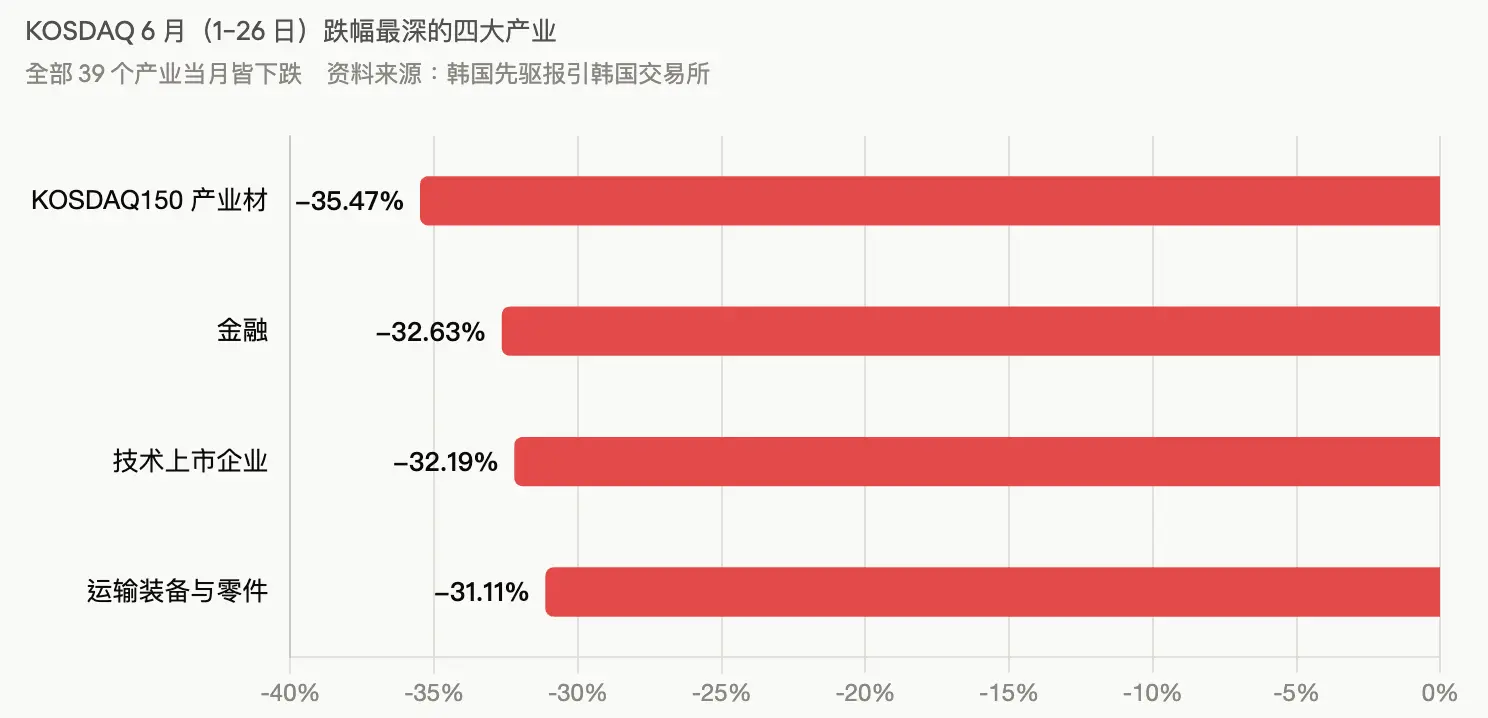
The Herald Business also cites data from the Korea Exchange, indicating that in June (from the 1st to the 26th), all 39 KOSDAQ industries were in the red, with the KOSDAQ150 industry leading the decline at -35.47%, and declines in finance (-32.63%), technology-listed companies (-32.19%), and transportation equipment and parts (-31.11%) also exceeding 30%.
Conclusion
For these ultra-small companies, the space for self-rescue through financial engineering is being compressed. The Herald Business quotes industry views suggesting that the new "market capitalization requirement" will be harder to meet than the "stock price requirement." A person from a KOSDAQ listed company candidly stated that penny stocks can at least rely on unpaid capital reductions and stock consolidations to prop up their prices, but it is difficult to meet market capitalization standards without a substantial increase in stock prices; it is also not easy to rely on mergers and acquisitions for a quick fix, as long as KOSDAQ remains sluggish, the number of companies unable to meet the market capitalization threshold will only increase.
A representative example is Hyungji I&C (형지I&C), which conducted a 10 to 1 unpaid stock consolidation in March, raising its stock price to nearly 4,000 won, but its market capitalization still remains around 10.6 billion won, far below the new threshold, indicating that even if the stock price temporarily meets the standard, it still cannot pass the market capitalization hurdle. The Chosun Ilbo also emphasizes that the revised listing regulations contain provisions that restrict capital reductions and consolidations after being designated as caution stocks, making it more difficult for companies without a substantial rebound in stock prices to continue to linger in the stock market.
Officials from the Korea Exchange downplayed the impact, stating that there will not be an immediate wave of delistings in July, as companies listed as caution stocks still have a period for improvement before moving to the next step. However, brokerage researchers' judgments are more pessimistic. Yuanta Securities researcher Lee Jae-won stated that, from the perspectives of supply and demand for funds, profitability, and interest rates, the current environment is all favorable for KOSPI; until personal funds return and profit rebound forecasts are confirmed, KOSDAQ's relative weakness is likely to continue.
In other words, while the overall momentum of the South Korean stock market is strong, this group of cryptocurrency concept stocks branded as "Korean version of Strategy" is at a crossroads of survival and demise, caught in a three-way squeeze of cryptocurrency prices, market funds, and new regulatory rules.

 Risk warning

Popular articles





