The prediction market becomes the new battleground on Wall Street: Kalshi bets on compliance, Polymarket partners with the New York Stock Exchange
 Core Viewpoint

 Kalshi's compliance advantages once seemed unassailable. If Polymarket could operate under a similar CFTC framework while leveraging ICE's technology and data coverage, as well as the unique value of on-chain transparent data, the gap between the two would gradually close.
Author: Chloe, ChainCatcher
In November last year, the FBI raided Shayne Coplan's apartment in New York, related to election betting involving his startup Polymarket.
In July this year, Polymarket spent $112 million to acquire the derivatives exchange QCX LLC (or QCEX), obtaining a DCM license that allows Polymarket to enter the U.S. market.
After the acquisition was completed, Polymarket experienced several weeks of waiting until the CFTC issued a "No-Action Letter" in September this year, officially allowing the company to operate within a specific scope without facing enforcement actions. Less than a month later, on October 7, the parent company of the New York Stock Exchange, Intercontinental Exchange (ICE), announced it would invest up to $2 billion in Polymarket, valuing the company at $8 billion.
Almost simultaneously, Polymarket's biggest competitor Kalshi also announced a $300 million funding round at a $5 billion valuation, planning to allow customers from over 140 countries to bet on its platform.
According to data from Dune Analytics, Kalshi recently surpassed Polymarket, capturing over 60% of the global market share, with its annual trading volume growing significantly from about $300 million last year to approximately $50 billion.
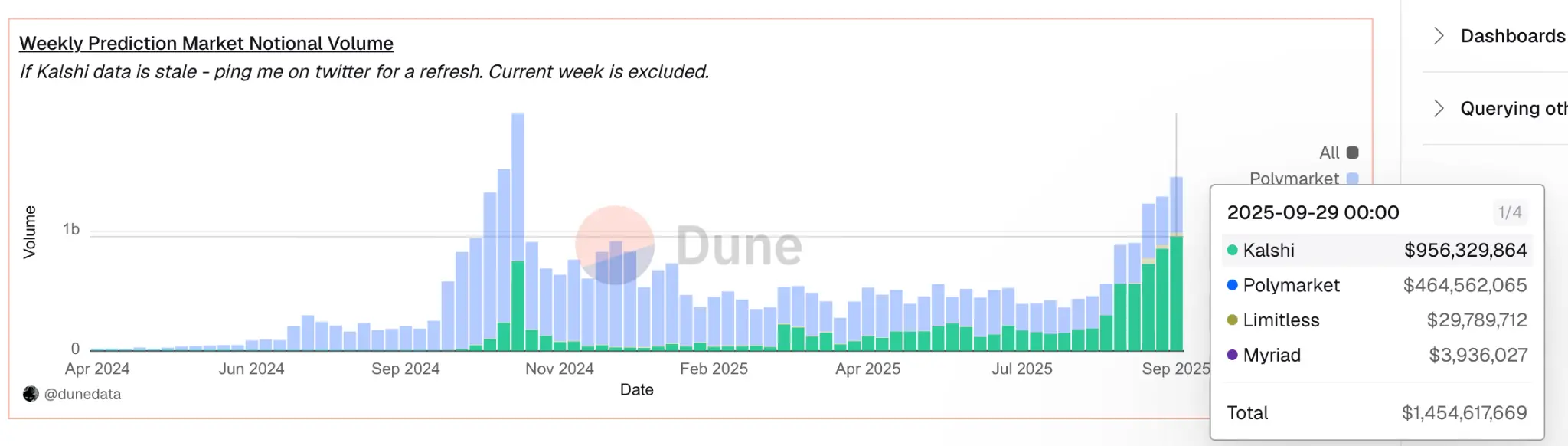
The announcements of funding from both companies in the same week highlight that prediction market platforms have entered the mainstream market view, and both Polymarket and Kalshi now possess regulatory legitimacy, competing from the same starting point.
What is ICE's true intention?
Firstly, ICE's choice to invest $2 billion in Polymarket may have been in the works for a long time, representing a significant step after years of laying the groundwork in blockchain and digital assets. This giant, which operates the New York Stock Exchange, launched Bakkt back in 2018, offering Bitcoin custody and futures services, and has emphasized in various public forums that tokenization will become the core of future market infrastructure.
CEO Jeffrey Sprecher even publicly predicted in 2022 that digital assets would become the track for value transmission of various asset types. However, from entering Bitcoin futures to directly investing in a fully on-chain crypto-native platform, ICE's decision highlights a shift in its vision from a single category of digital assets to a deeper focus on "blockchain-native data infrastructure."
Polymarket's appeal to ICE stems from its distinctly different operational model compared to other Web3 projects. Many platforms claiming decentralization still conduct core data and settlement on centralized servers, while Polymarket operates its market, settlement, and trading entirely on-chain.
Settlements are conducted via smart contracts deployed on the Polygon chain, using USDC as collateral and presenting results in a tokenized format. Users directly mint YES/NO tokens on-chain, which exist as ERC-20 assets in their wallets and can be freely traded or redeemed at the end of the prediction event. The settlement process is handled by UMA Optimistic Oracle, and in collaboration with Chainlink, the results of asset price markets are directly published on-chain. This operational model ensures that every transaction and settlement, regardless of the outcome, creates immutable and transparently auditable on-chain data.
For ICE, the value of Polymarket extends beyond prediction markets; it lies in the vast and verifiable on-chain prediction data it generates.
Unlike traditional financial prediction data, which may be subject to centralized compilation and manipulation, Polymarket's data genuinely reflects the collective expectations of market participants as price signals, recorded on a public blockchain, globally accessible and immune to human manipulation.
ICE plans to position itself as the "global distributor of Polymarket event-driven data," providing these real-time probabilities as sentiment indicators to institutional clients and viewing them as a new data source for macroeconomic forecasting and risk modeling.
Furthermore, this on-chain data could serve as the underlying asset for new financial products. For example, Polymarket could construct a "tokenized index" based on a set of event probabilities, allowing ICE to issue corresponding derivatives, similar to "event-driven ETFs," tracking probabilities related to the U.S. presidential election, Federal Reserve interest rate decisions, and Bitcoin price trends.
Integrating on-chain transparency with financial professionalism could create a new generation of institutional asset allocation tools.
Polymarket's path to regulatory return in the U.S. narrows the gap with Kalshi
Polymarket's regulatory return path, through the acquisition of QCX LLC, has obtained a DCM license that allows it to use a self-certification mechanism for event markets, permitting it to list new contracts without prior approval as long as the CFTC does not object.
Historically, Kalshi was the first prediction market regulated by the CFTC, allowing users to trade directly on the outcomes of real-world events, rather than on stocks affected by events or currencies that may fluctuate due to news, but on the events themselves.
This mechanism allows Kalshi to design new event contracts independently, only needing to submit contract design documents to the CFTC without prior individual approvals. If the CFTC does not raise objections during the review period, the contracts can be listed for trading directly. The CFTC retains the power for post-review and halting, but this "ex-ante review" model significantly accelerates product development speed. This enables Kalshi to quickly launch event markets covering various categories such as weather, economic data, political events, and entertainment awards, without getting bogged down in lengthy approval processes each time.
During the period from 2022 to 2024, when Polymarket was fined and operated offshore, this regulatory framework was Kalshi's strongest moat.
By acquiring QCX LLC, Polymarket has obtained the same regulatory permissions and operational mechanisms as Kalshi. It now holds a DCM license and can also use the self-certification mechanism to list new contracts without prior approval as long as the CFTC does not object, and it has received a No-Action Letter from the CFTC, officially confirming its legal operation within this framework.
The significance of this shift goes far beyond the surface. Between 2022 and the first half of 2024, the competition between Kalshi and Polymarket was not on the same track. Kalshi had a U.S. license and could legally serve U.S. users, while Polymarket could only operate offshore.
At that time, the competition was not on the same track. Kalshi's core advantage stemmed from its unassailable compliance status, while Polymarket, despite its popularity among crypto-native users, was unable to enter the U.S. market due to regulatory restrictions. Now the situation is entirely different; both companies hold the same level of exchange licenses, employ the same contract approval processes, can develop new products at the same speed, and can fully legally enter the U.S. market. It can be said that the regulatory arbitrage space that Kalshi once enjoyed has disappeared.
Crypto media outlet CryptoSlate pointed out: "Kalshi's compliance advantage once seemed unassailable. However, if Polymarket can operate under a similar CFTC framework while leveraging ICE's technology and data coverage, the gap between the two will begin to close."
Polymarket and Kalshi are more like a clash of business philosophies
From the outset, Kalshi has maintained the image and operational philosophy of a financial exchange rather than a cryptocurrency startup. It operates under comprehensive oversight from the CFTC, settles trades in U.S. dollars, requires KYC verification, and positions its products as risk management tools rather than speculative bets.
Founders Tarek Mansour and Luana Lopes Lara often describe their goal as building a "futures exchange for everyday events." Kalshi is rooted in traditional market structures, emphasizing transparency and gradual growth, viewing compliance as its core competitive advantage. The company has expanded to 140 countries and has an increasingly growing list of macro and cultural markets, attempting to establish an unassailable moat through regulatory certainty.
Polymarket's trajectory is entirely different. It rose during the DeFi boom, becoming an open tokenized platform where users can trade on almost any topic using stablecoins. Its speed and openness made it very popular among crypto-native users and political bettors, but its regulatory risks limited its opportunities to attract mainstream capital.
When U.S. regulators fined Polymarket and restricted its operations in 2022, it seemed to confirm Kalshi's long-held argument that compliance is the only way to scale. However, ICE's partnership may flip this narrative, proving that once a credible intermediary builds a bridge, a crypto-native model can coexist with regulatory legitimacy.
The outcome is converging: Kalshi slightly shifts towards innovation, while Polymarket leans towards regulation. Kalshi's compliance advantage once seemed unassailable. However, if Polymarket can operate under a similar CFTC framework while leveraging ICE's technology and data coverage, as well as the unique value of on-chain transparent data, the gap between the two will gradually diminish.
 Risk warning
 Risk warning





Popular articles