PayAI surpasses PING! x402 ecological value anchor point changes
 Core Viewpoint

 x402 Ecology's Key Reversal from Speculation to Practicality: PING vs. PayAI
Written by: KarenZ, Foresight News
In the rapidly changing competition of the cryptocurrency market, a striking reversal has just occurred within the x402 ecosystem.
Last week, PING, which was regarded as the "star token" of the x402 protocol, has seen its market cap advantage surpassed by the payment infrastructure of the x402 protocol. According to the latest data, PayAI's market cap broke $50 million this morning, increasing more than tenfold in just four days. Meanwhile, PING has experienced a pullback after an initial surge, currently holding a market cap of $34 million.
This is not just a competition between two projects, but a critical moment for the entire x402 ecosystem and even the decentralized payment infrastructure sector, transitioning from speculation to practicality.
PING's Highlights and Predicament
PING, as the first token issued on Base through the x402 protocol, experienced its "highlight moment" last week, surging over 20 times in just two days from October 23 to 24, with its market cap briefly exceeding $80 million.
This exponential growth attracted a large number of industry investors and brought unprecedented market attention to the x402 protocol itself, successfully opening a traffic gateway for this emerging track.
However, the lack of value support makes such enthusiasm difficult to sustain. Essentially, PING is a pure Memecoin, lacking practical application utility and real use cases, and is even compared by some community users to "inscription" type assets—its rise is more dependent on market speculation rather than being driven by value creation, representing a typical frenzy of traffic dividends rather than long-term growth based on value.
PayAI Breakthrough: The "Pragmatist" of x402 Infrastructure
In stark contrast to PING's speculative nature, PayAI has broken through as an x402 protocol Facilitator, achieving a clear infrastructure positioning and practical value, becoming the core target of the ecosystem's value shift.
What is an x402 Facilitator? x402 Facilitators are service providers that support processing x402 payments on Solana and EVM networks, offering unified endpoint access to validate and settle payments on the HTTP resource chain under the x402 protocol.
These Facilitators form the core infrastructure layer of the x402 payment ecosystem, responsible for validating and settling on-chain payments for HTTP resources using the x402 protocol:
- Supporting different blockchain networks (such as Solana, Base, etc.).
- Facilitators bear network fees and handle validation/settlement.
- No API keys required. Plug and play.
- Designed for human and agent use cases, from pay-per-use APIs to AI agents, payments can be settled within one second after blockchain confirmation.
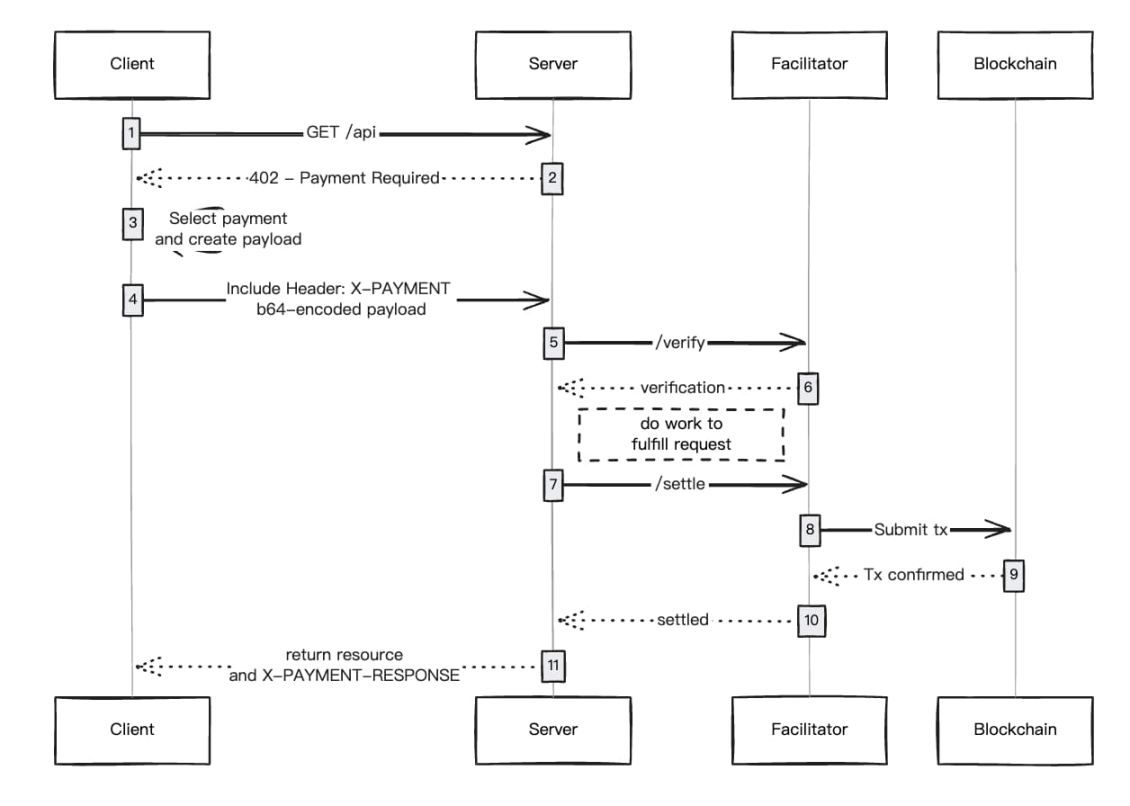
From the perspective of the x402 payment process logic, the client calls the protected resource and constructs the payment payload; the Resource Server publishes payment requirements, validates/settles the payment, and fulfills the request; the Facilitator server validates the payment payload and executes the settlement through standard endpoints; finally, the blockchain network executes and confirms the payment.
Eating into Coinbase's Share, Becoming the Second Largest Facilitator in the x402 Ecosystem
This role has made Facilitators the most valuable participants in the x402 ecosystem. Among these x402 Facilitators, PayAI is gradually eating into Coinbase's dominant position. According to x402scan data, PayAI has processed over 14% of x402 transaction volume, becoming the largest Facilitator aside from Coinbase. In contrast, Coinbase's market share has declined from an early absolute dominance to about 77%.
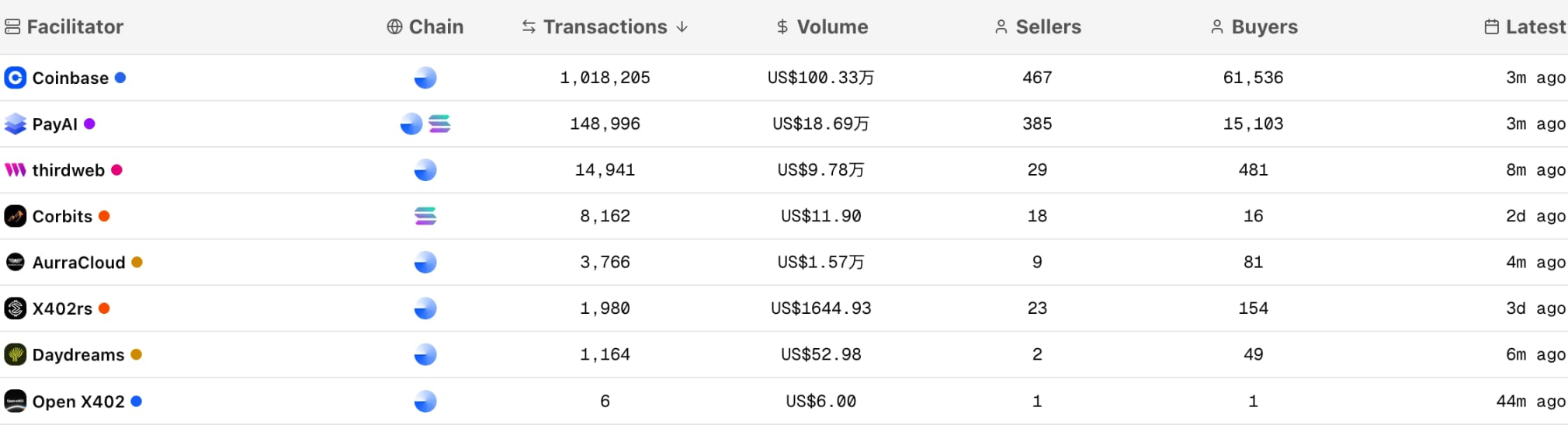
Chart source: x402scan
From the perspective of ecosystem participants, the number of PayAI sellers has reached over 82% of Coinbase's, with the gap continuing to narrow.
In the x402 ecosystem, sellers provide API or content monetization services, and the x402 protocol offers a "frictionless microtransaction monetization" solution—allowing income to be directly obtained from customers through programmable payments without mandatory subscriptions or advertising.
The scale of sellers directly determines the market potential of the x402 ecosystem: more quality sellers mean buyers have richer choices, which will attract more traffic, forming a positive cycle of "more sellers → influx of buyers → ecosystem prosperity," and PayAI's rapid penetration on the seller side is laying a solid foundation for its ecological position.
PayAI Token Economics and Utility
In terms of PayAI's token economics, the total supply of tokens is 1 billion, and all tokens will be in circulation at launch.
The PayAI team will purchase 20% of the token supply at the time of the token release and transfer it to the project treasury. These funds will be used for operations, marketing, and future token releases, such as community rewards and partnerships. Specifically, half of the treasury tokens will provide liquidity to generate fees, while the other half will vest linearly over one year.
What utility does the PAYAI token have? According to official documentation, the expected uses of PAYAI include:
- Waiving platform fees when executing service contracts between AI agents.
- Increasing visibility for buyer or seller agent listings.
- Participating in future platform governance (e.g., voting on feature proposals, agent ratings).
- Paying arbitration fees in dispute resolution (to be launched in the future).
Deep Reflection
The ebb and flow of momentum between PING and PayAI actually reflects an important issue: the x402 ecosystem is transitioning from concept to reality, shifting from speculation to practicality.
The first issued token, PING, received a "bonus premium," which is a common market psychology. However, as the market cools, investors begin to ponder: what exactly am I investing in? If PING is merely a minting game akin to an inscription, then its value foundation is quite weak.
In contrast, PayAI, as the payment infrastructure of the x402 Facilitator, anchors two core values: "transaction flow" and "ecological necessity," proving the fundamental value of the project with actual market share and application scenarios, naturally gaining sustained recognition from capital.
In this process, we see further maturation in the x402 field—market participants are beginning to determine a project's status based on actual transaction flow and fundamental value rather than blind speculation. This is undoubtedly a positive signal for the entire x402 ecosystem and the open payment ecosystem.
 Risk warning Risk warning