October Binance Alpha data backtesting, how to optimize strategies under the new normal of "more monks than meat"?
 Core Viewpoint

 Points increase, earnings decline, "long-term affection" is not as good as "quick sell."
Original | Odaily Planet Daily Azuma
The recently concluded October may not have been easy for all Binance Alpha users, especially for those new users who entered the market in September attracted by the wealth effect. If they continued to use the previously aggressive scoring strategy or lacked operational discipline, they likely ended up with a net loss.
There are two main reasons for this situation. On one hand, it can be simply summarized as "too many monks." With more and more new users (and not entirely just "users") entering the market, the scoring threshold keeps rising, and competition during the claiming phase is intensifying. Many users can only watch helplessly as their shares are claimed amidst endless error messages and verifications. On the other hand, there is "too little meat." Affected by the overall market downturn, the yield of single tokens has shown a significant decline.
In the following text, we review all the airdrops, TGEs, Pre-TGEs, and Prime Sale activities of Binance Alpha in October, and attempt to identify patterns that may help you optimize your scoring and trading strategies in this new normal of "too many monks and too little meat."
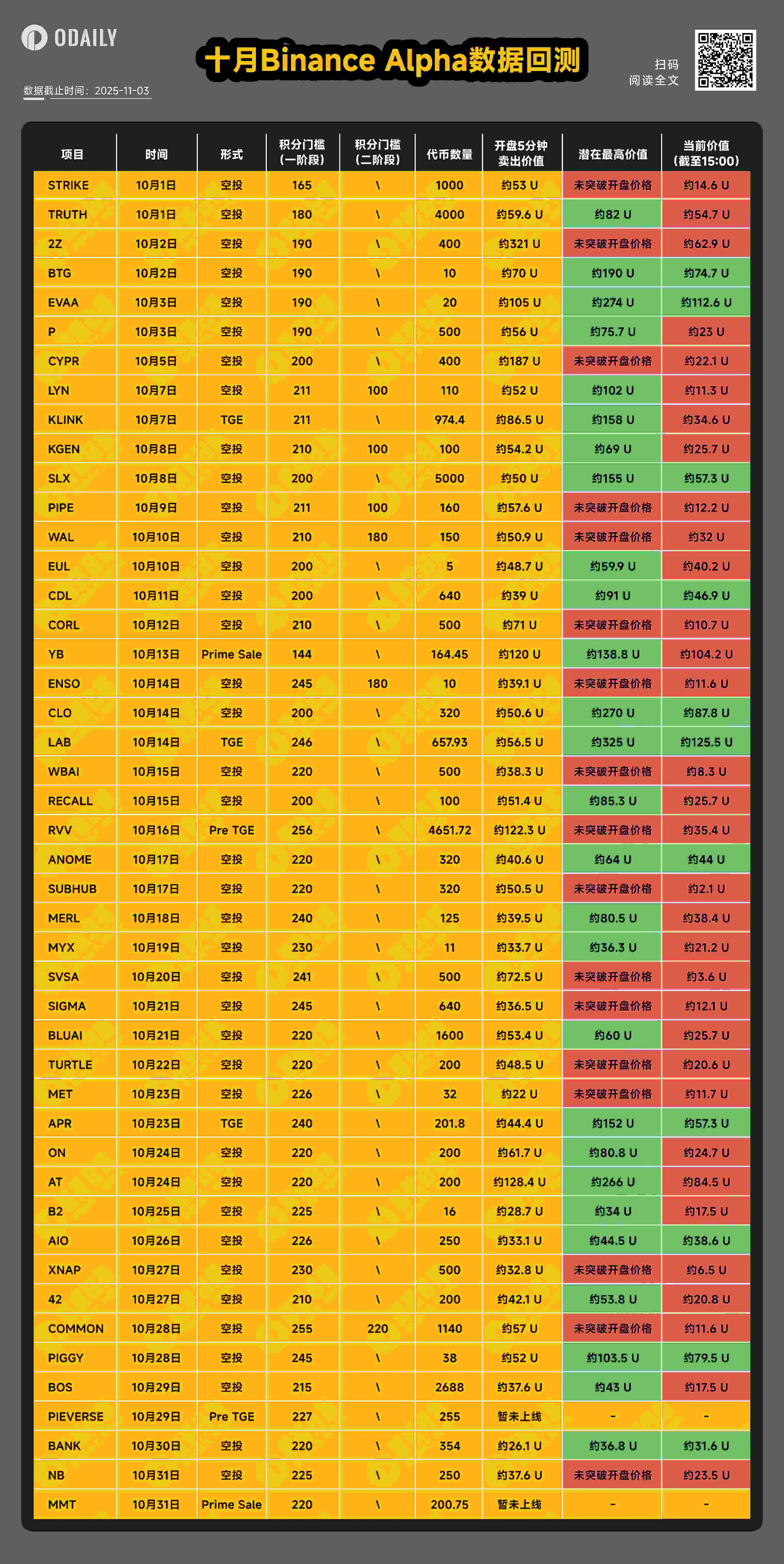
Phenomenon: Rising Scores, Declining Yields, "Long-term Holding" is Not as Good as "Quick Selling"
Based on the data performance in the above chart, the following information can be summarized:
Throughout October, Binance Alpha conducted a total of 46 activities, including 40 airdrops, 2 TGEs, 2 Pre-TGEs, and 2 new activities in the Prime Sale.
Excluding the tokens that have not yet been launched, PIEVERSE (Pre-TGE) and MMT (Prime Sale), and calculating based on the price sold within 5 minutes after the opening (for "old tokens" like MERL that are already listed, based on the claiming time), the average yield of the 46 activities is approximately $64 (not accounting for the cost wear of TGE-type activities, the same applies below). Overall, the yield differences among different types of activities are not significant ------ although Pre-TGE and Prime Sale show higher single-event yields, each has only one sample, making their reference value limited.
During October, the scoring threshold for Binance Alpha activities continuously increased ------ in the first half of the month, the average scoring threshold (only counting the first phase) for 14 activities was 197 points; in the middle of the month, the average scoring threshold for 14 activities rose to 219.4 points; in the latter half of the month, the average scoring threshold for 18 activities further increased to 227.2 points. Additionally, the number of phased airdrop activities, which are more friendly to retail investors, has also decreased, with 4 in the first half, and only 1 in both the middle and latter halves.
In terms of yield, based on the price sold within 5 minutes after the opening, in the first half of the month, the average yield for 14 activities was reported at $89.4, with 3 activities (2Z, EVAA, CYPR) exceeding $100; in the middle of the month, the average yield for 14 activities was reported at $58.9, with only 2 activities (YB, RVV) exceeding $100; in the latter half of the month, the average yield for 18 activities was reported at $46.4, with only 1 activity (AT) exceeding $100.
As for whether to sell or hold after obtaining the tokens, among the 44 tokens that have been launched, 17 reached their peak immediately after opening, while the other 27 tokens once had better selling points; if we consider the time up to the table creation (November 3, 15:00), 33 tokens' prices were below their opening prices, with a few tokens like SUBHUB (around $2.1) and SIGMA (around $3.6) dropping to single digits ------ although "selling immediately upon receipt" may never capture the maximum value, it is at least a relatively good choice and can effectively avoid the subsequent mental exhaustion of monitoring.
Conclusion: There is Still Room for Profit, but Strategies Need Optimization
From the above points, we can see more clearly the current trend of "too many monks and too little meat" in Binance Alpha. For retail investors, besides continuing to wait for Binance to crack down on studios, they must also subjectively optimize their strategies to adapt to the environment.
Based on the average scoring threshold of 227.2 points and the average yield of $46.4 in the latter half of October, although Binance Alpha's yields have shrunk, there is still some room for profit ------ even by using the most stable KOGE to score the basic "3 + 14" package, there is an opportunity to claim 2 to 3 rewards within a cycle, and the wear can be controlled at around $50.
The current Binance Alpha may never replicate the wealth effect of September, but if strict discipline and wear control can be maintained, there is still a chance to obtain some relatively stable "pork rice." As for various strategies to reduce wear, it is a matter of personal opinion.
 Risk warning Risk warning