






MegaETH announces the allocation strategy for the token sale
 Core Viewpoint

 Different allocation strategies for existing community members and long-term investors.
Original Title: MegaETH Public Allocation Strategy
Author: namik (CSO of MegaETH)
Compiled by: Jiahua, ChainCatcher
Handling a token sale event that was oversubscribed by 28 times with over 53,000 participants is not as fun as it sounds. In my previous article, I emphasized that we primarily focused on two groups of people this time:
Early, active members of the MegaETH community
Those we believe will grow alongside MegaETH in the long term
A few days before the sale ended, Artemis (our data lead) and I met in Istanbul to conduct extensive simulations. We tried many different methods to "perfectly" measure everyone's contributions and quickly realized that it was impossible to do so in such a short time, as "contribution" is multifaceted.
Therefore, we decided to break the problem into two parts:
- Fair distribution for existing community members
- Establishing a data-driven scoring and distribution system for long-term investors
The remainder of this article will detail how we achieved these two goals:

Distribution for Existing Community Members
For the first group, our existing community, we used the old method: manual distribution.
We relied on existing community channels, including @Heisenbruh and our mod circle, to compile a list of individuals who have had substantial participation in MegaETH since we emerged from "stealth."
This list includes those who:
Participated early and continuously
Helped shape the project's atmosphere and values
Supported us during bear markets and quiet times
Provided feedback, signals, and energy before the token attracted speculation
It should be noted that most of these individuals did not choose to lock their tokens. We believe this is acceptable. They have contributed with their time, attention, and belief. In our view, they have "put in the effort."
In the spirit of transparency, here is the token sale list that we believe represents our core community over the past few years.
This list is not perfect. We certainly missed some people, and I sincerely apologize for that.

This group, along with application developers who chose a one-year lockup, are the only individuals handpicked by the team.

Even within this group, not everyone received a full allocation. Far from it. The scale of the sale and demand still forced us to make trade-offs. But we are comforted by the fact that this approach respects those who have helped us get to where we are today, while not turning the sale into a pure popularity contest. These users received far more shares than what could be allocated through algorithmic sorting, and, aside from the previously mentioned application developers, the vast majority of these participants are unallocated.

Measuring Long-term Investors
The second group consists of all those who participated in the sale through the public process and may become long-term holders of MegaETH.
Here, we wanted to systematize. We designed a scoring system that combines:
On-chain activity
Social signals and influence
MegaETH-specific engagement
Not treating it as a trade (1-year lockup willingness)
Our goal is not to reward "points grinders," but to assess genuine belief.

Metrics Used
We used four different metrics in the overall scoring system.
1. Moni Score
The Moni score is used as:
A basic screening criterion
A component of a broader social score
Background information:
My Moni score is about 7,000
@artemis_onchain's Moni score is about 300
Based on this distribution, we believe it is appropriate to set the Moni score at 50 as the minimum threshold in most cases. It is not a perfect measure of quality, but it is a useful boundary to distinguish between blank accounts and those with at least some level of activity. Alternatives for social verification are discussed and implemented below.
2. On-chain Activity Score
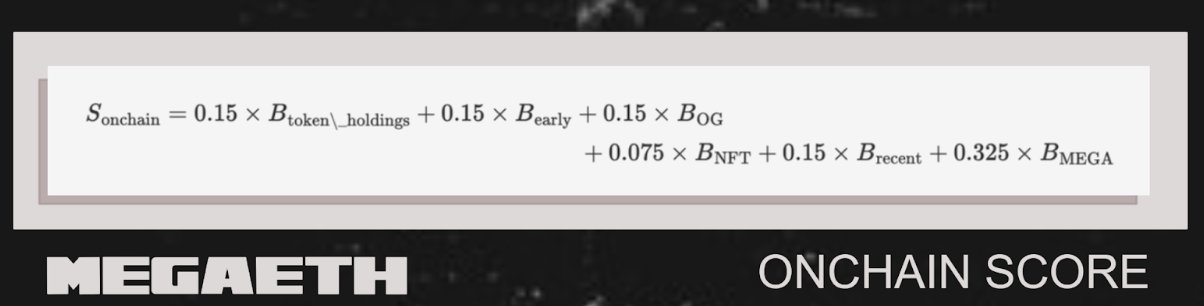
The on-chain activity score is a weighted composite of several categories.
- Early (15%)
Early interactions and adventurous behavior
- OG (15%)
Long-term participation in the broader ecosystem
- Holdings (15%)
Financial commitment and interest-related proxy metrics
- NFT (7.5%)
Current on-chain participation and activity represented through NFTs
- Recent (15%)
Your recent level of activity, not just from years ago
- MEGA Specific (32.5%)
Activities related to MegaETH, including CAP scores, MEGA NFTs, and specific testnet operations
3. Social Score

The social score combines:
Moni
Kaito
Additional references (indicated with []) and Ethos for manual review
We used overlays of different tools rather than trusting a single metric. This helped us avoid obvious bots and low-quality spam accounts, and also helped identify genuinely engaged participants.
4. Mega Score
The Mega score is a MegaETH-specific signal. It includes:
CAP score
Ownership of MEGA NFTs
Specific testnet activities
We use the Mega score in two ways:
As part of the on-chain activity score
As a filter for certain thresholds to ensure Mega-specific participants are not pushed out by ordinary on-chain points grinders
Why Locking is Important
We placed significant weight on whether someone chose to lock their $MEGA for a year.
In our view, locking for a year in a turbulent market is a strong indicator of belief. No one knows what will happen tomorrow. Committing to a one-year lock is a statement that you are in it for long-term growth, not just for quick trades.
Participant Screening and Allocation Process
Once we had the scores, we still needed to decide:
Who is included in the allocation list
How to translate the scores into actual allocation sizes
We divided it into two objects:
Locked participants
Unlocked participants
Allocation Process for Locked Participants

For participants who chose to lock, you must meet at least one of the following criteria to be considered:
Moni score above 50
On-chain score above 200
Mega score indicating more than just one Fluffle NFT
In other words, you need to meet at least one of the following:
A basic level of social activity
Clear on-chain signals
Strong MegaETH-specific engagement
After applying these screening criteria, about 29.4% of the locked addresses were included in the allocation set. This corresponds to about 1,000 addresses.
Once a wallet passes the screening, its allocation is a function of its final score, which integrates on-chain and social signals. We adopted a segmented continuous curve that rewards high performers while maintaining a minimum allocation threshold.
This design resulted in:
Top 5%: A linear gradient from 100% to 95% share
Next 3% (5%-8%): A steep drop from 95% to 55% share
Next 7% (8%-15%): A continuous decline from 55% to 35% share
Remaining 85%: An exponential decrease from 35% to a minimum share of 25%

Allocation Process for Unlocked Participants

If an unlocked address passes at least one of the following thresholds, it will be accepted:
Moni score > 200
Social score > 200
On-chain score > 300
Mega score > 68 (more than one Fluffle NFT)
Thus, if you are significantly active on-chain, have strong social signals, or demonstrate notable MegaETH-specific engagement, you qualify. You do not need to pass all these thresholds.
In fact, among 49,976 unlocked participants, 5,031 wallets passed this screening, with an acceptance rate of about 10.1%. The competition among the addresses that passed the screening was intense, even for the minimum share. We believe the algorithm will do its job and fully recognize that some individuals—even with substantial MegaETH activity and holdings—may not qualify if their other metrics are weak. But it is a fair game, and we respect the results.
Among the accepted group, we ranked the wallets based on their composite scores and then determined the percentage of the requested allocation they received.
At the top of the rankings, the allocation follows a smooth declining slope. The highest-ranked wallets receive the largest allocation shares, and this proportion gradually decreases as your rank falls.
After a certain rank, the curve flattens, and everyone else receives the same minimum allocation share.

Protection Measures for Small Bidders
We noticed that some smaller bidders managed to achieve the same ranking as larger bidders. To maintain fairness, we ensured that no participant received an absolute amount lower than that of the 5 adjacent bidders (i.e., those ranked right next to them).
For example, @thedefinvestor, who ranked in the top 15 among unlocked bidders, had no maximum bid limit. If allocated by percentage, he would receive a lower allocation amount. Meanwhile, his neighbor bid at the limit and received a similar percentage share but ended up with a much larger absolute amount.
To recognize @thedefinvestor's outstanding performance and his ability to rank so high despite a smaller bid, his allocation was raised to the limit, bringing it closer to his neighbor's level. This is how those 100% allocation shares came about.
Participant Examples
Case 1: Low social score, high on-chain score
@cp0xdotcom has little Twitter influence and has never tweeted about MegaETH. Therefore, his social score is low. However, this did not prevent him from ranking in the top 20 of all participants based on total score, receiving 92% of his locked maximum bid.
His advantages include:
Over 8 years of on-chain history
Burned 194 ETH in gas
Scored high due to early participation in contracts that later gained real traction in the Ethereum ecosystem
Interacted with 3,490 unique contracts historically
Active on the Ethereum mainnet for 164 out of the past 180 days
He has no NFTs and no Mega-specific activity. He still ranked highly, indicating that our system allows those who excel in their areas of expertise to reach the top, even without social or Mega-specific bonuses.
Case 2: Low on-chain score, high social score
@nics_off is almost a mirror image. His wallet has less than 2 years of on-chain history, burned only 1.5 ETH in gas, and interacted with only 150 unique contracts, resulting in a mediocre on-chain score. His social score played a significant role.
Factors pushing him up the rankings include:
Strong influence on Twitter and sustained activity
Ranked 13th on the Kaito MegaETH leaderboard
High-quality MegaETH-focused content
This combination allowed him to achieve the highest total score among unlocked participants. He ranked 17th among all unlocked users and received the highest allocation share of 20% in that group.
His example also shows that having a large Twitter following is not enough. Since the social score combines Moni and Kaito with equal weight, high-quality content related to Mega is more important than the original follower count.
We saw many similar cases at the top of the leaderboard. We particularly want to highlight:
@barthazian, who ranked first among all users and scored highly on every metric.
@0xMaxBT, who earned the title of "MegaETH Testnet Legend," being the only one among 53,000 participants to hit 100% on all tracked testnet contracts.
Anti-Witch Measures
We employed multi-layered witch attack protection.
First, we received reports of witch clusters from the community and external groups like Bubble Maps and Echo. These clusters were used as direct filters for participants.
Second, our scoring system itself makes it difficult for witches to pass. To achieve a high score, a wallet needs strong on-chain activity and credible history. Low-quality associated addresses often fail at this stage.
We also identified many cases where the same wallet or social account was associated with multiple KYC bids. When we detected such patterns, we ignored all related requests.
Finally, we will continue to perform witch checks on wallets that received allocations and reserve the right to refund users if malicious activity is discovered.
I would like to thank Artemis again for all the hard work. We feel honored by the demand for this sale, and we hope this maximum transparency will help everyone understand how we arrived at the final allocation results.
 Risk warning Risk warning