Morning News | U.S. government shutdown declared over; Joyoung Co. states that the company has no products related to Hakimi; Taiwan is studying the inclusion of BTC in its strategic reserves

 Overview of Important Market Events on November 13
整理:ChainCatcher
Important News:
- Joyoung Co., Ltd. stated on the interactive platform that the company does not have any products related to Hachimi
- Taiwan is studying the inclusion of BTC in its strategic reserves, planning to use confiscated BTC as a pilot holding source
- Trump signs bill, ending the U.S. government shutdown
- Balancer launches white hat recovery operation and transfers approximately $4.1 million to a controlled escrow account
- Ethereum Foundation: The account abstraction team and Vitalik jointly released the "Trustless Declaration" and placed it on-chain
- Glassnode: Bitcoin long-term holders are accelerating sales to take profits
- Monetary Authority of Singapore: Will pilot tokenized notes and introduce laws related to stablecoins
What important events have occurred in the past 24 hours?
According to ChainCatcher, Joyoung Co., Ltd. stated on November 13 that the company does not have any products related to Hachimi.
Previously, it was reported that the meme token "Hachimi" surged over 50% temporarily, possibly influenced by Joyoung's new product Hachimi soy milk. (Jinshi)
According to ChainCatcher, as reported by Bitcoin Magazine, the Executive Yuan and the Central Bank of Taiwan have agreed to study the inclusion of Bitcoin as a strategic reserve and plan to draft relevant regulations to support Bitcoin, while piloting Bitcoin inventory holdings, initially using confiscated Bitcoin from "waiting for auction" as a pilot holding source.
Trump signs bill, ending the U.S. government shutdown
According to ChainCatcher, as reported by Jinshi Data, U.S. President Trump signed a temporary funding bill, officially ending the longest government shutdown in U.S. history. The bill will provide ongoing funding for the federal government, allowing most government agencies to operate until January 30, 2026.
According to ChainCatcher, Balancer announced on the X platform that in response to the recent Balancer V2 stablecoin pool incident, the Balancer team has initiated a white hat recovery operation and transferred approximately $4.1 million to a controlled escrow account for reconciliation and return. This incident only affected the Balancer V2 stablecoin pool, and Balancer V3 was not impacted.
Balancer reminds community users to be cautious of phishing and temporarily refrain from any operations with the listed funds pools. Further updates will be provided after reconciliation is completed.
According to ChainCatcher, the Ethereum Foundation announced on the X platform that the account abstraction team and Vitalik Buterin jointly released the "Trustless Declaration" and placed it on-chain. The original intention of Ethereum was not to enhance financial efficiency but to enable people to collaborate without trusting intermediaries. This declaration clearly articulates a series of related values, including trustworthy neutrality, self-custody, verifiability, and resistance to "convenient" centralized models.
The declaration is fully stored in the form of an on-chain contract and provides a unique operation: pledge() (commitment). This contract has no owner, no administrator, and the text content cannot be edited; all operations rely on the Ethereum network. When the pledge() operation is called, the system will record the caller's address and the timestamp of the first commitment, issuing a public Pledged(address, timestamp) event. This operation only consumes gas fees and does not provide any form of incentives such as airdrops, points, or early access. If a party makes a commitment, it indicates their concern for the importance of user self-authorized operations, their desire not to rely on private servers and opaque relays, and their willingness to bear the actual costs to maintain Ethereum's trustless characteristics.
Glassnode: Bitcoin long-term holders are accelerating sales to take profits
According to ChainCatcher, Glassnode released an analysis stating, "Bitcoin long-term holders are accelerating sales, with their holding supply rapidly declining and net position changes sharply turning negative. While bulls are trying to hold the $100,000 mark, long-term holders are taking profits."
According to ChainCatcher, the top official of the Monetary Authority of Singapore (MAS) stated on Thursday that the Singapore central bank plans to advance the construction of a scalable and secure tokenized financial ecosystem. To this end, it will launch a pilot for tokenized MAS note issuance next year and introduce relevant laws to regulate stablecoins.
MAS Director Chia Der Jiun pointed out at the Singapore FinTech Festival, "Tokenization has begun, but have asset-backed tokens reached 'escape velocity'? Not yet." He stated that the MAS has been refining the details of the stablecoin regulatory framework and will draft relevant legislative proposals, with the core focus on "robust reserve asset support and reliable redemption mechanisms." Chia Der Jiun also added that the MAS is simultaneously supporting various pilot projects under the "Blue Initiative," which aims to explore the use of tokenized bank liabilities and regulated stablecoins for settlement.
According to ChainCatcher, monitoring by Arkham revealed that an attacker is suspected of deliberately attacking HLP (Hyperliquidity Provider) on Hyperliquid. The attacker used 19 wallets and $3 million in principal to establish a long position in POPCAT worth $20-30 million with 5x leverage, setting up a massive buy wall.
Subsequently, the attacker suddenly removed the buy wall, causing the POPCAT price to flash crash, and their $3 million collateral was instantly liquidated to zero. Due to a lack of liquidity, HLP was forced to take over the position, ultimately resulting in a $4.9 million bad debt loss. Analyst @mlmabc pointed out that this behavior of losing $3 million in seconds is not foolish or negligent, but rather a "deliberate attack" on HLP and Hyperliquid.
According to ChainCatcher, Binance announced that it will support the Ethereum network (ETH) upgrade and hard fork. To prepare for the upgrade and hard fork, Binance will conduct maintenance on the Ethereum network (ETH) wallet on November 26, 2025, at 14:00 (UTC+8).
To support this maintenance, Binance will suspend Ethereum network (ETH) deposits and withdrawals on November 26, 2025, at 13:55 (UTC+8). The maintenance is expected to take 1 hour, and deposit and withdrawal services will automatically resume after maintenance is completed.
The Ethereum network (ETH) will undergo a network upgrade on December 4, 2025, at 05:50 (UTC+8). Binance is expected to suspend Ethereum network (ETH) token deposits and withdrawals at 05:45 (UTC+8) on December 4, 2025.
Danske: The dollar is expected to rebound, and the Fed may abandon a rate cut in December
According to ChainCatcher, as reported by Jinshi, the dollar exchange rate fell on Thursday as traders remained cautious about the potential weak performance of data after the U.S. government reopened. The House of Representatives passed a temporary funding bill to end the government shutdown, which Trump signed into law, allowing official data to resume publication. Danske Bank's head of foreign exchange and interest rate strategy, Kristoffer Kjaer, pointed out that before the December Fed rate decision, there may be up to three employment reports and two inflation data releases, and the dollar is expected to rebound, prompting the Fed to abandon a rate cut in December.
Czech central bank becomes the first central bank to purchase Bitcoin
According to ChainCatcher, the Czech National Bank (CNB) announced the creation of a digital asset experimental portfolio worth $1 million, covering Bitcoin, USD stablecoins, and tokenized deposits.
The project aims to test the central bank's processes for purchasing, holding, and managing blockchain assets over a period of 2 to 3 years. This investment is not included in the foreign exchange reserves, and CNB Governor Aleš Michl stated that this move aims to explore Bitcoin's potential role in reserve diversification.
According to ChainCatcher, as reported by Cointelegraph, the decentralized privacy computing project Acurast has completed $11 million in financing, with participation from Ethereum co-founder and Polkadot founder Gavin Wood, MN Capital founder Michael Van The Poppe, and GlueNet founder Ogle.
The project plans to launch its mainnet on November 17 and simultaneously release its native token ACU. It claims to achieve tamper-proof execution and secure hardware verification on consumer-grade smartphones.
Investment app Public acquires Alto's cryptocurrency business for $65 million
According to ChainCatcher, as reported by Fortune magazine, investment app Public has acquired the cryptocurrency business of IRA provider Alto for $65 million in cash and stock. Alto is a company that allows users to add alternative assets to their retirement accounts, managing approximately $600 million in assets.
Under the agreement, Public will fully integrate Alto's cryptocurrency accounts by 2026, while Alto will continue to operate as a service provider. Alto will also continue to independently operate its other businesses, including private credit and venture capital investment projects.
Meme Popularity Rankings
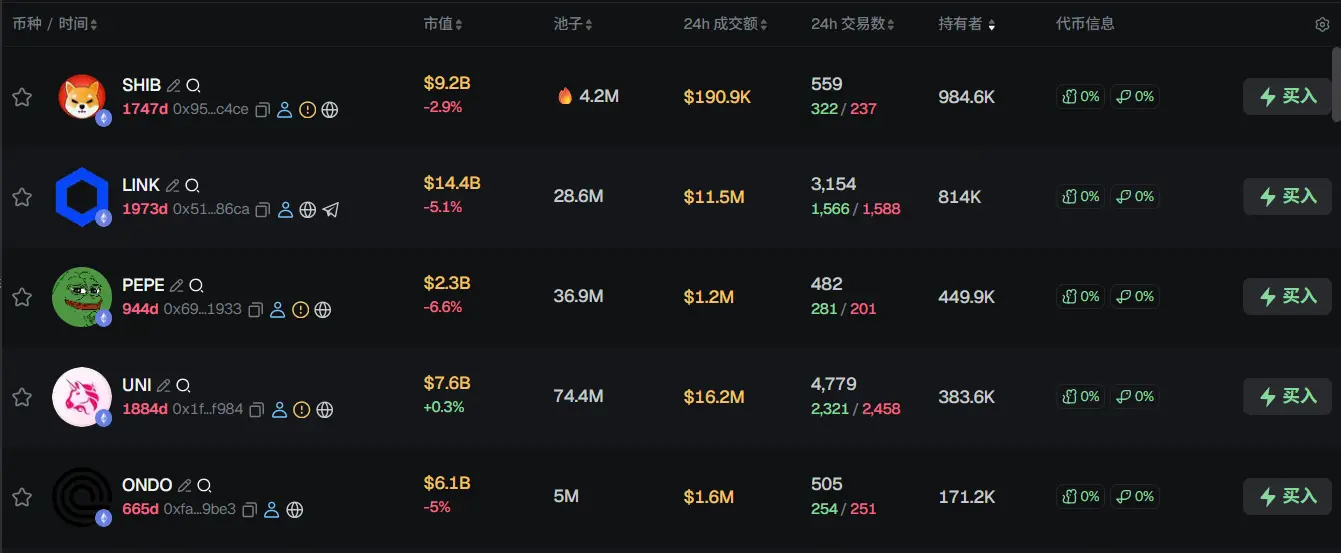
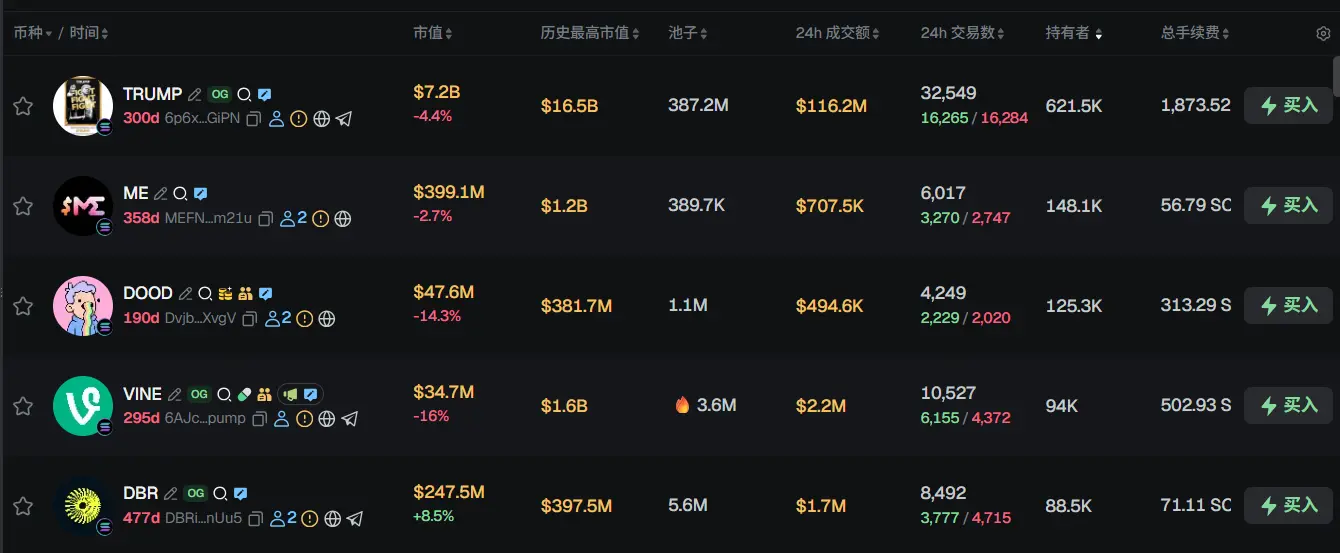
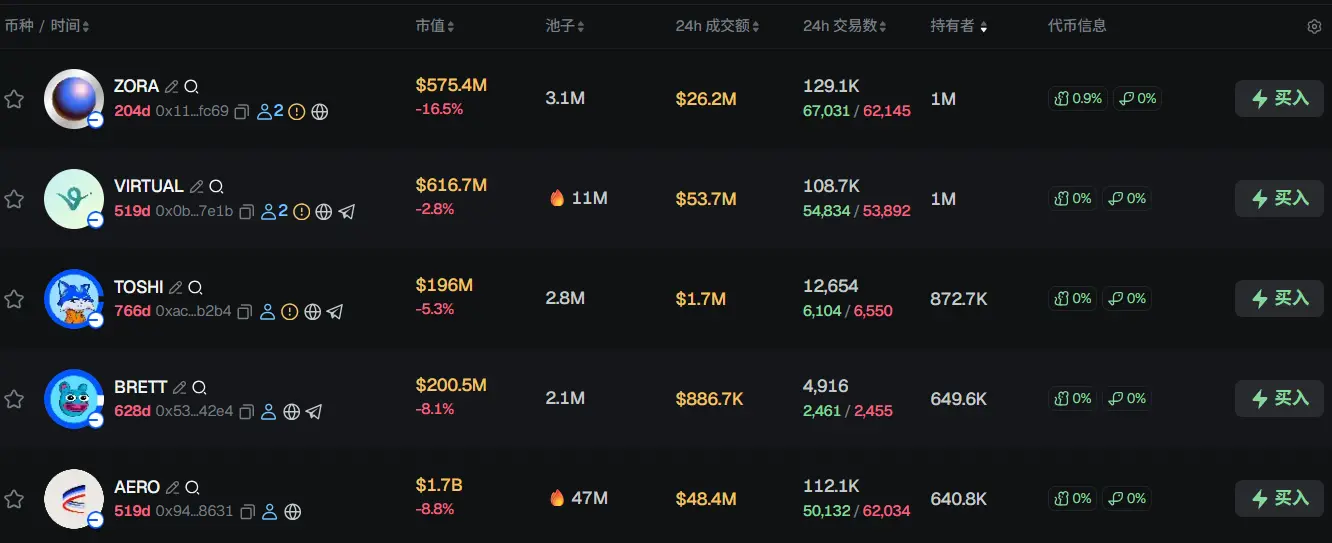
According to meme token tracking and analysis platform GMGN, as of November 14, 09:00,
The top five popular ETH tokens in the past 24 hours are: SHIB, LINK, PEPE, UNI, ONDO
The top five popular Solana tokens in the past 24 hours are: TRUMP, ME, DOOD, VINE, DBR
The top five popular Base tokens in the past 24 hours are: ZORA, VIRTUAL, TOSHI, BRETT, AERO
What are some interesting articles worth reading in the past 24 hours?
Recently, when discussing America's leadership in the digital financial revolution, I described "Project Crypto" as a regulatory framework established to match the vitality of American innovators (Note: The U.S. Securities and Exchange Commission launched the Project Crypto initiative on August 1 this year, aiming to update securities rules and regulations to enable the U.S. financial market to achieve on-chain capabilities). Today, I want to outline the next steps in this process. The core of this step is to adhere to fundamental fairness and common sense principles in applying federal securities laws to crypto assets and related transactions.
In the coming months, I expect the SEC to consider establishing a token classification system based on the long-standing Howey investment contract securities analysis while acknowledging the applicable boundaries of our laws and regulations.
At 5 a.m. Beijing time on November 13, a government shutdown crisis lasting 43 days and setting a historical record in the U.S. is about to come to an end.
The U.S. House of Representatives passed a temporary funding bill by a vote of 222-209 on the evening of November 12 local time, which was signed into law by Trump.
Thus, the deadlock that began on October 1 has officially ended.
During these 43 days, flights were widely delayed, food assistance programs were interrupted, and the release of economic data was suspended, casting uncertainty over all aspects of the world's largest economy.
As the shutdown ends, how will the market react?
Circle released its Q3 2025 financial report on November 12, reporting total revenue of $740 million, a year-on-year increase of 66%; net profit reached $214 million, a year-on-year increase of 202%.
Institutions had previously expected revenue of $700 million and EBITDA of $31 million, and the financial report data significantly exceeded expectations. However, due to the company's update of its full-year expense guidance, raising the forecast for 2025 operating expenses to between $495 million and $510 million, this change raised market concerns about its cost control and future profitability, leading to a closing drop of approximately 12.21% in CRCL on that day, reporting at $86.3, with a total market value of about $20 billion.
Reinterpreting sideways movement: Major coins are experiencing a significant shift in whale holdings
Ignas raised a point that despite the approval of the BTC ETF, institutional investors are accelerating their adoption, the "Genius Act" has passed, and the "Clarity Act" is about to be introduced, there is no regulatory crackdown, no major hacking incidents, and no fundamental narrative collapse, yet BTC remains sideways with insufficient liquidity. At this moment, early BTC investors are gradually planning to cash out (rather than sell), while new investors are planning to buy on dips.
 Risk warning
 Risk warning