Ten leading banks in Europe jointly established Qivalis, which will issue a euro stablecoin in the second half of 2026
 Core Viewpoint

 European banking giants establish Qivalis to achieve payment strategic autonomy through euro stablecoins.
According to Reuters, recently, ten European banks including ING (INGA.AS), Italy's UniCredit (CRDI.MI), and France's BNP Paribas (BNPP.PA) have formed a company that plans to launch a euro-pegged stablecoin in the second half of 2026, hoping to counter the dominance of the United States in the digital payments space.
The Amsterdam-based company is named Qivalis, and its CEO will be Jan-Oliver Sell, who previously served as the CEO of Coinbase's German operations and has also worked at Binance. The company announced at a press conference in Amsterdam on December 2 that former chairman of National Westminster Bank Howard Davies will serve as chairman.
Sell stated that the new company will be headquartered in Amsterdam and plans to hire 45 to 50 people in the next 18 to 24 months, adding that they have already recruited one-third of the staff.
Banks are striving to cope with the rapidly growing stablecoin industry and the broader development of cryptocurrencies, with some lending institutions viewing cryptocurrencies as potential direct competitors.
This growth has put pressure on traditional lending institutions, forcing them to explore the application of blockchain technology in their own businesses.
After U.S. President Donald Trump signed a law to establish stablecoin regulations, many top financial firms in the U.S. have been preparing to launch their own dollar-backed stablecoins.
Stablecoins are cryptocurrencies designed to maintain a stable value and are backed by traditional currencies, experiencing rapid growth in recent years, primarily due to Tether, a company based in El Salvador, which issues dollar tokens valued at approximately $185 billion.
Currently, there are almost no signs of market demand for euro-pegged stablecoins. Société Générale's cryptocurrency division SG-FORGE (not part of Qivalis) launched a euro-pegged stablecoin in 2023, but its circulating token value is only €64 million ($74.27 million).
Qivalis stated in a press release that the token will offer "near-instant, low-cost payments and settlements," but Davies noted that the initial use case will be cryptocurrency trading.
Sell mentioned that the name was chosen to convey trust, quality, and values, which are crucial in the financial sector, and that the name is also easy to pronounce in different languages.
Sell indicated that the company expects to launch its stablecoin in the second half of 2026, with the licensing process taking six to nine months.
The company is applying for an Electronic Money Institution (EMI) license from the Dutch central bank.
Regulators are concerned that stablecoins could siphon funds away from the regulated banking system. European Central Bank President Christine Lagarde has told European policymakers that privately issued stablecoins pose risks to monetary policy and financial stability.
The European Central Bank is also developing its own digital euro as a strategic alternative to the U.S.-dominated private payment methods (such as credit cards and stablecoins).
Floris Lugt, head of digital assets at ING, is set to become Qivalis's CFO, and he stated that the group has been in contact with the European Central Bank, which is "very supportive" of the plan.
"We feel that they are very supportive because an important policy goal is to achieve strategic autonomy in the European payments space, and they are very concerned about stablecoins, particularly those issued by U.S. fintech companies, and we feel they are more inclined to support leading European companies they can nurture."
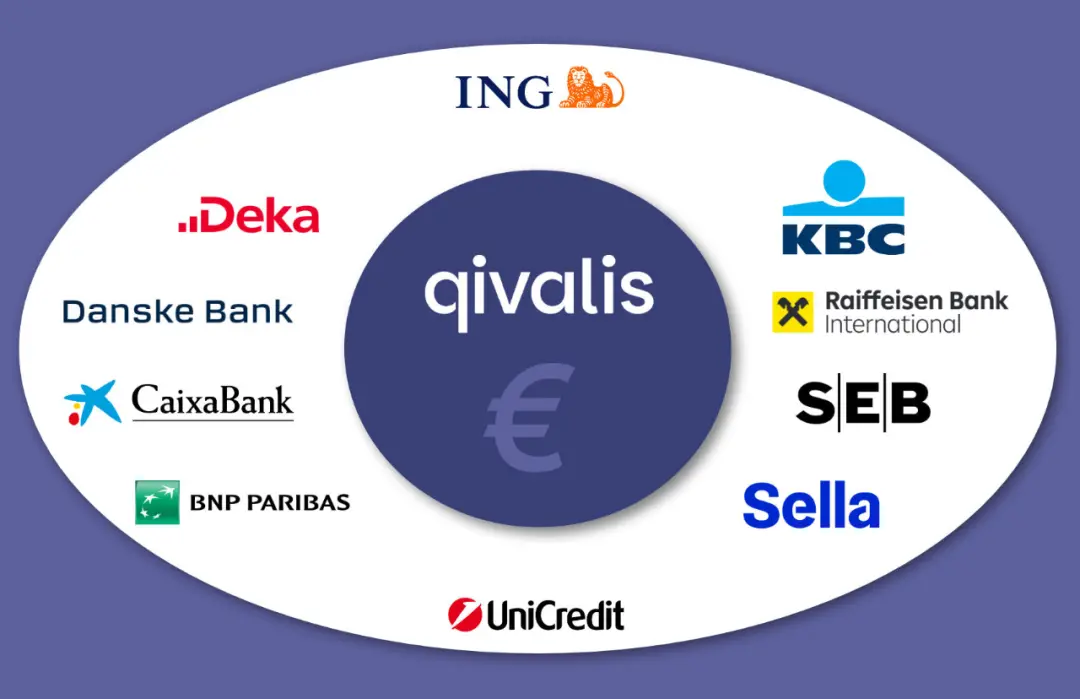
The project was initially announced in September, with participating banks including ING, UniCredit, and Banca Sella (BSEL.HT), KBC (KBC.BR), DekaBank, Danske Bank (DANSKE.CO), SEB (SEBa.ST), Caixabank (CABK.MC), and Raiffeisen Bank International. Lugt stated that BNP Paribas subsequently joined the group.
Another group of ten banks, including Bank of America, Deutsche Bank, Goldman Sachs, and UBS, has also stated that they are exploring the possibility of issuing stablecoins together. BNP Paribas is a member of both organizations.
 Risk warning Risk warning
Popular articles