When "intention" becomes the standard: How OIF ends cross-chain fragmentation and brings Web3 back to user intuition?
 Core Viewpoint

 OIF is not just an attempt to standardize the intent track, but also a key cornerstone to breaking down liquidity islands and transitioning the cross-chain experience from "manual" to "automatic."
In the previous article "Ethereum Interop Roadmap," we mentioned that the Ethereum Foundation (EF) has developed a three-step interoperability strategy to improve user experience (Improve UX): Initialization, Acceleration, and Finalization (see also "Ethereum Interop Roadmap: How to Unlock the 'Last Mile' for Mass Adoption").
If the future Ethereum is a vast highway network, then "Acceleration" and "Finalization" address the issues of road smoothness and speed limits. However, before that, we face a more fundamental pain point: different vehicles (DApps/wallets) and different toll booths (L2/cross-chain bridges) speak completely different languages.
This is precisely the core issue that the "Initialization" phase aims to solve, and the "Open Intents Framework (OIF)" is the most important "universal language" of this phase.
At Devconnect in Argentina, although the Ethereum Interoperability Layer (EIL) occupied a significant portion of the discussions, OIF, as the key adhesive between the application layer and the protocol layer, is equally important and is a prerequisite for realizing the vision of EIL. Today, we will break down this seemingly obscure but crucial OIF for user experience.
1. What exactly is OIF? A paradigm shift from "Commands" to "Intents"
To understand OIF, we first need to grasp a fundamental transformation occurring in Web3 interaction logic: from "Commands" (Transaction) to "Intents" (Intent).
Let’s start with a real pain point for an average user. Suppose you want to swap USDC on Arbitrum for ETH on Base. In today’s Ethereum ecosystem, this often means a "transaction marathon":
You need to manually switch your wallet to Arbitrum, authorize a cross-chain bridge contract, sign a cross-chain transaction, then open another aggregator, and finally swap the USDC that crossed to Base for ETH. Throughout this process, you not only have to calculate Gas and slippage yourself but also constantly guard against cross-chain delays and contract risks. It’s a cumbersome series of steps built from "a string of technical details," rather than a simple and clear demand path.
This is also how the traditional "Command" model maps onto Web3. It’s like planning your route to the airport when taking a taxi—"turn left, go straight for 500 meters, get on the overpass, take the exit…" On-chain, this manifests as users having to manually operate step by step, such as first crossing chains, then authorizing (Approve), and then trading (Swap). If any step goes wrong, it not only wastes Gas but could even result in financial loss.
The emerging "Intent" model completely bypasses the cumbersome middle steps. You only need to tell the driver, "I want to go to the airport and am willing to pay 50 yuan." As for which route the driver takes or what navigation they use, the user does not care, as long as the result is achieved. On-chain, this translates to users only needing to sign an intent that includes "I want to swap USDC on Chain A for ETH on Chain B," leaving the rest to a professional solver to execute.
Since intents are so beneficial, why do we need the Open Intents Framework (OIF)?
In simple terms, the current intent market is a fragmented "Wild West." UniswapX has its own intent standards, CowSwap has its own standards, and Across has its own standards. Solvers need to adapt to dozens of protocols, and wallets need to integrate dozens of SDKs, resulting in extremely low efficiency.
OIF aims to end this chaos by establishing a standardized "Intent Framework" for the entire Ethereum ecosystem, providing a common protocol stack for wallets, bridges, Rollups, and market makers/solvers. As a modular intent stack jointly promoted by the Ethereum Foundation and leading projects like Across, Arbitrum, and Hyperlane, it is not a single protocol but a set of universal interface standards.
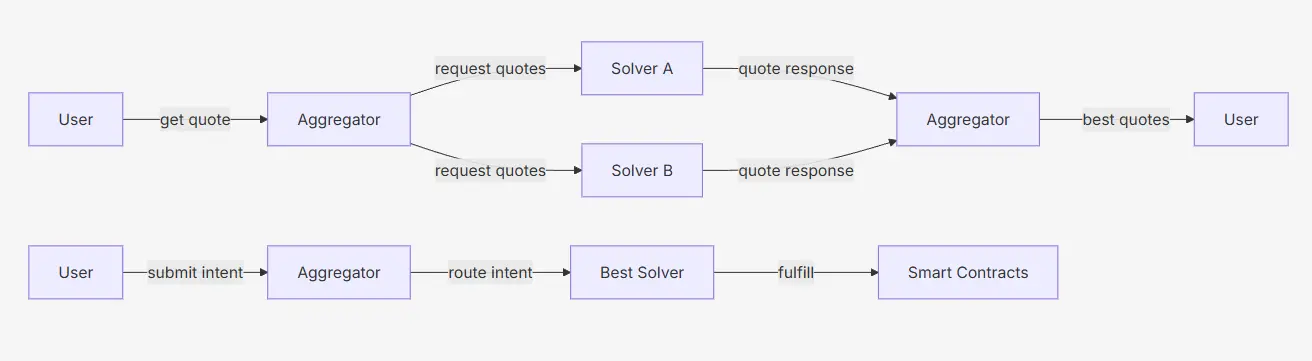
It specifies what an "Intent" should look like, how to validate it, and how to settle it, allowing any wallet, DApp, and solver to communicate on the same channel. It not only supports various intent trading modes, but developers can also expand new trading modes through OIF, such as cross-chain Dutch auctions, order book matching, and automated arbitrage.
2. The core value of OIF: Not just another cross-chain aggregator
You might ask, how is OIF different from today’s cross-chain aggregators?
The most fundamental difference lies in standardization. Most of today’s cross-chain aggregators can be understood as building a complete closed-loop system—defining their own Intent format, selecting bridges, routing, and managing risk control and monitoring. On this basis, any wallet or DApp that wants to integrate must connect to each aggregator's API and security assumptions one by one.
OIF, on the other hand, is more like a neutral, open-source standard library. It was designed from the start as a public facility built collaboratively by multiple parties, rather than a private standard of a single project. The data format, signature method, and auction/bidding logic of Intent all use common settlement and verification modules. Wallets or DApps only need to integrate OIF once to connect with multiple backends, bridges, and solvers.
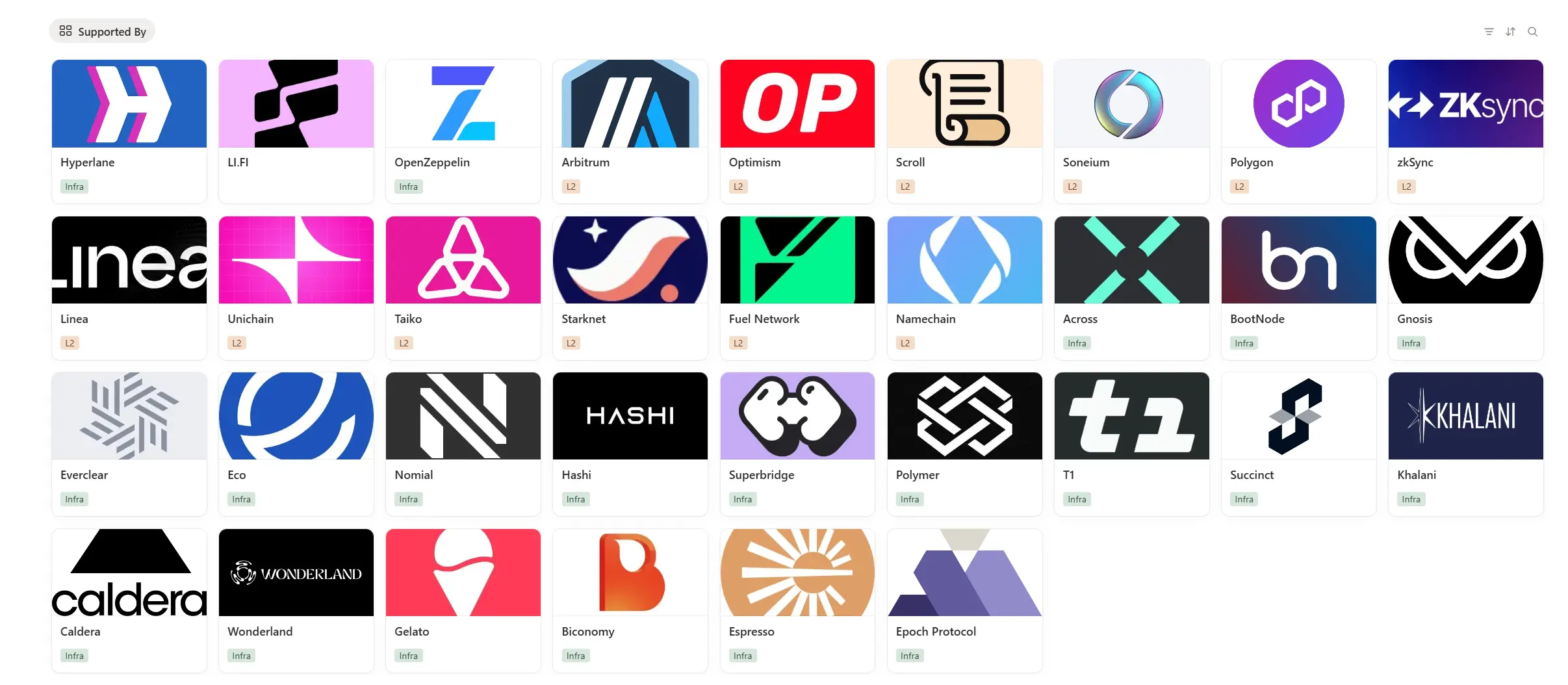
Currently, leading Ethereum players such as Arbitrum, Optimism, Polygon, ZKsync, and Across have already joined.
The liquidity fragmentation problem facing today’s Ethereum ecosystem is more complex than ever—L2s are blooming everywhere, liquidity is fragmented, and users are forced to frequently switch between different networks, cross chains, and authorize transactions. Therefore, from this perspective, the emergence of OIF is not just to make the code look better; it has profound commercial and experiential value for the mass adoption of Web3.
First, for users, under the OIF framework, they no longer need to be aware of which chain they are on. You can initiate a transaction on Optimism with the intent to purchase an NFT on Arbitrum. Previously, you would have needed to cross-chain assets, wait for them to arrive, switch networks, and then purchase the NFT.
Once OIF is integrated, wallets like imToken can directly recognize your intent and generate a standard order, automatically fronting the funds through a solver and completing the purchase on the target chain, requiring the user to sign only once. This is what is known as a "chain abstraction" experience, and OIF is the underlying syntax that enables this experience.
At the same time, for overall network liquidity, it can also break silos and achieve global sharing. After all, the liquidity of Ethereum L2s is currently fragmented; for instance, the liquidity of Uniswap on Base cannot directly serve users on Arbitrum. However, through the OIF standard (especially ERC-7683), all intent orders can converge into a globally shared order book.
A professional market maker (Solver) can listen to demand across all chains and provide funds wherever there is demand. This means that liquidity utilization will significantly increase, and users will receive better quotes.
Finally, for developers and wallets, it also means one integration, universal applicability. For wallet or DApp developers like imToken, OIF means a significant reduction in workload, as developers no longer need to develop adapters for each cross-chain bridge or intent protocol individually.
As long as they integrate the OIF standard, they can immediately connect to the entire Ethereum ecosystem's intent network, supporting all solvers that comply with that standard.
3. What stage is OIF currently at?
As mentioned earlier, according to the public statements from the Ethereum Foundation, OIF is led by the EF Protocol team, in collaboration with teams from Across, Arbitrum, Hyperlane, LI.FI, OpenZeppelin, Taiko, and others, and more infrastructure and wallets are expected to participate in discussions and testing in 2025.
Recently, the spotlight at Devconnect has been on many new concepts, but the puzzle of OIF is also being concretely implemented, mainly reflected in standard formulation and the establishment of ecological alliances. For instance, the Interop main stage at this year's Devconnect was almost entirely focused on "intent, interoperability, account abstraction," with OIF appearing multiple times in related agendas and presentations, clearly positioned as one of the key components for future multi-chain UX.
Although there is currently no large-scale application for ordinary users, from the density of meetings and participants, the community has basically reached a consensus: In the coming years, "good wallets + good applications" will very likely build cross-chain capabilities on public frameworks like OIF.
This includes the often-discussed ERC-7683, which is currently one of the most concrete outcomes of OIF, proposed jointly by Uniswap Labs and Across Protocol, aiming to establish a universal structure for cross-chain intents.
During Devconnect, discussions around ERC-7683 have indeed deepened, with more and more developers, solvers, and market makers increasing their support for this standard, marking a shift of cross-chain intent trading from private protocols to public facilities.
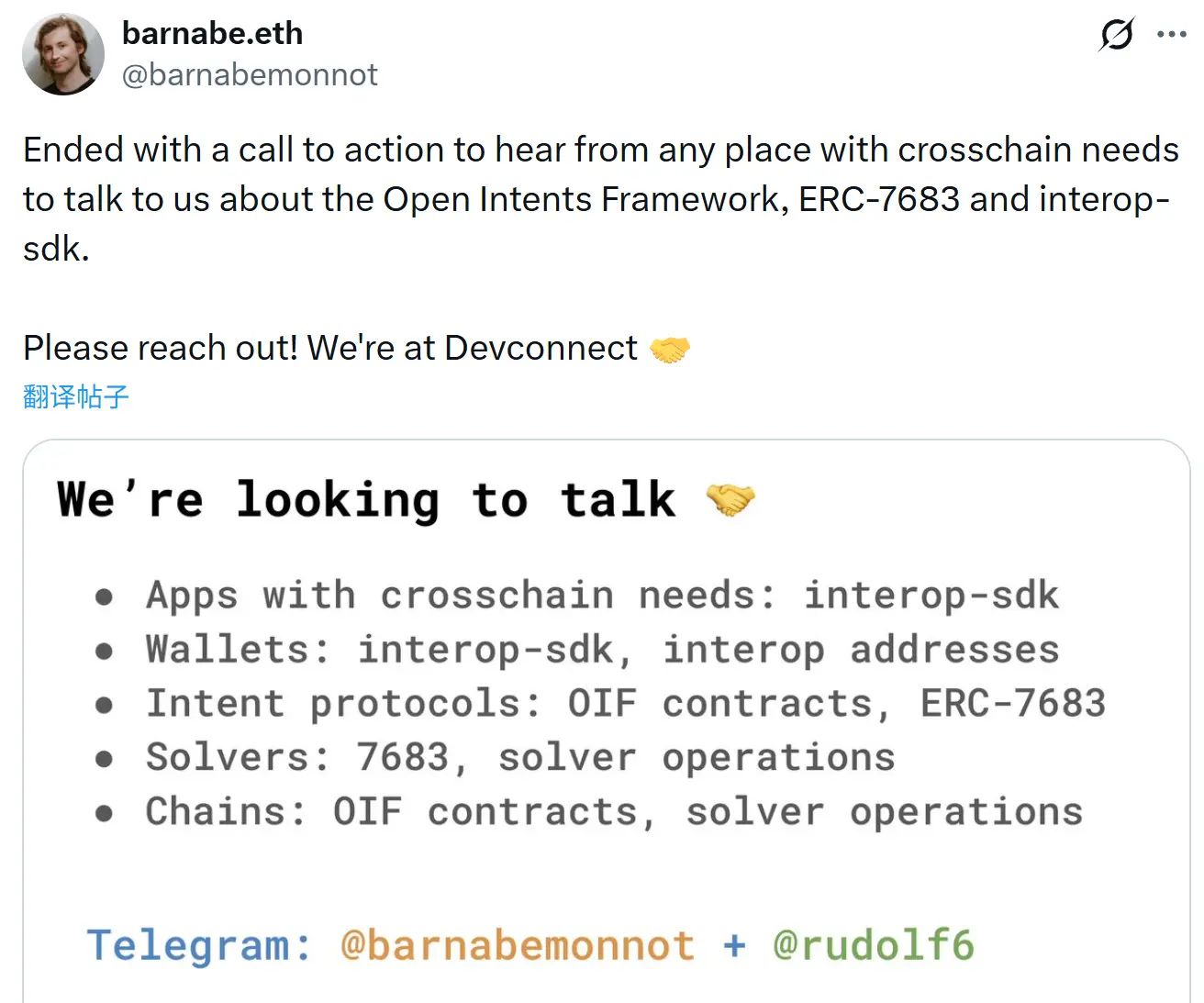
Secondly, in conjunction with another main line of the Interop series—Ethereum Interoperability Layer (EIL), OIF provides "intents and UX" at the upper layer, while EIL provides "trust-minimized messaging channels across L2s" at the lower layer. The combination of the two forms an important foundation for the future Ethereum interoperability stack.
The Ethereum Foundation plays the role of a coordinator rather than a controller in this process. Through documents like Protocol Update, EF has clarified that OIF is the initialization phase of the interoperability roadmap, which gives the market great confidence—intent is not a fleeting narrative but a long-term evolutionary direction recognized by Ethereum.
For the entire Ethereum ecosystem, OIF is advancing the concept of "interoperability" from a white paper idea to an engineering reality that can be replicated, audited, and integrated on a large scale. Perhaps in the future, when you use a wallet, you will gradually notice a change: you only need to express "what you want to do," without having to worry about "which chain or which bridge"—that’s the infrastructure like OIF quietly playing its role.
Thus, the "initialization" puzzle of interoperability has begun to take shape.
However, in EF's roadmap, merely understanding intents is not enough; it also needs to run fast and steadily. In the next article of the Interop series, we will delve into the core topics of Devconnect—EIL (Ethereum Interoperability Layer)—and show you how Ethereum builds a permissionless, censorship-resistant cross-L2 trust channel through the "Acceleration" phase, truly realizing the ultimate vision of making all Rollups "look like a single chain."
Stay tuned.
 Risk warning Risk warning




Popular articles