The public chain moat is only 3 points? Alliance DAO founder's remarks ignite debate in the crypto community
 Core Viewpoint

 Instead of worrying about the "moat," perhaps we should think about how cryptocurrencies can more quickly, cost-effectively, and conveniently meet the real needs of more market users.
Original / Odaily Planet Daily Wenser
Recently, Alliance DAO founder qw (@QwQiao) made a shocking statement: "The blockchain moat is limited," and rated the moat of L1 public chains at only 3/10.
This statement quickly ignited discussions in the overseas crypto community, sparking heated debates among crypto VCs, public chain builders, and KOLs. Dragonfly partner Haseeb fired back that rating "the blockchain moat as 3/10" is absurd, and even Aave founder Santi, who is critical of the gambling culture in the industry, has never believed that blockchain "has no moat."
The debate about the significance, value, and business models of blockchain & cryptocurrency often resurfaces in cycles. The crypto industry oscillates between ideals and reality: people nostalgically remember the original decentralized vision while yearning for the status and recognition of traditional finance, all the while grappling with self-doubt about whether it is merely a repackaged casino. The root of all these contradictions may lie in scale— the total market value of the crypto industry has been hovering around $3 to $4 trillion, which still seems small compared to traditional financial giants that easily reach hundreds of billions or even trillions.
As practitioners, there is a contradictory psychology of being both arrogant and insecure—arrogant because the blockchain was born from the ideal of de-dollarization and decentralization as envisioned by Satoshi Nakamoto, and because the crypto industry has indeed become an emerging financial sector that is gradually gaining attention, acceptance, and participation from mainstream forces; yet insecure, like a poor kid who feels that what he does is not glorious, filled with the blood, tears, suffering, and pain of a zero-sum game. In summary, the limitations of the industry's scale have fostered this cyclical identity anxiety, self-doubt, and self-denial.
Today, we will take the topic of qw's "moat business rating" to discuss the existing ailments and core advantages of the crypto industry.
Origin of the Debate: Is Liquidity the Moat of the Crypto Industry?
The major discussion about "whether there is a moat in the crypto industry" actually originated from a statement made by Paradigm team researcher frankie who said: "The greatest trick the devil ever pulled was convincing crypto people that liquidity is a moat."
It is clear that as a "purebred" VC, frankie is somewhat dismissive of the industry's current high regard for "liquidity is everything." After all, for an investor or research expert with funding and information advantages, they often hope that the money they manage can be spent on projects and businesses that have real business support, can generate real cash flow, and continuously bring them financial returns.
This viewpoint has garnered support from many in the comments:
- Multicoin partner Kyle Samani directly stated "+1";
- Ethereum Foundation member binji believes "trust is the real moat; even if trust may flow due to opportunities in the short term, liquidity will always be placed where it is trusted."
- Chris Reis from Circle's Arc public chain team pointed out: "TVL always seems to be the wrong North Star metric (business guiding target)."
- Justin Alick from the Aura Foundation jokingly said: "Liquidity is like a fickle woman; she can leave you at any time."
- DeFi researcher Defi peniel stated: "Relying solely on liquidity is not a moat; speculation can disappear overnight."
Of course, there were also many rebuttals—
- DFDV COO and CIO Parker commented: "What are you talking about? USDT is the worst stablecoin but holds absolute dominance. Bitcoin is (performance-wise) the worst blockchain but absolutely dominates."
- Former Sequoia investor and current Folius Ventures investor KD posed a rhetorical question: "Isn't it?"
- Fabric VC investor Thomas Crow pointed out: "In exchanges, liquidity is a moat— the deeper the liquidity, the better the user experience; this is the most important feature in this vertical industry, without exception. This is why the main innovations in crypto asset trading focus on solving liquidity shortages (which lead to worse user experiences), such as Uniswap, which obtains long-tail asset liquidity through LPs, and Pump.Fun, which attracts pre-launch liquidity through standardized contracts and joint curves."
- Pantera investor Mason Nystrom retweeted and commented: "Liquidity is definitely a moat." He then provided different examples to illustrate: in public chains, Ethereum's current lead is due to DeFi liquidity (and developers); in CEX, Binance, Coinbase, etc.; in lending platforms, Aave, MakerDAO; in stablecoins, USDT; in DEX, Uniswap, Pancakeswap.
Then came the tweet from Alliance DAO founder qw about the moat rating:
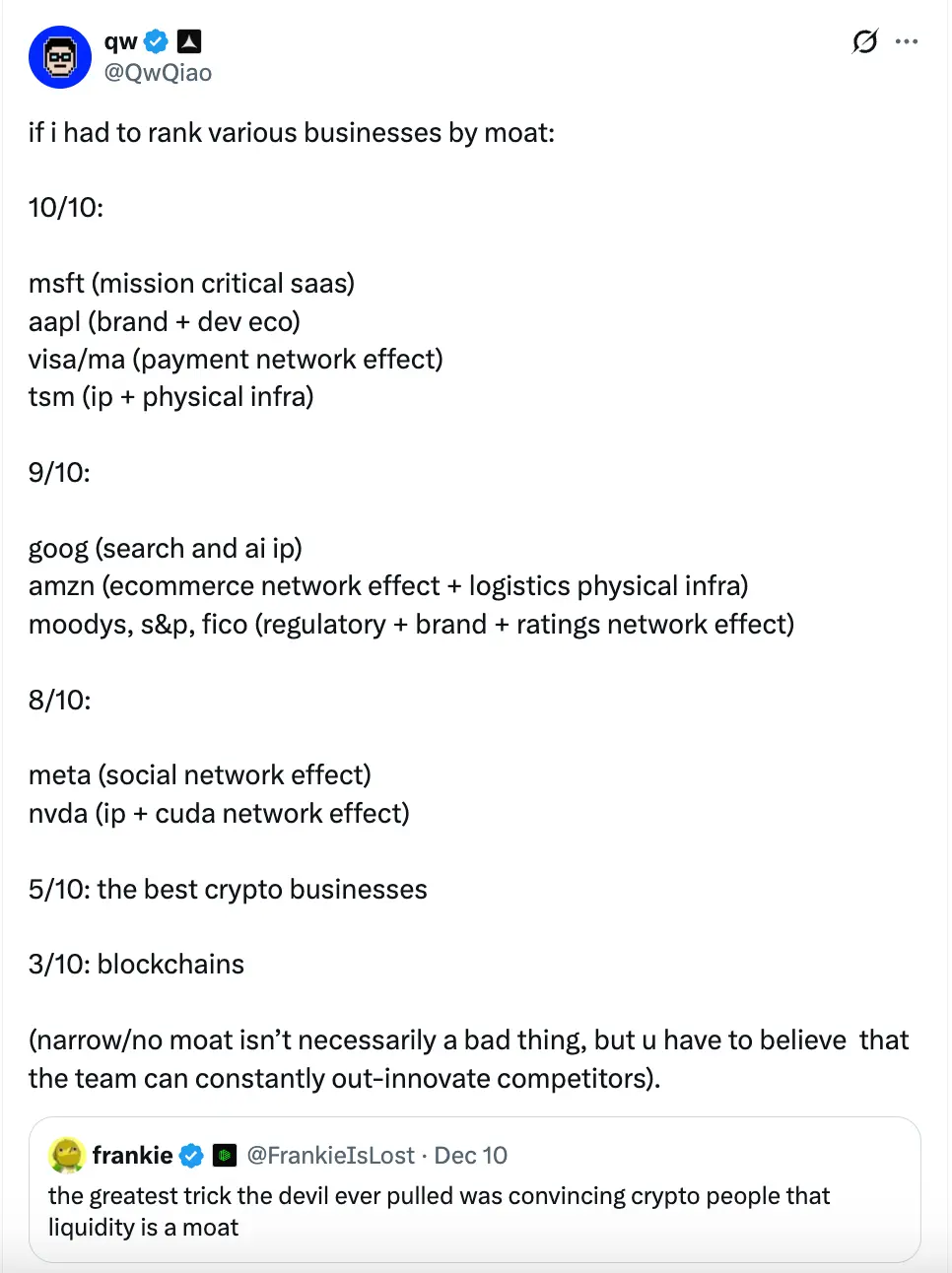
In his view, the moat of blockchain (public chains) itself is very limited, rated only 3/10.
- He believes that Microsoft (key SaaS), Apple (brand + developer ecosystem), Visa/Mastercard (payment network effects), and TSMC (IP + physical infrastructure) can score up to 10/10 (strongest moat);
- Google (search and AI IP), Amazon (e-commerce network effects + logistics infrastructure), Moody's, S&P, FICO, and other rating agencies (regulatory-driven + brand + rating network effects), and major cloud computing (AWS/Azure/GCP, etc.) can score up to 9/10;
- Meta (social network effects) and Nvidia (IP + CUDA network effects) score 8/10;
- The best crypto businesses in the crypto industry score 5/10;
- Public chains (blockchains) score only 3/10 (narrow moat).
qw further stated that a low moat rating is not necessarily a bad thing, but it means that the team must continuously lead in innovation, or they will be quickly replaced. Then, perhaps feeling that the previous rating was too hasty, he provided some supplementary ratings in the comments:
- The three major cloud service providers score 9/10;
- BTC's moat rating is 9/10 (Odaily Planet Daily notes: qw pointed out that no one can replicate BTC's founding story and the "Lindy effect," but deducted 1 point because it is unclear whether it can cope with security budgets and quantum threats);
- Tesla scores 7/10 (Odaily Planet Daily notes: qw believes that smart driving and other automation IP are very crazy, but the automotive industry is commoditized, and humanoid robots may be similar);
- ASML, the lithography machine manufacturer, scores 10/10.
- AAVE's moat rating may be higher than 5 (out of 10), with qw reasoning: "As a user, you must believe that their smart contract security testing is sufficient and will not lose your funds."
Of course, seeing qw take on the role of a "sharp critic" so grandly, the comments section not only debated the "moat system" but also included some irrelevant mockery of qw's statements, with some even mentioning: "What about those terrible launch platforms you invested in?" (Odaily Planet Daily notes: After investing in pump.fun, the one-click token issuance platforms that Alliance DAO subsequently invested in (like Believe) performed poorly, and even he himself didn't want to rate them).
With such a contentious focal topic, Dragonfly partner Haseeb's subsequent angry response followed.
Dragonfly Partner's Inner OS: Nonsense, I've never seen such a shameless person
In response to qw's "moat rating system," Dragonfly partner Haseeb wrote angrily: "What? 'Blockchain moat: 3/10'? This is a bit ridiculous. Even Santi doesn't think public chains 'have no moat.'
Ethereum has dominated for 10 years, with hundreds of challengers raising over $10 billion trying to capture market share. After ten years of competitors trying to defeat it, Ethereum has successfully defended its throne every time. If that doesn't indicate that Ethereum has a moat, I really don't know what a moat is?"
In the comments of this tweet, qw also shared his perspective: "What you are saying is looking back at the past ('the past ten years') and is factually incorrect (Ethereum no longer holds the throne on multiple metrics)."
Subsequently, the two engaged in several rounds of discussion about "what exactly is a moat?" and "does Ethereum have a moat?" qw even brought up a post he made in November, pointing out that his idea of a "moat" is actually revenue/profit. But Haseeb immediately provided counterexamples—projects like OpenSea, Axie, and BitMEX, which were once highly profitable, actually have no moat, and the real moat should focus on whether "it can be replaced by competitors".
Abra Global asset management director Marissa also joined the discussion: "I agree (with Haseeb's viewpoint). qw's statement is a bit strange—switching costs and network effects can be solid moats—both Solana and Ethereum have these, and I believe over time, they will become stronger than other public chains. They both have strong brands and developer ecosystems, which are clearly part of the moat. Perhaps he is referring to other public chains that lack these advantages."
Haseeb continued to mock: "qw is just arguing in bad faith, digging his own grave."
Based on the above discussion, perhaps we should break down what the "real moat" of public chains in the cryptocurrency industry actually includes.
The 7 Components of Public Chain Moats: From People to Business, From Origin to Network
In my view, the reason qw's "moat rating system" seems somewhat self-contradictory is primarily due to:
First, its rating criteria only consider the current industry position and revenue while ignoring multi-dimensional evaluation. Whether it is infrastructure like Microsoft, Apple, Amazon Cloud, or payment giants like Visa and Mastercard, the main reason qw gives high scores is due to their strong revenue models, which clearly simplifies and superficializes the business moats of giant companies. Moreover, it is worth noting that Apple's global market share is not dominant, and payment giants like Visa also face challenges such as market contraction and regional business decline.
Second, it overlooks the complexity and uniqueness of public chains and crypto projects compared to traditional internet businesses. As challengers to the fiat currency system, cryptocurrencies and blockchain technology, as well as the subsequent emergence of public chains and crypto projects, are rooted in the natural "concealment" and "node-based" characteristics of decentralized networks, which traditional revenue-driven businesses often cannot achieve.
Based on this, I believe the moat of public chain businesses mainly consists of the following 7 aspects:
1. Technical Philosophy. This is the greatest advantage and differentiating feature of Bitcoin, Ethereum, Solana, and countless public chain projects. As long as humanity remains vigilant against centralized systems, authoritarian governments, and fiat currency systems, and accepts the concepts of sovereign individuals and related ideas, the real demand for decentralized networks will always exist;
2. Founder Charisma. Satoshi Nakamoto disappeared after inventing Bitcoin and ensuring the smooth operation of the Bitcoin network, sitting on hundreds of billions of dollars without being moved; from a gamer who was obsessed with World of Warcraft but suffered "abuse" from game companies to co-founder of Ethereum, Vitalik resolutely embarked on his journey of decentralized spirit; Solana's founders like Toly were once elites from major American companies but were unwilling to stop there, thus starting their own "capital internet" construction path. The personal charisma and appeal of founders are particularly important in the crypto industry. This is why countless crypto projects gain favor from VCs, community support, and influx of funds due to their founders, but also why they can fade into obscurity when founders step down or face unexpected events. A good founder is the true soul of a public chain or a crypto project;
3. Developer and User Network. In this regard, as emphasized by Metcalfe's Law and the Lindy Effect, the stronger the network effect of a thing and the longer it exists, the more it can continue to exist. The developer and user network is the cornerstone of public chains and many crypto projects, as developers can be seen as the first batch of users and the most enduring users of a crypto public chain or project;
4. Application Ecosystem. A tree can hardly survive without branches and leaves, and the same goes for crypto projects. Therefore, a rich and self-sustaining application ecosystem that can generate synergistic effects is crucial. The reason why public chains like Ethereum and Solana can survive the winter is that they have always had various application projects being built. Moreover, the richer the application ecosystem, the more it can continuously generate value and feed back into the public chain;
5. Token Market Value. If the aforementioned aspects are the internal structure and foundation of a "moat," then token market value is the external form and brand image of a public chain and a crypto project. Only when you "look expensive" will more people believe that you "have a lot of money," and that this is a "gold mine," both for individuals and projects;
6. Openness to the Outside World. Public chains and other crypto projects need to maintain openness and operational exchange value with the external environment in addition to building their internal circular ecosystem. Therefore, openness is also crucial. Taking public chains like Ethereum and Solana as examples, it is their convenience and scalability in bridging with traditional finance, user capital inflow and outflow, and various industries through payment, lending, and other windows;
7. Long-term Roadmap. A truly solid moat must not only support in the short term but also continuously update, iterate, and innovate to maintain its vitality and longevity in the long term. For public chains, a long-term roadmap serves as both a North Star metric and a powerful tool to incentivize continuous development and innovation within and outside the ecosystem. The success of Ethereum is closely related to its long-term roadmap planning.
Based on the above elements, a public chain can evolve from zero to one, from nothing to something, gradually passing through the phase of barbaric growth and entering the mature iteration phase. Correspondingly, liquidity and user stickiness will naturally follow.
Conclusion: The Crypto Industry Has Not Yet Reached the "Talent Competition" Stage
Recently, Moore Threads, known as the "Chinese version of Nvidia," successfully listed on the Hong Kong stock market, achieving a milestone of 300 billion yuan on its first day of trading; shortly after, its stock price soared, reaching over 400 billion yuan in market value today, another astonishing breakthrough.
Compared to Ethereum, which took 10 years to finally reach a market value of 300 billion dollars, Moore Threads achieved 1/7 of the former's journey in just a few days. In contrast to the traditional financial giants with market values often in the trillions, the crypto industry seems small by comparison.
This makes us once again sigh that today, when the scale of funds and user involvement is far less than that of traditional finance and the internet, we are far from the time of "talent competition." The only pain point in the crypto industry right now is that we don't have enough people, the funds we attract are not large enough, and the industries involved are not broad enough. Rather than worrying about those macro, large-scale "moats," perhaps we should think more about how cryptocurrencies can more quickly, cost-effectively, and conveniently meet the real needs of more market users.
 Risk warning Risk warning