Dovey: Who pays for the bull market?
 Core Viewpoint

 The birth of a new god may be random, but the twilight of the old gods is already destined.
Author: Dovey
"The Long Bull Market from the West" has been nearly 6 years since its publication. After two cycles, crypto has finally fulfilled many items on the "wish list" from the past decade. The events described in the article are happening rapidly: various institutional investors are entering the market to allocate Bitcoin, a wide range of products linked to TradFi are being fully integrated, Circle has gone public with great fanfare, and the U.S. President has publicly endorsed it and even created memes. According to the old script, this should be the standard opening for a "high β bull market." However, what we see as this cycle concludes is a collapse in volatility, with market catalytic events being preemptively run, and the industry, which should have been filled with "surprises," has become less exciting as assets become fully financialized and mainstream.
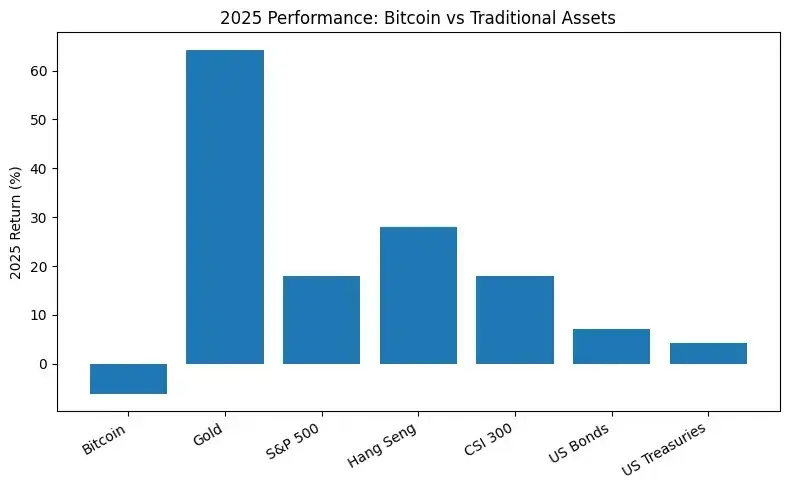
On a cross-asset level, even in the context of friendly policies and the release of institutional dividends, BTC has significantly underperformed major TradFi assets such as gold, U.S. stocks, Hong Kong stocks, and A-shares in 2025. It is one of the few assets that failed to reach new highs in sync with global risk assets.
Since the beginning of 2024, I have repeatedly analyzed the structural changes in the liquidity supply chain caused by asset mainstreaming from different angles on English Twitter here. Here are a few representative points:
CME's BTC open interest (OI) has already surpassed Binance since the beginning of 2024.
The launch of ETFs has provided the best environment for professional arbitrageurs on Wall Street, leading to a significant contraction in volatility.
The triparty banking agreement that Binance and OKX have been trying to push has faced significant challenges.
The launch of CME's ETF options and future spot products will further squeeze the market of offshore exchanges.
This year, CBOE and CME began accepting crypto in-kind collateral, which will greatly increase collateral mobility.
This year, DTCC will directly connect with several public chains, opening up on-chain pathways for stock assets from the source.
As the structure of participants in Crypto and the liquidity supply chain has undergone substantial changes: Who is buying? Who is selling? Who is quietly leaving?
Huge Divergence Between Offshore and Onshore Funds
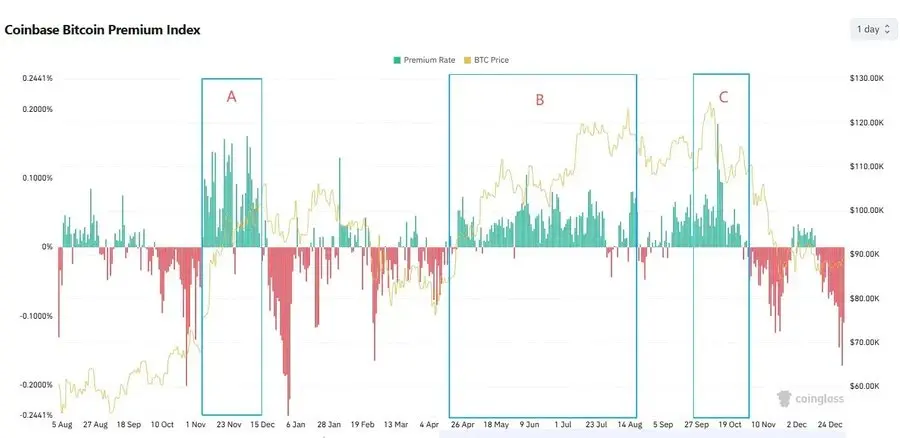
To understand the funding structure in this round, we first need to break down the three key peaks of BTC in this cycle:
Phase A (November 2024 - January 2025): Trump's election and improved regulatory expectations triggered FOMO across the entire onshore and offshore market, with BTC breaking through $100,000 for the first time.
Phase B (April 2025 - mid-August): After a deleveraging pullback, BTC surged again, breaking through $120,000 for the first time.
Phase C (early October 2025): BTC recorded a local ATH for this cycle, followed shortly by the 10·10 flash crash, entering a period of adjustment.
From the perspective of spot and derivatives combinations, the three phases share several common characteristics:
Spot: Onshore is the main buyer, while offshore tends to reduce positions at highs. The Coinbase Premium maintained a positive premium during the A/B/C peak phases, indicating that high-level buying mainly came from onshore spot funds represented by Coinbase.
Coinbase's BTC balance has been continuously declining during the cycle, reducing the available chips on the CEX side. In contrast, Binance's balance significantly increased during phases B and C as prices rebounded, corresponding to increased potential selling pressure from offshore spots.
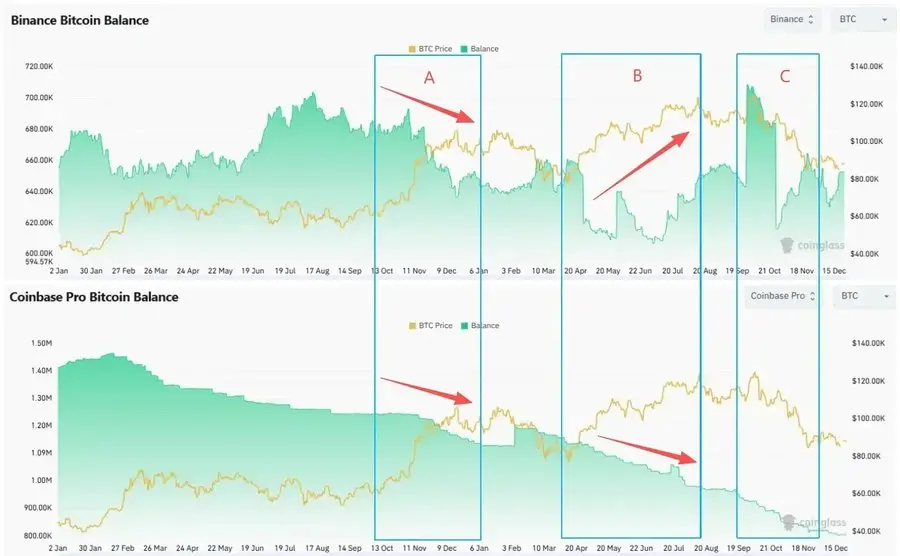
- Futures: Offshore leverage is active, while onshore institutions continue to reduce positions. The offshore OI (taking Binance BTC OI as an example) in BTC has consistently risen during phases B and C, with leverage increasing. Even after the short-term pullback following the 10·10 deleveraging, it quickly recovered to high levels, even reaching new highs. In contrast, the CME's onshore futures OI has been declining since early 2025 and did not rise in sync when prices reached new highs; at the same time, BTC volatility diverged from prices, especially when BTC first broke $120,000 in August 2025, while Deribit DVOL was at a phase low, and implied volatility did not provide a premium for the new highs, indicating that the options market was pricing in caution regarding trend continuation.
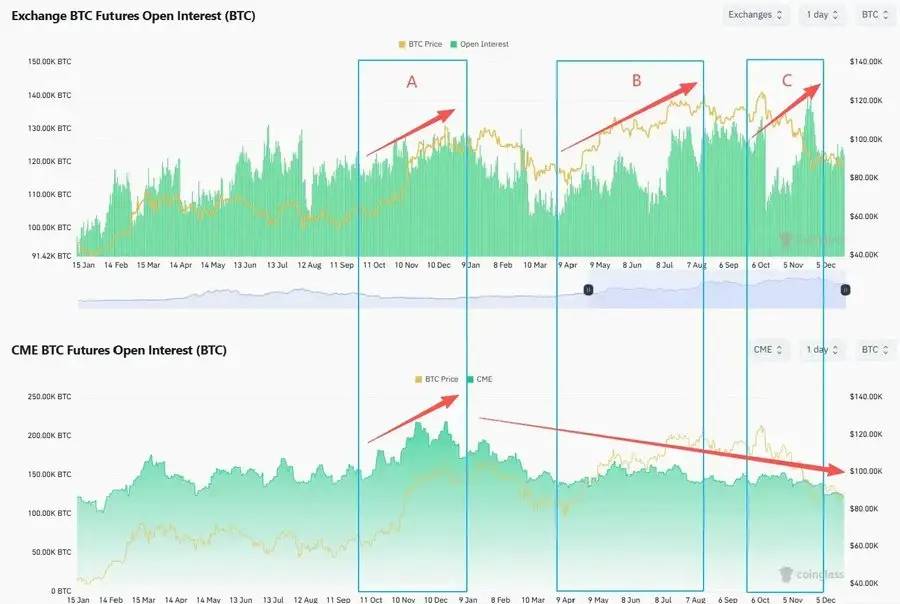
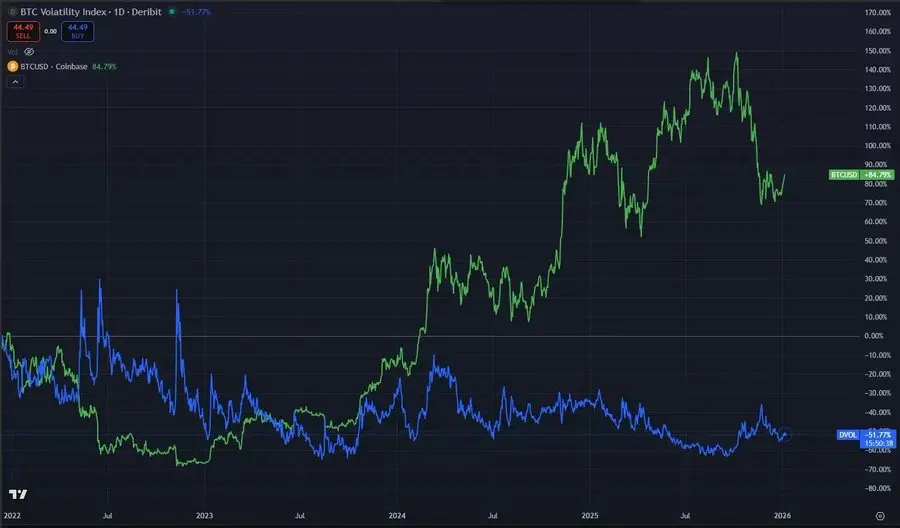
The spot market reflects a reallocation behavior in major asset classes, and the divergence in behavior on both sides indicates a lack of long-term confidence in the asset. The CME and options players are the smart money most sensitive to the bloodshed, with a keen sense. The trading setups and timing control on both sides are clearly distinguishable.
Is the "institution" just a bunch of fools with too much money?
At the beginning of 2025, two key policies laid the foundation for the structural entry of onshore buying:
Abolishment of SAB 121: Banks no longer need to count BTC held in custody as liabilities, making it feasible for large custodial banks like BNY Mellon and JPM to engage in BTC custody business.
FASB fair value accounting coming into effect (January 2025): Companies holding BTC are no longer "only accounting for impairment, not gains," but can measure it at fair value based on market price. For CFOs, this transforms BTC from a "highly volatile intangible asset" into a "reserve asset option" that can be accurately reflected in financial statements.
These two changes provided the accounting and compliance prerequisites for subsequent DAT, corporate treasury, and some institutional fund allocation behaviors. Thus, we began receiving numerous financing pitches from new DAT players starting in the first quarter of 2025. The core capability of the DAT founding team is solely financing ability. The so-called institutions are not smarter than retail investors; they simply have lower capital costs and more financial tools for continuous financing. According to Glassnode statistics, the number of BTC held by DAT companies increased from about 197,000 at the beginning of 2023 to about 1,080,000 by the end of 2025, with a net increase of about 890,000 over two years, making DAT one of the most important structural buyers in this round. The operational logic of DAT can be summarized as NAV premium arbitrage:
When the stock price has a premium relative to the net asset value of its held crypto assets, the company can issue additional shares through ATM or convertible bonds to finance at a high valuation;
The funds raised are used to purchase BTC and other crypto assets, pushing up the per-share value of the holdings, further supporting the stock price premium;
During the upward phase, the larger the premium, the easier the financing, and the more motivation the company has to "buy more as it rises."
Taking MSTR as an example, its large-scale accumulation from 2024 to 2025 coincided with BTC's strong upward movement, approaching or refreshing historical highs:
In November-December 2024, when BTC was hitting the $100,000 range, MSTR completed the largest single issuance of $3 billion in 0% convertible bonds in history;
Subsequently, it purchased over 120,000 BTC at an average cost above $90,000, effectively forming significant structural buying around $98,000.
Therefore, for DAT, high-level accumulation is not chasing the price but a necessary result of maintaining stock price premiums and the structure of the balance sheet.
Another frequently misunderstood aspect is ETF flow. The investor structure of ETFs has the following characteristics:
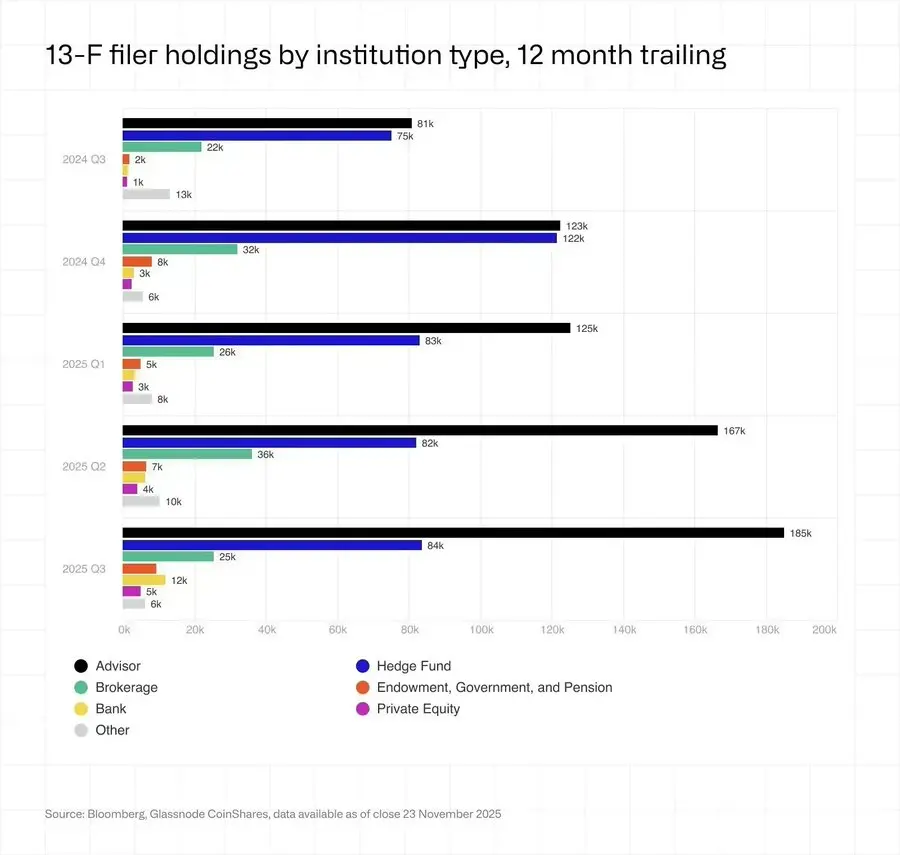
Institutions (narrowly defined as 13F filers) hold less than a quarter, so the overall AUM of ETFs is still dominated by non-institutional funds;
Among institutions, the main types are financial advisors (Advisors, including wrap accounts and RIAs) and hedge funds: Advisors primarily focus on mid-term asset allocation, with smooth accumulation rhythms (passive funds); hedge funds are more price-sensitive, leaning towards arbitrage and medium-high frequency trading, and have generally reduced positions after Q4 2024, highly consistent with the downward trend of CME OI (active funds).
A slight breakdown of the ETF funding structure reveals that institutions are not the major players; these institutions do not use their own balance sheet money, and wealth management and hedge funds are certainly not "diamond hands" in the traditional sense.
As for other types of institutions, they are not smarter than retail investors either. The business models of institutions boil down to two types: earning management fees and earning carry. Our industry's top-tier VC from the 2016 vintage has a DPI of only 2.4x (meaning if you invested $100 in 2014, you would receive $240 in 2024). This significantly underperforms Bitcoin's growth over the past decade. The advantage of retail investors is always to follow the trend and quickly pivot after understanding changes in market structure, without needing to rely on past paths. Most institutional investors die from path dependence and regression in self-iteration capabilities, while most exchanges fail due to misappropriation of user assets and security vulnerabilities.
The Absence of Retail Investors
From the traffic data of major CEXs like Binance and Coinbase, it can be seen that since the peak of the 2021 bull market, overall traffic has been continuously declining, and even when BTC reached new highs, it did not significantly recover. This stands in stark contrast to the popularity of Robinhood. More can be read in our article from last year "Where are the marginal buyers".
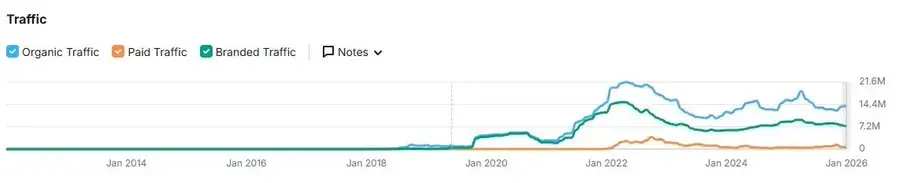
Binance traffic
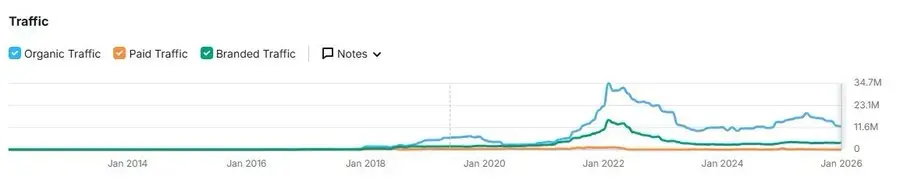
Coinbase traffic
The "wealth effect" in 2025 is more concentrated outside of crypto. S&P 500 (+18%), Nasdaq (+22%), Nikkei (+27%), Hang Seng (+30%), KOSPI (+75%), and even A-shares have risen nearly 20%, not to mention Gold (+70%) and Silver (+144%). Additionally, crypto has faced a 'kill' in this cycle: AI stocks have provided a stronger narrative for wealth effect, while U.S. stocks' 0DTE Zero-Day Options offer an even more casino-like experience than perpetual contracts, and some new retail investors are betting on various macro-political events in Polymarket and Kalshi.
Moreover, even the retail investors in South Korea, known for high-frequency speculation, have retreated from Upbit in this round, turning to gamble on KOSPI and U.S. stocks. In 2025, Upbit's average daily trading volume fell by ~80% compared to the same period in 2024, while during the same period, the KOSPI index in the South Korean stock market rose over 70%-75%.
South Korean retail investors' net purchases of U.S. stocks reached a record $31 billion.
Emergence of Sellers
As BTC's movements increasingly synchronize with U.S. tech stocks, a clear disconnection appeared in August 2025: after BTC followed ARKK and NVDA to reach the August top, it quickly fell behind and faced the 10·11 crash, which has yet to recover. Coincidentally, at the end of July 2025, Galaxy disclosed in its earnings report and press release that it had completed the sale of over 80,000 BTC in batches on behalf of an early BTC holder within 7-9 days. These signs indicate that crypto-native funds are undergoing massive turnover with institutions.
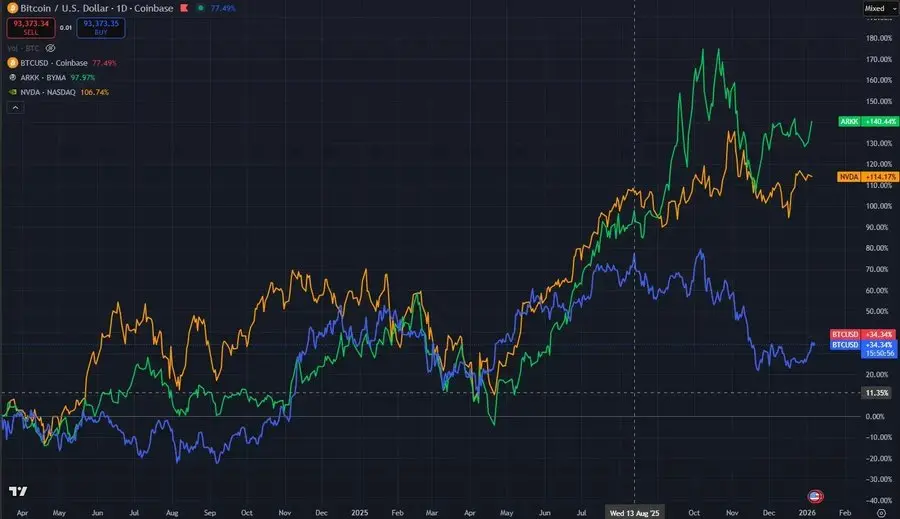
As BTC wrapper products (such as IBIT) gradually mature, improved financial facilities provide BTC OG whales with the best channels for liquid exit. The behavior of OGs has shifted from "selling directly at market price on exchanges" to utilizing structured products to exit or rotate assets, entering a broader world of TradFi assets. Galaxy's largest business growth in 2025 comes from helping BTC whales transition from BTC to iBit. The collateral mobility of iBit is far superior to that of native BTC, and it is also safer to store. As assets become mainstream, the high capital utilization of paper Bitcoin far exceeds that of real Bitcoin, which is an inevitable path for the financialization of other precious metals.
Miners: From "Paying Electricity Bills" to "Funding AI CAPEX"
From around the halving in 2024 to the end of 2025, miners' reserves have experienced the most sustained and significant decline since 2021: by the end of 2025, miners' reserves were approximately 1.806 million BTC, with hash rates down about 15% year-on-year, indicating signs of industry clearing and structural transformation.
More importantly, the motivation for miners to sell coins this round has exceeded the traditional scope of "covering electricity bills":
Under the so-called "AI escape plan" framework,
some mining companies have transferred approximately $5.6 billion worth of BTC to exchanges
to raise capital expenditures for building AI data centers;
Companies like Bitfarms, Hut 8, Cipher, and Iren are transforming their existing mining sites into AI/HPC data centers and signing long-term power rental agreements for 10-15 years, viewing electricity and land as "golden resources in the AI era";
Riot, which has always adhered to a "long-term holding" strategy, also announced in April 2025 that it would adjust its strategy and begin selling its monthly BTC production.
It is estimated that by the end of 2027, about 20% of Bitcoin miners' power capacity will be repurposed for AI.
Financialized Paper Bitcoin
Bitcoin and the crypto digital assets it represents are undergoing a slow migration from within, shifting from value discovery-driven active trading dominated by crypto-native funds to passive allocation and balance sheet management represented by ETFs, DAT, sovereign and long-term funds, with the managed positions often being financialized paper Bitcoin. The underlying asset, Bitcoin, is gradually becoming a risk asset component that is inserted into various portfolios and bought according to weight. The process of Bitcoin's mainstreaming is complete, but what follows is a leverage cycle and systemic vulnerabilities similar to those in traditional finance.
From the perspective of funding structure, incremental buying is more from passive funds, long-term asset allocation, and corporate/sovereign balance sheet management, with crypto-native funds playing a diminishing marginal role in price formation, becoming net sellers at highs in most phases.
From the perspective of asset attributes, the correlation with U.S. stocks (especially high β tech and AI themes) has significantly increased, but due to the lack of a valuation system, it has become an amplifier of macro liquidity.
From the perspective of credit risk, through proxies such as DAT stocks, spot ETFs, and structured products, cryptocurrencies have further financialized, significantly improving asset turnover efficiency, while also exposing them to risks of DAT unwind, collateral depreciation, and cross-market credit squeezes.
Where Do We Go From Here
Under the new liquidity structure, the traditional narrative of "four-year halving = a complete cycle" is no longer sufficient to explain BTC's price behavior. The dominant variables in the coming years will come more from two axes:
Vertical axis: macro liquidity and credit environment (interest rates, fiscal policies, AI investment cycles);
Horizontal axis: premiums and valuation levels of DAT, ETFs, and related BTC proxies.
In these four quadrants:
- Loose + High Premium: High FOMO phase, similar to the environment at the end of 2024 - early 2025;
- Loose + Discount: Macro relatively friendly, but DAT/ETF premiums are squeezed out, suitable for crypto-native funds to undergo structural reconstruction;
- Tight + High Premium: Highest risk, DAT and related leverage structures are most likely to experience severe unwinds;
- Tight + Discount: A true cycle reset.
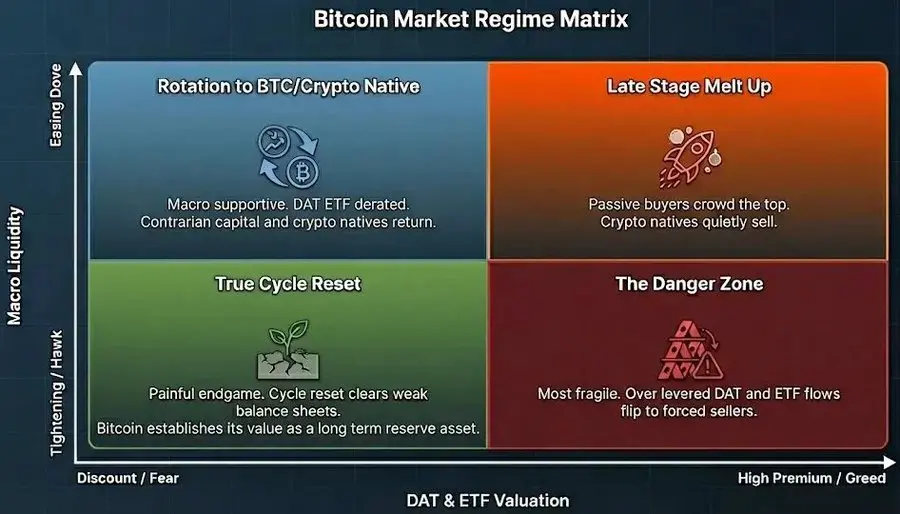
In 2026, we will gradually move from the right quadrant to the left quadrant, getting closer to the "Loose + Discount" or "Slightly Loose + Discount" spaces. At the same time, several key institutional and market variables will emerge in 2026:
SFT Clearing Service and DTCC 24/7 tokenization landing: Bitcoin will further complete its financialization, becoming part of Wall Street's foundational collateral; the liquidity gaps caused by time differences will be smoothed out, enhancing depth while also increasing leverage limits and systemic risks.
AI trading enters a "high expectation consumption period": In the second half of 2025, signs have already emerged that AI leaders' "performance continues to be excellent but stock price reactions are dulled," and simply exceeding expectations no longer corresponds to linear price increases. Whether BTC, as a high β tech factor, can continue to ride the coattails of AI capital expenditures and profit revisions will be tested in 2026.
BTC will further decouple from the altcoin market: BTC is connected to ETF flows, DAT balance sheets, and sovereign and long-term funds; while alts attract smaller, higher-risk preference funds; for many institutions, reducing BTC holdings is more likely to mean returning to better-performing traditional assets rather than "shifting from BTC to alts."
Is price important? Of course, it is important. Bitcoin, having crossed the $100,000 mark, has used its price to elevate this young asset, which is only 17 years old, to the level of a national strategic reserve. Beyond price, the next journey of crypto assets remains long. As I mentioned in my 2018 article "Hello, Primitive Ventures" when Primitive was founded,
"In our exploration of the crypto endeavor over the past few years, we have seen the power of distributed consensus achieved among individuals, along with the characteristic of information 'continuously dissipating,' giving crypto assets a strong vitality. It is precisely the fundamental desire of individuals for freedom and equality, as well as for certainty in assets and data, that has led us to see the possibility of 'entropy always increasing, crypto living forever.'"
When capital markets and cultural ideologies intertwine, it will release economic and production relationships that are more powerful than the cultural ideologies themselves. The populist finance represented by crypto is a typical product of the intersection of "capital markets + cultural ideologies."
If in the coming years we can see crypto rails as the only super-sovereign and global liquidity underlying structure, generating substantial cash flow, users, and applications of balance sheets, allowing some of the victories of ETFs/DAT to flow back on-chain and transforming passive allocations into active uses, then everything we discuss today will not be the end of a cycle, but rather the starting point for the next round of true adoption. From "Code is the law" to "Code is eating the bank," we have already traversed the most challenging 15 years.
The beginning of a revolution signifies the decline of old beliefs. The worship of Rome turned Roman civilization's dominance over the world into a "self-fulfilling prophecy." The birth of new gods may be random, but the twilight of old gods is already destined.
As a side note: This article is a deep review of the piece "The Long Bull Market from the West" written six years ago. Thanks to all of you who have been with us since 2017, or even earlier. Together, we have witnessed Bitcoin's journey from narrative to sovereignty, from the margins to the mainstream, and have experienced those beliefs that can only be understood by being present.
Also, thanks to the team at Primitive Ventures. This article was co-authored by me and our hardcore researcher, Ada.
 Risk warning
 Risk warning