0G: The Peak of Performance and Technological Paradigm in Reconstructing Decentralized AI Operating Systems

 The three major trump cards of 0G
Original Report: 《 Understanding 0G: A Comprehensive Overview》
Recently, the crypto research think tank @MessariCrypto released a comprehensive in-depth research report on 0G. This article is a summarized version in Chinese: >
【Core Summary】
With the explosion of decentralized artificial intelligence (DeAI) in 2026, 0G (Zero Gravity) has fundamentally resolved the historical problem of Web3's inability to support large-scale AI models with its disruptive technological architecture. Its core advantages can be summarized as:
Ultra-fast performance engine (50 Gbps throughput): Through logical decoupling and multi-level parallel sharding, 0G has achieved a performance leap of over 600,000 times compared to traditional DA layers (such as Ethereum, Celestia), becoming the only protocol in the world capable of supporting real-time distribution of ultra-large models like DeepSeek V3.
dAIOS modular architecture: It pioneers a four-layer collaborative operating system paradigm of "settlement, storage, data availability (DA), and computation," breaking the traditional blockchain's "storage deficit" and "computational lag," achieving an efficient closed loop of AI data flow and execution flow.
AI native trusted environment (TEE + PoRA): Through the deep integration of Trusted Execution Environment (TEE) and Proof of Random Access (PoRA), 0G not only addresses the "hot storage" needs of massive data but also builds a trustless, privacy-protected environment for AI inference and training, achieving a leap from "ledger" to "digital life foundation."
Chapter 1 Macroeconomic Background: The "Decoupling and Reconstruction" of AI and Web3
In the context of artificial intelligence entering the era of large models, data, algorithms, and computing power have become the core production factors. However, existing traditional blockchain infrastructures (such as Ethereum, Solana) are facing severe "performance misalignment" when carrying AI applications.
1. Limitations of Traditional Blockchains: Bottlenecks in Throughput and Storage
The original design intention of traditional Layer 1 blockchains is to handle financial ledger transactions, not to carry TB-level AI training datasets or high-frequency model inference tasks.
Storage deficit: The data storage costs on chains like Ethereum are extremely high, and there is a lack of native support for unstructured big data (such as model weight files, video datasets).
Throughput bottleneck: Ethereum's DA (data availability) bandwidth is only about 80KB/s, and even after the EIP-4844 upgrade, it is far from meeting the GB-level throughput requirements for real-time inference of large language models (LLMs).
Computational lag: AI inference requires extremely low latency (in milliseconds), while blockchain consensus mechanisms often operate in seconds, making "on-chain AI" nearly infeasible under the current architecture.
2. The Core Mission of 0G: Breaking the "Data Wall"
The AI industry is currently monopolized by centralized giants, forming a de facto "Data Wall," which leads to restricted data privacy, unverifiable model outputs, and expensive rental costs. The emergence of 0G (Zero Gravity) signifies a deep reconstruction of AI and Web3. It no longer merely views blockchain as a ledger for storing hash values but decouples the "data flow, storage flow, and computation flow" required by AI through a modular architecture. The core mission of 0G is to break the centralized black box, allowing AI assets (data and models) to become sovereign public goods.
Having understood this macro misalignment, we need to delve deeper into how 0G systematically addresses these fragmented pain points through a rigorous four-layer architecture.
Chapter 2 Core Architecture: Four-layer Collaboration of the Modular 0G Stack
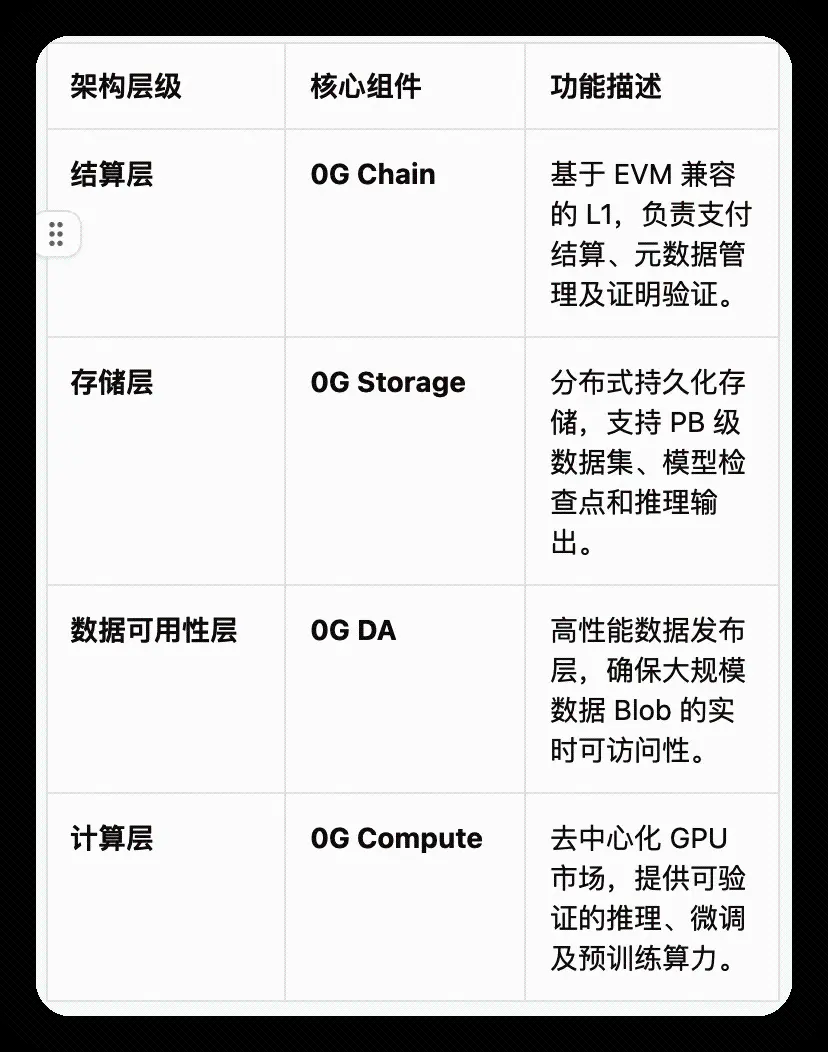
0G is not a simple single blockchain but is defined as dAIOS (Decentralized AI Operating System). The core of this concept is that it provides AI developers with a complete protocol stack similar to an operating system, achieving an exponential leap in performance through deep collaboration of the four-layer architecture.
1. Analysis of the Four-layer Architecture of dAIOS
The 0G Stack ensures that each layer can independently scale by decoupling execution, consensus, storage, and computation.
2. 0G Chain: Performance Foundation Based on CometBFT
As the neural hub of dAIOS, 0G Chain employs a highly optimized CometBFT consensus mechanism. Its innovation lies in separating the execution layer from the consensus layer and significantly reducing block production waiting times through pipelining and modular design of ABCI.
- Performance metrics: According to the latest benchmark tests, 0G Chain can achieve 11,000+ TPS throughput under a single shard, with sub-second finality. This extremely high performance ensures that on-chain settlement does not become a bottleneck during high-frequency interactions of large-scale AI agents.
3. Decoupled Collaboration of 0G Storage and 0G DA
The technological moat of 0G lies in its "dual-channel" design, separating data publishing from persistent storage:
0G DA: Focused on the rapid broadcasting and sampling verification of Blob data. It supports a single Blob of up to approximately 32.5 MB, ensuring data availability even if some nodes are offline through erasure coding technology.
0G Storage: Handles immutable data through the "Log Layer" and dynamic states through the "KV Layer."
This four-layer collaborative architecture provides fertile ground for the growth of a high-performance DA layer. Next, we will delve into the most striking part of the 0G core engine—high-performance DA technology.
Chapter 3 Technical Deep Dive into High-Performance DA Layer (0G DA)
In the decentralized AI ecosystem of 2026, data availability (DA) is not merely "proof of publication" but must support real-time pipelines for PB-level AI weight files and training sets.
3.1 Logical Decoupling and Physical Collaboration: The Generational Evolution of the "Dual-channel" Architecture
The core superiority of 0G DA stems from its unique "dual-channel" architecture: logically decoupling data publishing from data storage while achieving efficient collaboration at the physical node level.
Logical decoupling: Unlike traditional DA layers that conflate data publishing with long-term storage, 0G DA is solely responsible for verifying the accessibility of data blocks in a short time, while the persistence of massive data is entrusted to 0G Storage.
Physical collaboration: Storage nodes utilize Proof of Random Access (PoRA) to ensure data genuinely exists, while DA nodes ensure transparency through a sharded consensus network, achieving "instant verification and storage verification."
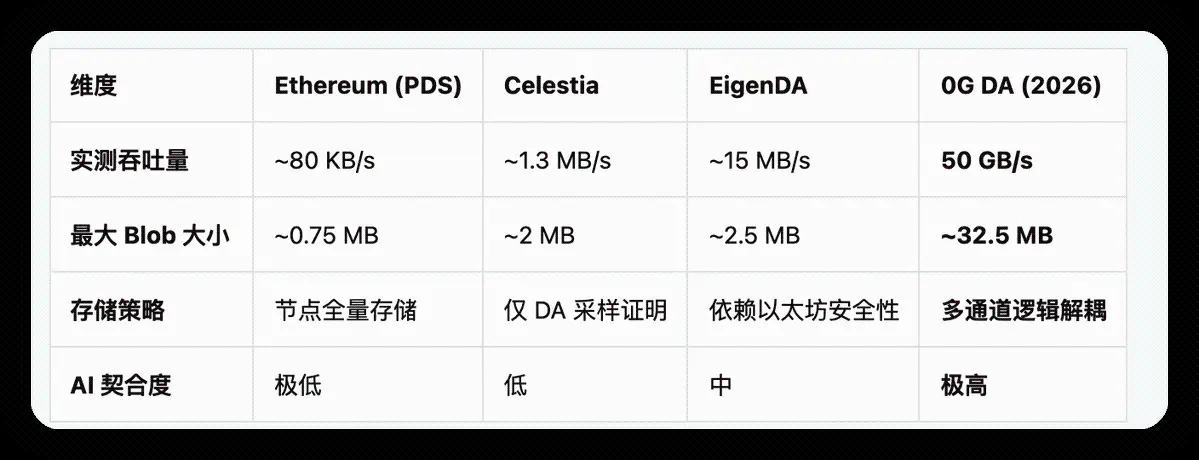
3.2 Performance Benchmark: Leading Data Confrontation
The breakthrough of 0G DA in throughput directly defines the performance boundary of the decentralized AI operating system. The table below shows a comparison of technical parameters between 0G and mainstream DA solutions:
3.3 Technical Foundation for Real-time Availability: Erasure Coding and Multi-consensus Sharding
To support massive AI data, 0G introduces erasure coding and multi-consensus sharding:
Erasure coding optimization: By increasing redundancy proofs, even if a large number of nodes are offline, complete information can still be recovered through sampling very small data fragments.
Multi-consensus sharding: 0G abandons the linear logic of a single chain handling all DA. By horizontally expanding the consensus network, total throughput increases linearly with the number of nodes. In 2026's tests, it supported tens of thousands of Blob verification requests per second, ensuring the continuity of AI training flows.
Having high-speed data channels alone is not enough; AI also requires a low-latency "brain storage" and a secure, private "execution space," leading us to the AI-specific optimization layer.
Chapter 4 AI-specific Optimization and Enhanced Secure Computing Power
4.1 Addressing Latency Anxiety of AI Agents
For AI agents executing real-time strategies, data read latency is a critical lifeline.
Cold-hot data separation architecture: 0G Storage is internally divided into an immutable log layer and a variable state layer. Hot data is stored in the high-performance KV layer, supporting sub-second random access.
High-performance indexing protocol: Utilizing distributed hash tables (DHT) and dedicated metadata indexing nodes, AI agents can locate the required model parameters in milliseconds.
4.2 TEE Enhancement: The Final Piece in Building Trustless AI
In 2026, 0G fully introduced TEE (Trusted Execution Environment) security upgrades.
Computational privacy: Model weights and user inputs are processed in the "isolation zone" within TEE. Even node operators cannot peek into the computation process.
Result verifiability: The remote attestation generated by TEE is submitted along with the computation results to 0G Chain, ensuring that the results are generated by a specific unaltered model.
4.3 Vision Realization: The Leap from Storage to Operating System
AI agents are no longer isolated scripts but digital life entities with sovereign identities (iNFT standard), protected memories (0G Storage), and verifiable logic (TEE Compute). This closed loop eliminates the monopoly of centralized cloud vendors over AI, marking the entry of decentralized AI into the era of large-scale commercial use.
However, to support these "digital lives," the underlying distributed storage must undergo a performance revolution from "cold" to "hot."
Chapter 5 Innovations in Distributed Storage Layer—The Paradigm Revolution from "Cold Archive" to "Hot Performance"
The core innovation of 0G Storage lies in breaking the performance shackles of traditional distributed storage.
1. Dual-layer Architecture: Decoupling Log Layer and KV Layer
Log Layer (streaming data processing): Specifically designed for unstructured data (such as training logs, datasets). Through an append-only mode, it ensures that massive data achieves millisecond-level synchronization across distributed nodes.
KV Layer (indexing and state management): Provides high-performance indexing support for structured data. When retrieving model parameter weights, response latency is reduced to the millisecond level.
2. PoRA (Proof of Random Access): Anti-Sybil Attack and Verification System
To ensure the authenticity of storage, 0G introduces PoRA (Proof of Random Access).
Anti-witch attack: PoRA directly links mining difficulty to the actual physical storage space occupied.
Verifiability: It allows the network to conduct random "spot checks" on nodes, ensuring that data is not only stored but also in a "readily available" hot activation state.
3. Performance Leap: Engineering Implementation of Second-level Retrieval
0G achieves a leap from "minute-level" to "second-level" retrieval through the combination of erasure coding and high-bandwidth DA channels. This "hot storage" capability offers performance comparable to centralized cloud services.
This leap in storage performance provides a solid decentralized foundation for supporting models with hundreds of billions of parameters.
Chapter 6 AI Native Support—Decentralized Foundation for Models with Hundreds of Billions of Parameters
1. AI Alignment Nodes: Guardians of AI Workflows
AI Alignment Nodes are responsible for monitoring the collaboration between storage nodes and service nodes. By verifying the authenticity of training tasks, they ensure that AI models operate within the preset logic.
2. Supporting Large-scale Parallel I/O
Handling models with hundreds of billions of parameters (such as Llama 3 or DeepSeek-V3) requires extremely high parallel I/O. 0G allows thousands of nodes to simultaneously process large-scale dataset reads through data slicing and multi-consensus sharding technology.
3. Checkpoints and High-bandwidth DA Collaboration
Fault recovery: 0G can quickly persist checkpoint files at the hundred GB level.
Seamless recovery: Thanks to the 50 Gbps throughput limit, new nodes can instantly synchronize the latest checkpoint snapshots from the DA layer, addressing the pain point of maintaining long-term decentralized large model training.
Beyond the technical details, we must broaden our vision to the entire industry and see how 0G is sweeping the existing market.
Chapter 7 Competitive Landscape—0G's Dimensional Overwhelm and Differentiated Advantages
7.1 Horizontal Evaluation of Mainstream DA Solutions
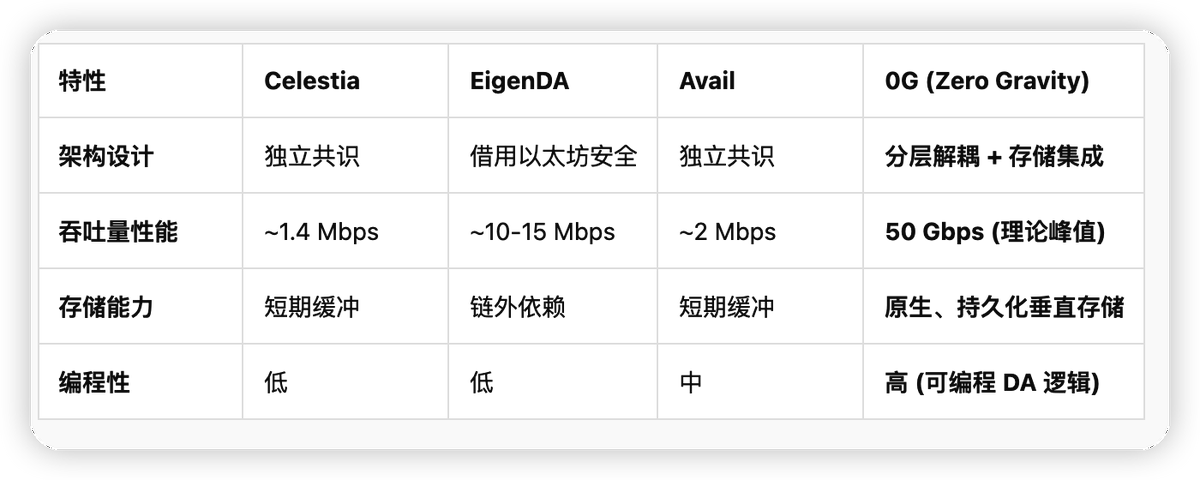
7.2 Core Competitiveness: Programmable DA and Vertically Integrated Storage
Eliminating transmission bottlenecks: Native integration of the storage layer allows AI nodes to directly retrieve historical data from the DA layer.
Leap in throughput to 50Gbps: Several orders of magnitude faster than competitors, supporting real-time inference.
Programmability: Allows developers to customize data allocation strategies and dynamically adjust data redundancy.
This dimensional overwhelm heralds the rise of a vast economy, with token economics serving as the fuel driving this system.
Chapter 8 2026 Ecological Outlook and Token Economics
With the stable operation of the mainnet in 2025, 2026 will be a critical node for the explosion of the 0G ecosystem.
8.1 $0G Token: Multi-dimensional Value Capture Pathways
Resource payment (Work Token): The only medium for accessing high-performance DA and storage space.
Security staking: Validators and storage providers must stake $0G to provide network revenue dividends.
Priority allocation: During busy periods, the amount of tokens held determines the priority of computational tasks.
8.2 2026 Ecological Incentives and Challenges
0G plans to launch the "Gravity Foundation 2026" special fund, focusing on supporting DeAI inference frameworks and data crowdfunding platforms. Despite its technological leadership, 0G still faces challenges such as high hardware thresholds for nodes, ecological cold starts, and compliance issues.
 Risk warning Risk warning