








What characteristics do projects that have been delisted by mainstream exchanges have?
 Core Viewpoint

 Mainstream exchanges are simultaneously massively delisting coins and launching tokenized stock assets. Essentially, this is a supply-side reform targeting "bad money," and the quality of the asset targets and the compliance of the platforms will become the focal point of competition for a period of time in the future.
Author: Hu Tao, ChainCatcher
In the cryptocurrency industry, "listing coins" used to mean the birth of another wealth creation myth, but now, it may just be a prelude to a long clearing process.
On March 18, Binance announced it would stop trading and delist 8 tokens, including Ampleforth(FORTH), [Hooked Protocol](https://www.rootdata.com/zh/Projects/detail/Hooked Protocol?k=MTg2MQ== "Web3 gamified social learning platform") (HOOK), IDEX(IDEX), Loopring(LRC), Neutron(NTRN), [Radiant Capital](https://www.rootdata.com/zh/Projects/detail/Radiant Capital?k=NDMzMA== "full-chain currency market") (RDNT), etc.
On March 16, Coinbase announced it would delist 25 contract trading pairs, including [REZ](https://www.rootdata.com/zh/Projects/detail/Renzo Protocol?k=OTk0NA== "EigenLayer-based re-staking protocol")-PERP, BABY-PERP, GMX-PERP, T-PERP, [YB](https://www.rootdata.com/zh/Projects/detail/Yield Basis?k=MTYyMDE= "decentralized yield protocol")-PERP, [HOME](https://www.rootdata.com/zh/Projects/detail/Defi App?k=MTUzMjY= "DeFi super application")-PERP, CATI-PERP, DOGS-PERP, DRIFT-PERP, etc.
On March 12, Binance Alpha announced it would remove over 21 tokens, including DGC (DecentralGPT), BNB Card ([BNB Card](https://www.rootdata.com/zh/Projects/detail/BNB Card?k=MTY4NDY= "BNB card meme coin")), PFVS (Puffverse), RDO (Reddio), MILK (MilkyWay), TAT ([Tell A Tale](https://www.rootdata.com/zh/Projects/detail/Tell A Tale?k=MTY4MzU= "AI agent platform")), etc.
Earlier in January, OKX announced it would delist 7 tokens, including ULTI, GEAR, VRA, [DAO](https://www.rootdata.com/zh/Projects/detail/DAO Maker?k=MjQ0 "project launch platform"), CXT, [RDNT](https://www.rootdata.com/zh/Projects/detail/Radiant Capital?k=NDMzMA== "full-chain currency market") and [ELON](https://www.rootdata.com/zh/Projects/detail/Dogelon Mars?k=MTAxNg== "dog-themed meme coin"). Additionally, Bithumb and Upbit also announced the delisting of multiple coins.
This wave of "delisting storm" across the spot and derivatives markets sends a cold and clear signal to the outside world: leading cryptocurrency exchanges are undergoing a paradigm shift from an "expansion phase" to a "contraction phase."
They are reassessing asset targets, establishing new listing and delisting mechanisms based on the liquidity, quality, and transparency of tokens/projects, which not only serves as a deterrent to other listed or potential listing projects but also better protects investors' interests.
I. "Zombie" Survival Under a Glossy Exterior
It is lamentable that among the "cleaning" list, there are many once-promising star projects, such as LRC, FORTH, NTRN, RDNT, etc.
Among them, Loopring(LRC) became a new star in the DeFi track with its narrative of "Layer2 scaling + decentralized trading," as well as a light for Chinese projects; [ELON](https://www.rootdata.com/zh/Projects/detail/Dogelon Mars?k=MTAxNg== "dog-themed meme coin") became a popular target among meme coins due to Musk's IP effect, with its market cap rapidly climbing in a short time; MilkyWay (MILK) once secured $5 million in funding thanks to its label as a Celestia liquid staking solution, backed by well-known institutions like Polychain and Hack VC.
The cryptocurrency market during the bull market has never lacked glamorous narratives. DeFi, NFT, meme, InfoFi, RWA, and other tracks have taken turns to appear, where a slogan or a white paper can easily attract tens of millions in funding, and a brand new concept can support hundreds of millions in valuation and gain favor from various leading exchanges.
However, these seemingly glamorous projects mostly share a fatal problem—lack of core technology and sustainable business models. When market enthusiasm wanes and narratives are gradually debunked, the shortcomings of these projects are magnified infinitely.
For exchanges, maintaining these projects that have lost community momentum not only means huge compliance costs but also invisibly depletes the platform's credibility. In an era of stock game, exchanges can no longer tolerate "air assets" occupying valuable liquidity resources for long, which is also an inevitable result of the previous phase of barbaric development.
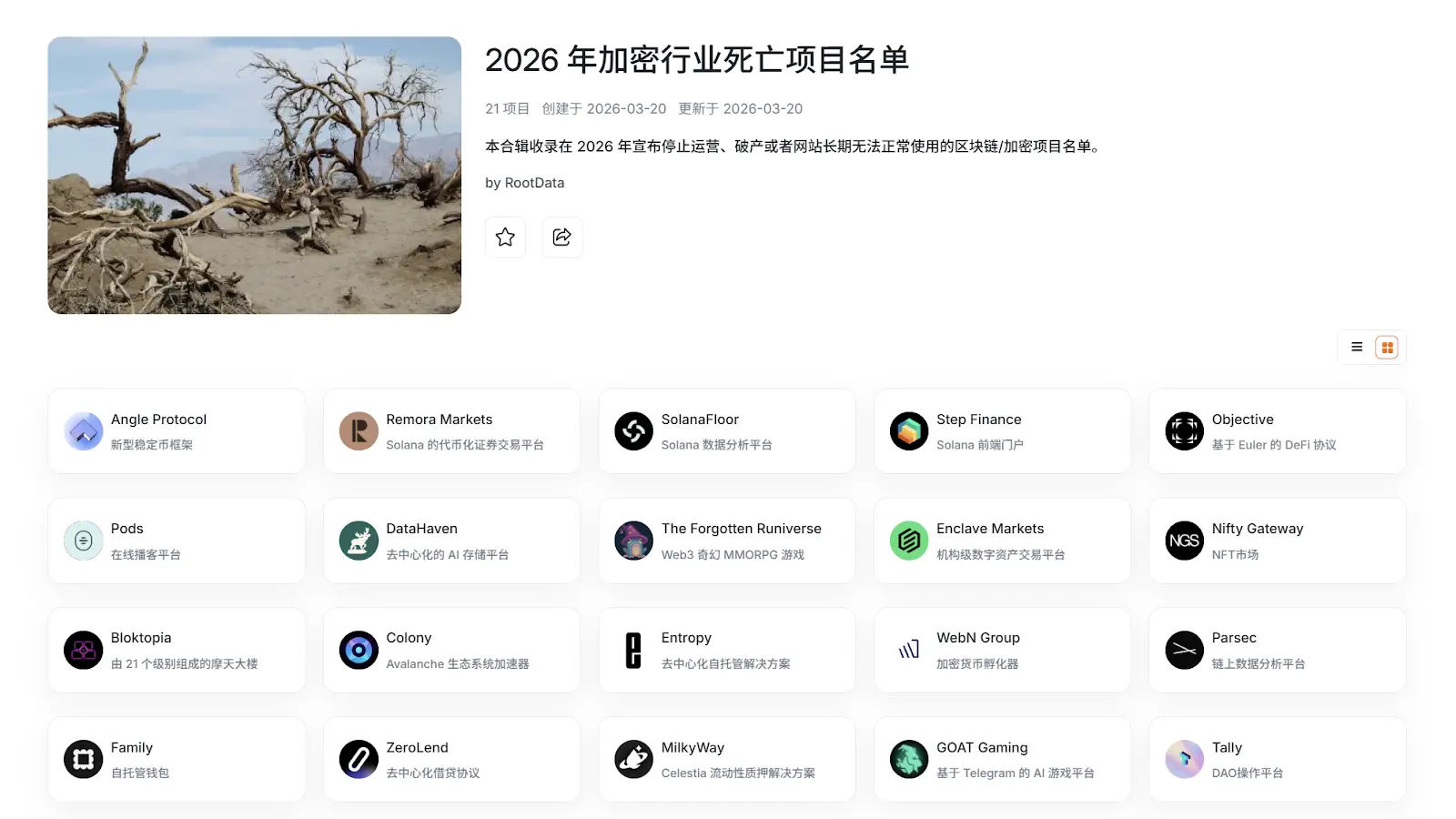
Looking at these delisted projects, DeFi and gaming sectors are heavily affected, also covering areas like Layer1 and DAO, which echoes the changes in the industry's mainstream narrative. More seriously than delisting, many projects have publicly announced they will no longer operate. According to RootData statistics, this includes decentralized storage platform DataHaven, DeFi options protocol Polynomial, DAO governance platform Tally, metaverse Bloktopia, incubator Colony, data analysis platform Parsec, etc.
At the same time, cryptocurrency exchanges have successively shifted their focus on listings to tokenized stocks, which have clear business models and market competitiveness, while also solving the problem of limited trading hours in traditional securities exchanges. Exchanges such as Binance, Kraken, OKX, Bitget, Bybit, and Gate have all supported trading of such assets, with the latter three supporting over 100 stock assets within a few months, showing strong strategic ambition.
II. Transparency is Becoming a Red Line
In addition to insufficient momentum within the industry, lack of transparency is also one of the main reasons many projects are being delisted.
With the continuous strengthening of regulatory efforts in the cryptocurrency industry and the increasing risk awareness of investors, exchanges are imposing stricter transparency requirements on token projects. According to official news, Binance has clearly included "the level of public communication, community participation, and transparency of the project party" and "the team's commitment to the project" in the assessment criteria for token health.
This means that having clear team and roadmap information, a complete information disclosure mechanism, and active community communication channels is crucial for any token. However, for many projects, the "listing means lying flat" state has become an awkward and cruel reality.
According to the transparency scores recently launched by RootData, most of the tokens delisted by exchanges like Binance have transparency scores below 70%, with varying degrees of issues such as insufficient project progress disclosure and missing team members, while community communication has stagnated, becoming the norm. This can lead to a significant reduction in user attention to the project and even trading willingness, forming a vicious cycle of insufficient trading volume and liquidity.
Taking Ultiverse, invested by YZi Labs, as an example, the project has hardly published any tweets since January, only retweeting a few pieces of information, and several core team members are similarly inactive.
This "black box" operation not only challenges the risk defenses of exchanges but also directly infringes on the right to know of retail investors. The collective "clearing" by exchanges this time is essentially a supply-side reform targeting "bad coins," directing more resources towards assets with high transparency and solid competitiveness. In this way, exchanges are forming a systemic deterrent to on-site projects: transparency is no longer a soft "bonus item," but a necessary option for survival.
Against the backdrop of traditional capital accelerating penetration and a gradually clarified global regulatory framework, the competitive dimension of exchanges has undergone a qualitative change, where the focus is no longer on trading scale and user numbers, but on the quality of asset targets and the compliance of the platform. The coordinated steps of leading exchanges like Binance, Coinbase, and OKX indicate that a "dehydration" cycle to squeeze out bubbles has already begun.
 Risk warning



Popular articles





