IMF | The Future of Stablecoins and Payments: Evidence from Financial Markets
 Core Viewpoint

 IMF deep report reveals the impact of stablecoin regulation: the US "Genius Act" triggers a $300 billion market earthquake for payment giants, with cross-border payments being the hardest hit, and the industry landscape is facing a reconstruction of "disintermediation."
Authors | Alexander Copestake, Cage Englander, Maria Soledad Martinez Peria, Germán Villegas-Bauer
Source | IMF
Original text compiled by | Wang Jiayi
Introduction
Since the release of the Bitcoin white paper, whether crypto assets can be widely used for legitimate payments has been a contentious issue. The reality is that Bitcoin's use for payments is still largely concentrated in illegal transactions, while supporters of stablecoins predict their widespread adoption, opponents still argue that the primary function of crypto assets is crime.
Evaluating the potential of stablecoins in the payment sector from an empirical perspective faces three challenges.
Network Effects: The adoption of new payment technologies is often slow due to network effects, as potential users tend to wait for enough people to use it first.
False Transactions: Less than 10% of stablecoin transactions recorded on the blockchain are between real users, with the rest mostly consisting of bot activity or rebalancing within the same exchange's accounts.
Unclear Motives: Blockchain data itself cannot reveal whether a transaction is a payment for goods and services or an investment activity.
Given these difficulties, this paper infers the payment prospects of stablecoins by examining changes in the financial market valuations of existing publicly listed payment companies. The stock market's reaction to shocks has predictive power; investors in publicly listed payment companies must make judgments about their future competitive environment, and their reactions to news related to stablecoins reflect expectations about stablecoins.
Theoretical Framework: How Stablecoins Affect Publicly Listed Payment Companies
If stablecoins are widely adopted in payments, they will primarily impact the future cash flows of publicly listed payment companies in the following two ways:
Intensified Competition: Public blockchains serve as globally accessible ledgers, lowering the barriers to entry for providing payment services. New entrants can use stablecoins to offer payment services on a large scale, and end users can make peer-to-peer payments, thereby bypassing publicly listed payment companies and squeezing their profits.
Lower Costs: Companies themselves can also use stablecoins to reduce the marginal cost of payments. In fact, stablecoins have become a relatively inexpensive way to transfer funds, with any scale of settlement completed in less than a second at a cost of less than $0.01.
Based on these two aspects, the authors propose four hypotheses:
Hypothesis 1: Financial markets expect stablecoins to play an important role in payments, and the impact of "intensified competition" is dominant; therefore, policy shocks supporting the use of stablecoins will reduce the market value of payment companies.
Hypothesis 2: Compared to domestic payments, cross-border payments are slower and more expensive, and the blockchain infrastructure supporting stablecoins inherently has a borderless characteristic; therefore, companies focused on cross-border payments will face greater competitive pressure.
Hypothesis 3: Strong network effects benefit payment network platforms (such as Visa and PayPal) and provide them with competitive protection.
Hypothesis 4: Payment companies that have already engaged with blockchain technology can better seize new opportunities or respond to new competition, thus experiencing less impact.
Regarding the relationship between expectations and market prices, the authors also consider the impact of partial expectations on the estimation results. When a policy shock has been partially anticipated by the market, the immediate price change at the time of occurrence does not reflect the full effect of the policy. Drawing on the methods of Snowberg et al., the authors use prediction markets to obtain estimates of the market's probability of policy passage, dividing the observed causal impact by the probability update to backtrack the full effect of the policy.
Empirical Research
This paper's empirical focus is on U.S. Senate Bill 1582, known as the GENIUS Act, which establishes the first federal regulatory framework for stablecoins in the U.S. The authors focus on stock price changes within ten trading hours before and after the decisive vote in the House of Representatives on July 17, 2025.
This event has three advantages: first, the vote occurs during "Crypto Week" in Congress, when market attention is high, and the GENIUS Act is the only legislative crypto bill of that week; second, the House vote is the last critical step before the bill becomes law, having already passed the Senate and received public support from the President; third, the voting outcome is difficult to predict in advance, with prior intra-party and partisan disagreements.
Data and Regression Setup
The study uses Bloomberg high-frequency stock price data, covering 35 publicly listed payment companies, other financial industry companies, and S&P 500 non-financial companies. The authors categorize payment companies into three subgroups: cross-border payment companies, network operators, and companies that have engaged with crypto assets, based on corporate regulatory filings. The baseline regression employs a difference-in-differences model, comparing stock price differences between payment companies and other financial companies before and after the vote at 15-minute intervals, controlling for firm and time fixed effects, with standard errors clustered at both the firm and period levels.
Baseline Regression Results
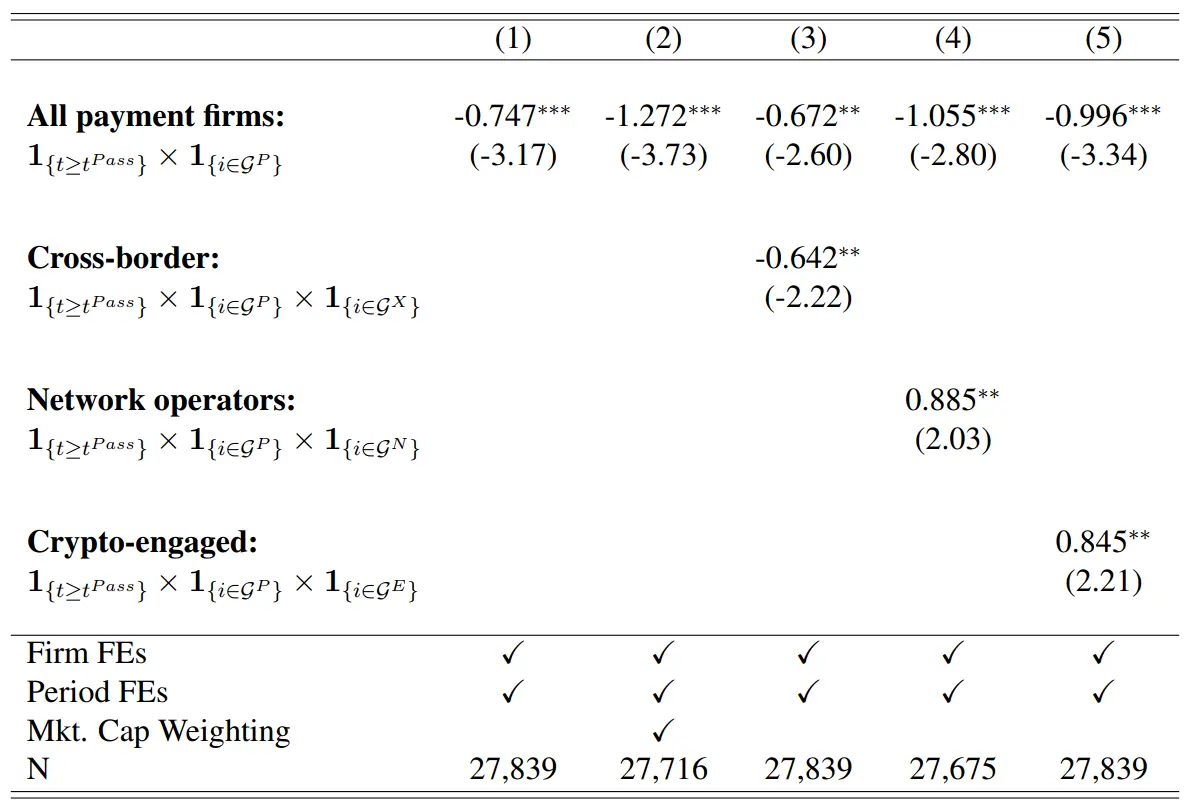
There are no significant differences in stock price trends between the two groups of companies within five hours before the vote, supporting the parallel trends assumption. After the vote, payment companies' stock prices fell by approximately 0.75 percentage points (significant at the 1% level) compared to the equally weighted average of other financial companies, and by approximately 1.3 percentage points when weighted by market capitalization, corresponding to a market value loss of about $21.5 billion.
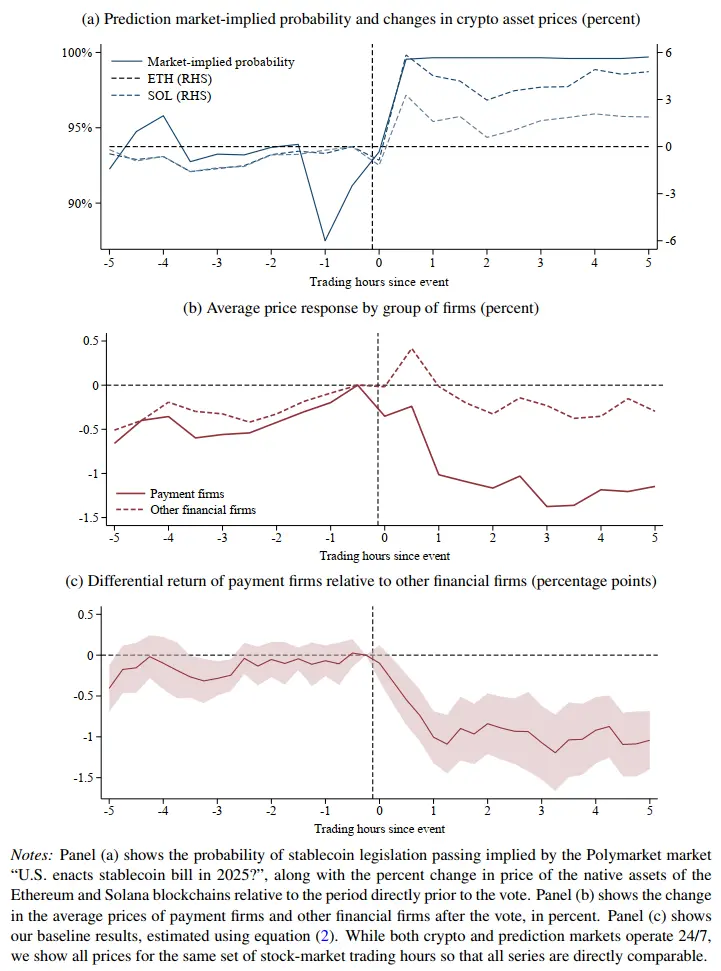
Figure 1: Changes in Market Value of Companies During the House Passage of the GENIUS Act Table 1: Average Excess Returns of Payment Companies vs. Other Financial Companies
Since the market had partially anticipated the bill's passage, the above immediate reaction does not reflect the full policy effect. The authors use Polymarket data, which shows that the implied probability before the vote was about 93%, and close to 100% after the vote. Scaling this, the passage of the bill led to a total market value decline of approximately 18% for publicly listed payment companies, or about $300 billion. Robustness checks indicate that this result remains consistent under various conditions, including using alternative control groups, controlling for differential trends in firm characteristics, adjusting the event window (4 to 48 hours), aggregating all five legislative votes, and excluding the interference of another crypto legislation (H.R.3633) passed on the same day. Placebo tests also confirm the specificity of the results.
Heterogeneity Analysis
Consistent with Hypothesis 2, the stock price decline of cross-border payment companies is significantly greater than that of other payment companies, with market value declining by about 27% after expectation adjustments, and all cross-border payment companies in the sample experienced significant declines. In line with Hypothesis 3, payment network platforms (such as Visa and PayPal) did not experience significant market value declines, with their returns significantly higher than the average level of payment companies, indicating that network effects can effectively resist competition from stablecoins. Consistent with Hypothesis 4, companies that have engaged with crypto assets also did not experience significant market value declines, indicating that actively embracing new technologies helps maintain competitiveness.
Conclusion
This paper provides forward-looking empirical evidence for the debate on whether crypto assets can play a role in payments. The study finds that U.S. stablecoin legislation has led to a cumulative decline of approximately 18% in the market value of existing publicly listed payment companies, a slightly larger impact than other regulatory shocks such as the Durbin Amendment and the digital euro initiative.
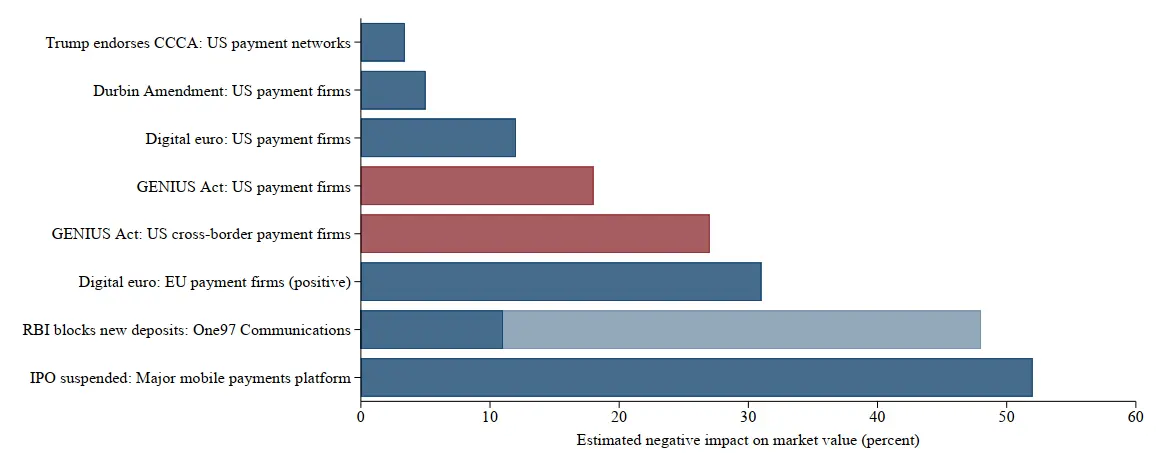
Figure 2: Comparison of Historical Impacts of Other Shocks on Payment Institutions
Different types of payment companies experience significantly different impacts. Cross-border payment companies face the greatest shocks; companies protected by network effects experience smaller shocks, indicating that this competitive advantage is harder to disrupt than technical expertise. In the months following the passage of the GENIUS Act, the proportion of payment companies providing crypto-related services increased, and the frequency of mentions of stablecoins in earnings call conferences also significantly rose, confirming that payment companies are actively responding to the competitive pressure posed by stablecoins.
 Risk warning