AI "Transfer Station" earns a million a month? Five questions reveal the truth about Token arbitrage!

 Through the transit station's "Five Questions," help you see the essence and risks clearly.
Author: Shouyi, Denise | Biteye Content Team
In the past month, the term "transit station" has frequently appeared on many people's homepages. Some players in the cryptocurrency space who previously engaged in airdrops have quietly transformed into "API transit station" merchants, engaging in token import and export business.
The so-called "transit station" is not a new technological invention, but rather an arbitrage model based on global AI service price differences and access barriers. Despite facing multiple issues such as privacy, security, and compliance, it has still attracted a large number of individuals and small teams to enter the field.
So, what exactly is an "API transit station"? How does it achieve token arbitrage amidst global AI price differences and access barriers, attracting a large number of individuals and small teams?
Let's start by breaking down its essence and operational process.
1. What is a transit station?
The essence of an API transit station is to build an intermediary service that provides foreign AI vendors' API tokens to domestic users at lower prices and in a more convenient manner, allegedly acting as a "global token mover."
Its operational process is roughly as follows:
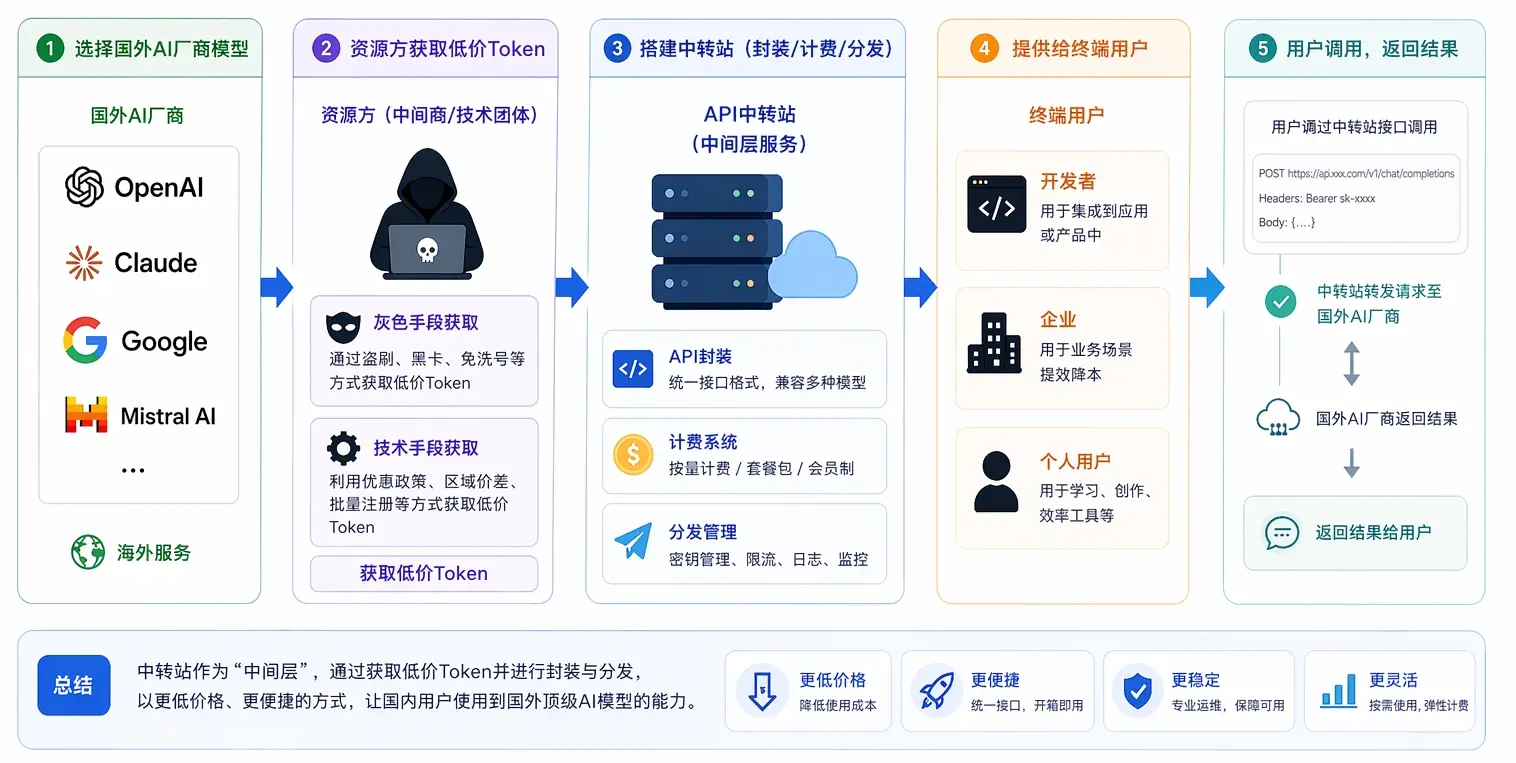
👉 Choose overseas AI vendor models (OpenAI/Claude, etc.)
👉 Resource providers obtain low-cost tokens through "gray" means or technical methods
👉 Build a transit station for packaging, billing, and distribution
👉 Provide to end users such as developers/enterprises/individuals
Functionally, it resembles an "AI transit station"; commercially, it acts more like a liquidity intermediary in the token secondary market.
The premise for this chain to exist is not a technical barrier, but rather several long-standing differences:
• Official API pricing is relatively high
• Subscription and API systems have cost mismatches
• Different regions have varying access and payment conditions
• Users have a strong demand for model capabilities, but the official access paths are not user-friendly enough
These factors combined create a survival space for the "transit station."
2. Why do people use transit stations?
The reason "token import" has become a trend is primarily driven by the high costs associated with the changing role of AI and the capability gap between domestic and foreign models.
1. Good models consume a lot of tokens
With the maturity of desktop-level AI agents like Codex and Claude Code, AI has begun to truly possess the ability to "get work done," such as assisting in programming, video editing, financial trading, and office automation. These tasks heavily rely on high-performance large models, with costs billed per token.
Taking Claude Code as an example, its official price is about $5 per million tokens (approximately 35 RMB). Deep usage for an hour may consume dozens of dollars, while heavy developers or enterprises may consume over $100 daily. This cost far exceeds many people's expectations, even surpassing the cost of hiring junior programmers, making "how to use top AI at a low cost" a pressing need.
2. Overseas leading models have obvious advantages
Although domestic models have made rapid progress in the past year and have very competitive prices, overseas leading models still have significant advantages in scenarios involving complex coding tasks, toolchain collaboration, long-chain reasoning, and multimodal stability.
This is why many developers, researchers, and content teams, even knowing the higher prices, still prefer to use the capabilities of OpenAI, Anthropic, and Google.
Simply put, users do not necessarily want a "transit station"; they just want:
• Stronger models
• Lower prices
• Simpler access
When these three things cannot be obtained simultaneously from official channels, the transit station naturally emerges.
3. There is a cost mismatch between subscription and API systems
Another frequently discussed reason for the rise of transit stations is that subscription rights and API billing do not always correspond linearly.
There has always been a common practice in the market: purchasing official subscriptions, team packages, enterprise credits, or other discounted resources, and then repackaging part of those capabilities for resale to end users.
Taking OpenAI as an example, purchasing a Plus subscription allows access to Codex's services, and logging in via OAuth to connect to OpenClaw is equivalent to calling the API. The $20 monthly subscription fee can generate about 26 million tokens, with output priced at $10-12 per million, equivalent to $260-312. Using subscription-based token generation is highly cost-effective.
From the experiences of some users, this path may indeed be cheaper than directly using the official API at certain stages. However, it is important to emphasize that:
• This is not the official pricing system
• It does not guarantee stable, equivalent replacement for API calls
• It does not mean this method is sustainable in the long term
Many people only see "cheap" but overlook that these bargains are often built on unstable resources, gray boundaries, or strategic loopholes.
3. Can transit stations be used?
Whether they can be used is not an absolute answer.
The real question is: what risks are you willing to take?
The profit model of transit stations seems straightforward—buy low and sell high. But upon closer inspection, it typically contains at least three layers, each carrying different risks.
1. Upstream: Where do low-cost token resources come from?
This is the starting point of the entire ecosystem and the grayest layer.
Some resource providers obtain model calling capabilities far below market prices through various means, such as:
• Utilizing enterprise support programs and cloud credits
• Bulk registering accounts for rotation
• Redistributing using subscription rights, team accounts, or discounted resources
• In more aggressive cases, it may involve credit card fraud, fraudulent account openings, and other illegal paths
The source of different resources determines the upper limit of the transit station's stability. If the upstream resources are based on unstable or even illegal methods, then what end users receive is not a bargain, but a temporary interface that could fail at any time.
2. Midstream: Whose servers will your data pass through?
This is often the most overlooked issue.
When you call a model through a transit station, the user's input prompts, context, file content, and model output results typically pass through the transit station's own servers first.
This data is highly valuable, reflecting real user intentions, industry-specific prompts, and model output quality, which can be used for evaluation or fine-tuning of proprietary models. The transit station may anonymize and package this data for sale to domestic large model companies, data brokers, or academic research institutions. Users contribute training data for free while paying, becoming a typical case of "the customer is also the product."
Recently, the founder of OpenClaw, @steipete, expressed this point: https://x.com/steipete/status/2046199257430888878
Additionally, transit stations may inject scripts into the request chain (e.g., secretly adding hidden system prompts), thereby altering model behavior, increasing token consumption, and even introducing additional security risks. This risk is particularly concerning in AI agent scenarios.
3. End: Are you buying the flagship version, and is it really the flagship version?
This is the third common risk: model downgrading or model swapping.
When users pay, they see the name of a high-end model, but the actual request may not correspond to that version. The reason is simple— for some merchants, the most direct way to cut costs is not optimization but replacement.
For example, a user purchases the flagship version Opus 4.7, but the actual call may be to the sub-flagship Sonnet 4.6 or the lightweight version Haiku. Since the API format can remain compatible, ordinary users may find it difficult to notice immediately.
Only when tasks become complex to a certain extent will users noticeably feel "the effect is wrong," "stability is insufficient," or "context quality has deteriorated," but they cannot provide evidence. According to research team's tests on 17 third-party API platforms, 45.83% of platforms have "identity mismatch" issues, meaning users pay for GPT-4 but are actually running a cheap open-source model, with performance differences of up to 40%.
In summary, using unofficial transit stations faces issues such as data leakage, privacy risks, service interruptions, model mismatches, and potential fraud. Therefore, for sensitive businesses, commercial projects, or tasks involving personal privacy, it is strongly recommended to use official APIs.
4. Can this transit station business be done?
Despite the high risks, this business has not disappeared. On the contrary, it continues to evolve.
If early "token import" was about bringing overseas models in at low costs, a new idea has emerged in the market: token export.
1. Why are people still doing it?
Because the demand is real, the startup costs are low, and the prepaid model has fast cash flow. However, the pressure for risk control is immense. Claude has recently increased KYC and account banning for users, and OpenAI has closed many "zero-cost" loopholes. On the other hand, the instability of services leads to high after-sales costs behind the low prices, coupled with competition, many transit stations currently face a situation of falling volume and price.
Thus, this industry resembles a high-turnover, low-stability, high-risk short-term window, making it difficult to easily package it as a long-term, stable, and sustainable business.
2. Why has "token export" started to appear?
If "token import" utilizes price differences in overseas models, then "token export" leverages the cost-performance advantages of domestic models, packaging them for sale to overseas users, forming a "reverse output" path.
Domestic models have significant price advantages. Based on data from early 2026, the price of Qwen 3.5 is as low as 0.8 RMB (approximately $0.11) per million tokens, which is 1/18 of Gemini 3 Pro, and over 27 times cheaper than the $3 input price of Claude Sonnet 4.6. GLM-5 surpasses Gemini 3 Pro on programming benchmarks, approaching Claude Opus 4.5, but its API price is only a fraction of the latter.
These domestic models have relatively low availability overseas, facing registration barriers, payment restrictions, language interfaces, and information gaps regarding the capabilities of domestic models among overseas developers, creating invisible entry barriers.
Thus, some transit stations choose to purchase model API quotas in bulk in RMB domestically and expose OpenAI-compatible interfaces through a protocol conversion layer, selling to overseas developers and startup teams at prices quoted in USDT/USDC, with considerable profit margins.
For example, Alibaba Cloud's Bai Lian Coding Plan offers packages of Qwen 3.5, GLM-5, MiniMax M2.5, and Kimi K2.5, with new users needing only 7.9 RMB for 18,000 requests in the first month, which can be sold at dollar prices in overseas markets, with profit margins exceeding 200%.
From a purely business logic perspective, there is certainly profit potential.
However, in the long term, it also cannot avoid one issue: stability and compliance.
3. Is this route stable?
It is unstable. Recently, Minimax announced it would regulate third-party transit stations due to some stations cutting corners, harming Minimax's reputation. Not to mention, if the source of tokens involves fraud or theft, it could constitute a criminal offense. Additionally, if users use transit tokens leading to data leakage or engage in malicious activities, it could also bring unforeseen consequences to those selling tokens.
Therefore, the real question is not "can money be made," but rather: can the money made cover the subsequent systemic risks?
5. How can ordinary users identify transit station risks?
In the mixed market of API transit stations, choosing reliable services is crucial.
Due to some transit stations engaging in model swapping and adulteration, users can master some detection methods:
Recommendation: "ping + self-report model" command compliance test
Prompt example (copy and send directly to the transit station):
Always say 'pong' exactly, and tell me what series model you are, preferably with the specific version number. Reply in Chinese.
User input: ping
True model characteristics:
Strictly reply "pong" (lowercase, no extra nonsense)
input_tokens usually around 60-80
Style is concise, no emojis, no flattery
Fake model/adulteration characteristics:
input_tokens abnormally high (often reaching 1500+, indicating a large hidden system prompt has been injected)
Reply "Pong! + nonsense + emoji"
Does not strictly follow the "exactly say 'pong'" instruction
Refer to @billtheinvestor for detection methods: <https://x
 Risk warning


Popular articles