Circle Q1 performance is below expectations, Arc initiates the second growth curve

 Circle's current most accurate status is: the old business is still profitable, but the declining interest rates are weakening profit elasticity; the new business is continuously advancing, but has not yet truly supported the main revenue; Arc is a new variable, but it remains to be seen whether it will enter guidance and the profit statement in Q2.
Author: SoSoValue Research
Circle released its Q1 2026 financial report on May 11. Overall, the report is decent but not strong.
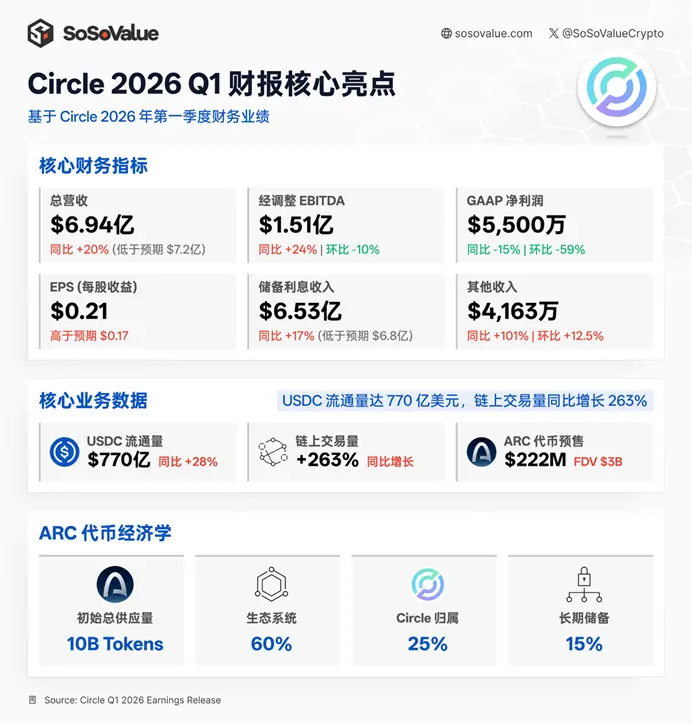
In Q1, Circle's total revenue was $694 million, a year-on-year increase of 20%, but below the market consensus expectation of $720 million; adjusted EBITDA was $151 million, a year-on-year increase of 24%, but a quarter-on-quarter decrease of 10%; GAAP net profit was $55 million, a year-on-year decrease of 15% and a quarter-on-quarter decrease of 59%; EPS was $0.21, higher than the consensus expectation of $0.17 but lower than some optimistic expectations of $0.25.
If we only look at the quarterly performance, it is difficult for the market to give a high evaluation. Revenue fell short of expectations, net profit saw a significant quarter-on-quarter decline, and reserve interest income is also beginning to face pressure from declining interest rates and rising costs. In other words, Circle's fundamentals are still growing, but profit elasticity has begun to come under pressure.
A new variable in this financial report is the Arc ecosystem. The ARC Token completed an institutional pre-sale of $222 million, with an FDV of $3 billion, and investors include top institutions such as a16z, BlackRock, ARK Invest, Apollo, and Intercontinental Exchange. This increment had not been fully reflected in market expectations before, providing Circle with a new valuation narrative.
Overall, although there are short-term macro headwinds, Circle's long-term story remains attractive. The stablecoin business model has advantages, and the demand for USDC usage is still growing. CPN, Managed Payments, AI Agent, and payment networks are progressing, while the Arc ecosystem adds a new valuation variable for Circle. Additionally, the market is looking forward to the swift passage of the Clarity Act, which has also become a driving force for the stock price.
1. Reserve business continues to grow, but profit pressure from interest rate cuts has emerged
Circle's current core source of revenue remains the USDC reserve interest.
In Q1, reserve interest income was $653 million, a year-on-year increase of 17%, but below the market consensus expectation of $680 million. The circulation of USDC reached $77 billion, a year-on-year increase of 28%, with a slight increase from $75.3 billion in Q4 2025; on-chain transaction volume increased by 263% year-on-year, indicating that the demand for USDC usage remains strong.
The issue is that the growth in USDC circulation is not enough to fully offset the pressure from declining unit yield.
The Q1 Reserve Return Rate fell to 3.5%, a quarter-on-quarter decrease of 30 basis points, comparable to the decline in secured overnight repurchase rates. As interest rates decline, the yield from each dollar of reserves will decrease. Circle needs faster growth in USDC circulation to maintain the growth momentum of reserve interest income.
This is also the market's core concern about Circle: it currently still heavily relies on the "USDC circulation × reserve yield" revenue model. The stablecoin business model itself remains excellent, but if the revenue structure remains long-term reliant on reserve interest, valuation will be suppressed by the interest rate cycle.
2. The Arc ecosystem is the biggest new variable in this financial report
The most important new variable in this financial report is the Arc ecosystem.
Arc is a stablecoin financial network launched by Circle, with the core goal of further embedding USDC into payments, cross-border settlements, institutional fund flows, and on-chain financial applications, currently in testing on the testnet.
Recently, Circle completed the ARC Token institutional pre-sale, raising $222 million, with an FDV of $3 billion, and investors include top institutions such as a16z, BlackRock, ARK Invest, Apollo, and Intercontinental Exchange.
According to the white paper, the initial supply of ARC is 10 billion tokens, of which 60% belongs to the ecosystem, 25% belongs to Circle, and 15% is reserved for long-term reserves. The gas for the Arc network is USDC, and the main functions of the ARC Token include staking for protocol fee distribution, discounted rates, and governance.
According to communications from the company's earnings call, the Arc Token may impact Circle's profit statement in three ways in the future:
First, Circle will hold ARC Tokens on its balance sheet at zero cost. Subsequent token sales will convert the revenue from selling tokens into pure profit, thereby enhancing EBITDA.
Second, Circle can earn network rewards by running validator nodes and other means.
Third, to promote the Arc network, Circle will provide incentive grants to developers or partners, which will be reflected in other income and other costs.
It can be seen that 25% of the ARC Token is expected to become one of Circle's new profit engines. The current guidance for Q1 does not include ARC Token pre-sale, Arc incentive plans, and future Arc revenue impacts, but there is room for upward adjustment when updating guidance next quarter. More accurately, Arc has already provided new performance elasticity, but management has not formally included it in the annual expectations.
Therefore, what the market really needs to watch is whether Circle will adjust its annual guidance in Q2 or subsequent quarters due to Arc-related revenue, expense recognition, or ecosystem progress.
3. Other income growth exceeds expectations, though the scale is still small, with significant payment potential
Circle's Q1 other income was $41.63 million, a year-on-year increase of 101%, and a quarter-on-quarter increase of 12.5%, exceeding the market consensus expectation of $37.4 million.
This is a relatively positive signal for the quarter, indicating that Circle's commercialization in payments, network services, and new settlement scenarios is progressing.
Among them, the CPN (Circle Payments Network) annualized transaction volume reached $8.3 billion, a 75% increase from the last financial report. The Managed Payments launched in April also allow banks and payment institutions to access stablecoin settlements without directly holding digital assets.
This part of the business represents the direction of Circle's future revenue structure transformation: from solely relying on reserve interest to gradually expanding into stablecoin networks, payment infrastructure, and on-chain settlement services.
Other income has high gross margins and fast growth, but the quarterly scale is only over $40 million, accounting for about 6% of total revenue. It is a growth highlight, but still not enough to change Circle's current heavy reliance on reserve interest in its revenue structure.
4. AI Agent payment network continues to land, enhancing the AI narrative
In addition to Arc, Circle is also continuing to strengthen the story of AI and Agentic Commerce.
On May 11, Circle announced the launch of Circle Agent Stack, with the first products including Circle CLI and agent wallets, aimed at serving the payment and settlement needs of AI Agents.
Stablecoins are naturally suitable as assets for machine payments, automatic settlements, and small high-frequency transactions. If AI Agents become a significant source of demand for on-chain payments in the future, USDC has the opportunity to become one of the underlying settlement assets.
5. Q1 maintains annual guidance unchanged, waiting for Q2 to provide more validation
Circle maintains its annual KPI guidance unchanged for this quarter: other income is expected to be between $150 million and $170 million; the medium to long-term annual compound growth target for USDC circulation is 40%; RLDC Margin is expected to be between 38% and 40%; adjusted operating expenses are expected to be between $570 million and $585 million.
This guidance is somewhat conservative.
Considering that the ARC Token pre-sale has just been completed, it is understandable that management did not immediately raise the annual guidance. However, this also means that Q2 will become a more important validation window. If Arc-related revenue, incentive arrangements, validator income, or network income are included in the annual model, there is room for Circle's other income guidance to be raised; if CPN and other income continue to exceed expectations, it will also strengthen market confidence in the transformation of the revenue structure.
Summary
Circle's Q1 financial report itself is not strong.
Revenue fell short of expectations, GAAP net profit decreased by 59% quarter-on-quarter, reserve interest income was below expectations, and USDC circulation did not break through the market expectation of $80 billion. Without the addition of the Arc variable, combined with the recent high market risk appetite, this financial report would likely have been initially interpreted as negative by the market.
However, Circle's long-term story remains attractive. The stablecoin business model has advantages, and the demand for USDC usage is still growing. CPN, Managed Payments, AI Agent, and payment networks are progressing, while the Arc ecosystem adds a new valuation variable for Circle. Additionally, the market is looking forward to the swift passage of the Clarity Act, which has also become a driving force for the stock price.
Circle's current most accurate state is: the old business is still profitable, but declining interest rates are weakening profit elasticity; new businesses are continuously advancing, but have not yet truly supported the main revenue; Arc is a new variable, but it remains to be seen if it will enter guidance and the profit statement in Q2.
What the market really needs to watch next is whether Circle can convert Arc, CPN, AI Agent, and payment networks into higher other income, better profit margins, and a revenue structure that relies less on reserve interest. If it can achieve this, Circle's valuation logic will upgrade from "a stablecoin company making money from reserve interest" to "a global stablecoin payment and on-chain financial network."
 Risk warning