Former Consensys CMO: The Evolution of Company Forms in the AI Era
 Core Viewpoint

 Every technological revolution destroys the roles that the previous era considered crucial—human calculators, production line foremen, project managers, and middle managers. Companies that are the first to understand the "new forms of economic organization" often reap the greatest rewards for being early movers.
Author: Lex Sokolin
Compiled by: Jiahua, ChainCatcher
This article explores how AI is reshaping organizational structures themselves. Companies are shifting from Amazon-style "two-pizza teams" (a team of about 6-10 people, maintaining an agile organizational structure) to "AI-native" groups consisting of 3 to 5 people, significantly boosting productivity.
We compared two paths:
Klarna's AI substitution strategy ended in failure. The number of employees was cut from 5,500 to 3,400, and quality issues ultimately forced it to rehire.
Coinbase and Ramp chose to reorganize their businesses around AI enhancement and orchestration. Coinbase laid off 700 people while transitioning to single-person product teams and AI code generation.
Ramp built an internal AI harness framework, with 99.5% of employees using it daily, covering over 350 business skills.
Additionally, we analyzed why companies like Box and Plaid are being repriced by capital markets as AI infrastructure, focusing on their control over the enterprise-level data necessary for AI agents to operate.
The Third Evolution of Organizational Forms
A few months ago, we discussed "Zero Human Companies" and the curve of AI economic autonomy:
While there are forces pushing for the establishment of organizations with no human intervention, the current economic entities are still us humans.
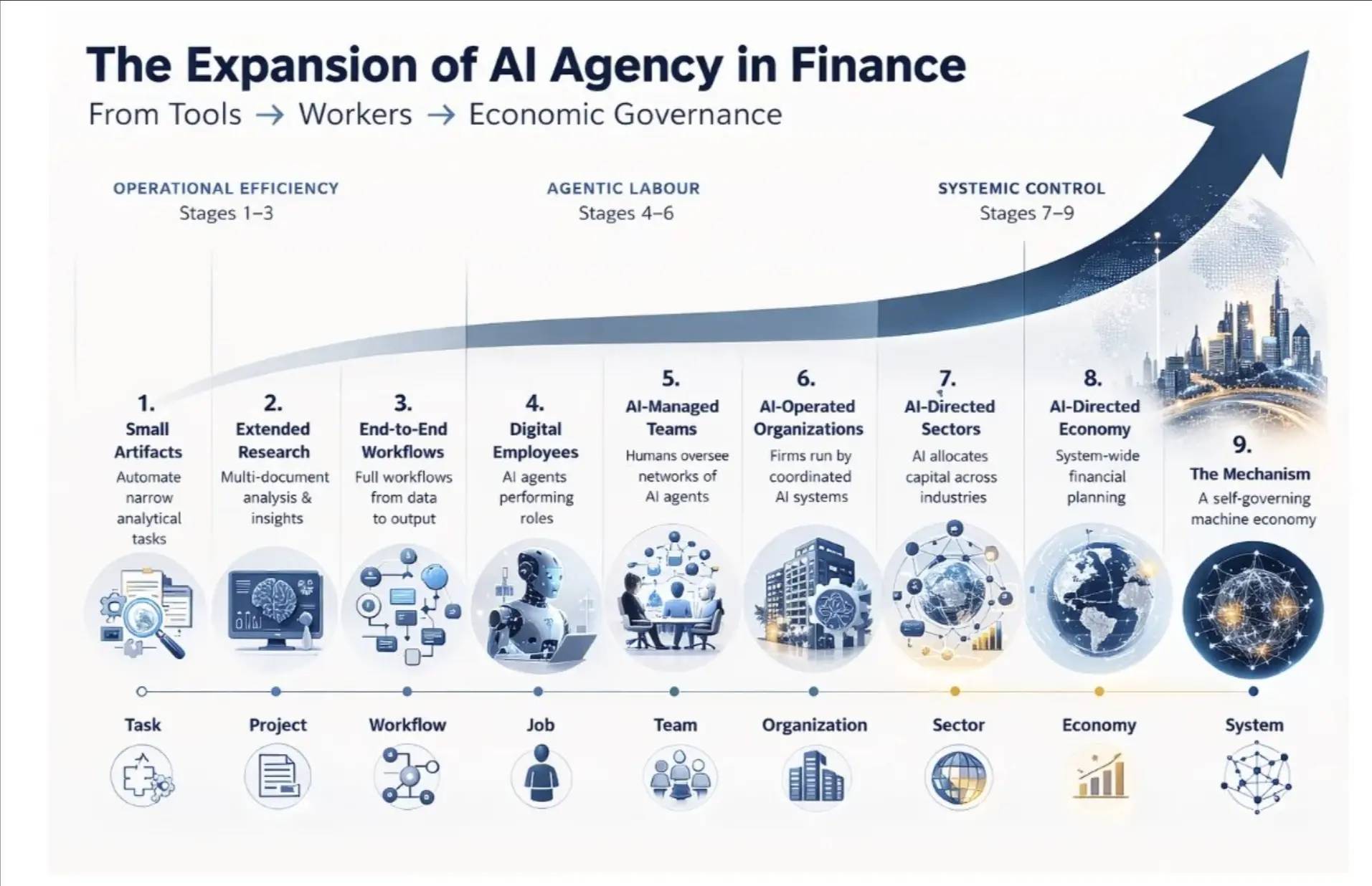
The most challenging task now is to transform existing traditional companies into AI-first forms.
This is an enormous opportunity, so much so that Anthropic is collaborating with the entire private equity industry to promote it.
Beyond those astonishing financial figures, we are beginning to perceive another angle of AI's impact: how people establish and organize companies.
Organizational structure itself is a technology.
Waterfall development nurtured the software development giants that dominated the early tech era, characterized by strict hierarchies.
The industry then shifted to lean teams using agile methodologies, which evolved into Amazon's original "two-pizza teams." This operational structure has built every modern fintech company today.
But the tide is changing again.
McKinsey's Martin Harrysson and Natasha Maniar predicted the next version by the end of 2025:
"AI-native roles essentially mean we are transitioning from the 'two-pizza structure' to 'single-pizza teams' consisting of 3 to 5 people."
Halving the workforce, yet productivity remains high.
On May 5, 2026, Brian Armstrong reinforced this assertion by laying off 700 people.
What Did Coinbase Do?
Coinbase cut 14% of its 4,951 employees.
Part of the reason is that this is a normal market cycle operation for a company highly tied to business and trading volume—its first-quarter revenue is expected to be $1.7 billion (a 26% year-over-year decline), with earnings per share (EPS) plummeting by 86%.
But what is particularly noteworthy is how its management plans the path for AI implementation in modern fintech/crypto companies and their expectations for future per capita productivity.
Coinbase's engineers can now launch products that previously took weeks to go live in just a few days, and this efficiency is accelerating.
Armstrong is restructuring the business lines to ensure that there are at most five management levels below the CEO and COO.
Pure "managers" will no longer exist—every leader must also be a personal contributor, proficient in modern tools, capable of leading a team while also being a "player-coach."
Cross-functional "AI-native teams" completely replace traditional teams. Coinbase is even piloting the integration of engineering, design, and product functions into single-person teams internally.
Coinbase, a publicly traded giant with $7 billion in revenue, is operating single-person product teams.
In September 2025, Armstrong publicly stated that 40% of Coinbase's code is generated by AI daily, with plans to increase that ratio to 50% in October.
In a Cheeky Pint podcast with Stripe co-founder John Collison, he admitted to firing engineers who refused to use Cursor and GitHub Copilot within a week of the enterprise license issuance:
"Some people just wouldn't use it, so they were fired."
Version 1 was direct substitution, but it failed
However, Coinbase is not the first fintech company to lay off employees citing AI.
Remember Klarna's textbook "AI cost-cutting" experiment in 2024? At the time, it seemed to herald an astonishing productivity explosion.
But we believed then that it was more like a tightening of the credit cycle rather than true innovation.
CEO Sebastian Siemiatkowski boldly announced that the AI assistant powered by OpenAI handled 2.3 million conversations in its first month, accounting for two-thirds of all customer chats, completing the workload equivalent to 700 full-time customer service representatives.
- Total employees dropped from 5,500 to 3,400
- Expected profit increase: $40 million
- Customer issue resolution time reduced from 11 minutes to 2 minutes
However, everything quickly collapsed upon encountering reality.
Customer satisfaction (CSAT) for complex tickets plummeted, and the rate of repeat contacts soared.
By May 2025, Siemiatkowski admitted to Bloomberg that the company "had taken too big a step." Klarna had to start re-hiring in a remote model similar to Uber—hiring students, full-time parents, and workers from remote areas.
The Commonwealth Bank of Australia rapidly halted 45 voice bot replacement projects within days. Taco Bell also removed voice AI from 500 drive-thru restaurants.
Gartner predicts that by 2027, half of the companies that had formulated "comprehensive replacement plans" will abandon them.
Klarna's IPO still surged 30% on its first day, reaching a valuation of $20 billion, reflecting that as long as companies correct their course in time, the public market is quite forgiving.
But this simplistic and crude "replacement" logic, directly cutting a human position and replacing it with a large language model (LLM), may work on "quantity" metrics but will inevitably collapse on "quality" metrics.
The cost of re-hiring far exceeds the expenses saved initially. It is evident that the first attempt at AI digital transformation in fintech has yielded a mixed report card.
But this will not be the last attempt.
Version 2 is capability enhancement, with Harness as a moat
Ramp officially launched "Glass" in early April 2026.
Seb Goddijn, an internal AI expert who co-developed the tool with five colleagues, published a lengthy article. That day, Ramp's CEO Eric Glyman retweeted it. Within hours, the article topped Hacker News.
Regarding why Version 1 failed, Goddijn pointed out:
"The primary barrier to AI adoption is not the model itself, but the extreme complexity of configuring the AI operating environment."
Glass was born to shatter this barrier:
First, automated access configuration—by simply logging in through Okta SSO, every authorized internal tool (Salesforce, Gong, Notion, Linear, Snowflake, Slack, Zendesk, and Ramp's own internal tools) is seamlessly integrated at the foundational level.
Second, establishing a Dojo—a marketplace containing over 350 AI skills, each skill represented by a Markdown file, responsible for teaching the agent to complete a task. They are all stored in Git, subject to code review and version control.
An agent named Sensei will intelligently push the five most relevant skills to new employees on their first day.
Third, building a persistent memory repository—automatically generated based on authentication connections and continuously refreshed through a 24-hour comprehensive processing pipeline. Thus, the agent is fully aware of the team the employee belongs to, projects they are involved in, active tickets, and ongoing communication threads whenever it engages in a conversation.
Now, 99.5% of Ramp employees use AI daily.
Half of Ramp's code is written by AI, and it is moving towards 80%. Its Chief Product Officer Geoff Charles has implemented an L0-L3 maturity framework, where L3 represents directly releasing production-level features through AI agents.
Any employee still at L0 is essentially considered to be slacking off.
Ramp is currently valued at $32 billion, with an ARR (annual recurring revenue) of $1 billion, topping Fast Company's list of the most innovative companies in finance for 2026.
Klarna attempted to lower the human threshold with automation, while Ramp is striving to raise the output baseline of every employee. Coinbase is somewhere in between.
AI Harness
At the core of all this is the concept of "AI Harness."
Companies like Manus have pioneered architectures that compress and transform raw AI intelligence into repeatable business flows, while orchestration frameworks like OpenClaw push it to the masses.
A Harness is a comprehensive integration of authentication, system integration, memory repositories, a catalog of team-embedded skills, a scheduling program for overnight batch processing, and a multi-pane interactive interface that allows analysts to work on multiple lines simultaneously.
The cutting-edge large language models are merely interchangeable components within this Harness—when OpenAI releases GPT-5.5 or Anthropic launches Opus 5, Ramp simply replaces the model, and everything else continues to operate as usual.
Anthropic's own Cowork product officially went live in Q1 2026, featuring 11 plugins tailored for specific roles across sales, finance, legal, marketing, HR, R&D, design, and operations—this job classification logic mirrors that of Glass's Dojo.
Once you accept that "AI productivity is shaped by business flows rather than chat boxes," job roles naturally become the smallest natural unit of AI organizations.
This is also the underlying logic for tools aimed at creating "Zero Human Companies" when considering how to build AI-first organizations. See the following section on Polsia and the subsequent rapid segmentation of the industry.
Capital Markets Are Catching Up
While many traditional software companies are struggling painfully due to AI's disintermediation, a certain type of player is soaring against the trend.
These companies have early on dug deep into their own data moats and are now seamlessly layering one-time AI software on top.
Take the enterprise-level file storage company Box as an example: after releasing its Q4 fiscal year 2026 earnings report, its stock price surged 10%. Aaron Levie revealed the secret during the earnings call:
"Files, at the end of the day, are the natural work units for AI agents."
Enterprise Advanced—Box's premium subscription tier focusing on AI and workflows—its pricing is directly 30% to 40% higher than the traditional flagship Enterprise Plus.
Fourth-quarter billings reached $420 million, a year-over-year increase of 5%.
- Box Extract can accurately extract structured data from contracts
- Box Shield Pro directly integrates agentic AI into the access control system
- Box AI Studio's professional and extended modes allow agents to handle multi-step loads in a larger context window
Levie remarked in an interview with GeekWire:
"Except for the first 12 months after its establishment, Box has never felt more like a startup than it does today."
It is worth noting that up to 95% of enterprise data is unstructured. AI agents are extremely eager for this data and must be called upon while fully retaining permission boundaries.
Whoever controls this permissioned data treasury can shed the label of "cheap storage" and be repriced by capital markets as "agent infrastructure."
Once, the market viewed Box as the slightly awkward older brother of Dropbox, with its stock price lingering around $26 for a long time. Now, Wall Street's consensus target price has settled at $35.63, representing a 35% premium over the current price.
Another example is Plaid—this financial data aggregator was nearly acquired by Visa and hoped to become a direct payment network.
However, for a time, Plaid found itself in a rather awkward position: Web3 later emerged, replacing Web2 as the new darling of financial infrastructure.
From its peak valuation of $13.4 billion in 2021, Plaid slid down to $6.1 billion in the primary market round in April 2025, before rebounding to $8 billion in February 2026 during a secondary market tender offer providing liquidity for employees.
It had to evolve.
About 20% of Plaid's latest clients are AI-native companies—they are building agents that require authorized access to financial data and rely on a trusted identity foundation.
Plaid Protect's anti-fraud platform detected 50% more fraud attempts in early 2026 tests compared to similar authentication tools.
Plaid Bank Intelligence, equipped with Retention Score and the upcoming Primacy Indicators, is selling its customer churn prediction capabilities back to banks.
Plaid is being repriced as the world's largest, permissioned financial transaction data corpus.
It is not just a data pipeline—data pipelines have always been cheap commodities. The real asset is the intelligence built on top of it, and the proportion of AI-native clients is the strongest evidence for this argument.
A typical case is its integration with Perplexity—jointly creating a fully integrated personal finance management "computer." How we miss Mint.com! (the national-level personal finance app born in 2006)
Box and Plaid are on the same side of the same track.
Both were priced under the logic of "SaaS dominance" during the zero interest rate (ZIRP) era, witnessing their valuations halved, and are now being re-underwritten under a completely new logic—unstructured content repositories and permissioned data networks are the underlying matrix that enterprises can be read by agents in the V2 era.
Version 3 is orchestration—birth of the "single-person company"
There is a bet among Sam Altman and other tech CEOs on which year the first "billion-dollar single-person company" will be born.
Dario Amodei has set the probability of it appearing in 2026 at 70% to 80%, naming three fields: proprietary trading, developer tools, and automated customer service.
Sequoia is adjusting its investment underwriting model, making "agentic leverage," or revenue per employee, the primary signal. In early batches of Y Combinator, 95% of the code has been generated by AI.
In fact, some companies have already created astonishing economic leverage with AI.
In such companies, the CEO transforms into an "agent orchestrator," dispatching countless AI agents from a giant cockpit.
The organizational chart becomes a business flow chart that can be outsourced to machines. The labor budget turns into a computing power budget.
The initial forms of these companies will reside in narrow fields—proprietary trading, developer tools, and consumer software with network effects. In these scenarios, work is fully digitalized, regulation is light, and trust costs are low.
They will be fragile because all single-point failure systems are fragile.
They will also find it difficult to penetrate regulated enterprise markets, where names on contracts and faces are structurally significant.
But such companies have already emerged.
Every technological revolution destroys the roles that the previous paradigm deemed critical—"computer (early human calculators)," production line foremen, project managers, middle managers.
And those companies that first figure out the "new forms of economic organization" often reap huge rewards for being first movers.
For example: Amazon's "two-pizza rule," and its ability to maintain innovation with a million employees, is itself a moat.
Ultimately, whether we land on "single-person companies" or "zero human companies" is not the real question.
Currently, we are still in the process of digital transformation, and delivering value across the economy along this vein will yield hundreds of billions of dollars in returns.
The real question is: whoever can possess or build the right AI Harness today can design the correct organizational chart for companies in 2026.
This means upgrading this corporate super-organism, allowing it to continue fighting, to live another day.
Hopefully, we humans can also get our wishes fulfilled from this.
 Risk warning