Circle's Second Growth Curve: After $222 million in financing, is CRCL still ARC?
 Core Viewpoint

 CRCL captures the overall stable cash flow of the company and the growth of existing businesses, while ARC captures the growth elasticity at the network level, including Gas fee conversion, ecological expansion, and long-term network effects.
Author: Zhou, ChainCatcher
On May 11, Circle announced that its public chain Arc's native token ARC completed a $222 million presale while releasing its Q1 2026 financial report, with a fully diluted valuation of $3 billion.
Among them, a16z crypto led the investment with $75 million, followed by leading institutions such as BlackRock, Apollo, the parent company of the New York Stock Exchange ICE, SBI Group, Standard Chartered Ventures, and ARK Invest.
The CRCL stock price surged nearly 16% that day, with its market capitalization recovering to over $30 billion.
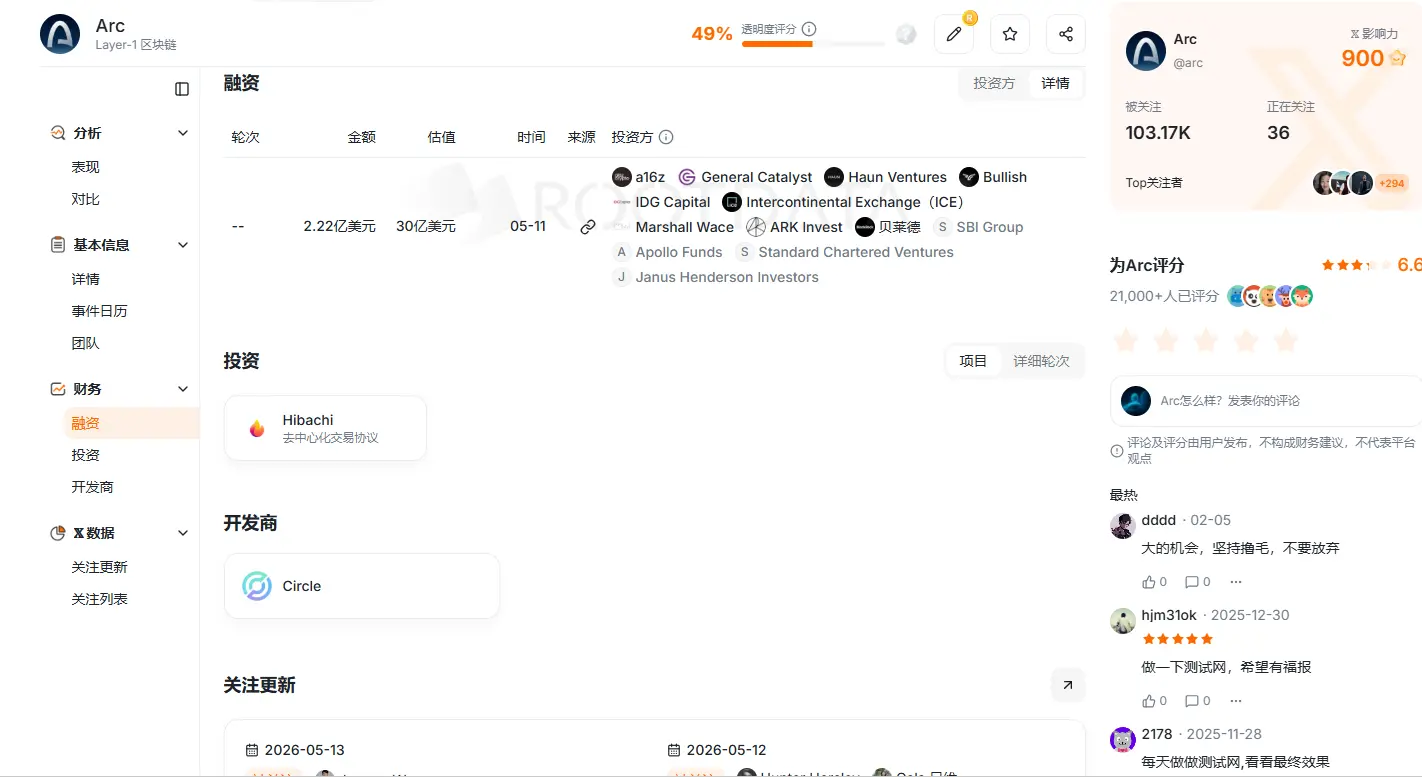
Image source: RootData
This raised a core question in the market: Circle is already a publicly traded company. If it is optimistic about its future, why not just hold CRCL stock directly instead of issuing the ARC token? Both are capturing the value of the Arc network, but what is the value of each?
1. Why Circle Built Arc
Why did Circle choose not to continue issuing and using USDC on Ethereum or Solana, but instead invest significant resources to build its own public chain?
a16z Crypto explained that as global finance gradually moves on-chain, only a few public chains will be able to support the "on-chain economic system foundation" in the future.
The trading volume of stablecoins approached $9 trillion last year, on par with global payment networks like Visa and PayPal. Cross-border payments, B2B settlements, and foreign exchange trading are becoming core scenarios for stablecoins, which have upgraded to the core layer of global financial infrastructure.
However, existing blockchain infrastructure primarily caters to crypto-native users and individual developers, lacking native support for large institutional needs.
Industry insiders point out that institutions face several core pain points when conducting business on-chain, including the need for a complete on-chain and off-chain closed-loop for asset issuance and redemption, the need for certainty in payment finality, compliance capabilities that must be pre-embedded at the base layer, configurable privacy protection, and predictable Gas costs using USDC.
These needs are difficult for existing public chains like Ethereum and Solana to meet natively.
For Circle, the company has primarily relied on USDC reserve interest for profitability, with the circulating supply of USDC reaching $77 billion in Q1, a year-on-year increase of 28%. As the scale of business continues to expand, relying solely on existing public chains can no longer fully match the deep needs of institutional clients.
Therefore, Circle launched Arc, one of its core purposes being to fill this gap. The circulation of stablecoins on others' chains does not mean that the financial aspect of stablecoins belongs to them—this is the underlying logic behind Circle's decision to build its own L1.
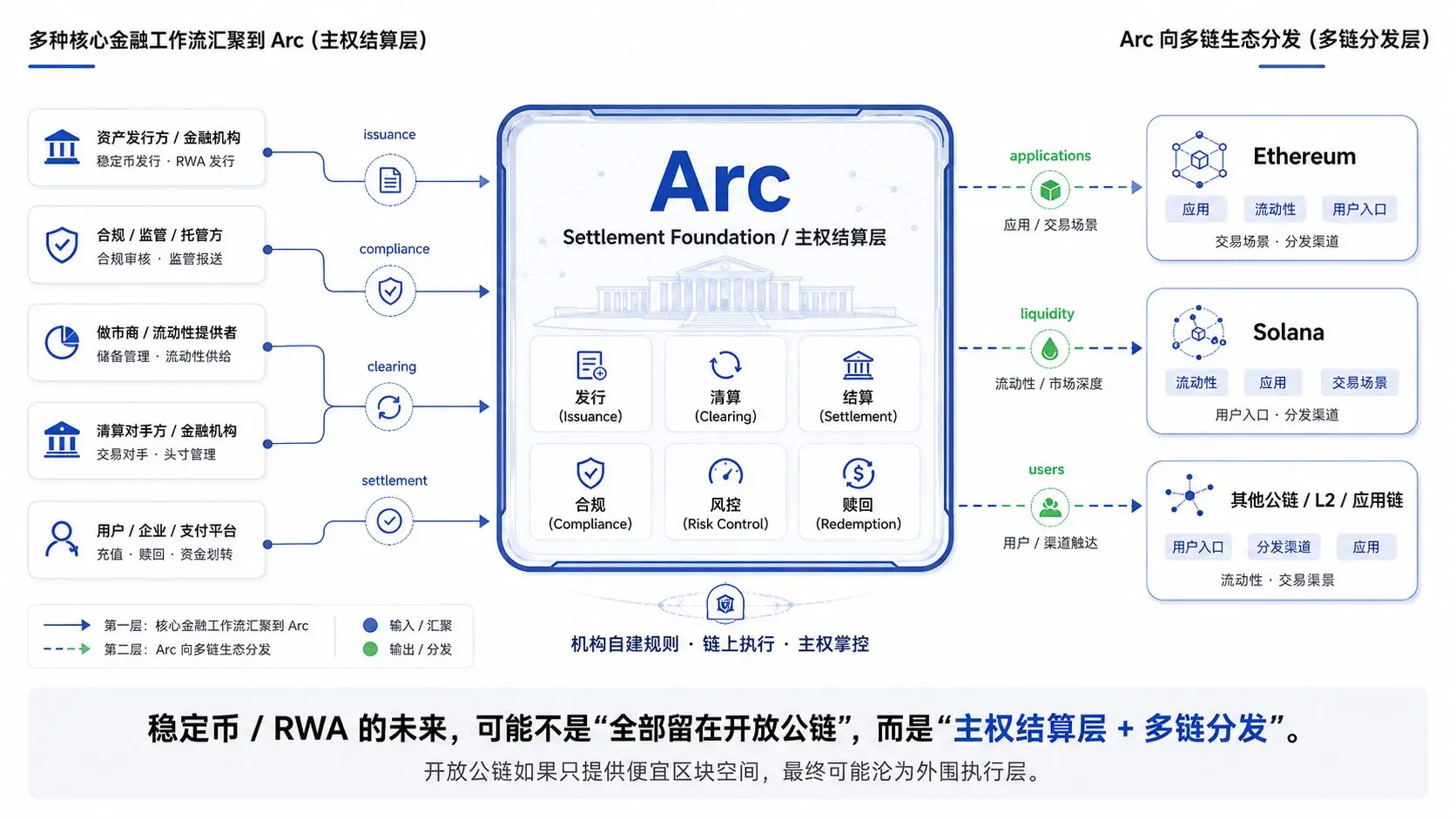
Image source: X user @vanisaxxm
2. USDC Solved Transaction Issues, ARC Solves Coordination Issues
Since USDC is already the Gas token for Arc, why issue an ARC token?
USDC has effectively solved the stability issue at the transaction level. Institutions can pay fees directly priced in dollars, making costs predictable and accountable, avoiding the troubles caused by price fluctuations of crypto assets for financial departments.
However, to ensure the long-term healthy operation of the network, merely solving transaction issues is not enough; coordination issues also need to be addressed.
According to the official white paper, Arc will gradually transition from PoA to PoS. Validation nodes need to stake assets to ensure network security, and the core of staking is to bind node behavior with economic interests; any wrongdoing will face penalties. The value of USDC remains constant at $1, which cannot truly bind nodes to the success or failure of the network; only the native token ARC can provide such dynamic economic incentives.
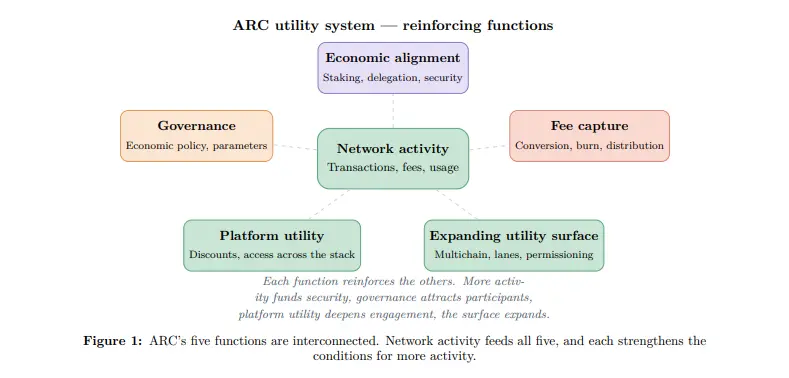
Governance also requires interest binding. Key decisions such as fee rates, inflation parameters, and destruction ratios need participants to consider from a long-term perspective. If voting is done solely with USDC, holders may lack sustained motivation and can leave after voting. The asset value of ARC holders is directly linked to network performance, providing more motivation to make choices beneficial for the long-term development of the network.
The white paper also clarifies that the governance rights of ARC have phased boundaries. Economic parameters are decided by token holders' votes, but important matters such as protocol upgrades, security incident handling, and validation node qualification reviews will initially remain under Circle's control, gradually decentralizing as the governance mechanism matures.
In simple terms, USDC is the blood of the Arc network, responsible for daily efficient flow; ARC is the equity of the network, responsible for binding various interests together in the long term. This dual-token design also allows the cost of ecosystem construction to partially shift from Circle's fixed cash expenditure to incentive arrangements linked to the success or failure of the network.
3. CRCL and ARC, What Cake Are They Eating?
In this way, Circle holds both the publicly traded equity CRCL and the network's native token ARC, both capturing the value of the same Arc network. So, what cake are they each eating?
According to the white paper, the total supply of Arc is 10 billion ARC tokens, with a clear distribution ratio: 60% for the ecosystem, including developer incentives, network growth plans, and user participation rewards; 25% belongs to Circle for operating validation nodes, staking, and governance; and 15% as long-term reserves for network stability and strategic flexibility.
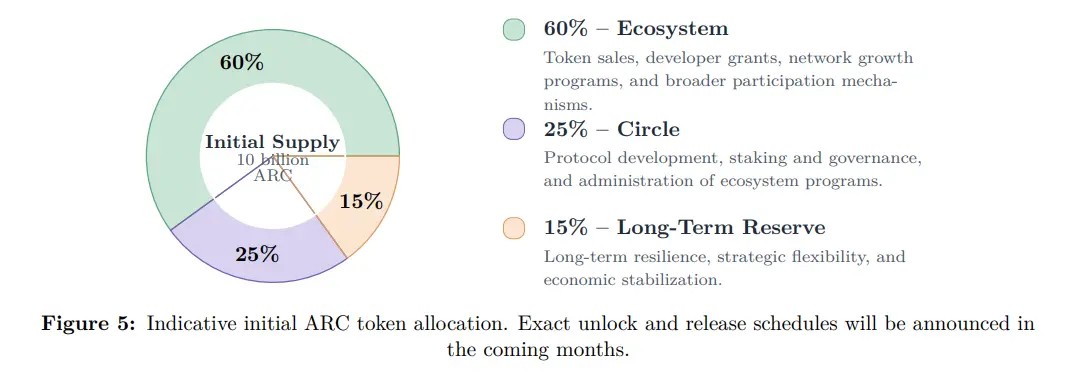
In terms of fee mechanisms, all protocol fees on Arc, regardless of the asset used by users for payment, will be fully converted to ARC at the protocol level, with a portion permanently destroyed and a portion distributed to stakers and validators. The more active the network, the stronger the value capture of ARC.
CRCL shareholders primarily profit through Circle at the company level. The company continues to enjoy core revenue from USDC reserve interest, as well as income from business growth such as the payment network CPN. At the same time, Circle holds 25% of ARC, allowing it to indirectly share in network-level rewards.
Crypto analyst BTCdayu proposed a three-dimensional valuation framework to understand CRCL: the first dimension is reserve interest income, which is currently the most stable cash flow, forming the valuation floor; the second dimension is payment network income, which is expected to approach a Visa-like network fee model as the CPN scale expands; the third dimension is the network option value brought by Arc, which reflects the market's expectations of Circle's transformation from a stablecoin issuer to a financial infrastructure platform.
In simple terms, CRCL captures the company's overall stable cash flow and existing business growth, while ARC captures the growth elasticity at the network level, including Gas fee conversion, ecosystem expansion, and long-term network effects.
The two form a clear dual-track structure. The more successful the Arc network, the greater the USDC usage and business synergy, benefiting Circle at the company level; at the same time, the value of the ARC token will rise, and the 25% share held by Circle will also appreciate, ultimately benefiting CRCL shareholders.
However, the two are completely independent at the legal level. The official statement mentions that ARC does not represent Circle's equity and does not confer any claim on Circle's revenue, profits, assets, or CRCL shares. This means that ARC holders do not have the fiduciary responsibility protection of public company shareholders, and their returns depend entirely on the actual adoption of the network and the design of the token economics.
4. How Ordinary Users Can Participate
After clarifying the value distribution of CRCL and ARC, a practical question arises: who exactly will the ARC token be sold to? How can ordinary users participate at a low cost?
The first type of buyer is institutional strategic investors. They entered through the $222 million presale at a unit price of $0.30, with lock-up periods ranging from 1 to 4 years. These institutions not only provide funding but are also mostly potential users and builders of Arc. For example, BlackRock has been testing tokenized asset settlement on the testnet, and ICE, as the parent company of the New York Stock Exchange, along with SBI Group, one of Japan's largest financial groups, are preparing to conduct business on Arc in the future.
The second type includes ecosystem builders and long-term holders. Developers and liquidity providers earn ARC incentives through contributions, with 60% of the ecosystem allocation prepared for this purpose. They are more focused on the long-term growth of the network, similar to early employees holding company equity.
The third type consists of retail speculators and participants. They focus on early narrative opportunities and ecosystem incentives, expecting price elasticity after the mainnet launch.
For ordinary users who do not qualify for the presale, Arc offers multiple low-cost participation paths.
The Arc Testnet was launched in October 2025 and has processed over 244 million test transactions to date, with the mainnet expected to launch in the summer of 2026. Users can receive test tokens for free to perform operations such as Swap, Bridge, and contract deployment, familiarizing themselves with network interactions.
The Arc House community is the primary entry point for ordinary users. Users can accumulate points by registering in the community, staying active, posting, reading content, and participating in Q&A sessions. Accepted answers will also earn extra points.
Advanced methods include content contributions, video sharing, event organization, and even hosting offline meetups. Additionally, users with teams or products can apply for Circle Developer Grants.
It should be noted that Arc House points are only recognition of community contributions and do not have monetary value, nor do they guarantee any specific rights distribution; specific rules are subject to the latest announcements from the official source.
Conclusion
Currently, the competition in the institutional on-chain space is fierce, and Arc is not the only player.
Digital Asset, which owns the Canton Network, is completing a new round of financing at a valuation of about $2 billion, led by a16z crypto; Plasma positions itself as a native settlement for stablecoins, with a relatively more attractive valuation; Visa has included Arc, Canton, Plasma, Base, Tempo, and other projects in its stablecoin settlement testing points since April. This indicates that the sector is still in a phase of parallel and competitive development among multiple players.
In this context, Arc's $3 billion presale FDV is relatively high. Retail investors participating in the secondary market need to fully assess the project's narrative potential and the competitive landscape within the sector.
In the long term, holding ARC with an annual inflation of 2% to 3% requires the network to generate sufficient real transaction fees to offset the pressure from the issuance increase in order to achieve value growth. In contrast, CRCL relies on USDC reserve interest and payment network income, having a relatively clear cash flow support. The two face different risk-return structures.
In the short term, market sentiment often has its own logic. The narrative concentrated explosion period around the mainnet launch may bring phase opportunities, at which point Circle's 25% ARC will also appreciate, benefiting CRCL shareholders as well.
On the regulatory front, the implementation of the GENIUS Act has solidified Circle's moat, while the new draft of the CLARITY Act has been made public and is currently advancing in Congress, expected to provide clearer regulatory certainty for the digital asset ecosystem, which is a significant benefit for Circle.
Overall, Arc is one of Circle's important strategic initiatives. The white paper states, "A global economic operating system cannot be coordinated by a single entity; it will use participants of Arc to transform into participants that maintain Arc." Whether this vision can ultimately be realized still depends on whether the mainnet can attract a sufficiently large scale of real institutional transactions and economic activities.
Until all data is truly realized, all narratives remain just narratives.

 Risk warning