The present and future of AI Agent participation in payments

 AI agents are undergoing a new revolution, transforming from traditional efficiency software into economic entities with their own wallets.
In the past, discussions about Agents focused on reasoning abilities, intent decomposition, or autonomous error correction. However, when it comes to executing a complex task in a production environment, they often get stuck at the payment stage. Whenever the execution path encounters payment data, MCP services, or specialized interfaces that require independent subscriptions, the automated process can break down instantly. Humans have to act like caretakers in the background, preparing the path for the Agent: purchasing subscriptions, configuring API Keys, and binding credit cards. In this old model, the Agent can only operate within the "sterile pipeline" defined by humans.
However, with cloud providers like AWS and payment infrastructures beginning to offer Agent payments, Agents can now directly pay for data and third-party services within an authorized budget during task execution. The funding channel is set up, but when Agents start making frequent payments, another systemic vulnerability emerges. 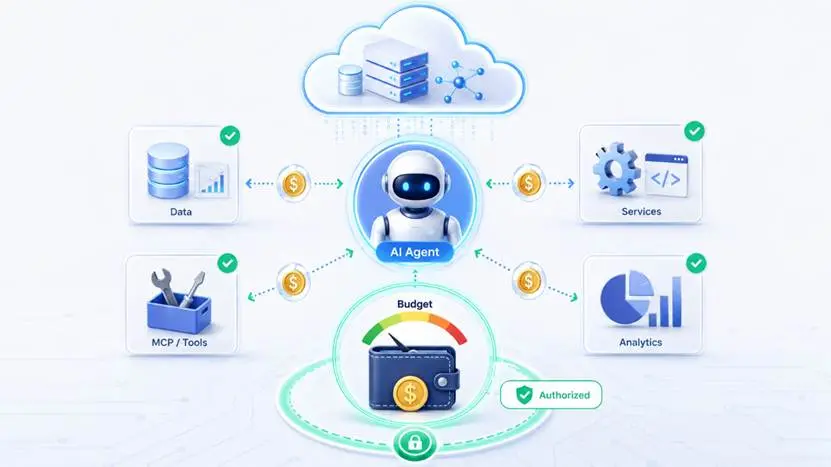
From Financial Bottlenecks to Agent Micropayments
In simple terms, this infrastructure is not designed to enhance the IQ of Agents but to prevent them from being forced to stop working due to "lack of funds." In real business collaborations, the execution path of an Agent is often determined on the fly. An Agent conducting industry research might find that public information is insufficient and needs to temporarily purchase a specific period's real-time order book; or an enterprise operation Agent might need to temporarily call a paid risk control interface while processing a transaction. If every tool switch requires human approval, recharging, and card binding in the background, automation loses its core value.
Thus, the traditional model of monthly subscriptions or prepayments inherently contradicts the collaborative mode of Agents. What Agents need is a more granular micropayment system that allows for instant payments based on single requests or even per returned data fragment. 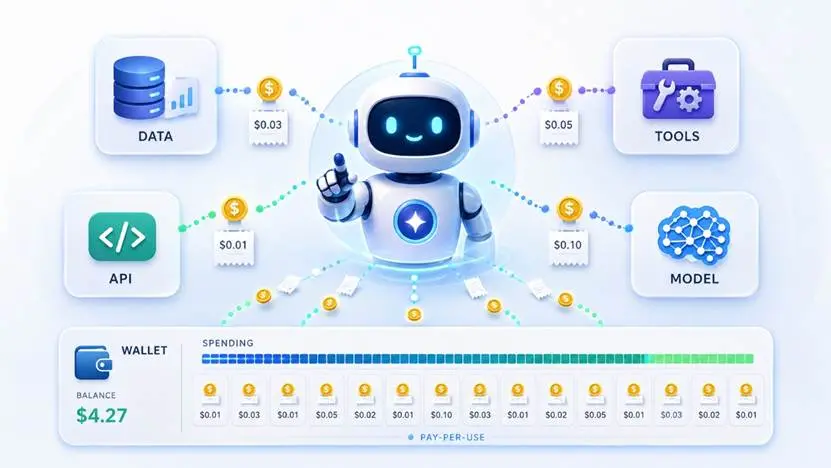
When paid resources return specific payment signals, the system automatically completes protocol negotiation, wallet authentication, and stablecoin payments at the underlying level, all within a very short time, allowing the Agent to receive the credentials and continue. Once this step is cleared, the business model of APIs and data services will undergo a complete transformation, and the Agent will truly evolve from a mere "tool requester" to a "tool purchaser" in the market.
Wallets Tightened with Restrictions, Unable to Prevent "Soft Poisons"
Once Agents have the ability to spend money, preventing financial risks becomes an instinctive reaction. No company would allow a boundary-less wallet to run amok in the background.
This also explains why current underlying designs are rushing to impose boundaries on Agent wallets: user pre-authorization, spending limits per session, revocable permissions at any time, and transparent log audits. These designs help you safeguard against exceeding the budget limit for a single task, the payment recipient, and the calling status, preventing the Agent from exhausting the account due to code loops or external inducements.
However, this only addresses the most basic transaction security. It can only prove that the money was "legally spent," but it cannot answer whether the money was "worth spending."
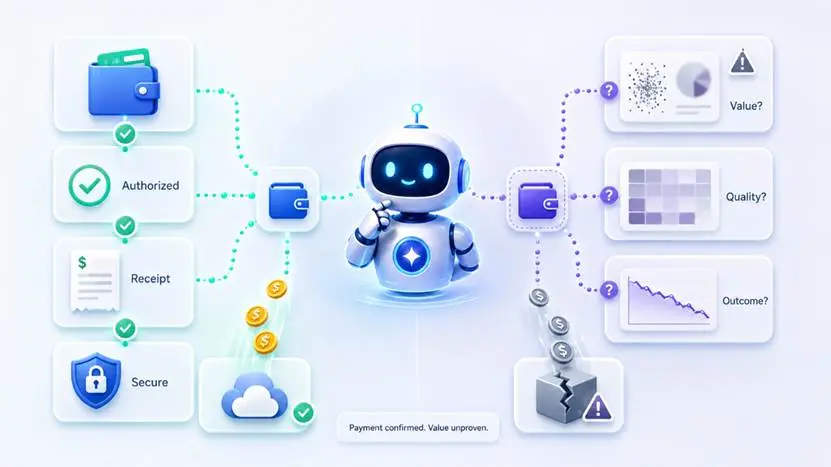
In a display environment, a successful payment only means that funds have been transferred. The Agent spent money to purchase business data, and the payment record looks perfect, but it cannot prevent the other party from returning a pile of AI-generated garbage information; it called an expensive external fine-tuning model, and the logs can prove that the call actually happened, but cannot determine whether the model's output logic is reliable.
What the agent economy truly needs to guard against is not large-scale fraud, but rather hidden, automated chronic consumption. A malicious third-party service doesn't even need to hack into your wallet; it just needs to legally collect a few cents from the Agent repeatedly within the allowed rules, continuously returning seemingly compliant but actually low-quality results. Every transaction on the bill meets risk control standards, the budget is not exceeded, but the final task result may have completely fallen apart.
This is why it is said: Payment layer secures the transaction, but Agent settlement secures the outcome. The payment layer can only ensure that the transaction occurs, while the market truly lacks a settlement layer that determines whether the results are valid.
When Errors Become Hard Costs
When the Agent is just a chat tool, the cost of making mistakes is at most illusions and poor answer quality. But when it starts to manage budgets, any logical noise and deviation will directly translate into certain economic losses.
Agents often work along a long chain. They are very likely to buy the wrong data in the first step or call a low-quality tool, and after receiving incorrect information, they will treat this noise as credible input and continue to the next stage of reasoning and purchasing. What is ultimately delivered to human users may be a seemingly complete automated consumption record where every step appears to be particularly diligent, but in reality, each step is paying for mistakes.
At this point, simply checking the bill or calling path does not solve the fundamental problem. The market needs a completely different verification infrastructure that must be able to fully record and align deeper information: what is the core motivation for the Agent to purchase this service? What is the specific payload returned by the target service? How does the Agent utilize these returned results in the subsequent reasoning steps? Is the final delivered result validated in the real world? If the overall task fails, where should the losses be accurately attributed?
The security guarantee of the next-generation agent infrastructure will inevitably shift from "how to execute payments frequently" to "how to accept results for these frequent actions." 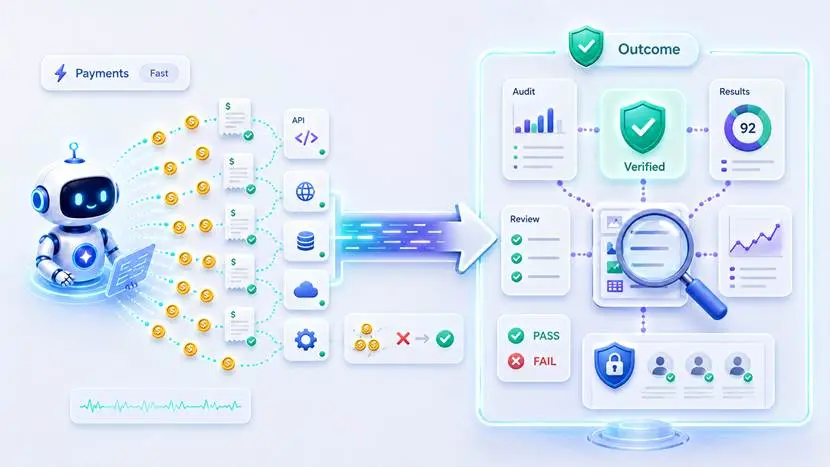
The Dilemma of Pre-emptive Practice in Prediction Markets
This dilemma regarding "result determination" has provided an excellent observational sample in prediction markets over the past two years.
In the architecture of prediction markets, asset matching, fund custody, and even algorithm-based price curve formation are technically very mature modules. The most vulnerable and fiercely contested core pain point of the entire system lies in the resolution of results.
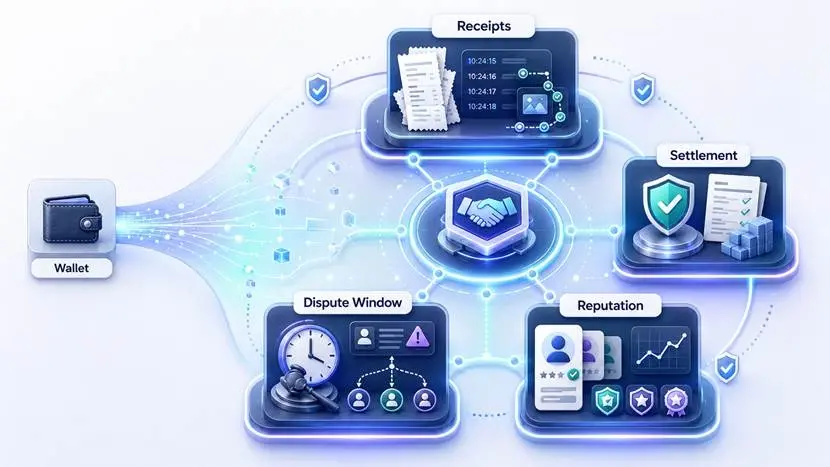
Does a geopolitical conflict count as an "escalation"? Does a regulatory bill being delayed count as "passed"? If a startup delivers test code, does that count as achieving a specific technical milestone? Information in the real world is not clean database fields; it is filled with gray areas, time delays, and conflicting sources. To resolve these ambiguous boundaries, prediction markets have had to introduce a complex adjudication mechanism composed of evidence preservation, source comparison, and dispute windows.
This is essentially the obstacle that the Agent economy will encounter in the future. When Agents begin to automatically buy data, make decisions, and order external services on a large scale and high frequency, the entire agent market will face the same underlying demands. The market needs not only wallets but also digital receipts, trustworthy settlements, dispute windows, and long-term reputation systems.
The Three-Tier Structure of the Agent Market's Endgame
Following this technological stack, a market capable of supporting the stable operation of autonomous economic entities will ultimately crystallize into three clear tiers.
The bottom layer is the Payment Layer, which addresses the question of "can it pay," responsible for providing Agents with readable micropayment channels and digital wallets. The next layer is the Security Layer, which addresses the question of "can it pay safely," responsible for permission control, budget breakage, and compliance auditing.
The most core and currently the most vacant is the Settlement Layer, which addresses the question of "after paying, can the results be verified." It functions more like a trust infrastructure, responsible for defining task delivery standards, providing dispute arbitration, and ultimately executing fund clearing.
Currently, cloud providers like AWS and payment giants are striving to dominate the first two layers, attempting to make the Agent payment experience as smooth as possible. After the first two layers are popularized, the second half of the competition in the agent economy will inevitably shift to the third layer, which is the most challenging yet crucial for result acceptance. 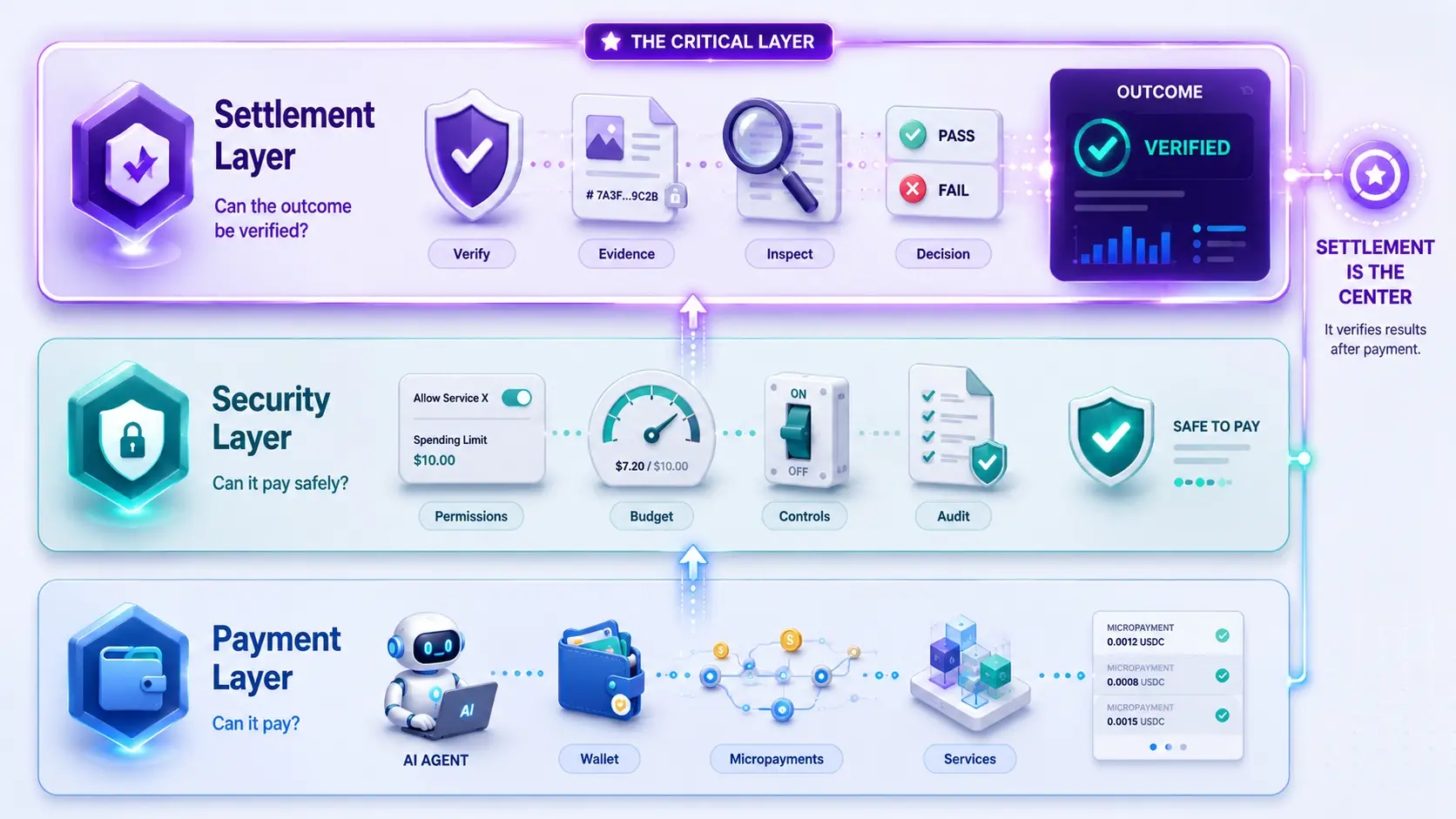
Wallets are Just Tickets, Reputation is the Endgame
Giving Agents wallets merely means they have received a ticket to enter human economic society. What truly determines whether an Agent can survive long-term in a complex business network and be entrusted with significant responsibilities by users is the reputation it has built over time.
In the future Agent market, the names of underlying models (regardless of which leading provider's flagship model) will no longer be the core basis. Model names can only represent their theoretical IQ ceiling under standard scoring sets but cannot reflect their actual execution performance in specific, noisy business tasks.
What truly holds premium asset value is the historical behavior logs that Agents have accumulated over time: what was their actual success rate in specific vertical tasks? What proven credible evidence sources do they habitually call upon when forming judgments? Do they frequently fall into low-quality or fraudulent endpoints? What is the deviation rate between their historical decisions and the actual outcomes in the real world?
These multidimensional credible records will collectively form the digital credit of the Agent. Without a settlement layer providing continuous verification, true reputation cannot be established; and without a reputation system, the market cannot identify truly efficient productivity among thousands of autonomous Agents.
Agent payment is the entry point. Agent accountability is the real market.
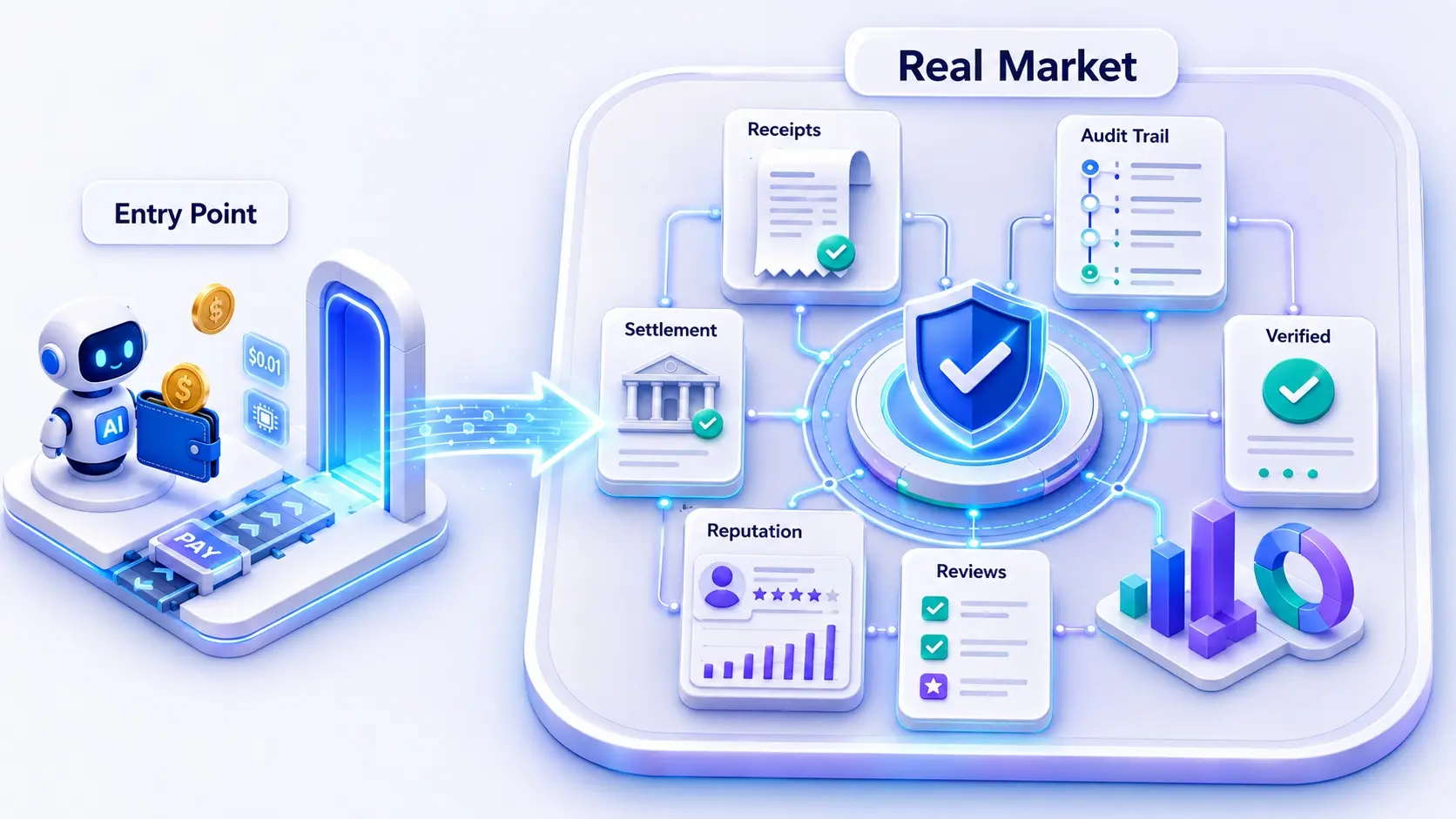
The payment layer grants Agents the rights to become economic entities, while the evidence, result acceptance, and long-term reputation formed around each action truly determine whether they can bear the responsibilities of economic entities.
 Risk warning