Tiger Research: South Korean crypto retail investors are disappearing, who will support the market in 2026?

 Whoever controls these infrastructures will control the customer entry point for the next decade.
This article is written by Tiger Research. The South Korean cryptocurrency market is undergoing a power shift. The era dominated by retail investors is coming to an end, as traditional financial institutions have begun to aggressively seize key infrastructures such as STO standard-setting, stablecoin payment rails, and custody markets, even before regulations are fully clarified. Behind this seemingly calm MOU competition is a struggle for control over the future financial front of digital assets—whoever controls these infrastructures will control the customer entry point for the next decade.
The partnerships and equity acquisitions between South Korean institutions and securities firms are accelerating in sync with the cryptocurrency market. However, the overall landscape remains difficult to discern at a glance. Many partnerships have been announced, but actual business deployments are still rare. This report explores why the conversion rate is so low and why institutions continue to push forward.
Key Points
South Korean institutional cryptocurrency activities have surpassed the MOU (Memorandum of Understanding, referring to cooperation intentions, hereinafter the same) stage and entered specific business operations and equity acquisitions of exchanges.
Institutions are secretly intensifying competition for key financial infrastructures, including STO standard-setting, stablecoin payment rails, and custody markets.
Domestic infrastructure builders are becoming the core pillars of institutional business, constructing local rails that comply with the South Korean central bank's CBDC framework and local regulatory requirements, reducing dependence on foreign technology.
The strategy of overseas Web3 foundations entering South Korea has completely shifted from retail community building to collaborating with large enterprises and financial institutions, as traditional finance accelerates its takeover of the market.
1. MOU Arms Race
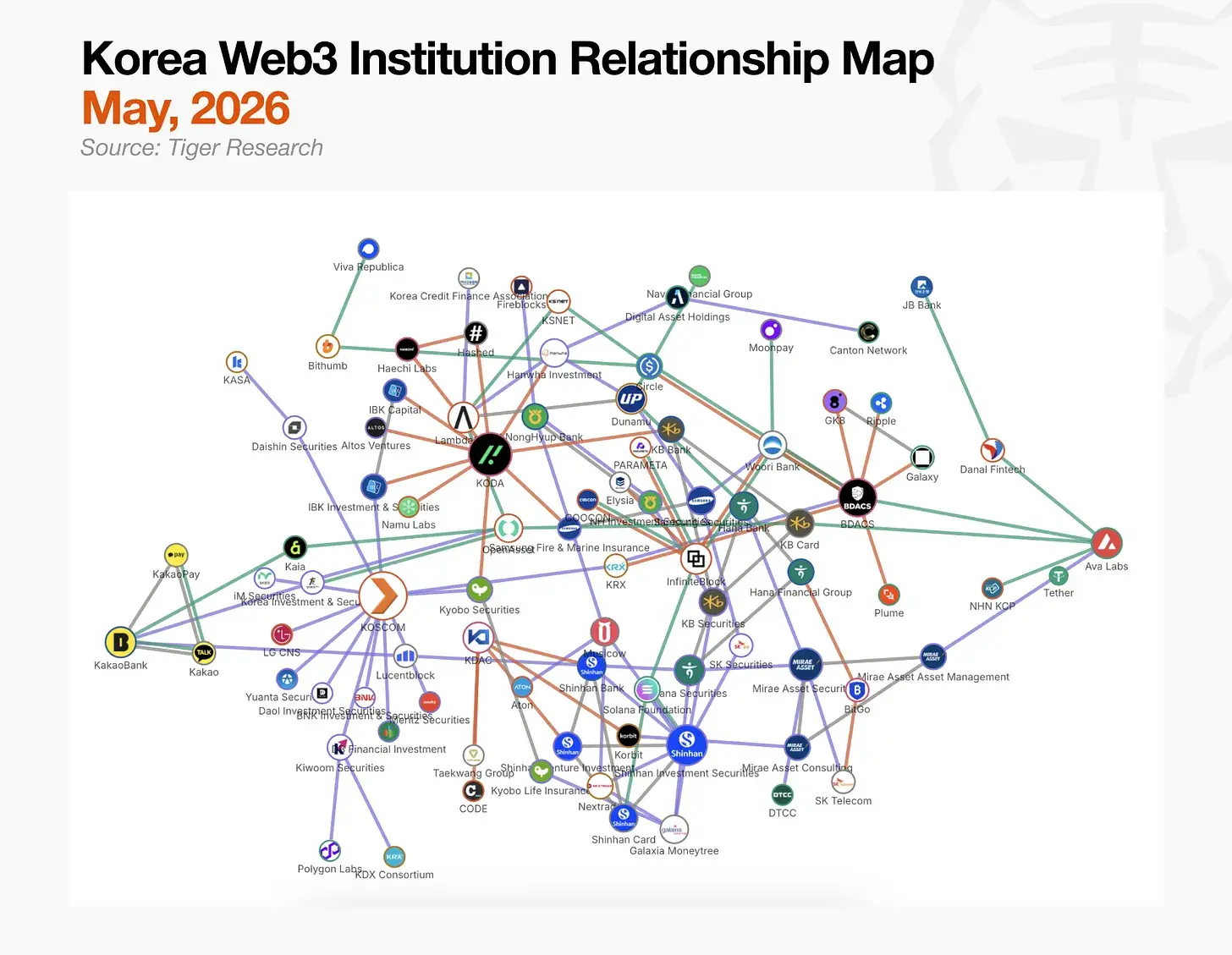
The above image, compiled by Tiger Research, illustrates the connections within the South Korean institutional cryptocurrency landscape. However, this structure is not easy to discern at a glance. It is difficult to distinguish which lines represent active business operations and which are merely MOUs; the boundaries between central hubs and peripheral participants remain blurred.
Notably, this complexity accurately reflects the current state of the South Korean institutional cryptocurrency market. As confirmed by Tiger Research's dataset—150 institutions and 196 partnerships—no hub has yet achieved dominant control over the market.
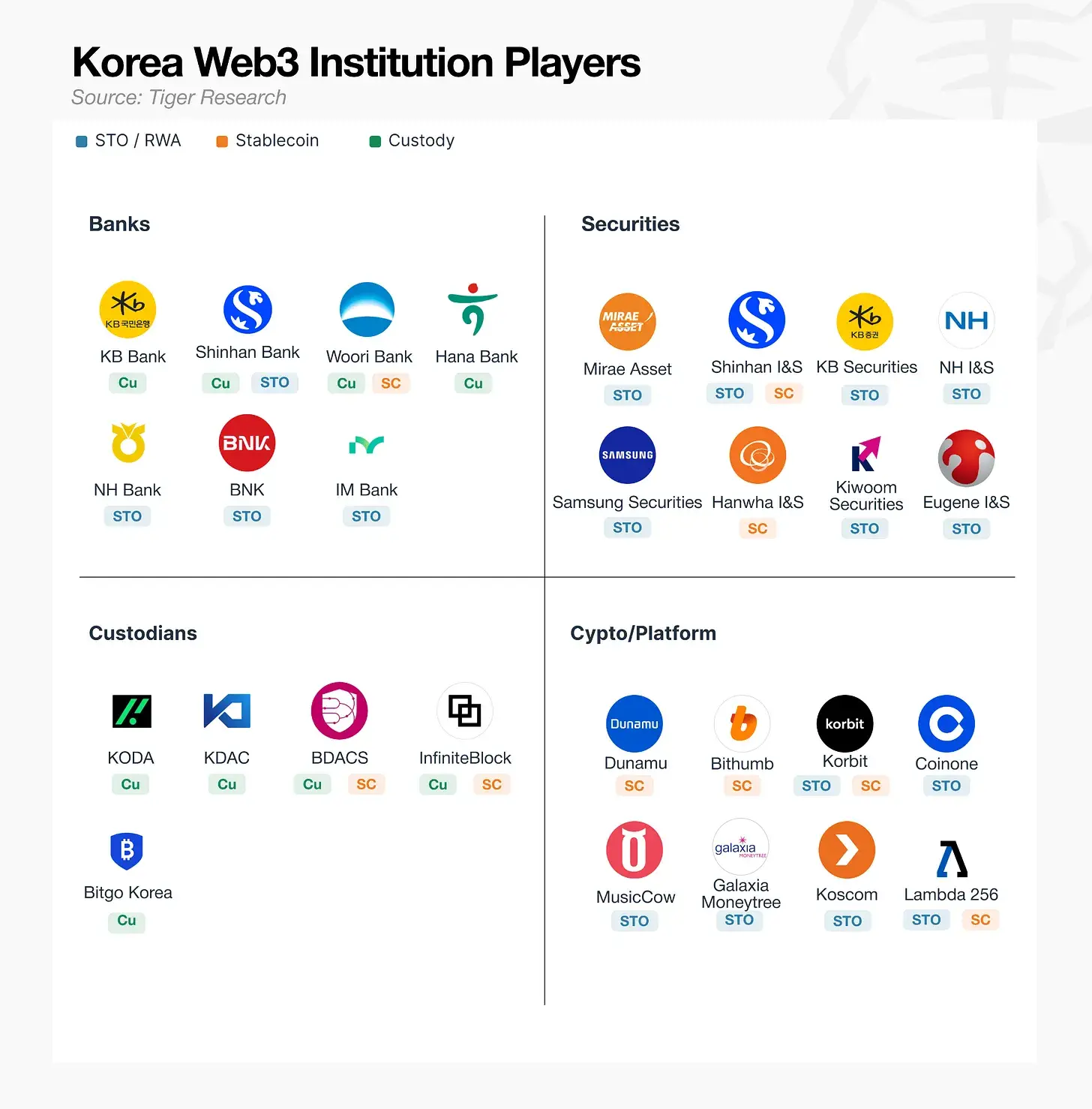
Domestic institutions are establishing their positions throughout the market before regulations are fully clarified. Competition is currently unfolding along three fronts: stablecoins, STOs (Security Token Offerings), and custody (cryptocurrency asset storage).
It is also noteworthy that financial institutions are continuously acquiring equity in exchanges, a move interpreted as a confidence-driven effort to secure footholds before regulations are fully clarified.
2. Exchange Equity Battle
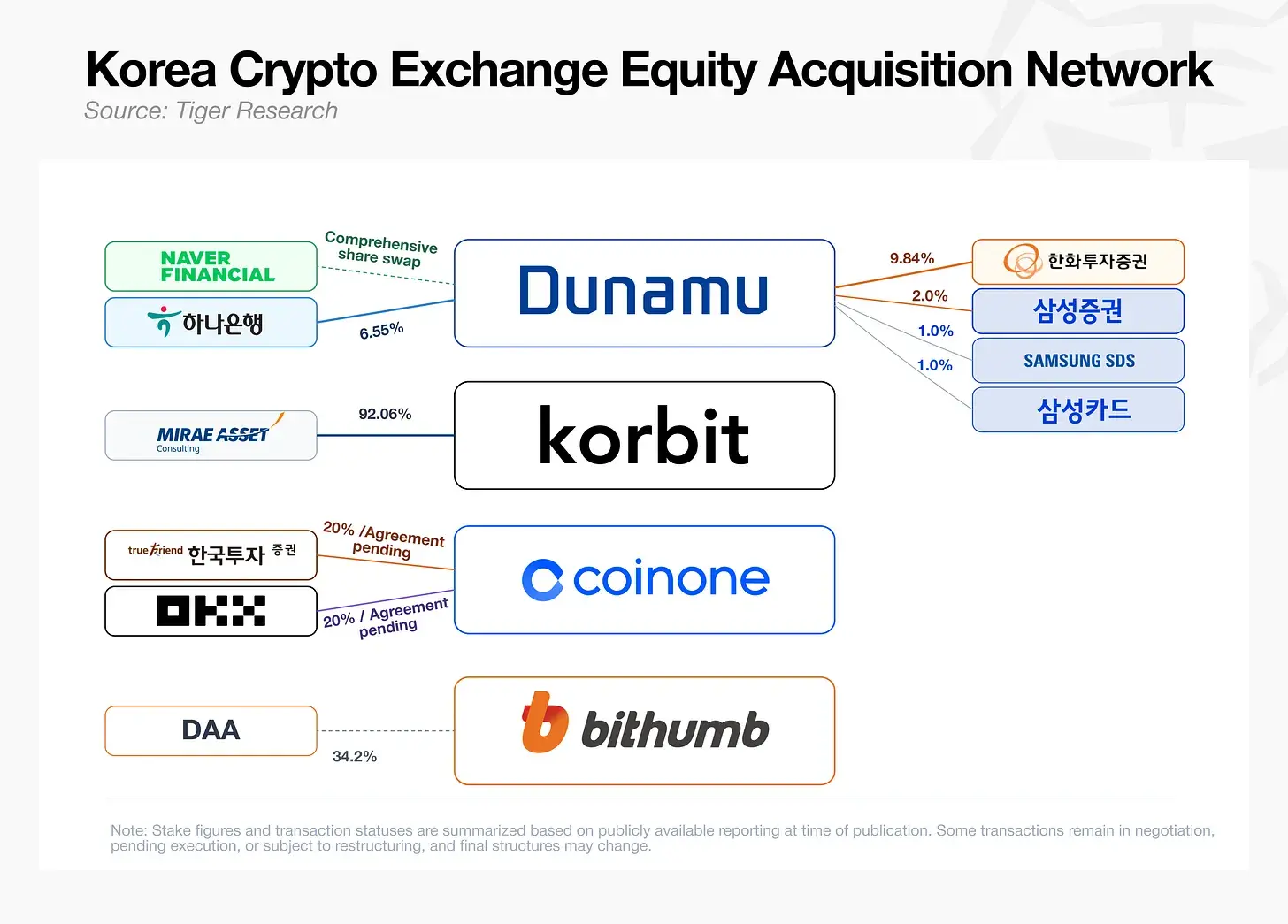
Less than 10 days after Hana Bank announced its acquisition of a 6.55% stake in Upbit operator Dunamu for approximately 1 trillion won (about $720 million), Hanwha Investment & Securities approved an additional 3.90% acquisition. On May 28 of the same month, Samsung Securities, Samsung SDS, and Samsung Card jointly announced a 4.0% acquisition. Mirae Asset Consulting signed a contract to acquire a 92.06% stake in Korbit as early as February, and there are reports that Korea Investment & Securities and global exchange OKX are discussing a joint acquisition of Coinone.
This competition reflects a revaluation of cryptocurrency exchanges, which are now seen not just as transaction fee platforms but as key customer touchpoints capable of distributing stablecoins, custody services, security tokens, and RWA products.
Banks and securities firms have gained indirect access to licenses such as VASP registration while ensuring the user base and liquidity of exchanges. The current equity battle is ultimately a competition over who will control the financial front of digital assets.
3. South Korean Cryptocurrency Market by Industry
A sector-by-sector analysis of the relationship diagram reveals an uneven landscape. Custody business operations are the most active, with many participants running real-time services after clearing regulatory hurdles. In contrast, RWA and STOs largely remain at the contract or MOU stage, awaiting relevant legislation to take effect. Stablecoins face similar stagnation, with no clear standard-setters in a position to dominate the market.
Due to the differing nature of barriers across industries, breakthrough strategies also vary. Some participants are integrating domestic alliances while waiting for regulatory openings. Others are turning to overseas markets where regulations are advancing more quickly, exploring alternative paths. The following sections discuss the specific barriers and participant strategies for each industry.
3.1. RWA/STO: Legislation Passed, Commercialization Infrastructure is the Bottleneck
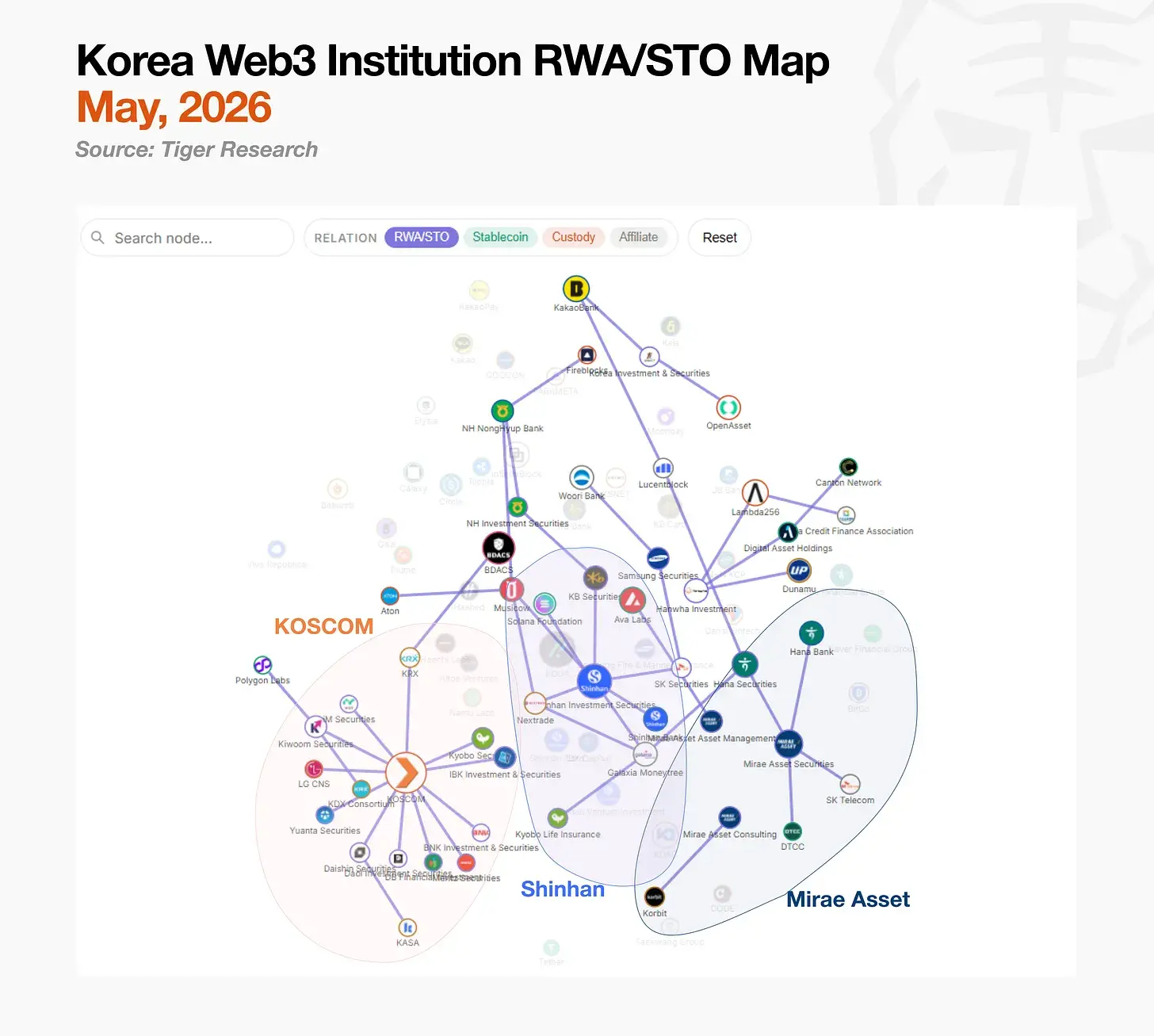
The domestic STO market is divided into two camps: the KOSCOM-led alliance and the fragmented investment alliance led by Shinhan Investment Corp. Mirae Asset Securities has taken an independent path, leveraging overseas business instead of waiting for domestic infrastructure.
KOSCOM is a core financial network operator, with the Korea Exchange holding 76.6% of its shares, pursuing a neutral infrastructure model that aligns with its founding mission to provide shared infrastructure for securities firms. It does not sign exclusive agreements with individual issuers but integrates 11 securities firms onto its platform, aiming to establish issuance and distribution technology standards and ensure compatibility with South Korea's comprehensive custody management requirements.
Shinhan Investment Corp has rapidly established its own STO ecosystem. Starting with a proof of concept with Lambda 256 in 2022, it launched the joint platform PULSE in 2024 and plans to officially launch multi-platform account integration services in 2025. In 2025 alone, it participated as an account manager in 10 investment contract securities issuances and gained control of the OTC exchange NXT, establishing an end-to-end pipeline from issuance to distribution within its ecosystem.
Mirae Asset Securities completely bypassed domestic infrastructure development and went directly overseas. It issued digital bonds in Hong Kong, obtained a digital asset retail license from the Hong Kong Securities and Futures Commission, and plans to launch an MTS for retail investors in the market in June. In the U.S., it is the only South Korean securities firm to join the DTCC-led tokenization working group, which includes JPMorgan, Goldman Sachs, and BlackRock, participating in global standard-setting discussions. This strategy positions Mirae Asset advantageously in regulatory alignment and negotiation leverage when domestic STO infrastructure eventually aligns with global standards.
3.2. Stablecoins: Legislation, Not Technology, is the Bottleneck
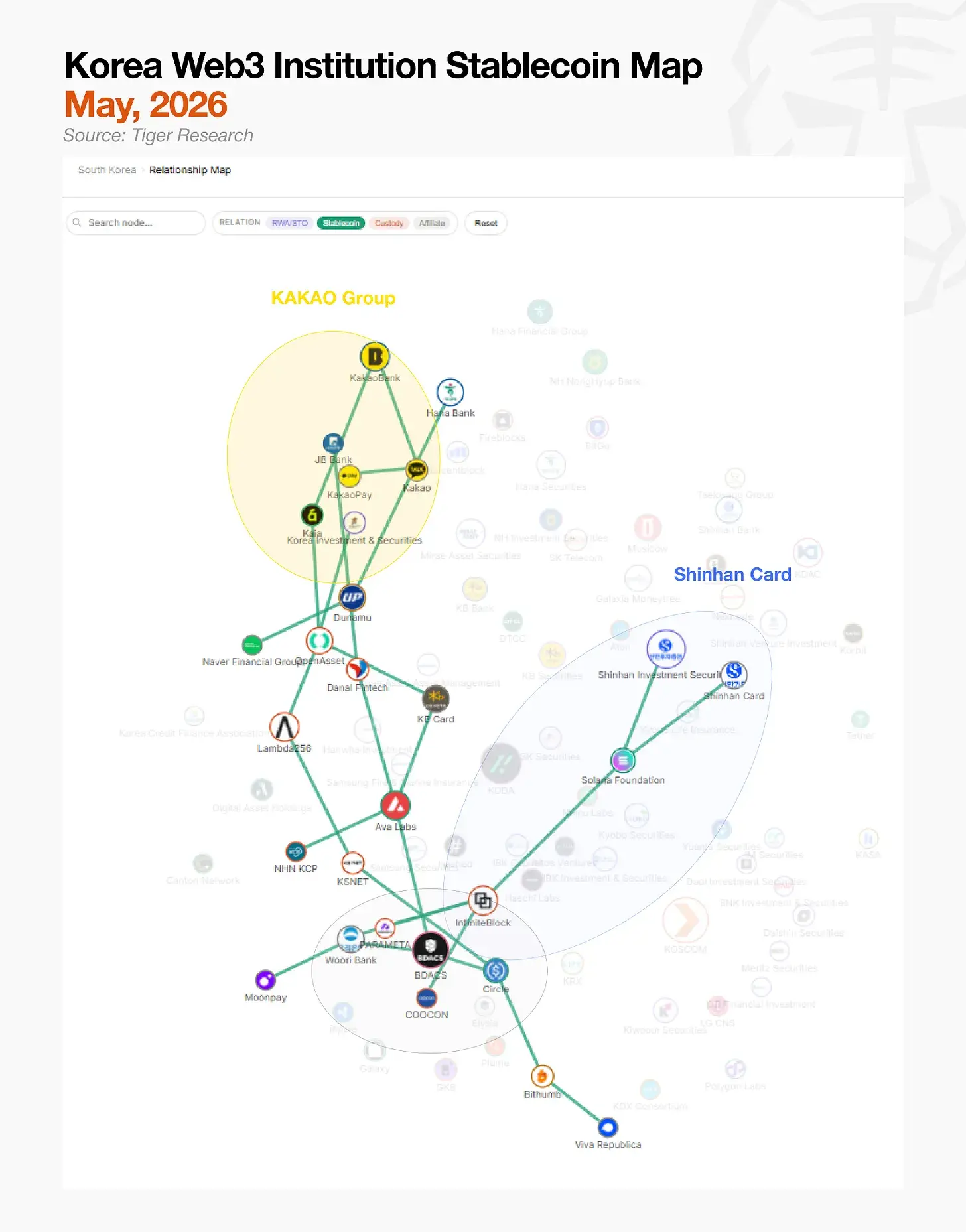
Participants in the stablecoin market are more diverse than in other industries. Card companies, exchanges, fintech firms, and infrastructure companies are entering through different routes, leveraging their respective strengths.
The largest camp is the Kakao Group. Kakao, KakaoBank, and Kakao Pay have formed a joint working group to build a "super wallet" covering stablecoins, cryptocurrencies, and local currencies. Their key asset is the infrastructure accumulated from operating the Kaia public chain since the Ground X era. Kaia has already deployed Tether (USDT) on its network and is conducting real-time payment tests.
Shinhan Card focuses on migrating its existing payment network to blockchain rails. In April, Shinhan Card signed an MOU with Solana, although the foundational technical work began before the agreement. The company has completed initial proof of concepts in collaboration with Solana, Visa, Mastercard, and Fireblocks, and is now conducting advanced testing in six areas, including wallets and smart contracts.
The exchange camp is bypassing the delay of won stablecoins through U.S. dollar stablecoins. Dunamu is developing a won stablecoin business based on its proprietary blockchain GIWA in collaboration with Naver Financial. Bithumb, facing regulatory delays for won stablecoins, has chosen to first ensure a U.S. dollar stablecoin distribution network through partnerships with Circle and WLF. A joint won stablecoin plan with Toss is also under discussion, although progress is slow.
All camps are active but face the same regulatory barriers. The Bank of Korea is pushing for a 51% rule, requiring that only alliances with a majority of banks are allowed to issue stablecoins, while fintech companies are seeking access, delaying government-party negotiations. Once issuance guidelines are released, the camp with the most comprehensive public touchpoints is expected to gain market leadership.
3.3. Custody: More Institutional Capital Needed
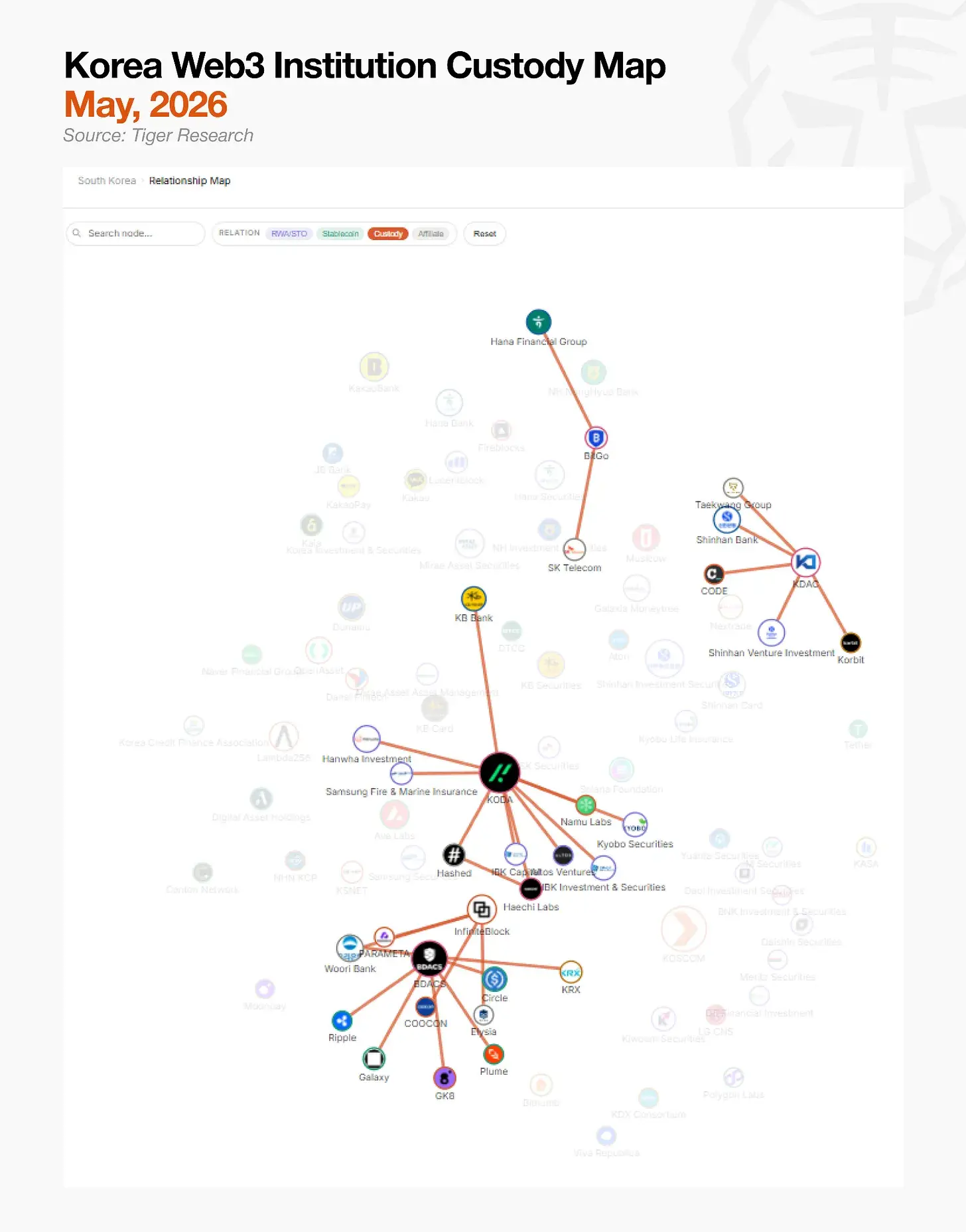
The custody market is structurally simpler than other industries. The four major custody institutions have each secured domestic and international financial and technical partners to establish their market positions.
KODA was co-founded by KB Kookmin Bank, Hashed, and Haechi Labs, combining traditional financial capital with crypto-native VCs. Hana Investment & Securities, IBK Capital, and Kyobo Securities subsequently joined as investors, further enhancing its stability with a dedicated custody insurance agreement with Samsung Fire & Marine Insurance.
KDAC is a custody institution dominated by traditional finance, with Shinhan Bank and NH Nonghyup Bank as major shareholders. NH Nonghyup Bank was initially an investor in another custody institution, Kardo, and became a shareholder of KDAC after the merger. After the merger, KDAC's shareholders include two of South Korea's five largest banks.
BDACS has taken a unique approach centered on technology and partner development. By expanding custody and payment infrastructure through partnerships with Woori Bank and international digital asset infrastructure companies including Galaxy and GK8, it has also signed an MOU with Circle to issue the won stablecoin KRW1 on Circle's Arc blockchain and is the only VASP and key custody partner in the KRX-led KDX alliance. BDACS is currently conducting a proof of concept for KRW1, positioning itself as a custodian targeting both custody and payment infrastructure.
BitGo Korea has entered the domestic market with the technological strength of its global parent company. BitGo holds custody of over $70 billion in assets and processes about 20% of global Bitcoin on-chain transactions. Domestically, Hana Financial Group and SK Telecom each hold shares, making it a custody institution supported by financial and telecom capital.
Institutions have entered the market through their respective custody relationships. However, it has been reported that all major custody institutions experienced net losses last year, indicating that their construction has outpaced the institutional capital inflow required to maintain operations.
Overall, the infrastructure development for STOs, stablecoins, and custody reveals a clear common limitation: domestic institutions have built a business framework, but the underlying technological infrastructure largely relies on overseas solutions.
4. Infrastructure Builders
Reliance on overseas solutions brings structural costs: as the market grows, a significant portion of revenue will flow overseas in the form of technology licensing fees. If overseas partners change policies or increase costs, domestic infrastructure may also face disruption risks.
The more fundamental issue is that areas needing to align with South Korea's specific regulatory environment—such as the issuance of won stablecoins, STO distribution rules, and domestic corporate account integration—cannot simply apply global solutions directly. This is why, once relevant legislation is finalized and capital begins to flow seriously, domestic tech companies capable of directly designing and controlling underlying rails according to South Korean regulatory frameworks will be essential.
Domestic companies that have identified this technological gap and are building South Korea-specific financial infrastructure are already taking action. Leading technology providers include:
4.1. LG CNS
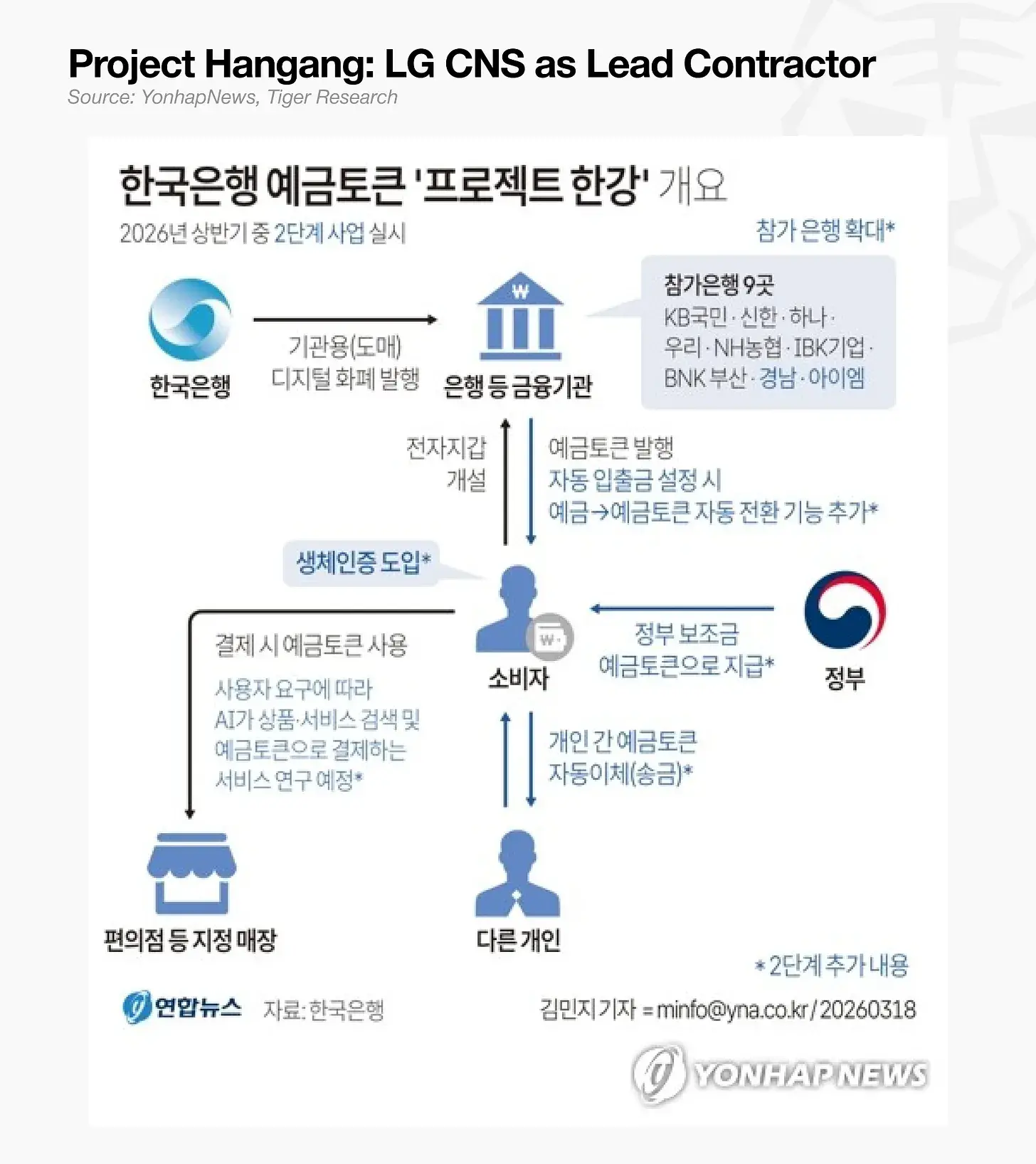
Among traditional IT service companies, LG CNS stands out prominently. Since launching its own blockchain platform "Monachain" in 2018, it has provided services to over 220 local governments through the local currency platform of the Korea Minting and Security Printing Corporation, accumulating operational experience.
This permissioned chain experience translates into orders for CBDC and STO projects. As the main contractor for the Bank of Korea's CBDC project "Han River," LG CNS is developing a government subsidy distribution system utilizing deposit tokens. Through this process, it has established the capability to operate institutional CBDCs and private digital currencies on a single network, effectively transplanting traditional financial security standards and procedures onto the blockchain.
Developing the KOSCOM joint STO issuance platform and the Mirae Asset Securities STO platform follows the same logic. LG CNS is not directly issuing assets but is targeting three directions: building issuance and distribution platforms for banks, providing SaaS to payment operators including credit card companies, payment gateways, and simple payment services, and developing digital asset payment platforms for securities firms. Once the regulatory framework is finalized, it seems to be the most likely candidate to secure infrastructure contract markets.
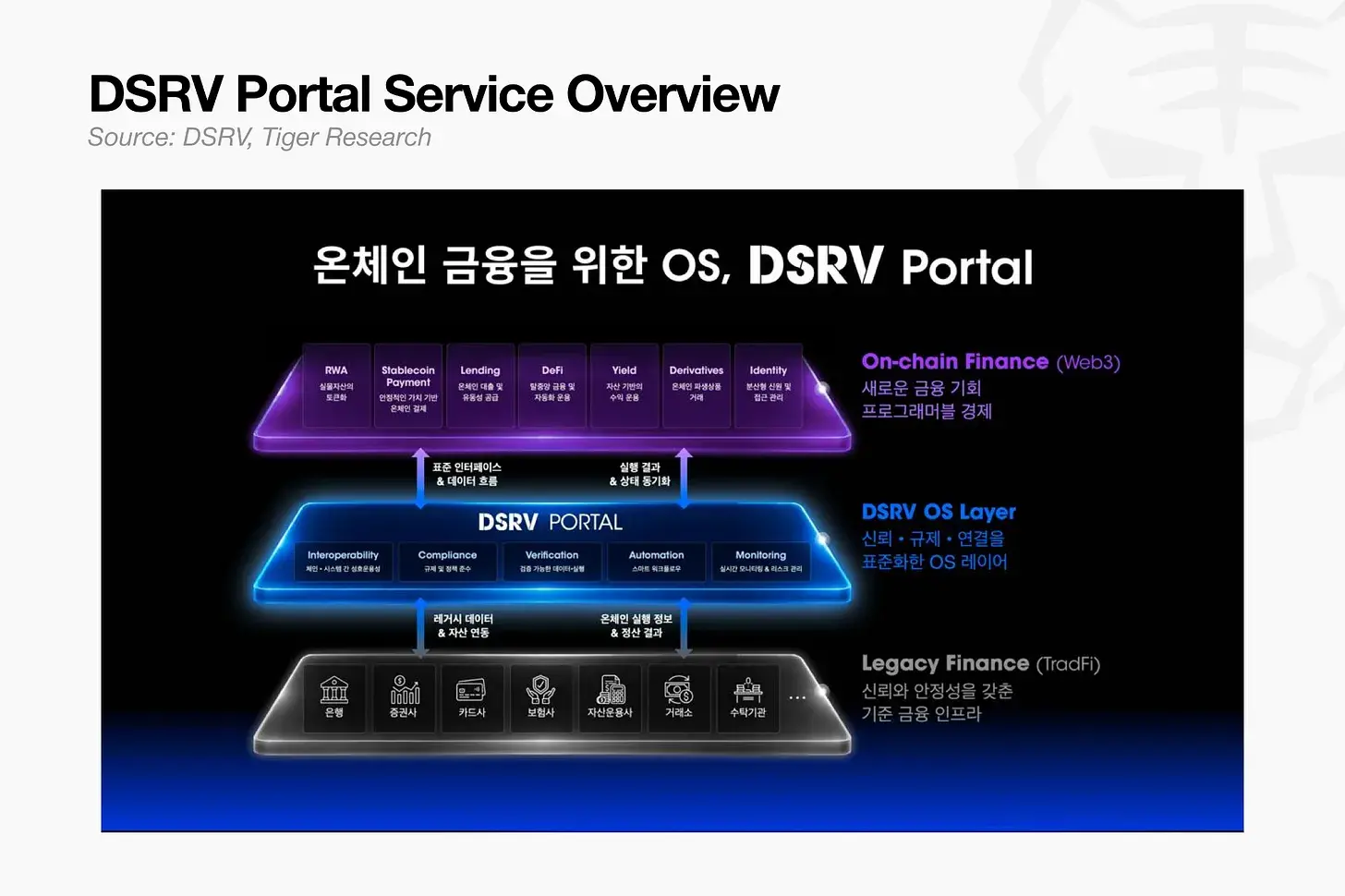
Among blockchain infrastructure companies, DSRV stands out for directly assisting financial institutions in accessing on-chain infrastructure. As a validator and infrastructure company operating on over 70 blockchain networks, DSRV manages over 40 trillion won (approximately $2.9 billion) in assets, ranking first in South Korean Ethereum staking and among the top ten globally.
A key development is its expansion from node operations to full-stack institutional on-chain infrastructure. Through the DSRV Portal, financial institutions can access wallet, payment, tokenization, custody, and staking functionalities via API and dashboard interfaces. Without needing to build their own nodes and security infrastructure, financial companies can access user wallets, institutional wallets, periodic payments, token issuance, destruction, transfer, and locking, custody, and staking capabilities.
A trust mechanism is also in place. DSRV was the first to obtain VASP, ISMS, and SOC 1 Type 1 certifications, directly meeting the regulatory, security, and operational control requirements demanded by financial institutions. In practice, this means that external infrastructure providers bear the most burdensome wallet security, internal control, and operational risks for financial companies when deploying on-chain services.
Its partnerships are focused on payment rail construction. DSRV is developing remittance infrastructure compliant with South Korean and Japanese regulations in collaboration with SBI Ripple Asia. It is working with Circle to develop an institutional USDC issuance, redemption, and settlement framework that bypasses exchanges. It has signed an agreement with BC Card to connect traditional card payment networks to blockchain-based stablecoin payment infrastructure.
DSRV recently completed a Series B funding round of 30 billion won (approximately $21.7 million) to accelerate technology development.
4.3. Altus (formerly B-Harvest)
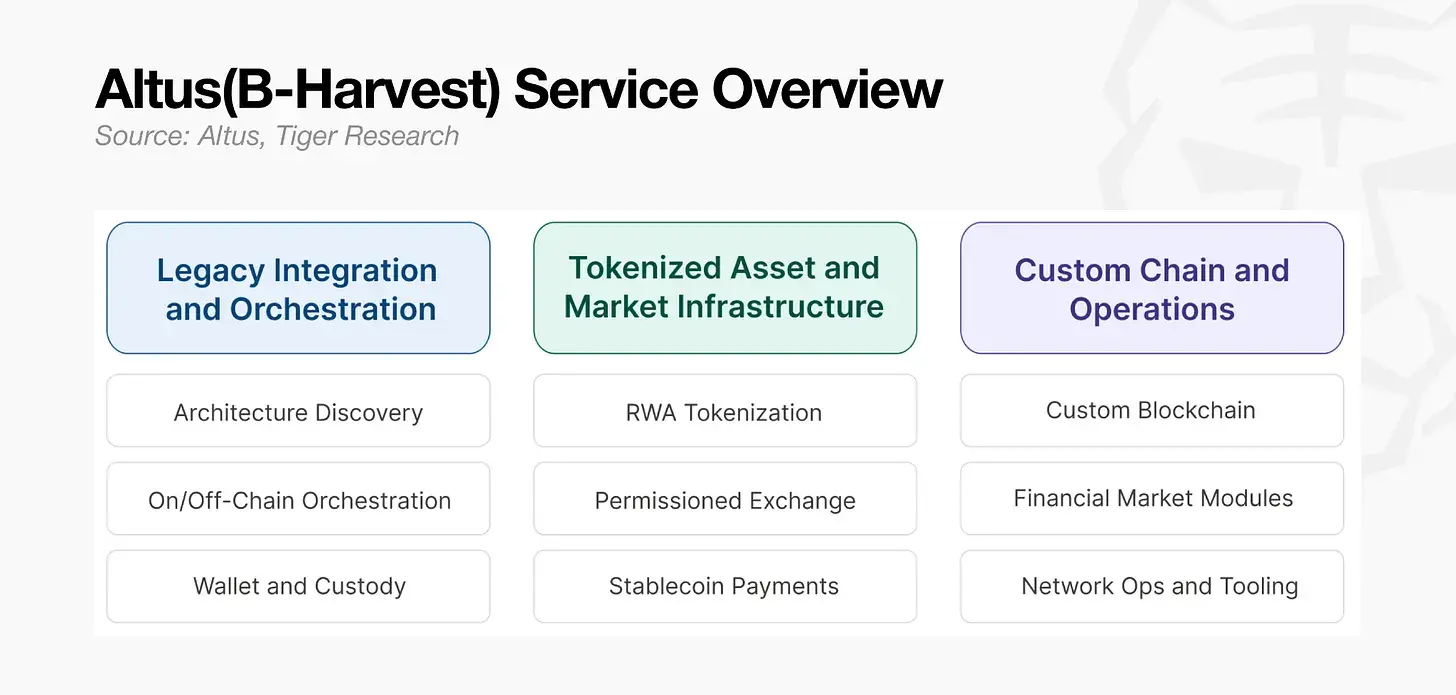
Altus (formerly B-Harvest) operates at the integration layer between financial institutions' legacy systems and blockchain environments. Founded in 2018, it has contributed to EVM chain development based on the Cosmos SDK and is an organization of over 40 engineers and researchers who have directly built several production networks, including Canto, Crescent, Stable, and Ault.
Altus handles protocol engineering and core architecture for Ault Blockchain, an institutional L1 focused on RWA, trading, and payments. In 2025, it contributed EVM integration, performance improvements, and security audits for the Bitcoin staking L1 Babylon, supporting its production readiness.
Its financial institution solutions stem from the same layer. Altus builds from scratch according to financial industry requirements: an on-chain and off-chain orchestration layer connecting legacy systems and blockchain execution environments, RWA tokenization, licensed exchanges, stablecoin payments and settlements, as well as institutional wallet and custody infrastructure.
Current internal R&D is proceeding in parallel: the Canton Network architecture supporting selective data disclosure between institutions, and the Commonware Stack, a modular blockchain framework targeting 1 million TPS.
The three companies start from different positions and have different strengths. LG CNS leads with financial IT credibility, DSRV leads with blockchain validator infrastructure, and Altus leads with protocol-level custom design capabilities. But all companies share the same goal: to secure core operating systems before institutional capital flows in on a large scale. The determining factor will be how much credible building experience each company can accumulate before the market fully opens.
5. Retail Exit, Institutional Entry
The recent surge in partnership announcements should not be interpreted as ordinary business expansion. These are positioning moves: institutions are seizing advantageous arrangements before regulations are finalized, then using these arrangements to influence the final shape of the regulatory framework. The current cooperation race is less about market competition and more about regulatory design.
The South Korean cryptocurrency market has undergone significant restructuring in just six months. The custody camp has formed, the STO alliance has taken shape, and major financial holding companies have taken action to acquire equity in exchanges. Meanwhile, retail trading volume has significantly decreased. The total trading volume of South Korea's five major exchanges has dropped by approximately 48% year-on-year. The market focus is rapidly shifting from retail to institutional.
This shift is also changing how overseas cryptocurrency foundations approach South Korea. Just as Solana was adopted as a partner by Shinhan Card, Avalanche was adopted by Mirae Asset; foundations entering the domestic market have shifted their primary focus from exchange trading volume to collaboration with financial institutions and large enterprises. The community meetups that once drove retail liquidity are no longer effective.
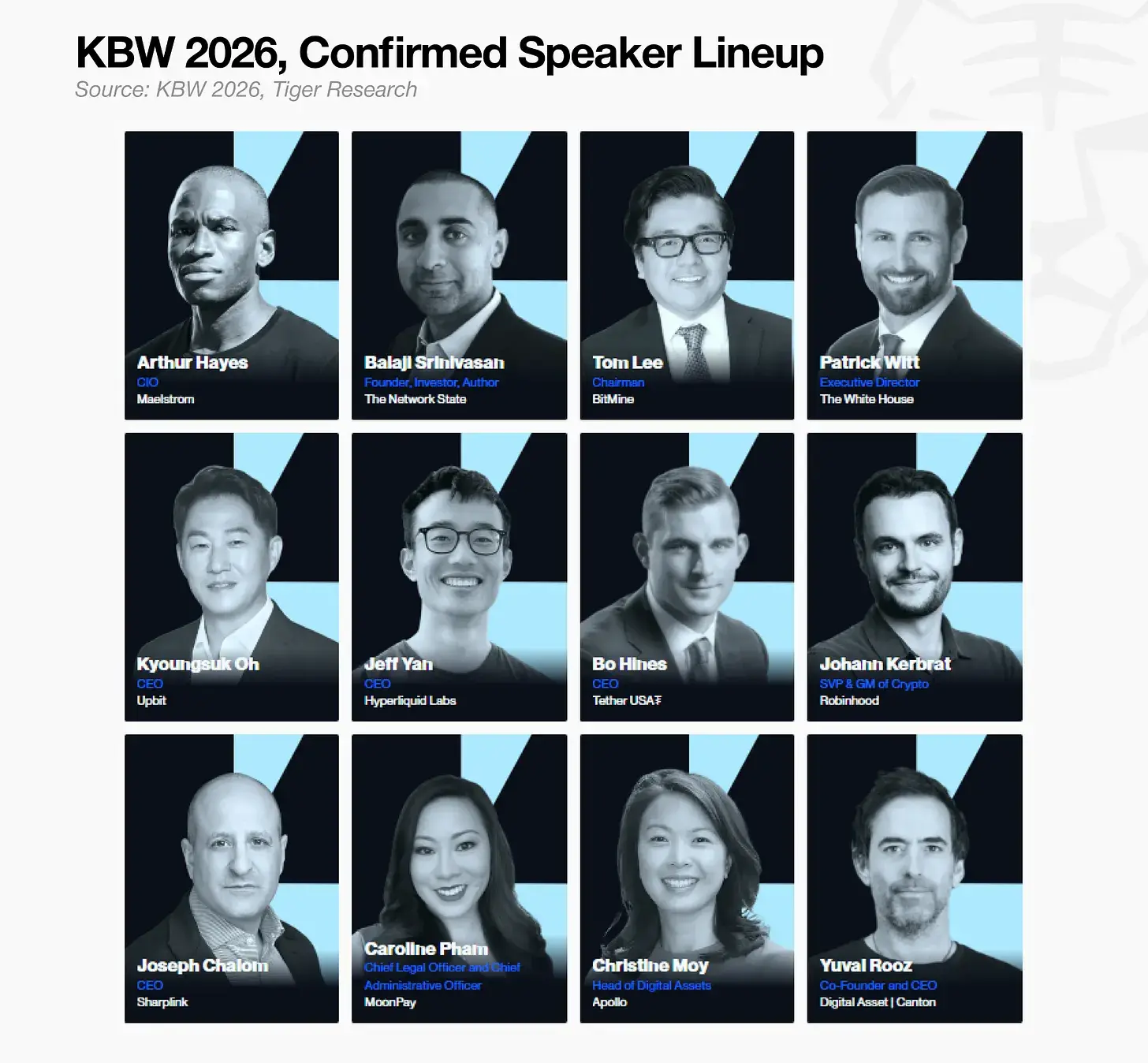
The results of this market restructuring are expected to manifest at KBW 2026, which will be held in Seoul in September 2026, an event that consistently reflects mainstream market conditions. Looking at the confirmed list of speakers, traditional financial professionals dominate. Last year, overseas foundations competed through community peripheral activities incentivized by tokens; this year, the focus is expected to shift towards substantive business discussions.
 Risk warning
Popular articles