








BitTorrent starts a 100% buyback and burn plan for BTT, officially launching a new era of deflationary value

 BitTorrent will use 100% of the decentralized business revenue for the long-term plan of BTT repurchase and destruction, promoting the fully circulating BTT into a new stage of sustainable deflation.
On July 6, BitTorrent, a global leader in decentralized network infrastructure services, released significant positive news, announcing the official launch of the long-term BTT token buyback and burn plan, marking the beginning of an upgrade to the entire ecosystem's value system.
According to the official announcement, BitTorrent will use all profits generated from its decentralized business for BTT buybacks, which will be continuously promoted on a quarterly basis. The corresponding token burn data will be publicly disclosed to the community around the middle of the first month of the next quarter, ensuring transparency and traceability throughout the process.
This arrangement also means that 100% of the profits generated from BitTorrent's decentralized business will be directed into the BTT buyback process, executed with a stable quarterly rhythm, truly achieving a token-driven deflation effect directly driven by actual business revenue.
The implementation of this long-term buyback and burn plan marks a key step for BitTorrent in deepening the BTT token economic model and strengthening the ecological value. By deeply binding its commercialization capabilities in decentralized business with the BTT token value system, it injects sustainable internal deflationary momentum into the BTT economic model, and will promote BTT's core identity upgrade from "ecological circulation governance token" to "revenue-driven deflationary asset."
BitTorrent Launches Long-Term Mechanism for BTT Buyback and Burn, Investing 100% of Decentralized Business Revenue into BTT Buyback Pool
On July 6, BitTorrent officially released the announcement regarding the launch of the BTT token buyback and burn, clearly stating that the long-term buyback and burn plan for BTT tokens will be fully launched in the third quarter (Q3) of 2026. This plan is centered around the logic of "all profits from decentralized business reinvested into token value" — all revenue generated from BitTorrent's decentralized business sector will be 100% directed towards BTT token buybacks, with all buyback and burn operations normalized to proceed on a natural quarterly basis, marking the formal establishment of a revenue-driven deflationary mechanism supported by real business revenue.
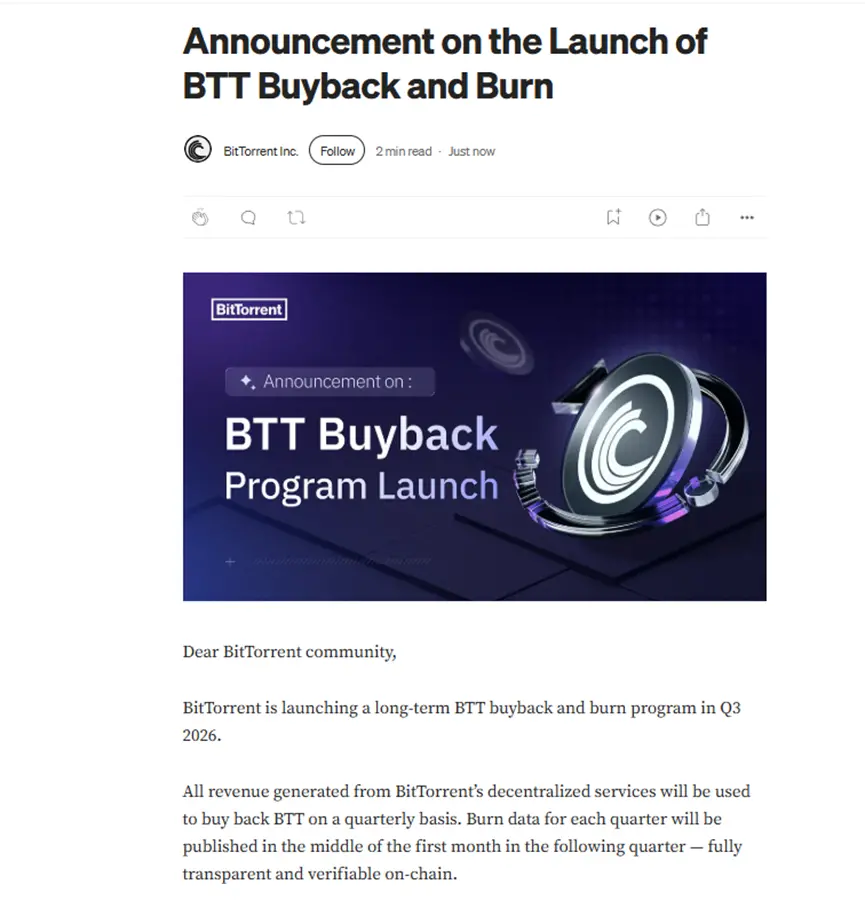
Regarding the source of the buyback funds, the official announcement clearly defines that all profits from BitTorrent's decentralized business sector will be used for BTT token buybacks, continuously executed on a quarterly basis. The corresponding BTT token burn data will be published around the middle of the first month of the next quarter, with all data publicly available on-chain.
The core rules of the BTT buyback and burn plan are clear: all revenue generated from BitTorrent's ecological decentralized business sector will be 100% directed into the BTT buyback fund pool, with buyback operations normalized to proceed on a fixed quarterly cycle, completely moving away from a phase-dependent model reliant on external funding. This completely abandons the phase-dependent operational model that relies on external financing, ensuring that each round of buybacks is supported by real business cash flow from a mechanistic level.
This buyback model, anchored in the real business's ability to generate revenue, fundamentally differs from mainstream practices in the industry. Most projects in the current market rely on funds raised through financing or team reserves for token buybacks, which are often one-time, short-term marketing buybacks primarily serving phase-based market value management goals, lacking sustained business revenue as a foundational support, making it difficult to form stable long-term execution expectations. In contrast, BitTorrent's BTT buyback and burn plan is entirely based on the revenue-generating capabilities of its ecological business, operating on a fixed cycle, representing a long-term sustainable deflationary system with self-generating and self-circulating capabilities.
In terms of information disclosure, BitTorrent also adheres to the principle of openness and transparency, with detailed data on BTT buybacks and corresponding burns for each quarter to be publicly announced around the middle of the first month of the next quarter.
Regarding the implementation arrangements for the first phase of the plan, the announcement also specifies specific milestones: the third quarter (Q3) of 2026 will initiate batch buybacks, with the revenue from BitTorrent's decentralized business in Q3 being used for BTT buybacks, and the corresponding batch burn data will be publicly disclosed around the middle of the first month of the fourth quarter (Q4), adhering to the principles of openness and transparency in execution.
In the current context of the overall pressure on the cryptocurrency market, where many projects are passively shrinking their business boundaries, BitTorrent's clear commitment to "100% of decentralized business revenue used for BTT buyback and burn" sends a strong signal of long-termism to the entire industry, embedding this entirely anchored in real business revenue-generating capability long-term buyback and burn value mechanism into the core rules of ecological operation. From now on, the value foundation of BTT will be deeply tied to BitTorrent's real business growth, and the dividends of sustainable ecological development will effectively reach all community participants.
BTT Has Completed Full Circulation Release, Buyback and Burn Mechanism Will Drive Deflation Model Initiation
For BTT, the formal implementation of the long-term buyback and burn mechanism means that each round of buybacks will directly correspond to a contraction in market circulation supply; and in a market landscape where the token has basically achieved full circulation, this normalized operating mechanism will truly push BTT into a new phase of sustainable deflation driven by real revenue.
According to public statistics from the cryptocurrency data platform CoinMarketCap, the initial total supply of BTT was approximately 990 trillion tokens, and the current total supply is 987.03 trillion tokens, while the actual circulating supply has also reached 987.03 trillion tokens, indicating that the phased release cycle of the token has been fully completed, and the overall market has officially entered a state of full circulation.
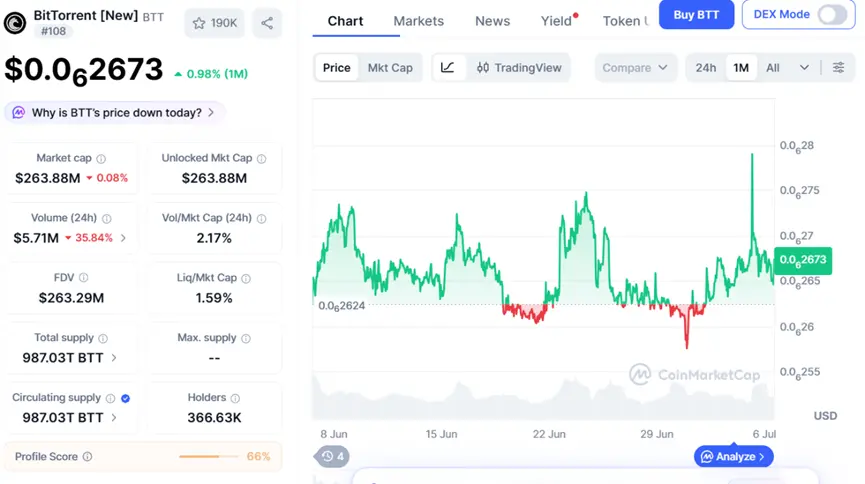
On this basis, the supply-demand model of BTT has entered a stable and mature normalized operating phase dominated by existing supply. With the completion of the release of early team and private placement tokens and market sedimentation, the current ecology has established a solid foundation of consensus among existing holders. In the future, as buyback actions continue to be implemented, they will more directly and efficiently translate into tangible deflationary momentum, continuously strengthening the underlying support for the core value of the token.
As of now, the number of global BTT holding addresses has exceeded 366,000, with holders covering multiple countries and regions around the world, highly decentralized, and possessing a broad and solid global community consensus foundation.
The implementation of this buyback and burn plan, under the premise of full circulation and no new selling pressure in the market, will continuously apply deflationary forces directly to the token's supply-demand balance system. Each round of quarterly buybacks and burns directly contracts the market circulation supply and continuously solidifies the fundamental value of BTT, ultimately promoting a positive cycle where token value growth and ecological business expansion are deeply bound.
More critically, the quarterly normalized buybacks of BTT are completely anchored in the real business revenue of the ecosystem, which will continuously reduce the circulating supply at a stable and predictable pace; and as BitTorrent's decentralized business landscape continues to expand and revenue scales steadily grow, the intensity of future buybacks will also increase, providing a continuous internal driving force for the entire deflationary effect, rather than relying on external funding for phase-dependent short-term operations.
BitTorrent Ecological Diversification Strengthens BTT Long-Term Value Foundation
As the native core token of the BitTorrent ecosystem, the application boundaries and value foundation of BTT have always been deeply tied to the business landscape of the ecosystem. In recent years, BitTorrent has continuously deepened its layout in core tracks such as distributed transmission, decentralized storage, and cross-chain infrastructure, continuously expanding the ecological boundaries.
On June 17, BitTorrent launched the BTTInferGrid decentralized AI inference computing network based on BTFS upgrades, linking a vast amount of idle GPU computing power worldwide with the needs of AI developers, officially entering the decentralized AI computing track, adding a core growth engine to the ecological business matrix. As the ecosystem continues to expand, the application scenarios of BTT are continuously extending in multiple dimensions.
Currently, the BitTorrent ecosystem has built a diversified business matrix covering multiple tracks, with core products including the BitTorrent network, high-performance cross-chain infrastructure BTTC (BitTorrent Chain), and the BTTInferGrid decentralized AI inference computing network, which has been upgraded and iterated from the BTFS system.
In terms of application, BTT currently relies on the BitTorrent user network and BTTC cross-chain infrastructure to form a diversified application system covering a vast number of users and multi-chain ecosystems.
In the BitTorrent network, the BitTorrent Speed download acceleration service is one of the core landing scenarios for BTT. Users can earn BTT rewards by sharing idle bandwidth and upload resources, and they can also use BTT to exchange for faster download speeds, creating a complete economic closed loop of "contribution equals mining, consumption equals payment." According to official data, as of June 24, over 58,100 wallet addresses have been created on BitTorrent Speed, and the large existing user base will provide strong support for the continued application of BTT.
In the cross-chain infrastructure BTTC network, BTT, as the core native asset of the network, undertakes underlying functions and can be widely used for node staking, ecological incentives, and on-chain payments throughout the process: users can stake BTT to become network validation nodes, participating in on-chain consensus maintenance and ecological governance decisions; at the same time, BTTC also features a BTT staking lock-up yield mechanism, with current lock-up annual yields reaching 7.38%. According to official disclosed data, there are over 27 various ecological applications deployed on the BTTC network, and the continuously active ecological operation brings richer circulation scenarios and value support for BTT.
With the launch of the new BTTInferGrid business, it not only represents a key leap in BTT application scenarios but also injects new long-term growth momentum into the buyback fund pool, allowing the deflation mechanism to have the potential for continuous enhancement. On one hand, BTT will become the native unified incentive and settlement token within the BTTInferGrid ecosystem, covering all aspects of the AI computing industry chain, including payment for computing power usage, node contribution incentives, and dynamic scheduling of computing resources. On the other hand, as the scale of the BTTInferGrid business continues to grow, the revenue generated will also be included in the buyback fund pool, expected to become a core new force driving the continuous expansion of buyback fund scale in the future.
As an important milestone, the strategic positioning of BTT has completed a critical upgrade, and its intrinsic value logic has also become clearer and more systematic.
First, in terms of application dimension, BTT will evolve from a circulating medium within the world's leading decentralized file transfer network to a multi-scenario value medium that spans distributed transmission, cross-chain settlement, and decentralized AI computing, significantly expanding its application boundaries.
On this basis, its value empowerment mechanism has also been reconstructed and strengthened. With the implementation of the long-term buyback and burn plan for BTT, all revenue growth from decentralized business scenarios will directly solidify as rigid value support for the token, thoroughly connecting the transmission chain between ecological business and token value: on one hand, the continuous expansion of business scenarios and steady improvement in profitability provide an increasingly strong revenue base for BTT buybacks; on the other hand, the ongoing execution of the buyback mechanism will continuously convert business dividends into deflationary support for the token.
Both aspects mutually reinforce and drive each other in a dynamic cycle, jointly constructing a positive flywheel effect of "business revenue generation → buyback deflation → value feedback → ecological expansion."
Thus, BTT is no longer merely a circulation and governance tool within the BitTorrent ecosystem, but has become a core value asset anchored in real business revenue with continuous deflationary attributes; every BTT held by users will share in all the dividends of ecological development as the scale of ecological business and revenue grow.
 Risk warning




Popular articles





