








Binance Research: Stablecoins are reshaping the financial landscape
 Core Viewpoint

 Stablecoins are transforming from a transit point in cryptocurrency trading to a place for capital accumulation: 30% of users allocate more than half of their assets to stablecoins, a figure that has risen from 4% in 2020 to 30% in 2026. More critically, 87% of fiat currency incurs a premium when exchanged for stablecoins, with a severe inflation premium reaching as high as 62%, indicating that demand is driven by currency risk rather than trading convenience. This report suggests that stablecoins are simultaneously fulfilling the three major monetary functions of store of value, payment, and settlement.
Author: Binance Research
Compiled by: Jiahua, ChainCatcher
I. Key Points
Stocks begin to settle with stablecoins. Perpetual contracts linked to traditional finance rose to about 11% of the total trading volume of perpetual contracts within just five months in 2026, with a cumulative trading volume exceeding $1.1 trillion. Binance leads with over $500 billion, accounting for about 47% market share.
Since 2022, Binance Earn has distributed $1.2 billion in rewards to stablecoin holders. On-chain USD yields range from 2% to 4%, far exceeding the national average savings rate of 0.38%.
User behavior reflects "savings," while prices indicate "escape." 30% of users allocate more than half of their assets to stablecoins (up from just 4% in 2020); 87% of fiat currencies experience a premium when exchanged for stablecoins, with premiums reaching as high as 62% in hyperinflationary economies.
A single platform holds $53 billion in reserves, and its advantage continues to expand. Binance leads the second-largest exchange by $42 billion, with its share rising from 54% to 57%; it has also nurtured explosive growth in stablecoins: United Stable (U) has grown approximately 180 times to over $1 billion this year, while USD1 has increased by over $1.4 billion, a rise of 43%.
The growth engine of stablecoins is surpassing the dollar. Local currency stablecoins, including EURI, AEUR, and KGST, have accumulated trading volumes exceeding $5 billion on Binance since 2025, with an average monthly trading volume stabilizing at $316 million.
A public chain begins to support daily stablecoin payments. BNB Chain processes an average of 10 million transactions daily, with 15 million active addresses monthly; Binance Pay's transaction volume has grown by 114% since 2025, with the median merchant payment rising from $10 to $18.
Adoption varies by region based on function. East Asia and the Pacific contribute about 70% of Earn savings balances, while the Middle East and North Africa (MENA) is the fastest-growing savings user group. Latin America's remittance share has increased by 21 percentage points, and North America (excluding the U.S.) leads in local currency trading growth.
A market that never sleeps sees $76 billion in liquidity every weekend (close to Visa's scale), and its next batch of users is machines. On-chain foreign exchange trading volume has grown by 670% since 2024, with the median transaction amount for AI agents reaching $0.34.
II. Introduction
Traders pursue cost optimization, while savers pay for "safety." The most revealing finding of this report is that stablecoin users today behave more like the latter than the former.
Among Binance users, 87% of fiat currencies experience a premium when purchasing stablecoins, with premiums in hyperinflationary economies reaching 62%. No one would pay a price 62% above the official exchange rate for "convenience"—they are paying for a "ticket out."
In the first decade since the emergence of stablecoins, they were often seen as a cryptocurrency infrastructure: a currency for pricing, a stopover in trading gaps. However, the data in this report paints a different picture—stablecoins are now a place for capital accumulation, not just a transit point.
30% of Binance users allocate more than half of their assets to stablecoins, a figure that has steadily climbed from 4% in 2020, traversing every market cycle with almost no correlation to token prices.
Idle balances can earn yields of 2% to 4%, while the national savings rate is only 0.38%; government bonds continue to trade over the weekend; new issuers reach billion-dollar scales within months. Meanwhile, two demand lines—machine payments and on-chain foreign exchange—almost nonexistent two years ago, are accelerating compound growth from a real base.
This report interprets this behavior using the oldest yardstick in monetary economics—the three functions of money. Stablecoins are being used as savings accounts when local currencies are untrustworthy, as payment rails when traditional channels charge excessively, and as settlement venues that remain open when other markets are closed.
The functions adopted first in different regions vary, but the direction is consistent. As the largest reserve holder, yield distributor, and on-chain payment network in the industry, Binance is at the center of this flow of funds.
Thus, the question is no longer whether stablecoins will join the financial system, but how many financial systems may migrate to stablecoins and how quickly.
III. Identity Transformation: Towards the Same Destination
From Cryptocurrency Trading Currency to Global Settlement Currency
Stablecoins were once merely trading currencies in the crypto world; today, they have become a settlement layer of a completely different magnitude: obtaining sovereign-level yields, gaining 24/7 exposure to stocks and indices through TradFi-Perps, and directly holding traditional assets—all accomplished within a single account, without brokers, intermediaries, or settlement delays.
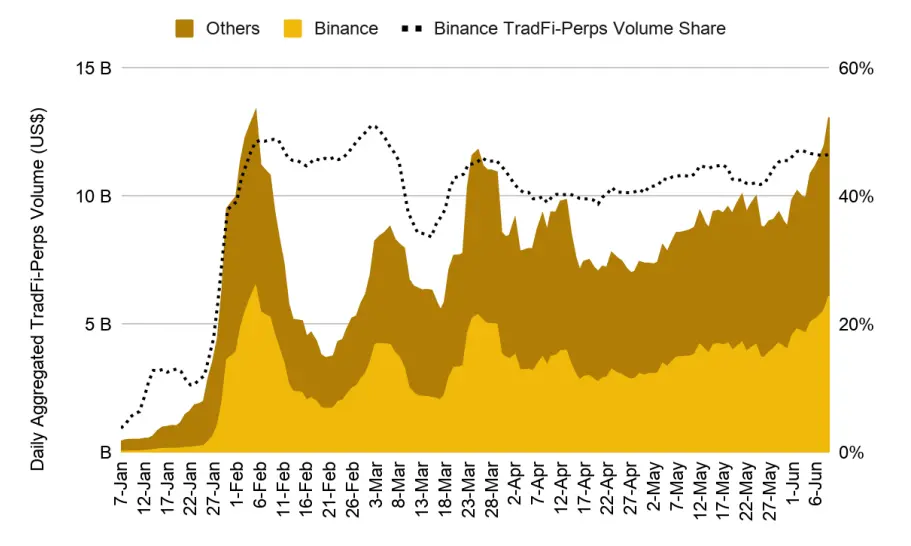
The speed of adoption is extremely fast. TradFi-Perps grew from a negligible base to about 11% of the total volume of perpetual contracts in just five months in 2026, accounting for 8.1% of the daily trading volume of all categories of stablecoins. Cumulative trading volume has exceeded $1.1 trillion, with Binance leading with over $500 billion, about 47% market share.
The key point is that since February, the "bottom" of trading volume has been rising (rather than just the "top"), indicating structural adoption rather than event-driven speculation.
Directly settled stock trades using stablecoins are still in their early stages, currently accounting for less than 0.1% of stablecoin daily trading volume. However, as the infrastructure for directly holding traditional assets (not just leveraged derivatives) expands, this area is expected to grow significantly. Stablecoins are no longer just a liquidity layer in the crypto world.
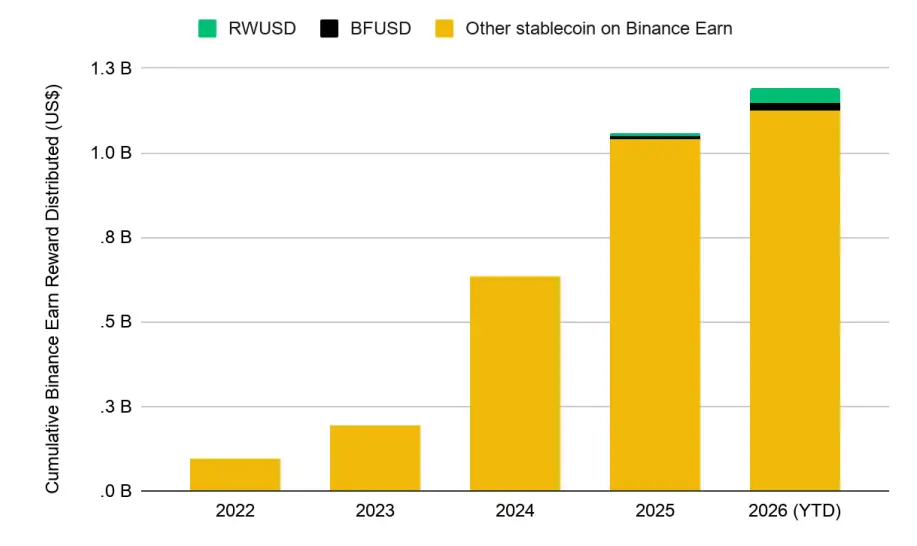
Since 2022, Binance Earn has distributed $1.2 billion to stablecoin holders
Stablecoins are not only used differently but are also "held" differently. At Binance, this transformation has become quantifiable.
Binance Earn has evolved from a supplementary feature to a core retention engine. Stablecoins allocated to Earn now account for 33% of the platform's holdings, serving over 14 million users, a scale few centralized platforms can match.
Yields come from Binance's broader ecosystem revenue, supplemented by platform-sponsored incentive activities—56 have been launched in the past year. Cumulative rewards to stablecoin holders have grown from $97 million in 2022 to $1.2 billion in 2026, reflecting the sustained and widespread increase in participation in on-chain yield products.
Its architecture also extends to proprietary products: RWUSD captures yields from tokenized U.S. Treasury bonds and other real-world assets, BFUSD operates delta-neutral basis strategies, and will expand over time to include more crypto and traditional yield sources. Collaborations with Ethena's USDe further increase options, making Binance Earn a multi-source crypto savings layer rather than a single product aggregator.
Historical reward data only reflects past distributions and does not guarantee future rewards; amounts may vary and are not guaranteed, and the value of digital assets may fluctuate.
Yields exceed banks by more than 8 times
Yield-bearing stablecoins represent one of the most profound shifts in the financial industry. Dollar-denominated yields have historically been constrained by brokers, minimum balance requirements, and geographic locations in developed markets, concentrating the economic benefits of the interest rate environment in the hands of a small portion of the global population. Yield-bearing stablecoins dismantle this structure, decoupling dollar yields from traditional financial intermediaries.
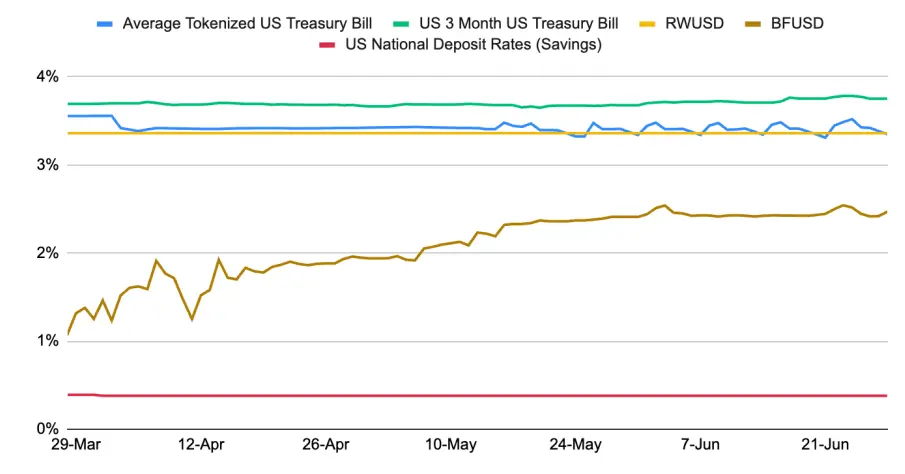
The yield landscape confirms this shift. In Q2 2026, the average annualized yield of tokenized U.S. Treasury bond products was 3.42%, with RWUSD's individual yield at 3.36%; the yield of BFUSD based on delta hedging was 2.09%—all significantly higher than the national savings rate of 0.38%.
Three-month U.S. Treasury bonds yield 3.70%, remaining the sovereign benchmark, while tokenized bond products are nearing that level without requiring broker accounts, qualification verification, or almost any minimum balance threshold.
Exchanges periodically launch yield activities with annualized rates of 8% to 12% (with caps); Binance Earn supports deposits starting as low as $0.01 and provided an additional 8% yield on United Stable (U) in June 2026, capped at 10,000 U per user, with returns far exceeding market averages. Activity yields are time-limited and capped, and do not represent long-term returns; see the relevant activity terms for details.
An increasing number of stablecoin holders are migrating idle balances into these products, treating yield products as a "production layer" above their foundational stablecoin positions. Demand for yield-bearing stablecoins remains robust even during downturns in the crypto market, constituting a structural rather than cyclical part of stablecoin supply growth.
The rise of "long-term holders" of stablecoins
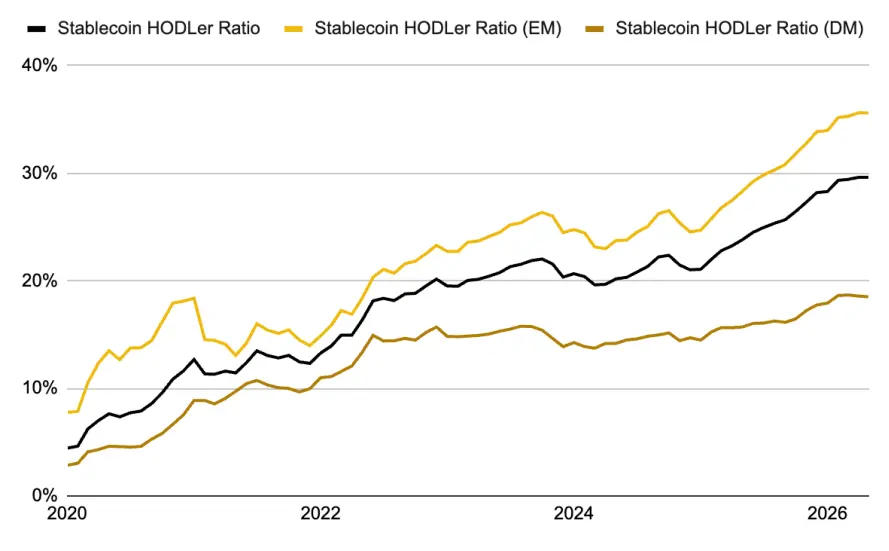
Stablecoins are no longer a transit point between crypto trades but have become a destination. Among Binance users with total holdings of at least $10, 30% allocate more than half of their assets to stablecoins, aligning with savings intentions (rather than active trading).
This proportion rises to 36% in emerging markets, and stablecoin holdings show no significant correlation with crypto market cycles, steadily increasing from 4% in 2020 to 30% in 2026.
This shift is most significant in emerging markets—stablecoins have effectively become a borderless digital dollar savings account. For users facing currency depreciation, capital controls, or limited access to foreign exchange, it allows them to preserve dollar-denominated purchasing power without needing a U.S. bank account or proximity to developed market financial institutions.
For ordinary savers in emerging markets, no traditional savings product can replicate the combination of "dollar stability + yield + censorship-resistant portability."
However, this trend is not limited to emerging markets. The proportion of developed market users holding stablecoins in a savings-like manner ranges between 14% and 16%, rising to 19% in 2026.
The universality of these two groups points to a larger signal: the demand for stablecoins is long-term, structurally anchored, driven by monetary conditions and financial exclusion, rather than crypto sentiment. It is steadily compounding growth, much like the historical demand for physical dollars and gold in economies where monetary policy is unreliable.
Premiums as "revealed preferences"
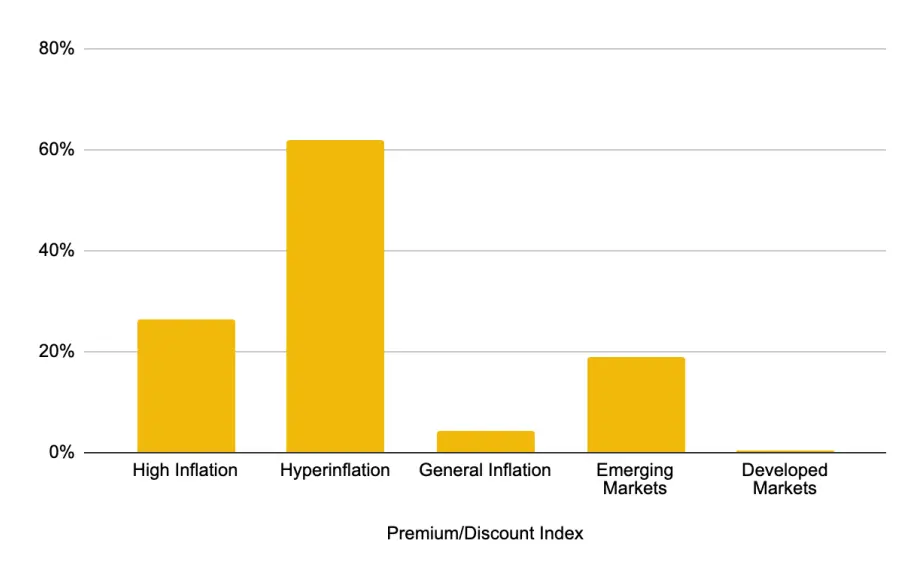
The price users are willing to pay for stablecoins, above the current fiat exchange rate, reveals their urgency to escape local currencies. Among Binance users, 87% of fiat currencies experience a premium when purchasing stablecoins, which is almost a universal signal: demand is driven by currency risk rather than trading convenience.
Premiums correlate highly with inflation: users in hyperinflationary economies (inflation above 10%) pay an average premium of 62%, those in high-inflation economies (above 5%) pay 27%, while in normal inflation environments, only 4% (roughly equivalent to standard trading costs).
The divergence between emerging and developed markets reinforces this same pattern. Emerging market users pay an average premium of 19%, reflecting varying degrees of currency instability, capital controls, and structural misalignments between secondary market pricing and official managed exchange rates. Developed market users, on the other hand, pay an average premium of only 0.3%, consistent with smoothly obtaining dollar liquidity through sound financial facilities.
Willingness to bear a premium of 27% to 62% above the spot exchange rate is not a rational trading behavior but rather a wealth preservation under pressure.
Users seeking to protect purchasing power outside the formal banking system have adopted stablecoins as their default hedging tool; in economies where access to dollars is restricted or costly, it has become a practical substitute for dollars.
IV. The Gravity Center of Stablecoins
Exchanges as Stablecoin Hubs
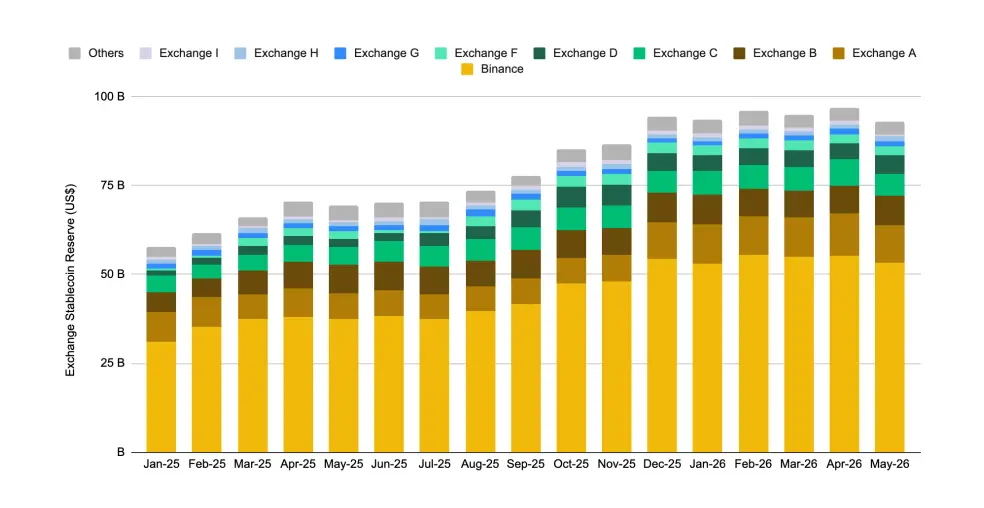
Stablecoin reserves measure "trust," and by this standard, Binance's position is unequivocal. Binance holds $53 billion in stablecoin reserves, exceeding the second-ranked exchange by $42 billion.
This lead is also expanding: since early 2025, Binance's share has risen from 54% to 57%, while the total reserves of stablecoins across exchanges have expanded by 61% (an increase of $35 billion), with Binance capturing most of that incremental growth—indicating that the speed of funds flowing to the platform is faster than the total of the rest of the industry.
Two conclusions can be drawn from this.
First, centralized exchanges remain the primary venues for stablecoin activity, with most capital deployed in trading, yield, payments, and collateral management, rather than being moved to self-custody wallets or DeFi.
Second, Binance's disproportionate share points to something beyond scale: users are actively concentrating their stablecoin holdings on a single platform.
A reserve base of $53 billion, growing faster than the market it already dominates, is no passive result. It reflects users treating Binance as the primary custodian and operational layer for dollar-denominated capital on-chain, and this concentration is the clearest quantifiable signal of platform trust.
The Growth Engine of Stablecoins
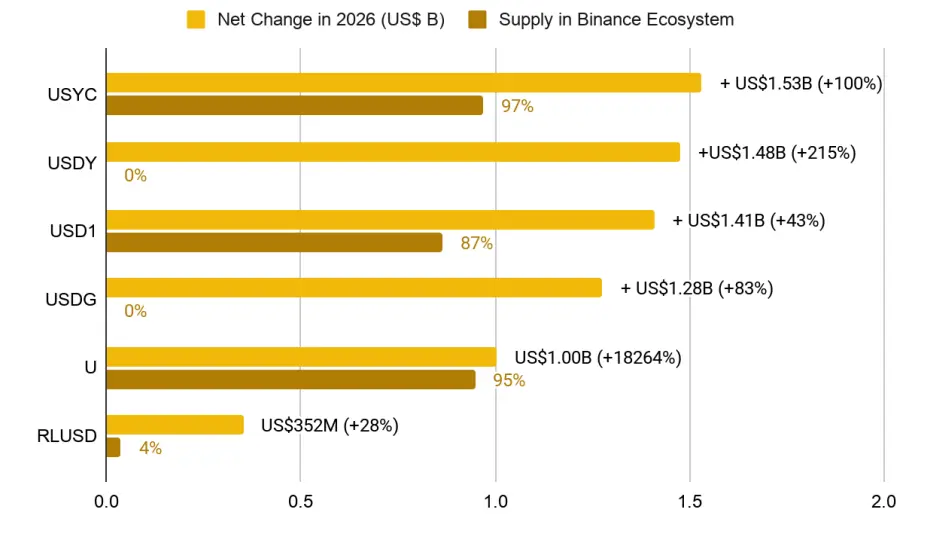
Yield-bearing stablecoins led in the first half of 2026, driven by the growing on-chain demand for productive dollar assets.
USYC, issued by Circle, leads all peers in absolute dollar amounts, increasing by $1.53 billion, from about $1.5 billion to $3 billion, a rise of over 100%, with nearly 97% of the supply issued on BNB Chain.
Ondo's USDY has followed a similar steep trajectory, expanding from $687 million to $2.16 billion. Both entered 2026 from relatively inconspicuous positions and reached institutional-level scales within six months, demonstrating that in a mature ecosystem, distribution capabilities can quickly translate into market cap growth.
Among stablecoins with a market cap below $1 billion at the beginning of 2026, U is the fastest expanding one during this period. It started with a market cap of about $5 million and surpassed $1 billion by mid-2026, growing approximately 180 times within the year—such a growth rate is rare for any asset. About 95% of the supply is concentrated on Binance and BNB Chain, reflecting the platform's unique ability to serve both as an incubator and a primary distribution channel for emerging stablecoin projects.
At the large-cap end, USD1 entered 2026 with a base of $3.3 billion and grew by 43%, adding over $1.4 billion in market cap, with 87% of the supply on Binance and BNB Chain. USDG grew from $1.53 billion by 83% to $2.8 billion; RLUSD grew from $1.28 billion by 28% to $1.63 billion, with 4% of the supply on Binance.
Growth spans all market cap tiers, from early assets to mature large caps, indicating that the Binance ecosystem is not just a venue for stablecoin activity but a structural force shaping how new monetary tools are adopted and scaled.
The $5 Billion Baseline for Non-Dollar Demand
Since the emergence of stablecoins, the dominance of the dollar has defined the on-chain monetary system. However, this pattern is beginning to change.
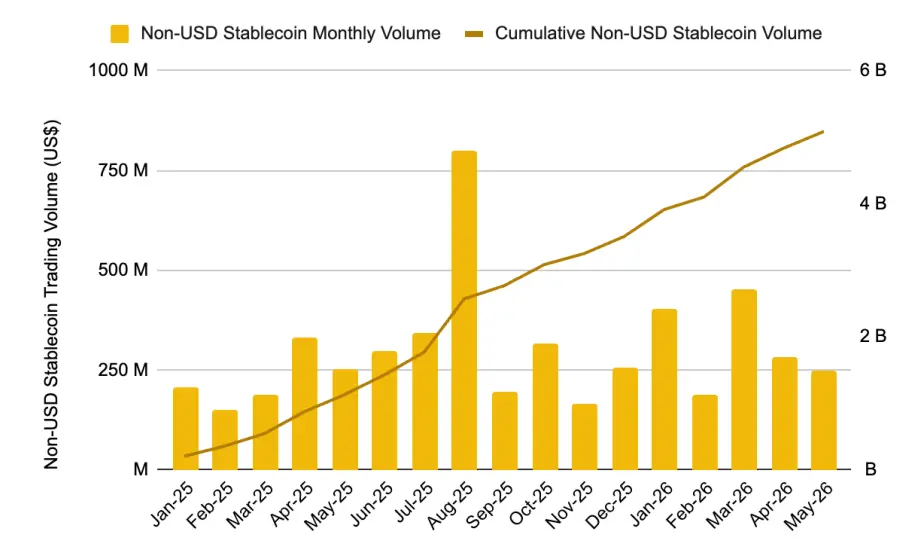
Since 2025, local currency-pegged stablecoins have accumulated trading volumes exceeding $5 billion on Binance, with an average monthly trading volume of $316 million, making non-dollar stablecoins like EURI, AEUR, and KGST a structurally significant part of the broader stablecoin landscape. In August 2025, monthly trading volume peaked at $800 million, about 2.5 times the average for the period, with the euro stablecoin EURI holding the leading share.
Exchange infrastructure is accelerating this transformation. Zero-fee trading pairs and the primary liquidity supply for non-dollar stablecoins directly address the barriers that have historically limited their adoption: poor liquidity, wide spreads, and limited use cases.
For users whose income, liabilities, and expenses are denominated in euros, pounds, or other major currencies, circumventing dollar stablecoins introduces unnecessary exchange friction and basis risk, while local currency stablecoins completely eliminate this issue.
The average monthly trading volume of $316 million can be maintained during both peak and trough periods, which is a more enduring signal: demand is not sporadic but is compounding growth. As regulations become clearer and liquidity deeper, the on-chain monetary system is gradually achieving the currency diversity that has long existed in offline global trade.
V. The Preferred Trading Network
BNB Chain Leads in Transactions and Users
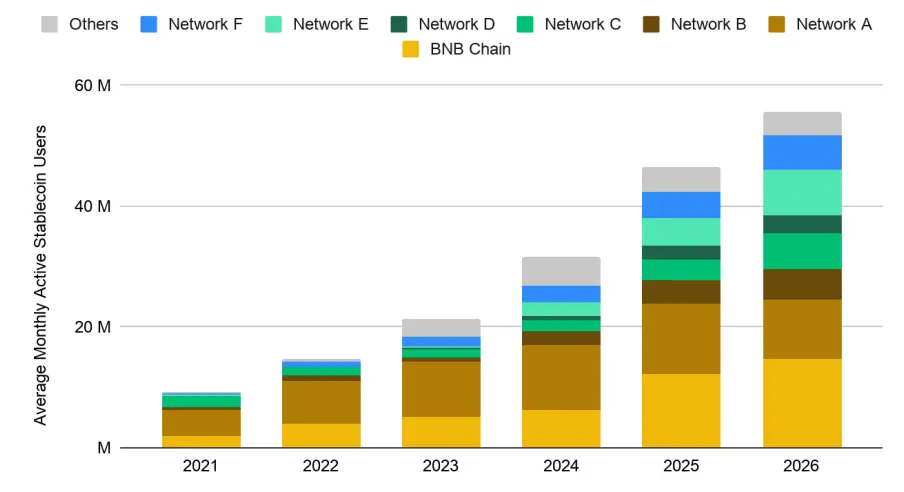
Market capitalization only measures supply; transaction counts and active users measure whether stablecoins are truly being used. On both dimensions, BNB Chain leads.
The network processes an average of 10 million stablecoin transactions daily, with 15 million active addresses monthly, clearly outpacing competing networks. Since 2025, BNB Chain has processed over 5.3 billion stablecoin transactions, accounting for 24% market share, the largest share among all networks based on transaction counts.
This activity reflects retail-level payment behavior: individuals repeatedly transact amounts suitable for shopping, remittances, and daily financial management (rather than institutional fund movements). High transaction counts and moderate average transaction amounts are the clearest signals of genuine daily adoption.
The development trajectory further reinforces this lead. Monthly active addresses grew nearly 30% in 2026 compared to 2025, indicating that adoption is accelerating rather than reaching a mature plateau. Retail users are establishing habitual infrastructural relationships, and BNB Chain is accumulating behavioral patterns that define lasting network dominance.
Rising Payment Amounts
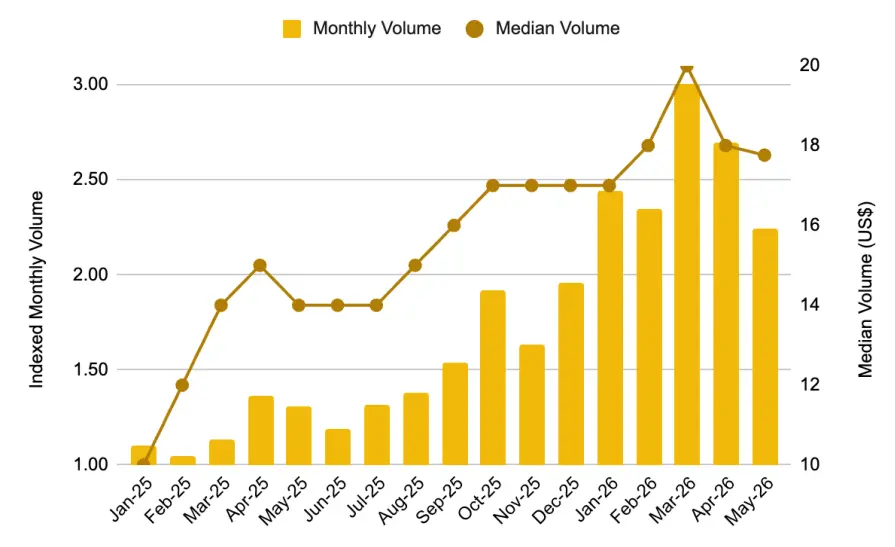
Binance Pay's transaction data reveals a decisive shift in stablecoin commercial settlements. In 2026, the monthly merchant payment volume from 21 million registered merchants globally grew by 114% year-on-year, with stablecoins accounting for 98% of total payment volume.
The composition of these transaction volumes is also noteworthy. The median payment amount rose from $10 in 2025 to $18 in 2026, an 80% increase within a year.
Early stablecoin payments were primarily small, crypto-native use cases. The rise in median transaction amounts marks a qualitative shift beyond this phase, reflecting growing confidence in the finality, settlement reliability, and cost efficiency of stablecoins.
In traditional payment systems, the transition from low-value to high-value adoption only occurs after sufficient confidence has been built around counterparty reliability and operational resilience. Binance Pay data reflects this dynamic: institutional and semi-institutional participants are now directing substantial transaction volumes into stablecoin rails.
Businesses organizing procurement, cross-border vendor payments, and large transactions around stablecoin settlements are embedding this tool into their operational frameworks, creating compounding conversion costs and network effects over time. This is not a fleeting payment trend but a structural shift in commercial settlement methods.
VI. The Geographic Landscape of Stablecoin Demand
Regional data presents three portraits of stablecoin demand: value storage against currency instability or capital controls, yield-bearing Earn deposits in regions with limited yield access, and payment utility in high remittance corridors where traditional channels are costly. When these portraits overlap, adoption accelerates.
Stablecoin Savings Accelerate in MENA
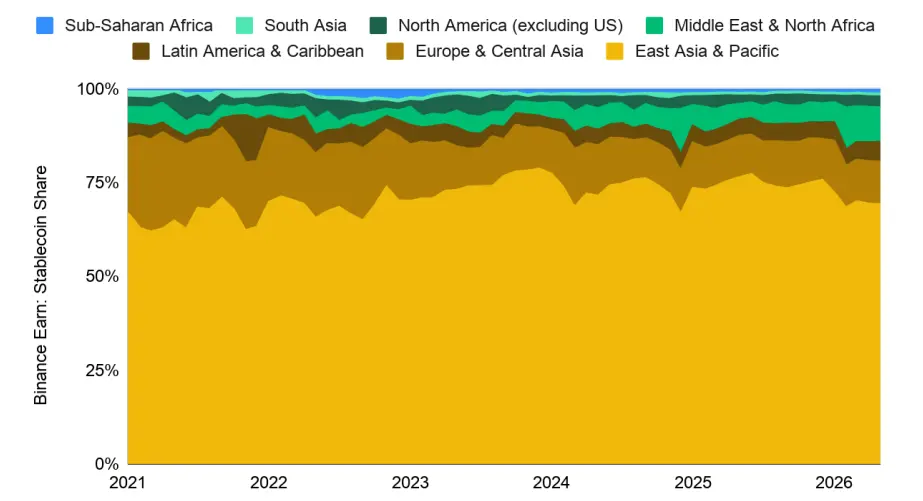
East Asia and the Pacific anchor about 70% of Binance Earn's stablecoin deposit balances, reflecting the region's deep crypto-native engagement and high exchange penetration. Europe and Central Asia (11%) and the Middle East and North Africa (9%) form a clear second tier.
However, similar shares mask different trajectories: Europe and Central Asia present a mature picture, with users supplementing existing savings facilities; while MENA has recorded the fastest expansion among all regions, with market share rising 67% since 2025, from 5.53% to 9.21%.
In markets where currency pegs depress domestic yields and runaway inflation erodes the value of local currency savings, yield-bearing stablecoins have become a tool for users to fend off wealth erosion.
MENA users are turning to them not due to a lack of alternatives but because traditional finance has failed to provide dollar yields without requiring offshore banking relationships—while a deposit share that has expanded 67% since 2025 speaks volumes.
Latin America Increasingly Favors Stablecoin Remittances
For users in emerging markets, stablecoins address the core flaws of traditional cross-border banking: multi-day settlement windows, opaque fee structures, and the value extraction by intermediary banks at every step.
Near-instant settlement and effectively lower costs represent a fundamentally different capability rather than a gradual improvement. This speed and cost advantage translate into faster remittance adoption, most notably in Latin America and the Caribbean.
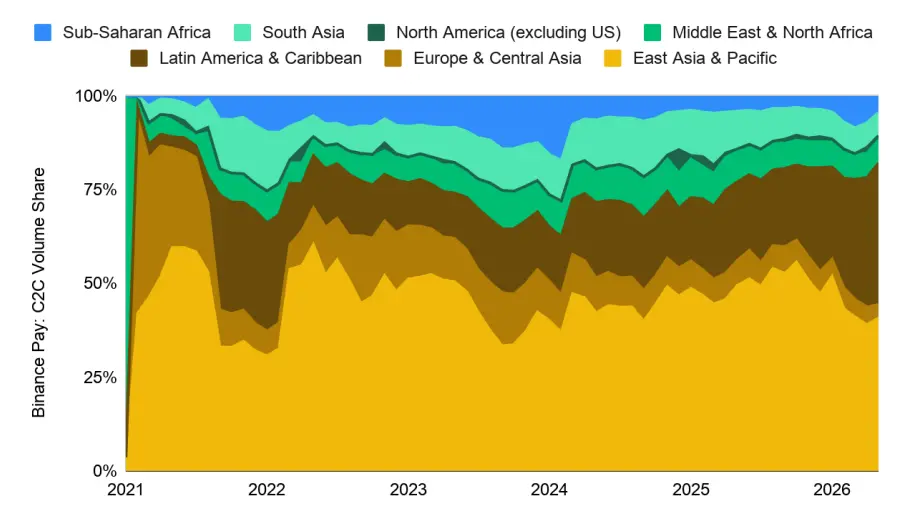
East Asia and the Pacific lead with a 41% share of peer-to-peer stablecoin remittances, consistent with their overall on-chain dominance; however, Latin America and the Caribbean have recorded the fastest regional adoption rate globally, with the share of stablecoin remittance users more than doubling since 2025, from 17% to 38%.
This region encompasses some of the world's most active remittance corridors, where incoming funds represent a significant portion of GDP across multiple economies, and the cost differences between stablecoin rails and traditional wire transfer channels are most pronounced.
Widespread currency instability adds another layer of adoption incentive, giving users more reason to denominate and transfer value in dollars. The shift of users in this region towards stablecoin remittances is not due to a lack of options but because traditional facilities cannot match the speed and cost offered by stablecoin rails—an increase of over twofold in remittance share since 2025 speaks for itself.
The Preferred Settlement Currency
Local currency stablecoin trading presents a distinctly different regional picture compared to remittances and holdings, with the dominant dynamic being concentration in developed markets.
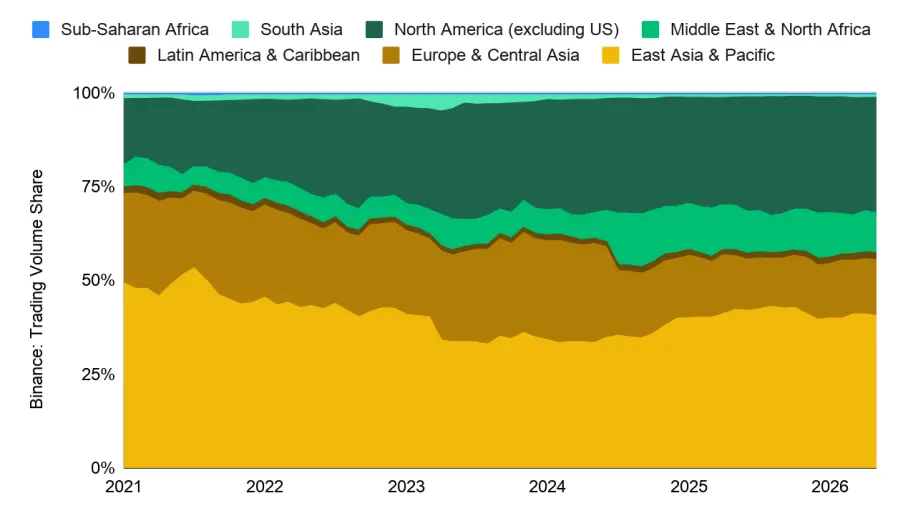
East Asia and the Pacific maintain the largest share at 40%, consistent with their existing on-chain trading dominance and long-standing preference for stablecoin settlement positions (which can smoothly rotate assets outside of regular forex trading hours).
The most analytically significant development is the expansion of North America (excluding the U.S.) from 28% to 31%, the largest increase among all regions during this period. The driving factor is not currency substitution but trading infrastructure: stock markets close at 4 PM, forex desks thin out over the weekend, and settlement cycles introduce delays, while stablecoin rails eliminate these delays entirely.
The significance lies in "who is adopting": traders in developed markets with mature financial infrastructure still choose stablecoin settlements—because as macro volatility intensifies, 24/7 risk management has become a competitive necessity.
The stable trading share in emerging markets remains stable, combined with growth in North America (excluding the U.S.), reflecting an expansion across different demand portraits, reducing structural concentration risks, and pointing to a trading market anchored in lasting operational utility.
VII. Unmissable Stablecoin Trends: The Currency That Never Sleeps
Time Arbitrage: $76 Billion Flowing Every Weekend
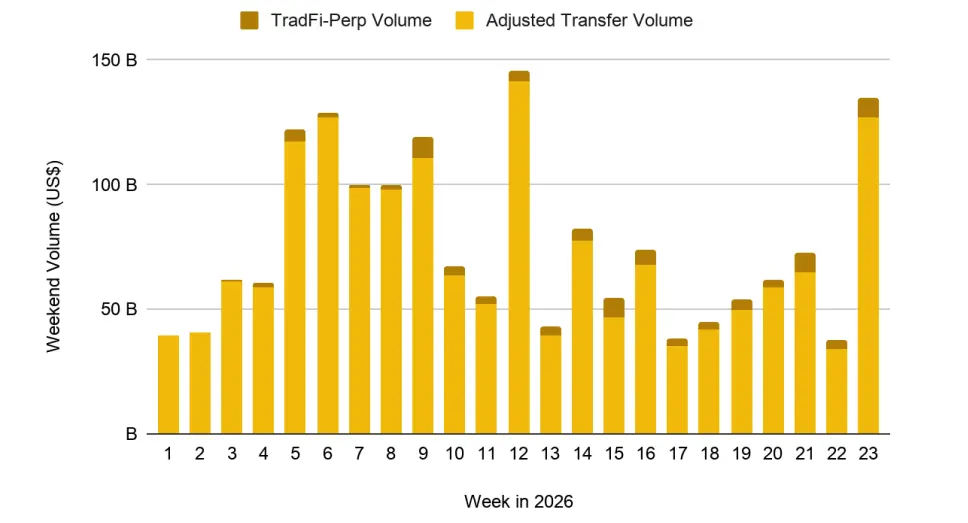
Traditional markets impose a 60-hour liquidity vacuum every weekend. When macro shocks occur on Saturday, there is no mechanism for action before the market reopens, and by then, repricing has often already happened. Stablecoins do not face this constraint.
According to Allium's adjusted transfer metrics (excluding any activity exceeding 1,000 transactions or $10 million within any 30-day period), stablecoin transfers still average $76 billion every weekend, roughly $38 billion daily, close to Visa's daily transaction volume of about $40 billion, equivalent to 53% of the weekday average of $71 billion.
Traditional asset perpetual contracts settled with stablecoins add about $4 billion in weekend trading volume—this demand exists precisely because the stablecoin market remains open when other markets are closed.
This is not residual crypto speculation but evidence that stablecoins have embedded themselves into financial workflows that do not pause due to trading hours.
Agent Payments: The $0.34 Economy
AI agents cannot open bank accounts, cannot undergo identity verification, and cannot tolerate traditional settlement delays. They trade in a programmatic, continuous, high-frequency manner, and the only tool that meets these requirements is stablecoins: permissionless, programmable, compatible with micropayments, and capable of real-time settlement at near-zero costs.
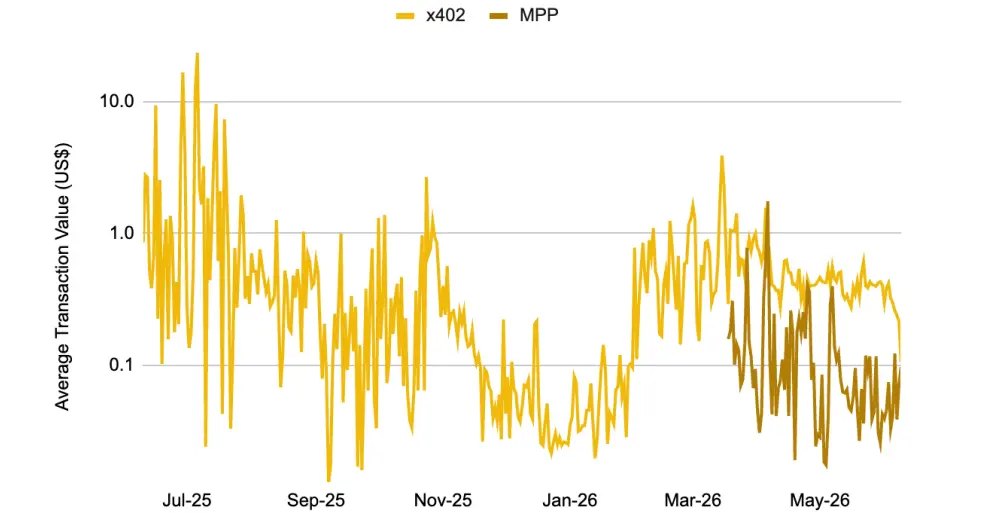
The economic feasibility makes traditional infrastructure structurally incompatible. The median payment amount for x402 is $0.34, while the median transaction amount for machine payment protocols (MPP) is only $0.08. At such amounts, traditional network fees often exceed the value of the transaction itself, disqualifying credit card networks, ACH facilities, and traditional blockchains with fluctuating gas costs.
Stablecoins on high-performance blockchains directly address this issue: near-zero fees, sub-second finality, and native programmability allow payments and subsequent actions to be atomically settled in a single transaction, eliminating reconciliation costs associated with multi-step settlements.
Adoption data confirms that this infrastructure is finding its market. The 7-day rolling average transaction volume has rebounded 184% from the low point in mid-2026; merchant adoption on x402 has quadrupled to over 7,500 merchants; more than 750,000 independent buyers have completed transactions through this ecosystem.
As the scale of AI agent deployments expands, the unique viability of stablecoin micropayment economics will become an increasingly decisive structural advantage.
On-Chain Foreign Exchange: Eating Away at a $75 Trillion Daily Market
Every cross-border capital flow carries an implicit tax: intermediary banks extract spreads and fees at every step, forex hedging costs accumulate, and multi-day settlement windows create timing mismatches, resulting in additional currency exposure.
Stablecoin AMM trading eliminates this entire cost structure. Settlement and clearing are completed simultaneously in a single atomic operation, without intermediary banks, without pre-funded accounts, and without delays between agreement and execution.
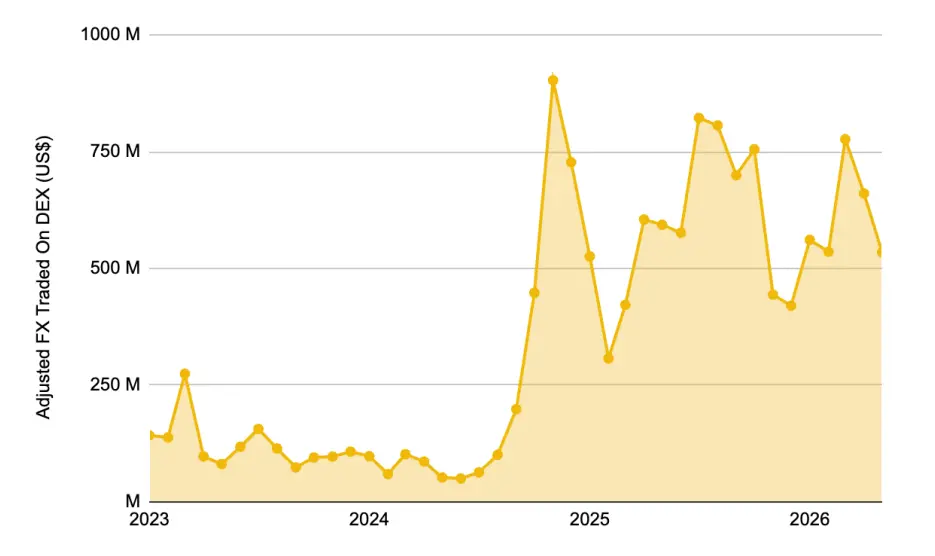
The market is responding. In 2026, the on-chain foreign exchange trading volume for non-dollar stablecoin pairs exceeded $3 billion for the year, with an average monthly operating scale of $614 million, growing 670% compared to the same period in 2024, with a compound annual growth rate of 177%.
The driving force is the proliferation of local currency stablecoins: as euros, pounds, and other non-dollar instruments reach sufficient issuance depth and exchange liquidity, each new addition expands the reachable market and deepens the network effects between tradable currency pairs.
The global spot forex market sees daily transactions exceeding $75 trillion. On-chain foreign exchange remains a negligible fraction of this, but the 670% growth rate outlines a trajectory from "negligible" to "significant," a speed that traditional forex facilities cannot impede. The infrastructure capable of moving trillion-dollar markets on-chain is not under construction; it is already operational.
The Ultimate Goal: A Payment Stack Without Intermediaries
The model taking shape in 2026 is a financial super application: funds are always denominated in stablecoins across trading, savings, payments, investments, and cross-border transfers, never leaving the ecosystem.
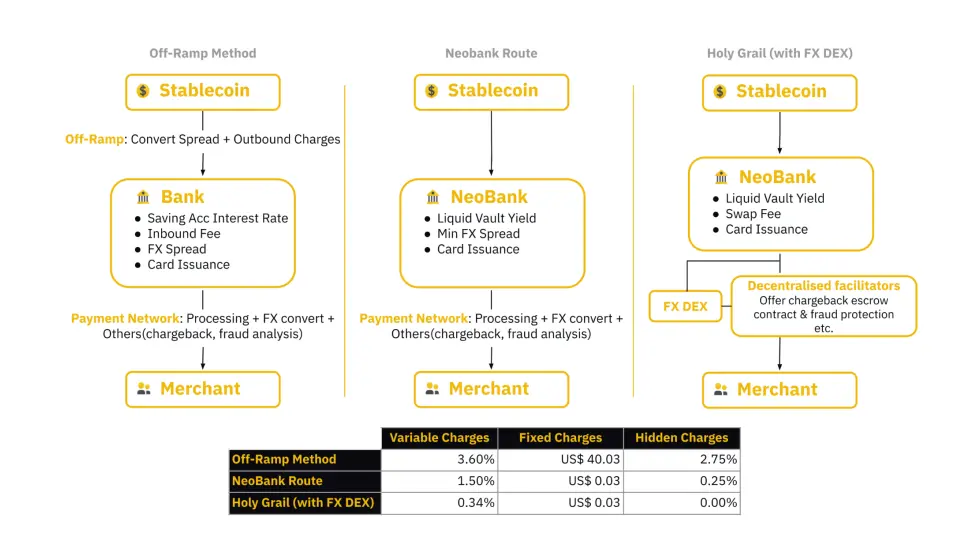
The contrast with the old model is stark: converting crypto positions into real purchases used to mean incurring about 3.6% in off-chain redemption fees, a fixed cross-border SWIFT transfer fee of about $40.03, foreign exchange spreads, and virtually zero yield on idle balances, along with payment network fees. The accumulated intermediary costs consumed a substantial portion of the original position before funds reached their destination.
The super application model eliminates much of this chain. Idle balances can earn yields far exceeding traditional bank savings rates; payment cards can be used for direct consumption without first converting to fiat; borrowing rates for credit lines are also far below the traditional credit card annualized level of about 20%.
There remains a layer of structure: merchant payments still need to convert stablecoins to fiat through traditional card organization facilities at transaction nodes.
This final layer points to what will happen next. On-chain foreign exchange protocols can execute atomic currency conversions with sub-second finality, allowing merchants to receive settlements in their preferred currency stablecoins, while smart contract logic can replicate fraud protection and dispute resolution at costs far below existing levels.
The infrastructure being built in 2026 is the second-to-last step, and the final step may significantly weaken the role of traditional intermediaries in payment settlements.
VIII. Conclusion
When viewed chapter by chapter, this report resembles a checklist of independent progress: stablecoins earning yields and settling traditional assets, reserves and new issuances concentrating in a single venue, a dominant payment network, and increasing median transaction amounts among merchants, with regions specializing in currency demand, as well as a market that flows across weekends, machine payments, and on-chain currency exchanges.
But together, they represent the same thing. Stablecoins have quietly begun to fulfill the three main functions of money: storing value where local currencies fail, circulating value where traditional channels overcharge, and settling value during timeframes and amounts that the existing system has never designed for.
The defining characteristic of 2026 is that all of this no longer relies on crypto cycles. Every main thread in this report—the proportion of long-term holders, Earn allocations, weekend transfer volumes—has been compounding growth alongside the fluctuations in token prices.
The underlying forces are structural, not speculative: currency instability, financial exclusion, an 18-fold yield differential, time zone arbitrage, and the arrival of software-driven commercial activities. None of these will reverse due to emotional shifts.
Risks are real and worth mentioning. Reserve transparency and anchor integrity are uncompromising foundations for this asset class. Regulation is converging unevenly, and fragmented rulebooks may slow down institutions or fracture liquidity across borders.
Activity is distributed unevenly across different venues, public chains, and issuers—this concentration highlights the importance of ongoing resilience building and regulatory communication as the market matures.
The direction is clear. Stablecoins initially entered the financial system as tools for trading crypto assets, and now they are becoming the underlying layer upon which the rest of the financial system relies for settlement.
 Risk warning



Popular articles





