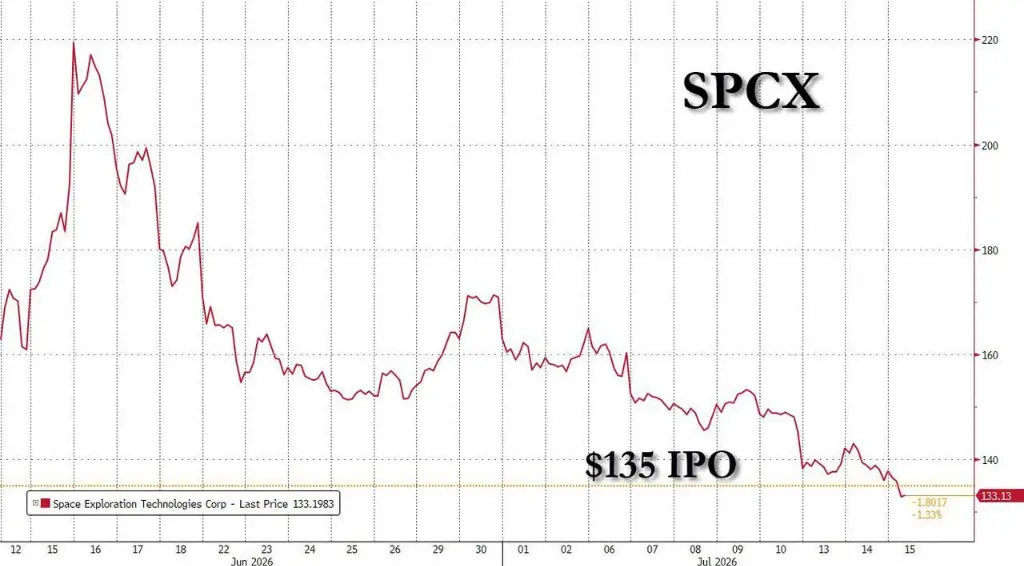
Breakdown! SpaceX's stock price has fallen below $135 for the first time, the IPO issue price. The company's bonds have been declining continuously, with yields reaching as high as 7.5%, comparable to junk bonds
 Core Viewpoint

 On Wednesday, SpaceX's stock price briefly fell to $132 during trading, closing at $136. Analysts pointed out that as the market becomes increasingly cautious about the costs and returns of AI infrastructure, the prospects for xAI's business are being questioned. Meanwhile, SpaceX will release its first quarterly results in the coming weeks, and the lock-up period for its early investors' shares will also expire successively. However, Wall Street remains supportive, with over 80% of analysts giving a "buy" rating and an average target price of $238, implying a 78% upside potential.
SpaceX's stock price has fallen below its offering price just one month after its IPO, with early gains almost entirely reversed. SpaceX is facing a typical confidence test following its IPO, and the upcoming expiration of the lock-up period adds further downward pressure.
On Wednesday, SpaceX's stock price dropped by as much as 2.9% to $132.15, falling below the $135 per share offering price from last month's record $86 billion IPO. It ultimately closed at $136.08, slightly above the offering price.
The stock's performance has shown the typical volatility of new shares: it surged nearly 50% in the first three trading days after listing, only to give back nearly a quarter of those gains in the following three trading days.
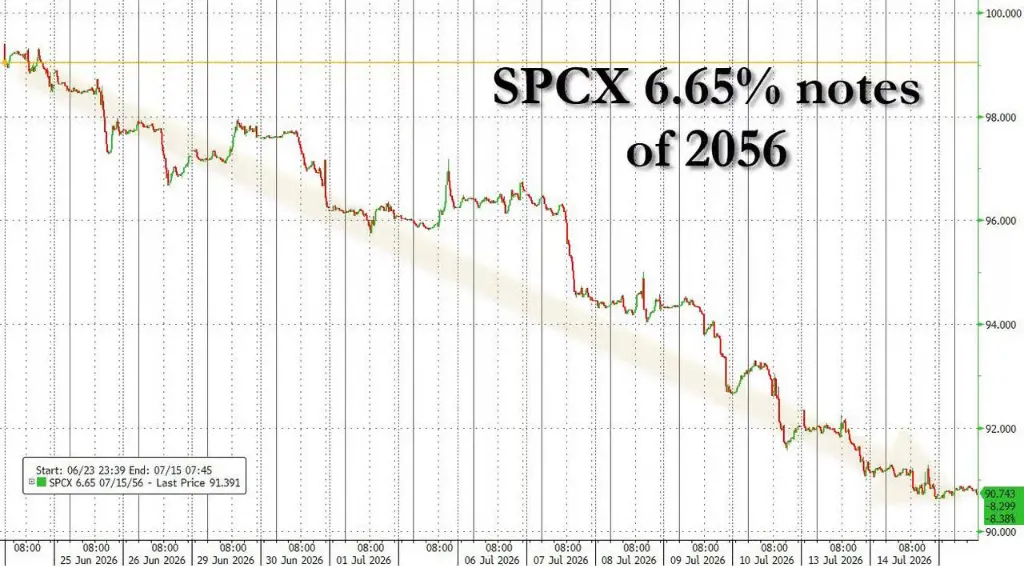
Beyond the stock price, more attention should be paid to SpaceX's newly issued $25 billion bond, which will mature in 2056. Since trading began on June 24, its price has been declining, and the yield has reached as high as 7.5%, comparable to junk bonds.
Dec Mullarkey, Managing Director at SLC Management, stated:
"Investors are increasingly realizing that SpaceX's story largely revolves around its xAI ambitions. As the market becomes more cautious about the costs and benefits of large-scale infrastructure projects, SpaceX's plans sound overly distant."
Of the $75 billion raised in SpaceX's IPO in June, about 20% went to retail investors, which is an unusually high proportion for a large-cap offering. The stock price falling below the offering price not only punctured the narrative carefully crafted by the company and underwriters but also plunged some newly listed companies into an unshakeable crisis of confidence.
Approaching lock-up expiration increases selling pressure risk
Downside risks may not yet be fully realized. As SpaceX is required to release its first quarterly results in the coming weeks, the lock-up period for the first batch of early investors will soon expire. Once these investors begin to sell after the lock-up period ends, the stock price will face greater selling pressure.
The sensitivity of this timing lies in the fact that new stock performance disclosures often become a window for early investors to realize profits. Although the current stock price has significantly retreated from its peak, there remains considerable unrealized gains for early investors, making the motivation to sell hard to ignore.
Index inclusion has driven passive funds to flow in
The early surge in SpaceX's stock price may partly stem from mandatory purchases by passive index funds.
After Nasdaq modified its rules, newly listed large-cap companies can be included in the Nasdaq 100 index as soon as 15 trading days after listing, significantly shortening the previous minimum requirement of three months. Accordingly, SpaceX was included in the index in July and joined the Russell 1000 index about two weeks after its IPO in late June.
According to Bloomberg, analyst Rob Du Boff estimated that SpaceX's inclusion in the Nasdaq 100 and FTSE Russell-related indices would drive index funds to buy at least $5.4 billion worth of stock. This substantial passive buying support helped stabilize the stock price in the early days of listing, but such technical demand is often difficult to sustain.
Wall Street remains bullish, target price suggests significant upside
Despite the pressure on the stock price, Wall Street remains optimistic about SpaceX overall.
As the quiet period for analysts from the banks participating in the IPO ends, a series of bullish reports have been released, with Raymond James providing the highest target price on the street at $800.
According to Bloomberg tracking, over 80% of analysts have given SpaceX a rating equivalent to "buy," with an average target price of about $238, implying an upside of approximately 78% from the current stock price.
 Risk warning


Popular articles