Crude oil surged 10% during trading! The U.S. military resumes the blockade against Iran, and Trump stated tonight and tomorrow there will be a "heavy strike," imposing a 20% fee on shipping through the Strait
 Core Viewpoint

 The U.S. military has launched airstrikes against Iran for the third consecutive night and will begin maritime blockades in the Gulf starting at 4 PM Eastern Time on the 14th. Iranian media reported that Iran shot down a U.S. military drone; explosions were heard near the islands of Larak and the southern port of Abbas. Trump stated that the U.S. charges for shipping through the Strait of Hormuz are to compensate for the expenses required to maintain regional security, and related processes and deployments will be initiated immediately. U.S. media reported that Trump's fee request means that each fully loaded supertanker must pay $30 million, while Iran previously charged a maximum of $2 million. Reports indicate that Trump has notified Congress of the renewed outbreak of hostilities with Iran. The International Maritime Organization opposes charging tolls for international navigation through the Strait. Iran's foreign minister stated that the U.S. fee rate is "excessive."
Author: Li Dan, Li Jia
The situation between the U.S. and Iran has suddenly escalated, with the risk of passage through the Strait of Hormuz sharply increasing, and international crude oil futures rebounding strongly.
According to Xinhua News Agency, U.S. President Trump stated on Monday, the 13th, that he would restore a maritime blockade against Iran. According to CCTV News, Trump posted on his social media on Monday that the Strait of Hormuz is currently open, and it will remain open regardless of Iran's participation. The U.S. will re-implement a "blockade against Iran," which will only target Iranian vessels or clients, restricting their entry and exit from the strait, while all other countries can use the strait fairly and openly. He also stated that the U.S. will charge a 20% fee on all goods transported through this area, and the relevant processes and deployment will start immediately.
In his social media post, Trump touted the aforementioned fee as "compensation" for the U.S. acting as the "guardian of the Strait of Hormuz." He wrote, "From now on, the U.S. will be seen as the 'guardian of the Strait of Hormuz'; as a guardian, based on the principle of 'fairness,' the U.S. will charge a 20% fee on all transported goods, as compensation for the necessary expenses to maintain security and safety in this tumultuous region of the world."
After Trump's post during the early trading session on Monday, U.S. stocks rose further, with West Texas Intermediate (WTI) crude oil surpassing $75, increasing by 5% during the session, while Brent crude approached the $80 mark, also rising nearly 5%; the U.S. dollar index and U.S. Treasury yields rose in tandem, and the S&P 500's decline widened to 0.5%, while spot gold plummeted nearly 3%.
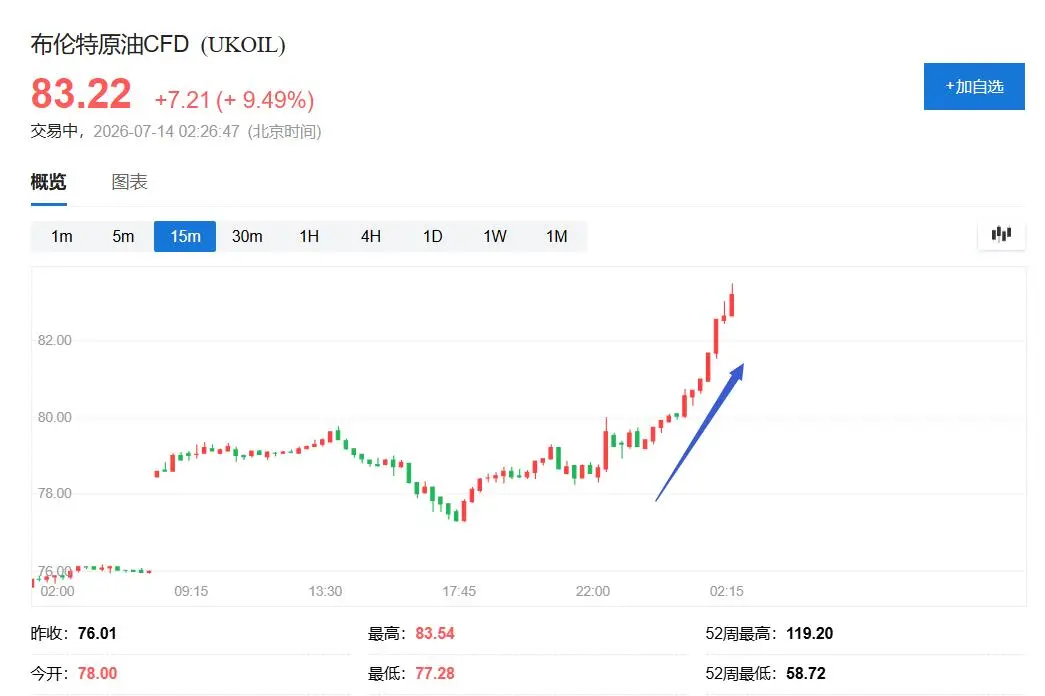
During the midday trading session, U.S. Central Command confirmed that the U.S. military would restart the maritime blockade against Iran at 4 PM Eastern Time on Tuesday, the 14th, which is 4 AM Beijing Time on Wednesday, causing international crude oil prices to rise nearly 10%. Iranian Foreign Minister Zarif stated that Trump's 20% fee on the Strait of Hormuz is "excessive," and claimed that Iran has always been the guardian of the Strait of Hormuz.
In the late trading session, according to Iranian media Tasnim, explosions were reported on Larak Island in the Strait of Hormuz, and explosions were also heard in the southern Iranian ports of Abbas and Konarak. Subsequently, CCTV reported that on the evening of the 13th local time, four explosions were heard in the eastern part of Abbas port. After U.S. stock trading hours, CCTV learned that three more explosions were reported in Abbas port in the early hours of the 14th local time. Iranian officials have not confirmed the nature of the explosions.
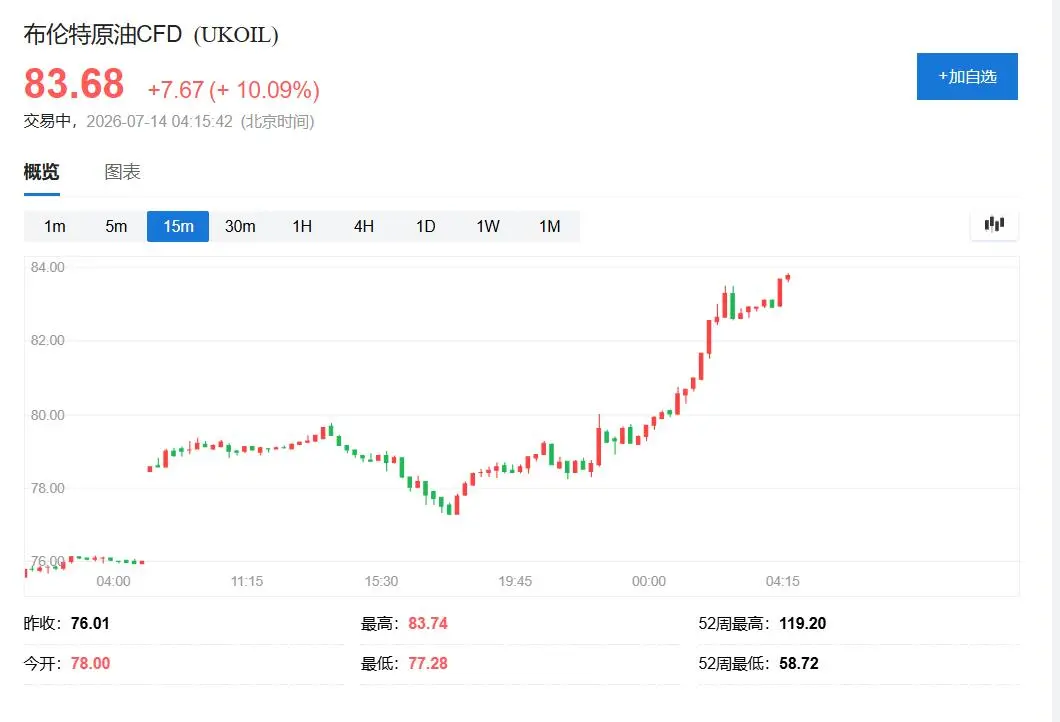
In the late trading session, after the news of the explosions in the aforementioned Iranian region was released, international crude oil maintained an increase of about 9%. After U.S. stock trading hours on Monday, Trump stated that the U.S. would "hit" Iran hard tonight and tomorrow, keeping oil prices high, with Brent crude rising more than 10% compared to last Friday's close.
Subsequently, Trump declared that he believed a deal with Iran might be reached. He said he wanted "compensation" for the Strait of Hormuz, and that the U.S. would seek compensation from countries that benefited from the protection provided for shipping in the Strait of Hormuz.
After U.S. stock trading hours on Monday, according to Xinhua News Agency citing Iranian Fars News Agency, a U.S. military MQ-1 drone was shot down by the Iranian Islamic Revolutionary Guard Corps' air defense system over the Strait of Hormuz late that night. Earlier on Monday, U.S. Central Command revealed on social media that the U.S. military struck a submarine and ship repair facility at the Iranian naval base in Abbas port on Sunday, marking the first time the U.S. military used armed unmanned vessels in combat.
CCTV cited a post from U.S. Central Command stating that under Trump's orders, the U.S. military began a third consecutive night of airstrikes against Iran at 4:45 PM Eastern Time on Monday, stating that the actions would continue to impose heavy costs on Iran's armed forces and weaken their ability to attack innocent civilians and commercial shipping in the Strait of Hormuz.
U.S. military to begin maritime blockade against Iran on Tuesday
The International Maritime Organization (IMO), a UN agency, expressed opposition to charging ships passing through maritime routes after Trump's post but stated it would wait for more details. During the midday trading session, according to CCTV, the Joint Maritime Information Center, overseen by the U.S. Navy, stated that the U.S. military would begin enforcing a maritime blockade against all Iranian ports and coastal areas at 8 PM GMT on July 14 (4 AM Beijing Time on the 15th).
The blockade applies to all vessels, regardless of the flag they fly. The blockade covers the entire coastline of Iran, including but not limited to Iranian ports and oil terminals. The blockade will not hinder neutral vessels from passing through the Strait of Hormuz to non-Iranian destinations or departing from non-Iranian destinations. Humanitarian cargo transport will be allowed but must be subject to inspection. Following the announcement of the U.S. military's maritime blockade, oil prices continued to rise, with WTI and Brent crude rising above $78 and $83, respectively, with intraday increases reaching 9.86% and 9.9%, close to 10%.
Although Trump stated that the fee plan would be immediately developed and implemented, the White House did not provide further details regarding the proposal, including how it would be enforced or whether it had been communicated with U.S. allies. Commentators believe that Trump's remarks have intensified the dispute between the U.S. and Iran over whether this critical shipping corridor is open to traffic.
Previously, according to Xinhua News Agency citing Iranian media on the 13th, the spokesperson for the Iranian Armed Forces' Khatam al-Anbiya Central Headquarters stated that the U.S. would never be allowed to interfere in the management of the Strait of Hormuz.
The spokesperson said that the Iranian Armed Forces would strongly retaliate against U.S. military actions that intrude into designated shipping lanes without Iranian authorization and interfere with the passage of merchant ships and oil tankers. "The recent actions of the Iranian Islamic Revolutionary Guard Corps and the Iranian Islamic Republic Army are clear evidence of this."
Earlier on Monday, Trump stated in a phone interview with Fox News that the U.S. plans to control the Strait of Hormuz and should be compensated for "guarding" this important waterway. He said, "We have guarded this strait for 50 years without ever receiving compensation. We want to be compensated for this, after all, we put our personnel in danger."
Iran claims the southern route of the Strait of Hormuz is "unsafe"
According to Xinhua News Agency, the Iranian Embassy in the UK stated on social media on the 13th that the southern route of the Strait of Hormuz is "unsafe, unreliable, and prone to accidents."
The Iranian Embassy in the UK stated that to comply with the Islamabad Memorandum of Understanding, Iran has established a temporary maritime safety corridor that has no technical or military barriers and has informed the International Maritime Organization. However, "the U.S. is directing vessels toward a dangerous southern parallel route. This route is not only legally questionable but also unsafe, unreliable, and prone to accidents."
The Iranian Embassy in the UK stated that U.S. attacks on Iranian ports and other "military aggression" have made the Strait of Hormuz a highly tense and high-risk area.
After the U.S.-Iran Memorandum of Understanding was reached, the strait formed two shipping lanes: the northern lane controlled by Iran and the southern lane closer to Oman, with the U.S. military providing navigation assistance in the southern lane.
The Iranian Islamic Revolutionary Guard Corps Navy announced early on Sunday, the 12th, that due to illegal foreign interference causing an unsafe situation, the Strait of Hormuz would be closed until further notice and until the U.S. stops interfering in the region. The U.S. Central Command stated on social media on Sunday morning Eastern Time that "traffic is still continuing" in the Strait of Hormuz. Iran does not control the strait.
International Maritime Organization: Opposes charging fees for international navigation through the strait
After Trump's post, a spokesperson for the International Maritime Organization (IMO) stated, "We have noted the relevant comments and are waiting for more details."
The spokesperson said, "Our position on the issue of fees is consistently clear— the International Maritime Organization firmly opposes charging fees for the passage of ships used for international navigation through the strait. It is legally untenable to impose fees solely for passing through the strait."
Media reports mentioned that shipping industry officials expressed concerns about Trump's latest move to charge fees, stating that such measures would violate international law.
An industry official questioned Trump's remarks, saying, "How can this make navigation safer? What kind of guarantees can it provide?"
Trump has formally notified Congress of the resurgence of hostilities with Iran
According to CCTV citing U.S. sources on Monday the 13th, Trump has formally notified Congress of the resurgence of hostilities with Iran. In a letter to congressional leaders on the 10th, Trump wrote that the U.S. military conducted "defensive strikes" against targets within Iran on the 7th.
It is reported that this letter has further intensified the dispute between Congress and the White House, although both chambers of Congress had previously voted to require the president to end hostilities or seek approval to continue actions, the White House insists that Trump, as Commander-in-Chief, is acting within his constitutional powers.
 Risk warning