Bitget UEX Daily Report|The passage through the Strait of Hormuz becomes a mystery, driving up oil prices; SK Hynix's storage will still be in short supply by 2030; Bitcoin fluctuates narrowly around $64,000

 Bitget UEX Daily Report
# 1. Hot News
Federal Reserve Dynamics
Rising Energy Prices May Affect Federal Reserve's Inflation Path Assessment
- The escalation of the US-Iran conflict over the weekend has driven up oil prices, with the market focusing on the potential transmission of energy costs to US inflation data.
- Today, Federal Reserve Vice Chair Michelle Bowman and Governor Christopher Waller will speak, possibly commenting on inflation and policy outlook.
- Analysis: If oil prices continue to run at high levels, it may increase the Federal Reserve's reasons to maintain a cautious stance, providing some support for the dollar index in the short term, while the risk of fluctuations in interest rate expectations rises.
International Commodities
Escalation of US-Iran Conflict Leaves Navigation Through the Strait of Hormuz in Question
- The US military and Iranian forces engaged in mutual missile and drone attacks last Sunday, with Iran claiming to target US military facilities in multiple Gulf countries and once again announcing the closure of the strategically significant Strait of Hormuz.
- Trump stated, "For the United States, the Strait of Hormuz remains open," highlighting significant differences in opinions regarding navigation status.
- Analysis: The incident directly raises geopolitical risk premiums, with WTI crude oil surging over 3% to nearly $74 per barrel. The market will closely track OPEC's monthly report and subsequent supply dynamics, with short-term energy price volatility expected to remain high.
Macroeconomic Policy
Tech Giants Borrowing to Support AI Infrastructure; White House Pressures Intel for Revival
- Silicon Valley tech companies are issuing bonds on a large scale to finance AI infrastructure, with Amazon issuing a single bond of $25 billion, while AI-related bond types performed the weakest during the sell-off.
- The White House has prioritized Intel's revival, pressuring Apple and Nvidia to use Intel for manufacturing, while Apple is suing OpenAI for stealing trade secrets for AI hardware development.
- Analysis: This reflects that the AI capital expenditure boom is still ongoing, but also exposes risks of rising financing costs and supply chain policy interventions, potentially exacerbating the divergence in the semiconductor and tech sectors.
# 2. Market Review
Commodity & Forex Performance
- Spot Gold: $4,070/oz, -1.2%
- Spot Silver: $58/oz, -2.12%
- WTI Crude Oil: $74.39/barrel, +4%
- Brent Crude Oil: $79/barrel, +3.8%
- Dollar Index (DXY): 101.174, +0.21%
Driving Factors Analysis: The escalation of the US-Iran conflict over the weekend became the main variable in the market. Iran's claim to close the Strait of Hormuz (which accounts for about 20% of global oil transport) directly raised energy risk premiums, with WTI and Brent crude oil quickly rising over 3%. The dollar index strengthened slightly, and 10-year US Treasury futures fell, reflecting a coexistence of risk aversion and inflation concerns. Both spot gold and silver retreated, indicating that the strong dollar's suppressive effect on precious metals temporarily outweighed the geopolitical safe-haven buying. Institutional views suggest that short-term oil prices will maintain high volatility, depending on whether the conflict escalates further or OPEC signals an increase in production; precious metals will need to observe the subsequent dynamics between the dollar and real interest rates. The overall asset linkage logic is clear: geopolitical risk → energy prices ↑ → potential inflation pressure → dollar and bond markets under pressure, precious metals are under short-term pressure but still have allocation value in the medium term.
Cryptocurrency Performance
- BTC: $64,070, +0.19%
- ETH: $1,830, +1.9%
- Total Cryptocurrency Market Cap: $2.25 trillion, +0%
- Market Liquidation Situation: Total liquidation in 24h is $147 million, with long positions liquidated at $80 million.
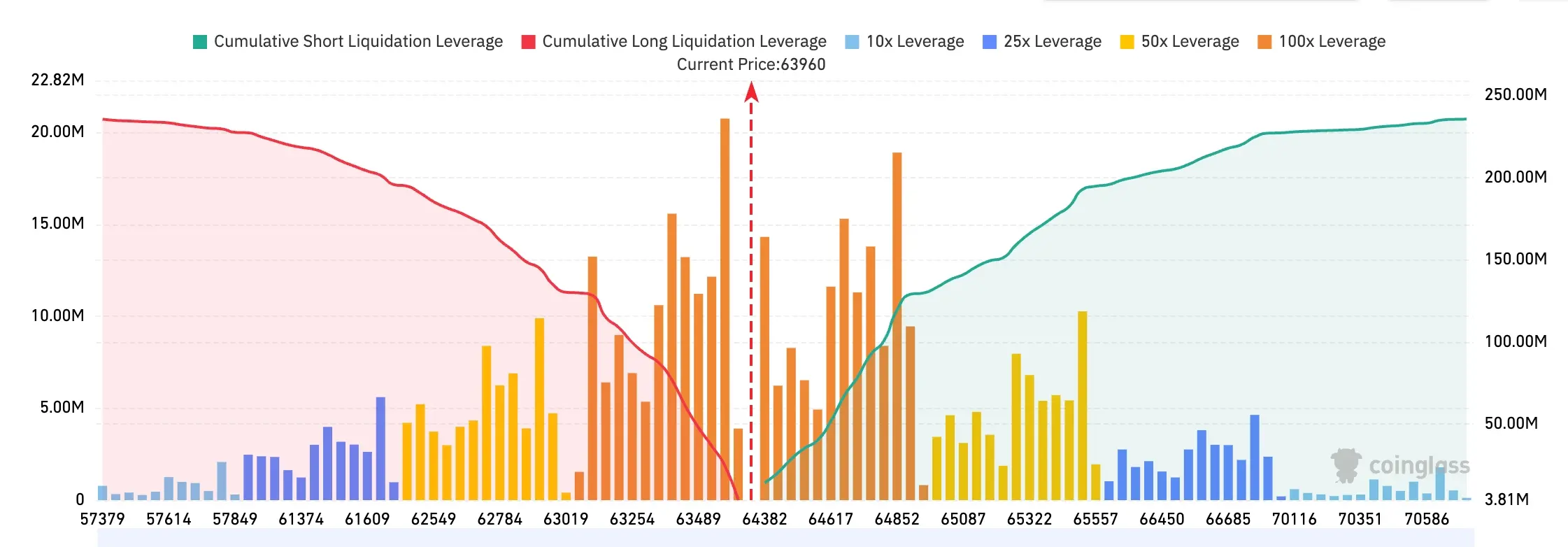
- BTC/USDT Liquidation Map: The current BTC price is about $63,960, with a large concentration of short liquidations in the $64,300-$64,900 range, especially around $64,800 where there is strong liquidation pressure. If this range is broken, it may trigger a short squeeze and push prices further up. Liquidation for long positions is mainly concentrated in the $63,000-$63,500 range, but the cumulative scale is significantly smaller than the short liquidations above, indicating that the short-term liquidation magnetic effect still leans towards the upside, with the market having the momentum to continue challenging above $64,500.
Driving Factors Analysis: The cryptocurrency market showed strong resilience amid the weekend's geopolitical conflict, with Bitcoin fluctuating narrowly around $64,000, appearing more stable than spot gold. ETH slightly outperformed BTC, possibly related to network activity or capital rotation in DeFi. ETF fund flows warmed (with a net inflow of nearly $90 million yesterday), indicating that institutional allocation willingness has not significantly weakened due to external events. The scale of leveraged liquidations was moderate (totaling $131 million), with a near balance in long and short ratios, suggesting a lack of extreme one-sided squeeze conditions in the current price range. Institutional consensus indicates that under macro uncertainty, the correlation between crypto assets and traditional risk assets has decreased, but if the US tech sector remains strong, BTC may rise with risk appetite; in the short term, caution is needed regarding the indirect impact of further rising oil prices on global risk assets.
US Stock Index Performance
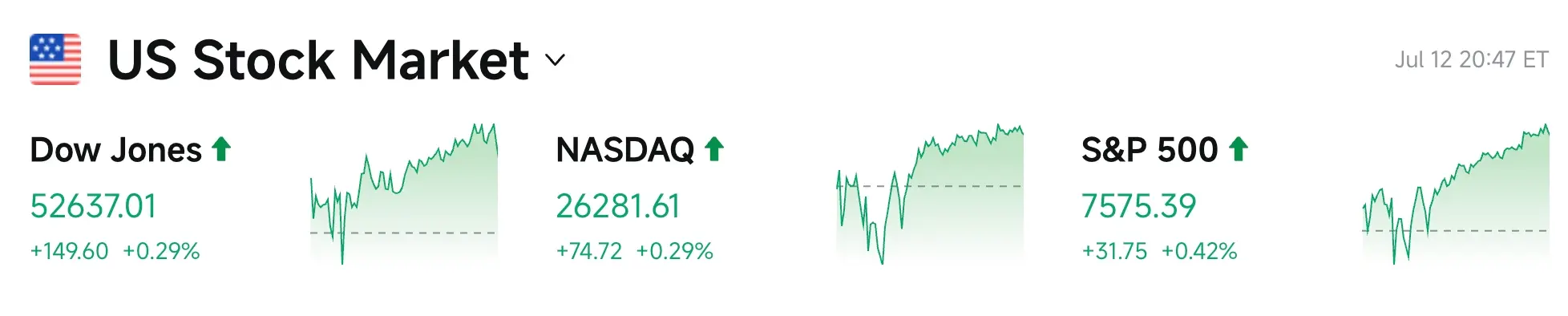
- Dow Jones: 52,637.01 points (+0.29%), with a slight increase for three consecutive days
- S&P 500: 7,575.39 points (+0.42%), with tech-weighted stocks contributing the main gains
- Nasdaq: 26,281.61 points (+0.29%), led by AI and semiconductor sectors
Tech Giants Dynamics
- NVDA: $210.96 (+4.03%)
- AAPL: $315.32 (-0.28%)
- MSFT: $385.10 (+0.19%)
- GOOGL: $357.18 (-0.48%)
- AMZN: $245.34 (-0.69%)
- META: $669.21 (+5.97%)
- TSLA: $407.76 (+0.30%)
Performance Summary and Driving Analysis: US stocks saw a slight increase on Monday, with a clear divergence in the tech sector. Meta and Nvidia led the gains, benefiting from the release of new AI models and positive signals during roadshows indicating "quarterly revenue nearing $100 billion, with growth still accelerating." Nvidia emphasized that the Rubin Ultra has not been delayed, and the share of computing power from top clients has risen to nearly 50%, further strengthening market confidence in its long-term dominance. Apple, on the other hand, faces dual pressures: suing OpenAI for intellectual property infringement while being pressured by the White House to support Intel's manufacturing, resulting in relatively restrained stock price gains. The overall sector trend indicates that AI capital expenditure and efficiency improvement themes remain dominant, while traditional valuation pressures are temporarily yielding to leading companies. Institutions believe that as long as the pace of AI commercialization does not significantly slow down, tech giants will continue to be the core driving force of US stocks.
Sector Movement Observation
Semiconductor and AI-related Sectors rose over 2-4% (represented by NVDA, MU)
- Representative Stocks: NVDA rose over 4%, MU followed suit.
- Driving Factors: Nvidia's roadshow released strong demand signals, and SK Hynix's CEO stated that "storage will still be in short supply by 2030," boosting sector confidence; while the White House's support for Intel policy has caused short-term divergence, the overall logic of AI computing power and advanced process demand remains unchanged.
# 3. In-depth Analysis of US Stocks
1. Meta Platforms - Leader in AI Model Efficiency Competition
Event Overview: Meta's stock price rose nearly 6% on Monday, standing out against the backdrop of OpenAI, Meta, and SpaceX launching lower-cost AI models simultaneously. The company continues to promote its Llama series open-source strategy and emphasizes cost-effectiveness advantages under corporate AI expenditure reviews. Market Interpretation: Several investment banks believe that Meta has high long-term growth certainty driven by both advertising business and AI infrastructure; the release of new models further consolidates its competitiveness in the generative AI field, supporting valuation premiums. Investment Insight: Short-term focus on advertising recovery and AI capital returns, still one of the core targets for tech growth in the medium term.
2. NVIDIA - Demand Exceeds Expectations, Rubin Ultra Progressing as Planned
Event Overview: Nvidia's roadshow released positive signals, with quarterly revenue nearing $100 billion and growth still accelerating, and the Rubin Ultra chip has not been delayed; a leading frontier model client has seen its share of computing power rise to nearly 50%. Market Interpretation: Institutions generally maintain optimistic ratings, believing that under the dual drive of AI training and inference demand, Nvidia is unlikely to be surpassed in the short term; while rising client concentration brings certain risks, it also reflects its technological barriers and ecological advantages. Investment Insight: A pullback presents a layout opportunity, with a focus on tracking the shipment rhythm and gross margin performance of Blackwell/Rubin.
3. Apple Inc. - Dual Variables of Intellectual Property Litigation and Policy
Event Overview: Apple has officially sued OpenAI, accusing it of stealing trade secrets for developing AI hardware, demanding an end to the infringement and destruction of related materials; at the same time, it faces pressure from the White House to use Intel for manufacturing to support the revival of domestic semiconductors. Market Interpretation: Investment bank views are divided; on one hand, the lawsuit highlights Apple's ambition in AI hardware, while on the other hand, policy interventions may affect its supply chain flexibility and cost structure, potentially suppressing valuation expansion in the short term. Investment Insight: Focus on the progress of the lawsuit and the pace of iPhone AI feature rollout, with long-term reliance still on ecosystem and hardware innovation.
4. Amazon.com - Major Bond Issuance to Support AI Infrastructure
Event Overview: Amazon issued $25 billion in bonds, primarily for AI data center and infrastructure construction; during the same period, the overall bond issuance wave among tech giants triggered a sell-off in the bond market, with AI-related credit types performing poorly. Market Interpretation: Institutions believe this move reflects that AI capital expenditure is entering a substantial landing phase, but rising financing costs and pressure on the bond market also signal risks; Amazon's AWS cloud business will still be a major beneficiary. Investment Insight: Focus on the increase in the proportion of AWS AI-related revenue, and be wary of changes in the macro interest rate environment affecting tech financing.
# 4. Project & Market Dynamics
- CryptoQuant analyst Darkfost stated that short-term Bitcoin holders (STH) have been in a long-term state of loss, which is one of the more obvious market characteristics in each bear market cycle. Data shows that Bitcoin prices have been below the short-term holder cost basis (STH Cost Basis) for over 9 consecutive months. Historically, such prolonged STH loss phases are often highly correlated with bear market cycles.
Currently, the cost basis for short-term Bitcoin holders is about $70,700, which continues to constitute an upper resistance level. Darkfost pointed out that the market trend in May already reflected this pressure, when BTC quickly encountered a pullback after testing around $82,000. However, the recent significant decline in the cost basis for short-term Bitcoin holders indicates that some investors are accumulating at low levels, with new buying funds pulling down the overall holding cost. Darkfost believes that whether Bitcoin can re-establish itself above the short-term holder cost basis will become an important signal for judging changes in market trends.
Fidelity: Bitcoin has entered a long-term value observation zone, but a short-term reversal still requires a return of liquidity.
Michael Saylor has again released Bitcoin Tracker information, with changes in holdings data expected to be disclosed this week.
IrrationAlanalysis reported that sources revealed Nvidia has decided to temporarily abandon the use of TSMC's COUPE (Compact Universal Photonic Engine) technology solution due to slow progress in TSMC's silicon nitride (SiN) technology advancement and the development of two-dimensional grating couplers not meeting expectations.
The rift between OpenAI and Apple is deepening, with Apple's lawsuit potentially casting a shadow over OpenAI's upcoming first hardware device, which may be released as early as February next year. Analysts believe this legal dispute could also affect OpenAI's IPO plans, increasing uncertainty for potential investors.
According to The Kobeissi Letter disclosed on the X platform, US economic growth is now entirely centered around AI. AI investment currently accounts for over 25% of US GDP growth, setting a new historical high.
# 5. Today's Market Calendar
Data Release Schedule
|----------|----|---------------------------|-----| | 05:25 ET | US | Speech by Federal Reserve Vice Chair Michelle Bowman | ⭐⭐⭐ | | 12:30 ET | US | Speech by Federal Reserve Governor Christopher Waller | ⭐⭐⭐ | | 14:00 ET | US | June Federal Budget | ⭐⭐ |
Important Event Forecast
- Federal Reserve Officials' Speeches: Several officials will comment on the economy and policy outlook today, focusing on assessments of energy prices and inflation.
- Middle East Situation Progress: Continuously track the dynamics of the US-Iran conflict and navigation through the Strait of Hormuz; any signals of escalation or de-escalation may trigger significant market volatility.
Institutional Views:
Several Wall Street investment banks pointed out that the escalation of the US-Iran conflict over the weekend is currently the main short-term variable in the market, and the rapid rise in oil prices has fully reflected the geopolitical risk premium, but has not yet evolved into a systemic risk event. The equity market shows resilience, with tech and AI themes still dominating fund flows, indicating that investors' confidence in fundamental growth still outweighs external disturbances. Precious metals are under short-term pressure from a strong dollar, while the crypto market shows a degree of independence through moderate fluctuations and ETF fund inflows. Analyst consensus believes that if the conflict remains controllable, risk assets still have medium-term allocation value; if oil prices rise further and push up inflation expectations, the Federal Reserve's policy path may see marginal changes, and the dollar and US Treasury yields will face repricing. It is recommended to pay attention to the wording of the Federal Reserve's speeches and OPEC's subsequent statements, with a focus on defensive position management.
Disclaimer: The above content is compiled by AI search, with human verification for publication, and does not constitute any investment advice. The data in the text may inevitably contain deviations; please refer to real-time market data.
 Risk warning