Morning Report | South Korea's financial regulatory agency has initiated sanctions against Upbit operator Dunamu; the Financial Services Commission of South Korea will introduce an AI monitoring system for virtual asset regulation, having investigated over 30 market manipulation cases in the past two years

 July 19 Market Important Events Overview
Compiled by: ChainCatcher
What important events have occurred in the past 24 hours?
U.S. regulators failed to issue GENIUS Act stablecoin rules within the 1-year statutory deadline
According to ChainCatcher and The Block, U.S. regulators failed to publish the final rules necessary to implement the federal stablecoin framework required by the GENIUS Act within the 1-year deadline set by the act. The bill was signed into effect by Trump on July 18, 2025, requiring the OCC, Federal Reserve, FDIC, NCUA, U.S. Treasury, and state stablecoin regulators to complete the supporting rulemaking by July 18, 2026, at the latest. As of the afternoon of July 18 local time, the main rule proposals released by the OCC, FDIC, NCUA, and Treasury remain in the proposal stage, with some rules related to the Federal Reserve and anti-money laundering regulation still open for public comment. The report points out that the bill does not stipulate that missing the deadline will automatically extend it, nor does it suspend the relevant statutory requirements or delay the overall framework's effectiveness. Among them, the OCC's comprehensive implementation proposal covers reserve assets, capital, liquidity, custody, risk control, and reporting requirements; the FDIC's proposal involves reserves, redemptions, custody, and deposit insurance treatment of stablecoin reserves; the NCUA proposed licensing and operational risk control plans in February and May, but the latter's comment collection only ended the day before the deadline, making it objectively impossible to complete formal rulemaking before the statutory deadline. The report states that this means that some key rules necessary for the operation of the stablecoin framework will not be finalized until after the deadline.
David Sacks: Opposes using regulatory uncertainty to suppress open-source AI, warns that AI duopoly seeks to eliminate competition
According to ChainCatcher, David Sacks, chairman of the U.S. President's Council of Advisors on Science and Technology, stated on the X platform that using regulatory uncertainty as a competitive tool is "completely unacceptable." Regulatory decisions should be based on facts, logic, and evidence, rather than deliberately creating fear and uncertainty (FUD). He is unsure whether venture capitalist and AI policy researcher Dean Ball is acknowledging a strategy of "regulatory capture" or merely predicting that such a situation will occur, but in any case, the practice of using regulatory agencies to issue "soft law" warnings and create market panic to force regulated companies away from Chinese open-source models should not be accepted. David Sacks pointed out that Dean Ball believes there is no need to directly ban Chinese open-source models; it is sufficient to guide regulatory agencies to issue relevant warnings, which can influence corporate decisions by creating enough doubt and uncertainty, and these reasons "do not even need to be very substantial." Any regulatory decision must have sufficient basis, rather than implementing policies through "artificially creating doubt." He warned that this practice of bypassing public deliberation procedures not only erodes the foundation of the rule of law but may also open the door to future regulatory abuse against any company or individual. David Sacks further stated that current AI policy is at a critical turning point, with leading closed-source labs that have formed a duopoly in AI model revenue attempting to use government power to eliminate open-source competitors, and he calls on other Silicon Valley companies and developers that still support open competition to make clear statements to jointly maintain an open ecosystem in the AI field.
Famous trader has closed all cryptocurrency short positions and has begun buying Bitcoin spot again
According to ChainCatcher, well-known crypto trader Doctor Profit announced that he has closed all cryptocurrency short positions, including Bitcoin shorts established in the $115,000 to $125,000 range, another Bitcoin short established in the $79,000 to $82,000 range, and over 100 altcoin shorts opened in recent months, claiming that these positions have all achieved significant profits. He also stated that he has re-entered Bitcoin spot at $64,000, marking his first long allocation since September 2025. He plans to invest 5% of his planned funds daily for spot purchases when Bitcoin is in the $54,000 to $64,000 range, continuing for up to 20 days; if the price approaches $54,000, he will increase his buying intensity. Doctor Profit believes that the current market shows obvious "herd behavior": investors who were previously bullish to $150,000 are now generally waiting for Bitcoin to drop to $40,000 to $50,000, viewing September or October as the bottom of the four-year cycle. When a large number of investors are waiting for the same price and time point, the market may not operate according to this expectation, so he chose to build positions early and judges that the current bottom may appear earlier than the market generally expects. He also listed regulatory clarity, asset tokenization infrastructure, and institutional adoption progress as structural reasons for his shift to buying and retracted his previous prediction that Bitcoin would drop to $40,000 to $50,000. However, he still retains all short positions in the S&P 500 index, believing that the crypto market has undergone significant repricing while U.S. stock valuations remain high.
Korean financial regulators have initiated sanction procedures against Upbit operator Dunamu
According to ChainCatcher, the Korea Herald reported that Korean financial regulators have issued an investigation report to Dunamu, the operator of Upbit, initiating sanction procedures. Previously, the company suffered a hacking incident resulting in a loss of 44.5 billion won. Since the incident, the Financial Supervisory Service (FSS) has been investigating whether there have been violations of the "Virtual Asset User Protection Act," but since there are currently no direct penalties for hacking incidents or computer system failures, it remains uncertain whether this will lead to severe disciplinary actions. The FSS plans to notify the company of the sanction opinion letter, which includes the level of sanctions, after the company provides an explanation. Subsequently, the final sanction measures will be determined by the Sanction Review Committee, the Securities and Futures Commission, and the Financial Services Commission through resolution.
Data: $83.9485 million liquidated across the network in the past 24 hours, with $26.71 million in long liquidations and $57.2385 million in short liquidations
According to ChainCatcher, data from Coinglass shows that $83.9485 million was liquidated across the network in the past 24 hours, with $26.71 million in long liquidations and $57.2385 million in short liquidations. Among them, Bitcoin long liquidations amounted to $3.8368 million, Bitcoin short liquidations amounted to $14.4067 million, Ethereum long liquidations amounted to $4.5691 million, and Ethereum short liquidations amounted to $17.5008 million. Additionally, in the last 24 hours, a total of 50,348 people were liquidated globally, with the largest single liquidation occurring on Binance - ETHUSD_PERP worth $1.764 million.
Data: Four major Bitcoin mining pools control over 70% of the hash rate
According to ChainCatcher, as of June 23, 2026, Foundry Digital, AntPool, ViaBTC, and F2Pool collectively control over 70% of the Bitcoin network's hash rate, accounting for approximately 31%, 18%, 13%, and 10%, respectively. Foundry Digital is a U.S. mining pool backed by Digital Currency Group, primarily targeting large institutions and publicly listed mining companies. D-Central reported a Nakamoto coefficient of 3 for the first half of 2026, meaning that only 3 mining pools are needed to exceed half of the block production. ViaBTC faces stricter regulatory scrutiny in 2026, and some miners have turned to alternative pools like EMCD.
Data: $72.3283 million liquidated across the network in the past 24 hours, with $29.2017 million in long liquidations and $43.1266 million in short liquidations
According to ChainCatcher, data from Coinglass shows that $72.3283 million was liquidated across the network in the past 24 hours, with $29.2017 million in long liquidations and $43.1266 million in short liquidations. Among them, Bitcoin long liquidations amounted to $1.1837 million, Bitcoin short liquidations amounted to $12.6716 million, Ethereum long liquidations amounted to $3.8755 million, and Ethereum short liquidations amounted to $9.9417 million. Additionally, in the last 24 hours, a total of 49,355 people were liquidated globally, with the largest single liquidation occurring on Binance - ETHUSD_PERP worth $1.764 million.
Survey: 84% of North American financial institutions view tokenization as a strategic priority, nearly one-third plan to increase investment in the next 2 years
According to ChainCatcher, a survey by fintech service provider Broadridge of 200 North American financial services executives shows that 84% of the responding institutions believe tokenization is significant for their business, indicating that Wall Street is transitioning from the blockchain experimentation phase to preparing for the integration of tokenized assets into everyday market infrastructure. The survey shows that 68% of respondents believe tokenization will at least partially reshape financial markets in the next 3 to 5 years, and nearly one-third of institutions plan to increase investment in tokenization projects by 26% to 50% or more in the next 2 years. Meanwhile, 92% of institutions expect digital assets and traditional assets to coexist in the foreseeable long term, with 69% planning to integrate tokenization into existing infrastructure rather than building a native on-chain system.
Korea releases roadmap for the internationalization of the won: plans to issue won-denominated stablecoins and launch a government bond tokenization pilot next year
According to ChainCatcher, ETNews reported that the Korean government has released a "Roadmap for the Internationalization of the Won," aiming to transform the won from a regulated currency to a freely convertible currency and build an offshore won settlement network. It is reported that the Bank of Korea will launch an "offshore won settlement network" (tentative name), expected to conduct trial operations in September this year and officially launch in January next year. At the same time, it will also build digital asset payment infrastructure to lay the foundation for the issuance, distribution, and trading of won-denominated stablecoins, planning to launch a pilot project next year to promote the tokenization of government bonds linked to the central bank's digital currency (CBDC). Additionally, Korea will officially join the cross-border digital payment project "Agora," led by the Bank for International Settlements (BIS) and involving eight national central banks.
Coinbase CEO changes X avatar, Base chain meme coin BRIAN drops about 86% in 24 hours
According to ChainCatcher, The Defiant reported that Coinbase CEO Brian Armstrong has changed his X platform avatar to a newly purchased CryptoPunk, causing the Base chain meme coin BRIAN, which had previously surged due to the avatar change, to drop significantly afterward. In the past 24 hours, the token's market value has decreased by about 86%, falling to around $1.5 million; during the same period, its trading volume in about 30 Uniswap liquidity pools was approximately $13.2 million, with total liquidity of about $561,000. The report noted that Brian Armstrong had changed his X avatar to the "Coinbase Man" image corresponding to BRIAN on July 16, stating "New profile photo - who dis," which the market interpreted as a signal of interest in the token, driving BRIAN to rise rapidly. The report emphasizes that BRIAN is a community-created token, and Brian Armstrong is not the issuer and has not claimed any official association with it.
News: Visa hiring Senior Director for Stablecoin Labs, with a maximum annual salary of $400,000
According to ChainCatcher, Frank Chaparro, GSR's strategic communications director, posted that Visa is hiring for a "Sr Director, Stablecoin Labs" position in New York, with a maximum annual salary of $400,900, plus bonuses and equity incentives. The job posting indicates that this position will be responsible for Visa's Web3 and stablecoin product roadmap, exploring new commercialization application scenarios, and participating in the planning of the company's next-generation stablecoin payment products. Frank Chaparro believes this further indicates that stablecoins are becoming a core priority in the global payments sector.
Data: About 50% of Bitcoin supply has changed hands above $59,000, indicating a potential market bottom range
According to ChainCatcher, CryptoQuant analyst Darkfost stated that data shows Bitcoin is currently building an important support level in the $59,000 to $70,000 range, which has become one of the most fiercely defended price ranges in Bitcoin's history. Currently, about 50% of the total Bitcoin supply has changed hands above $59,000, and if we exclude millions of Bitcoins considered permanently lost, this proportion will further increase. The main drivers of this round of turnover are short-term holders, and the behavior of market participants is showing divergence, with some investors choosing to panic sell while others continue to accumulate.
Ostium releases update on attack incident, price data was attacked, but traders' collateral and positions were unaffected
According to ChainCatcher, Ostium released an update on the attack incident. Its liquidity provider fund was attacked on July 15, resulting in a loss of 23,752,746 USDC. Preliminary investigations show that the attacker compromised the off-chain infrastructure providing price data to the protocol and submitted disguised illegal price reports, extracting artificially generated profits from the fund through rapid opening and closing of multiple large positions. Ostium stated that traders' collateral is stored in independently isolated smart contracts and was unaffected by this incident, and all trading positions remain open. The team paused trading and froze all trading contracts within 60 minutes after the first attack transaction occurred. Currently, Ostium is working with Mandiant, zeroShadow, Collisionless, SEAL 911, and law enforcement agencies, coordinating with trading platforms, bridging contracts, and stablecoin issuers to advance the investigation. The engineering team is focused on repairing and strengthening the relevant infrastructure to support the secure resumption of trading. Ostium stated that it will notify at least 24 hours in advance before unfreezing trading contracts. After trading resumes, existing positions will be marked at the price at the time of reopening, unaffected by price fluctuations during the pause. Addressing the affected liquidity providers and the secure resumption of trading remains the current priority.
Data: Hyperliquid platform whales currently hold $5.705 billion, with a long-short ratio of 0.96
According to ChainCatcher, data from Coinglass shows that whales on the Hyperliquid platform currently hold $5.705 billion, with long positions of $2.8 billion, accounting for 49.08% of positions, and short positions of $2.905 billion, accounting for 50.92%. Long positions have a loss of $54.4536 million, while short positions have a loss of $35.648 million. Among them, the whale address 0x66f8..a9 is long on BTC with 40x leverage at a price of $63,957.5, currently having an unrealized profit and loss of $1.3193 million.
Data: Weekly trading volume of the top 5 Korean crypto exchanges drops to about 8.06 trillion won, a new low since May 2023
According to ChainCatcher, Korean media Digital Asset reported that the total trading volume of the top 5 digital asset exchanges in Korea from 2 PM on July 9 to 2 PM on July 16 dropped to about 8.06 trillion won, further declining from the previous week and reaching the lowest level in nearly 3 years and 2 months. Data shows that the weekly trading volume of the top 5 exchanges has been declining for several weeks, from 17.7 trillion won from June 5 to 12, sequentially dropping to 15.4 trillion won, 14.6 trillion won, 13.4 trillion won, and 9.97 trillion won, with the latest week further falling to 8.06 trillion won, the lowest since recording 8.44 trillion won from May 11 to 18, 2023. In terms of exchange shares, the rankings have not changed, with Upbit continuing to rank first with 63.57%, but down 0.63 percentage points from the previous week; Bithumb rose to 29.18%, Coinone rose to 6.41%, while Korbit and Gopax accounted for 0.76% and 0.07%, respectively.
Data: On-chain trading volume of tokenized stocks reaches $1.8 billion in the past 90 days, with collateral scale of about $23 million
According to ChainCatcher, The Defiant reported that the on-chain trading activity of tokenized stocks and the use of collateral for lending are both on the rise, but they still account for a small proportion of the entire DeFi market. Specifically, the on-chain trading volume of tokenized stocks on DEX has reached $1.8 billion in the past 90 days, with the lending market's deposit scale at about $23 million. In detail, on-chain trading volume is mainly concentrated on BNB Chain and Solana, accounting for nearly 47.3% and 45.5% of the trading volume over the past 90 days, respectively; by asset, tokens tracking QQQ and SPY account for 40.5% and 40.4% of the total trading volume. In terms of lending collateral, xStocks account for 86.5% of the issuer's share, Solana accounts for 85.5% of the on-chain share, and Kamino accounts for 82.6% of the protocol's share. The report also points out that compared to Uniswap's monthly trading volume of about $45 billion and xStocks' TVL of about $330 million, the current scale of tokenized stocks in terms of both trading and collateral usage is still at a low base.
Changxin Technology will announce the online lottery results on the Shanghai Stock Exchange website on July 20
According to ChainCatcher, Changxin Technology disclosed in an announcement that the issuer and the co-lead underwriters will conduct the online subscription lottery ceremony for this issuance on the morning of July 17 (T+1 day) and will announce the online lottery results on the Shanghai Stock Exchange website on July 20 (T+2 day). Changxin Technology reminds investors to pay close attention to the payment stage of this issuance and to fulfill their payment obligations in a timely manner on July 20 (T+2 day). Offline investors should pay the new stock purchase funds in full and on time according to the "Preliminary Allocation Results for Offline and Online Lottery Results Announcement" on July 20 (T+2 day) at the final determined issuance price of 8.66 yuan/share and the allocated quantity, with funds to be received by 16:00 on July 20 (T+2 day).
Analyst: If Bitcoin cannot effectively break through $66,000, the risk of a temporary peak increases
According to ChainCatcher, CryptoVizArt, chief research analyst at Glassnode, stated that the heatmap of short-term holders' cost basis distribution shows that during Bitcoin's rebound from $57,000, a new round of chips has been transferred to new buyers in the $62,000 to $65,000 range. He believes this structure has two sides. On one hand, buyers are actively accumulating chips during the upward process, which may form new cost basis support, providing conditions for Bitcoin to further test levels of $66,000 and above. On the other hand, this round of chip accumulation is concentrated towards the end of a local rebound. If Bitcoin cannot effectively break through $66,000, the risk of the market forming a temporary peak will increase. $66,000 is a key short-term position for judging the above two scenarios.
Analyst: Bitcoin bear market may be nearing its end, short-term holders' cost has dropped to $69,000
According to ChainCatcher, CryptoQuant analyst Darkfost stated that the Bitcoin bear market has lasted about 9 months, affecting both short-term and long-term holders. The cost basis of short-term holders has fallen below that of long-term holders and has been confirmed for 3 days, triggering a "bear market nearing its end" signal. This indicator excludes BTC held for more than 7 years when calculating the cost basis of long-term holders to more accurately reflect the economically active long-term holdings. Darkfost emphasized that this signal does not mean the bear market will end immediately or that the market bottom has been determined, but indicates that the market may be entering the final stage of the bear market, during which adopting a dollar-cost averaging strategy may be more reasonable. He stated that if the cost basis of short-term holders subsequently breaks above that of long-term holders, it can be seen as a confirmation signal for the start of a bull market phase and can serve as a reference for ending dollar-cost averaging. Currently, the cost basis of short-term holders has dropped from $112,500 to $69,000.
Data: An entity extracted 31 BTC from Wasabi, then bought $1.16 million in Spain winning the World Cup on Polymarket
According to ChainCatcher, on-chain detective Specter monitored that an unknown entity extracted 31 BTC from Wasabi Mixer minutes ago, worth $1.98 million, and cross-chain transferred the funds to Ethereum, exchanging it for 1,059 ETH. The wallet then created a new Polymarket account named "yamal19" and deposited the funds into the platform. As of now, this account has purchased $1.16 million worth of "Spain will win the 2026 FIFA World Cup" YES shares.
Project Eleven launches Bitcoin quantum vulnerability recovery tool, prototype not yet audited
According to ChainCatcher, Project Eleven has launched a new zero-knowledge proof system to provide recovery methods for quantum-vulnerable Bitcoin proposed in BIP-361, including those held by Satoshi Nakamoto. This solution utilizes the characteristic that quantum computers can break elliptic curve signatures but cannot break the one-way hash used for modern wallet key derivation, allowing the true owners holding seed materials to prove control. Benchmark tests show that the Project Eleven prototype is significantly faster than previous solutions, but the prototype has not yet been audited and is incomplete, requiring controversial modifications to blockchain rules before it can protect existing Bitcoin on-chain.
Michael Saylor: The solution proposed by BIP 110 is more dangerous than the problem itself
According to ChainCatcher, Michael Saylor stated on the X platform that many Bitcoin supporters he respects support the BIP 110 proposal. He understands and agrees with these people's desire to protect Bitcoin but believes that the solution proposed by the proposal is "more dangerous than the problem itself." Bitcoin needs guardians to maintain network neutrality, and he claims he will present "110 reasons" explaining why Bitcoin must adhere to the principle of neutrality, emphasizing that protecting Bitcoin is about maintaining its fundamental attributes as a global open, decentralized currency network, rather than resolving short-term disputes in ways that may undermine network consensus.
Korean Financial Commission to introduce AI monitoring system for virtual asset regulation, having investigated over 30 market manipulation cases in two years
According to ChainCatcher, KBS reported that the Korean Financial Commission announced the results of virtual asset market regulation, stating that since the implementation of the "Virtual Asset User Protection Act," approximately 40 investigations into unfair virtual asset trading have been completed, and over 30 cases have been reported or notified to judicial authorities, focusing on behaviors that disrupt market order such as short-term manipulation and "pump and dump." In the future, the commission will further strengthen market monitoring capabilities by building an AI-based virtual asset regulatory system, including real-time market monitoring, second-level price manipulation analysis, and automatic identification of suspicious accounts and trading intervals.
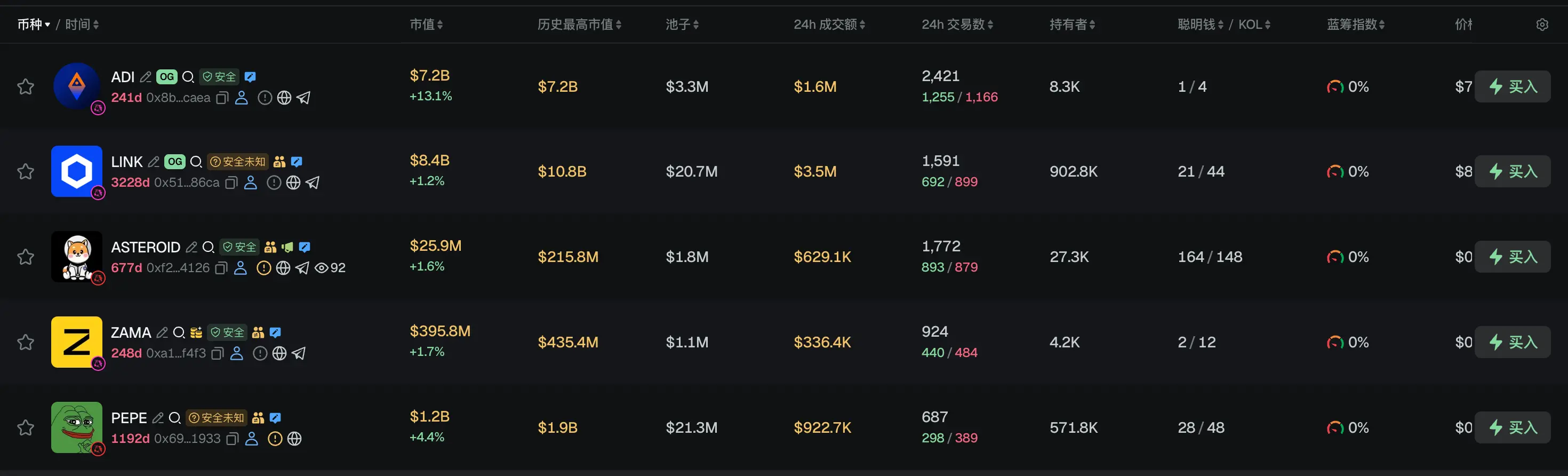
Meme Popularity Rankings
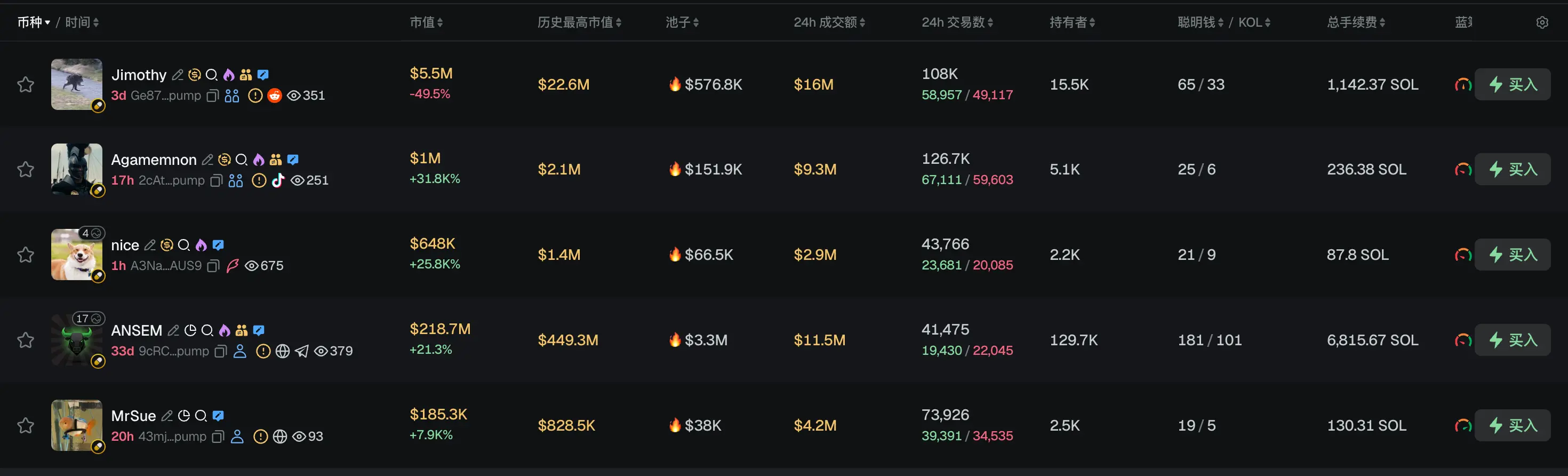
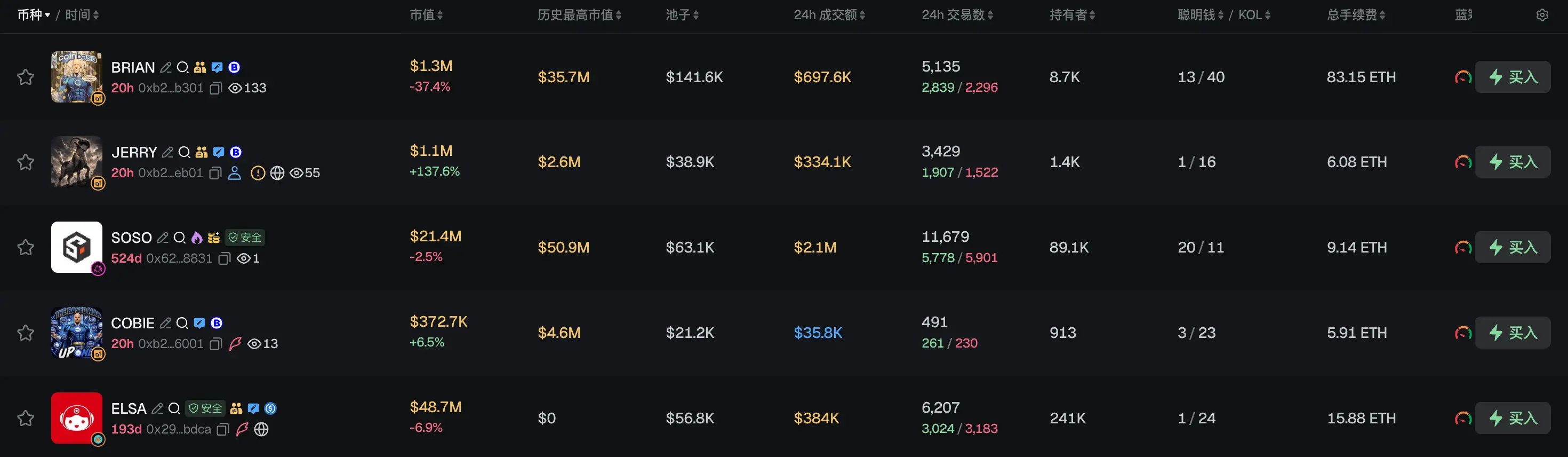
According to the meme token tracking and analysis platform GMGN, as of July 20, 09:30,
The top five popular ETH tokens in the past 24 hours are: ADI, LINK, ASTEROID, ZAMA, FIFA
The top five popular Solana tokens in the past 24 hours are: Jimothy, Agamemnon, ANSEM, nice, MrSue
The top five popular Base tokens in the past 24 hours are: BRIAN, JERRY, SOSO, COBIE, ELSA
What are some interesting articles worth reading in the past 24 hours?
Jacquelyn Melinek: Do you think traditional finance, on-chain finance, and trading ecosystems will eventually merge into one? CZ: Absolutely. There shouldn't be a distinction between crypto finance and traditional finance. Just as you wouldn't say that postal services and email are two parallel systems. Most people today no longer use postal services to send messages. Crypto blockchain is just a new technology in the financial system. Because it is new, it initially formed a niche, but integration is already happening. Stocks are being tokenized on-chain, and traditional banks and financial institutions are also using blockchain. Ultimately, there won't be two parallel lines, only one financial system. Jacquelyn Melinek: Thank you very much for your time, and congratulations to the Binance team on their ninth anniversary.
I think the biggest challenge with this kind of thing is that all decisions are essentially anomaly handling. The question is always: what is it that you cannot automate? What needs a person to make decisions, to judge, to have their own opinions—because that thing may have never been written down, never happened, or looks different from before.
The distinction I use in my talks is the difference between tasks and positions. The tasks used to fulfill a position may change, but the position itself may not change much, or what that position delivers to the client may not change much. Think about accountants 50 years ago and accountants today—the core things they do are almost none of the same. But from the client's perspective, it seems like the same thing, just accomplished in completely different ways, through a series of completely different tasks.
I think a deeper or more abstract way of thinking is: In what areas do you want the app to provide "the answer that everyone does"? That is the answer everyone wants, anyone can give, any junior employee can do, the answer anyone can give me. And in what areas do you not want that answer? In what areas do you want an answer to a new question, a different answer, or a different idea? Because LLMs will be very good at anything you can describe how people do it, and what you want is just what a general person would do. In areas where they are not good, it is where you cannot explain why you are doing it that way, and what you are doing is different from others.
Is the fastest and largest tech stock sell-off in history nearing its end?
The rotation is nearing its end, but the reversal catalyst is yet to appear. Mark Wilson suggests that he tends to believe that the unwinding process of the momentum factor is nearing its end, but also points out that there is a lack of summer catalysts that can immediately drive a market reversal in the short term. He also notes that as efficiency and commercial landing capabilities improve, new leading directions in the market will gradually emerge, and market breadth will expand accordingly—an example being the Dow Jones Transportation Index breaking new highs again this week. However, he also warns that the second derivative of profit growth (i.e., the slowdown of growth) will become increasingly important as the market digests the second-quarter earnings reports and enters summer, while various valuation metrics indicate that tech sector valuations remain high. Additionally, the correlation between traditional asset classes and assets is showing abnormal fractures, such as the three-month correlation between gold and oil dropping to extreme inverse levels in 35 years, making risk management and portfolio construction…
 Risk warning