The next competition in AI is no longer about models, but about value systems

 Aqi AI proposes a framework for the business value system of AI, reconstructing the logic of value creation in the AI era from three dimensions: payment, circulation, and rights.
As the capabilities of large models rapidly converge, the competitive focus of the AI industry is shifting. Recently, Arkie AI has proposed a complete "AI Value System" framework for the first time, attempting to provide a new commercial infrastructure idea for the AI industry from three levels: value entry, value circulation, and value rights. This framework offers a new perspective on the commercialization path of AI that is currently being discussed in the industry.
 Models are getting stronger, but value is still flowing in one direction
In the past few years, the development speed of large models has far exceeded the iteration speed of business models. From the wave of generative AI sparked by ChatGPT to the intensive emergence of AI Agents, AI search, AI programming, AI video, and AI office products, model capabilities are refreshing industry perceptions almost every month. Today, whether it is OpenAI, Google, Anthropic, or the continuously growing open-source camp, they are all capable of handling complex tasks such as writing, programming, translation, design, and video generation.
However, at the same time, a realistic problem is becoming increasingly apparent: AI creates value, but that value does not form a true cycle. Most AI products' business models are still stuck in the traditional internet era—users pay subscription fees, companies earn revenue, and platforms continue to invest in research and development, with the entire value flow being almost one-directional.
With the rise of AI Agents, AI will no longer just be a conversational tool but will become a true intelligent entity participating in commercial activities, automatically purchasing services, completing procurement, calling APIs, managing assets, and even completing transactions. This means that what the AI commercial ecosystem needs is not just a stronger model but a complete set of new infrastructure that can support value creation, value circulation, and value distribution.
Three-layer structure: from value entry to value rights
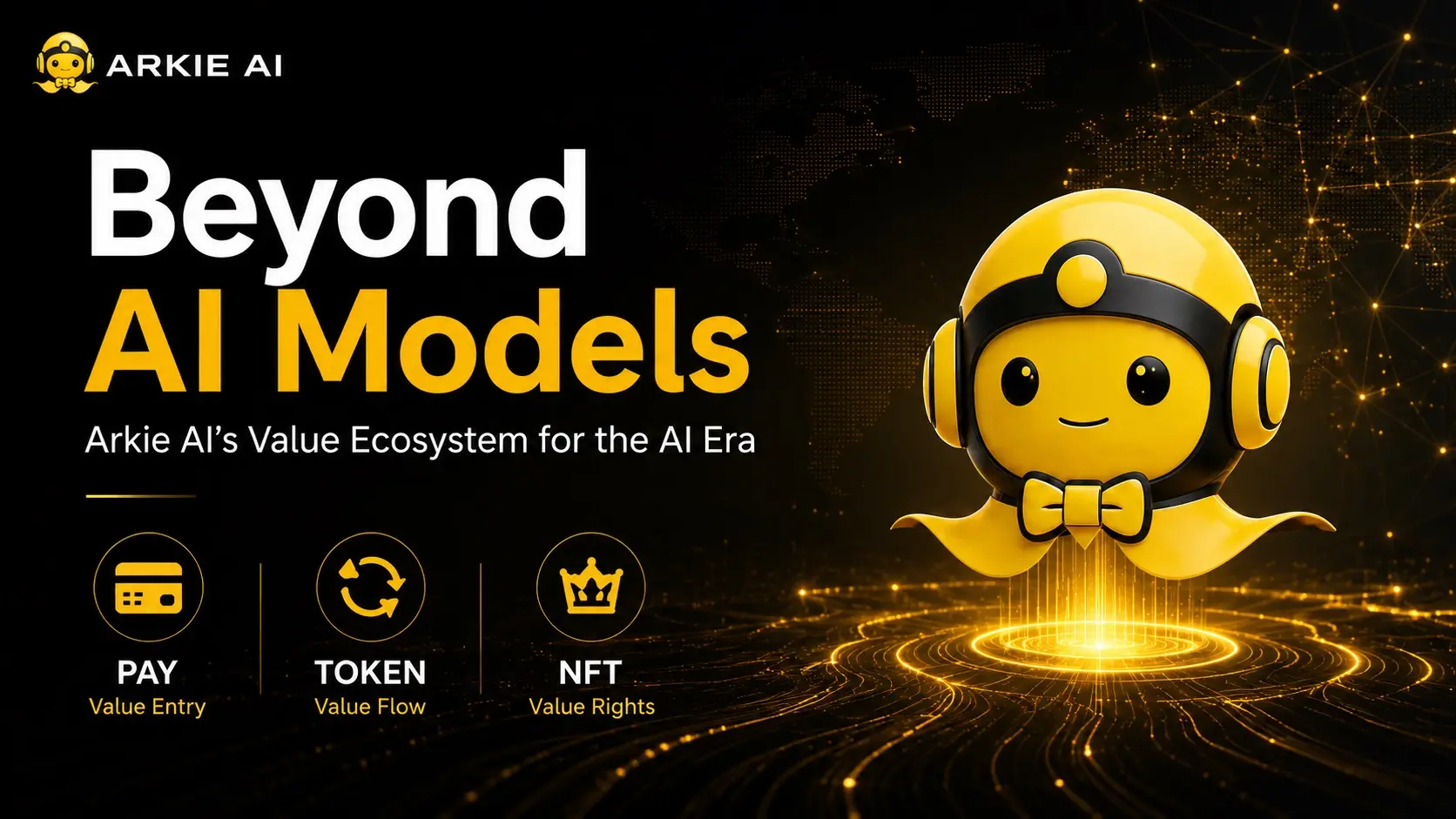
In the framework proposed by Arkie AI, the future AI commercial ecosystem is divided into three core levels.
The first layer is Value Entry. When AI directly participates in transactions, whether it is AI Agents purchasing services or AI automatically completing payments, a payment entry suitable for AI use is needed. Traditional payment systems mainly target people and businesses, while future payment systems need to cater to AI Agents, digital identities, automated transactions, and on-chain assets. Arkie AI defines this layer as Arkie Pay, which enables AI to directly complete payments, settlements, and value exchanges through a unified payment entry, providing underlying capabilities for AI commercial activities.
The second layer is Value Flow. Payment is just the beginning; the real key is how value continues to flow. In the internet era, once a transaction is completed by the platform, the value stops flowing; however, the AI commercial system requires a continuous value cycle. Arkie AI proposes a value circulation system centered around ARK Token, allowing behaviors such as payment, consumption, service invocation, and ecological applications to circulate within the same value system. Compared to traditional points systems, digital assets inherently possess characteristics of global circulation, programmability, combinability, and traceability, making them more suitable as value carriers in the AI commercial ecosystem.
The third layer is Value Rights. If payment solves the entry issue and tokens solve the circulation issue, the next question the AI industry needs to answer is: who does the value actually belong to? AI's training comes from users, its growth comes from data, and its commercialization comes from the entire ecosystem. Arkie AI defines this layer as Arkie NFT, which is not merely a digital collectible but a certificate of long-term participation in the ecosystem. The starting point of this design is to provide a public and verifiable record method for the distribution of ecological value, so that the commercial value of AI does not just remain at the transaction level but can further extend to long-term value sharing.
From a single transaction to a value closed loop
In Arkie AI's view, a mature AI commercial ecosystem should not just complete a single transaction but should form a complete value closed loop: AI creates value, the payment system undertakes value, digital assets promote value circulation, the rights system shares value, ecosystem participants continuously contribute, and ultimately drive AI to create more value. Only through this repetitive cycle can a continuously growing business flywheel be formed.
This idea aligns closely with the concept of "AI Economy" that has been continuously discussed in the industry in recent years. The focus of future competition will not just be on model parameters and reasoning capabilities but on who can establish a business system that allows value to continuously flow and be shared.
AI business competition is entering a new stage
Looking back at the development history of the internet, it can be found that every industrial upgrade does not come solely from technological breakthroughs. In the search era, what truly changed the world was the information distribution system established by Google; in the mobile internet era, what truly transformed the industry was the commercial ecosystem built by the App Store; in the mobile payment era, what truly changed consumption patterns was the payment network and commercial infrastructure.
Today, AI is at a similar juncture: model capabilities are rapidly converging, while commercial infrastructure is still in its early stages. The AI value system proposed by Arkie AI revolves around the three modules of value entry, value circulation, and value rights, attempting to provide a new commercial architecture idea for the AI era.
As AI Agents, digital payments, on-chain economies, and intelligent business continue to merge, AI competition may be shifting from competition in model capabilities to a higher-level competition in value systems. What truly defines the value of an AI platform will not just be how smart the model is, but whether it can build a complete ecosystem that allows value to be continuously created, circulated, and shared.
About Arkie AI
Arkie AI is a "universal spirit" that can help you summon AI from around the world. It allows ordinary people to no longer need to study models, compare parameters, or learn prompts; they just need to express their needs as if chatting, and the world's leading AI capabilities will automatically collaborate to complete tasks for them. Arkie AI's mission is to enable everyone to easily possess and use the most advanced artificial intelligence.
At the level of computing power infrastructure, Arkie AI has partnered with Tencent Cloud to jointly support the platform's scalable service capabilities for global users.
 Risk warning