Podcast Notes | Conversation with three core partners of a16z: Crypto funds must be restructured, heavily investing in the "boundless ambition" of the AGI era
 Core Viewpoint


 Starting today, not only blockchain, but all fields at the edge of human technological possibilities will receive our full investment through a16z Frontier.
Compiled by: Deep Tide TechFlow
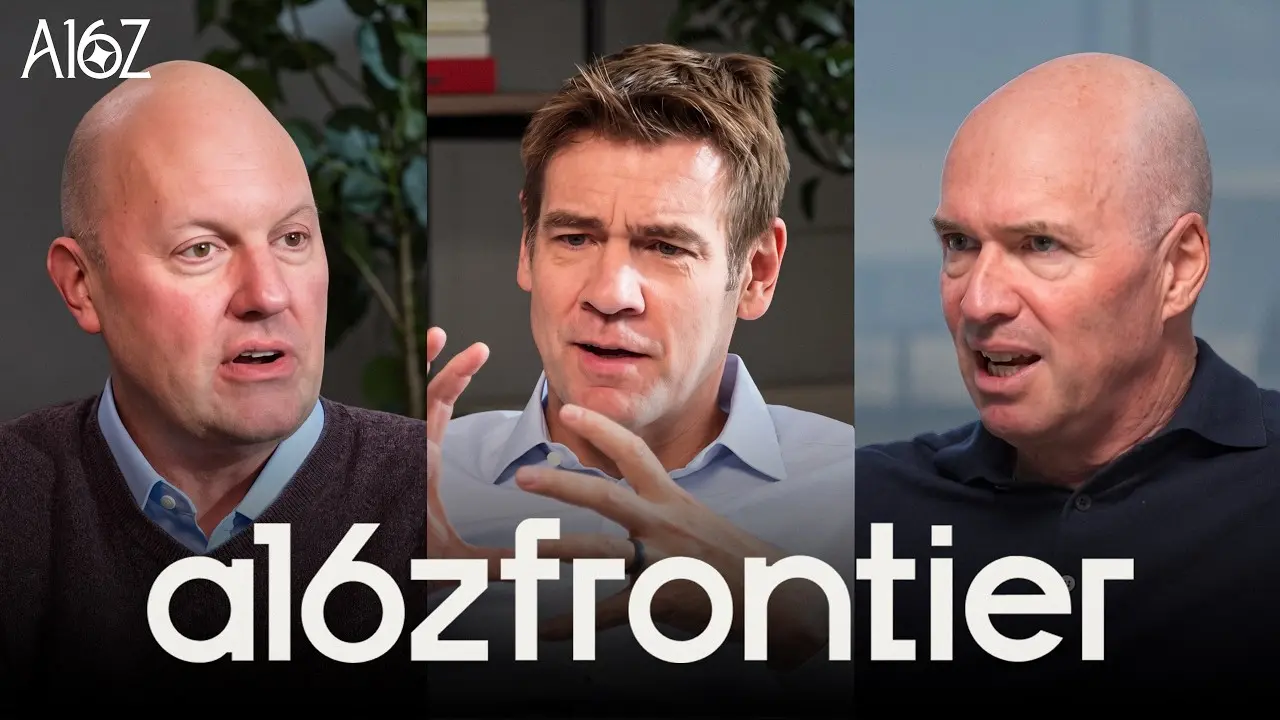
Deep Tide Guide: In this episode of the podcast, Silicon Valley's top venture capital firm a16z officially announced the restructuring and expansion of its blockchain-focused a16z crypto fund into a brand new "a16z Frontier" exploration fund. Led by Chris Dixon, the fund will expand its investment scope from purely on-chain infrastructure to a broader range of areas including hardware, embodied robotics, entertainment gaming, space biology, and decentralized open-source intelligence, covering more extensive hard-core physical and digital frontiers. a16z co-founders Marc Andreessen, Ben Horowitz, and Chris Dixon engage in an in-depth dialogue about the evolution of technology cycles, the power restructuring in the AI era, and the opportunities for entrepreneurs.
The three Silicon Valley titans pointed out in the interview that today's world is at a critical moment with the largest cognitive gap between early technology explorers and the general public in history. They explicitly refuted the pessimistic view that "AI will inevitably lead to centralization," deeply analyzing the core value of open-source AI and cryptographic protocols in combating monopolies. They stated that the commercial contracts of traditional internet protocols have been broken by giants and called on a new generation of entrepreneurs to step out of the mediocre trap of minor functional optimizations and boldly ask, "Is my vision grand enough?" to become true builders at the wild frontier where the software and physical worlds intersect.
Guests: Marc Andreessen (a16z co-founder and general partner), Ben Horowitz (a16z co-founder and general partner), Chris Dixon (founding partner of a16z Frontier / a16z crypto)
Host: Erik Torenberg (notable tech investor, founder of Turpentine, special host of a16z podcast)
Podcast Source: a16z Official Special (https://www.youtube.com/watch?v=-9XQMHhpypc)
Original Title: The Frontier Ideas a16z Wants to Fund Now | Marc Andreessen, Ben Horowitz & Chris Dixon
Broadcast Date: October 22, 2026
Key Points Summary
· a16z crypto fully evolves into a16z Frontier: The original crypto fund is officially expanded into a broader frontier technology fund, no longer limited to a single blockchain narrative, but fully funding hard-core pioneers at the edge of technological possibilities, covering hardware, robotics, entertainment media, and biological sciences.
· Historical cognitive gap between early explorers and the general public: Ordinary people still view AI as a simple conversational toy, while true early builders have fully entered the era of autonomous agents, local large model clusters, and super productivity. This cognitive potential gap holds enormous dividends.
· Breaking free from the mediocre "product manager mindset": Marc Andreessen sharply criticized Silicon Valley's excessive reliance on A/B testing and incremental improvements in conversion rates, emphasizing that only non-consensus leap innovations and deep artistic taste can lead to true platform-level breakthroughs.
· Open-source AI is the ultimate trump card against monopolistic centralization: In response to Peter Thiel's assertion that "cryptography is decentralization, AI is centralization," Andreessen and Dixon firmly believe that the combination of open-source large models and cryptographic ledgers is the only defense against the collusion of tech giants and bureaucratic regulation.
· The foundational contracts of the internet are breaking down: The traditional model of "creators contribute content, platforms return traffic and revenue" has been completely destroyed by AI scraping and closed-loop summarization, making it urgent to build new economic agreements with on-chain rights confirmation, verifiable ownership, and digital scarcity.
· New forms of physical computing are brewing for an iPhone-level explosion: Smart glasses, environment-aware spatial computing, and companion AI are reshaping human-computer interaction interfaces, ending the nearly two-decade absolute monopoly of smartphones.
· Core advice for contemporary youth: Reject the step-by-step credentialism and mediocre career trajectories, deeply study physics, mathematics, and underlying systems engineering, and master AI tools to amplify individual productivity by a hundredfold, becoming super builders with both geek spirit and aesthetic taste.
II. Exciting Perspectives
· "The question that the new generation of founders should ask themselves is no longer 'Is my ambition too big?' but rather 'Is my ambition big enough?'"
· "The understanding of technological possibilities by today's early users has the widest gap in history compared to what the general public and traditional management perceive."
· "We have witnessed too many mediocre projects hijacked by the so-called 'product manager mindset,' who excel at improving conversion rates by a fraction but know nothing about pioneering leap innovations that create entirely new dimensions."
· "Open-source is not a simple charity; it is the most powerful anti-monopoly weapon in human technological history. When the top open-source models run freely on millions of edge devices worldwide, the centralizers' blockade is destined to fail."
· "The original economic contract of the internet has been unilaterally torn apart by the giants. You contribute all your knowledge, and AI takes it for training, yet does not return even a single independent click. We must rebuild this system with cryptography and on-chain ownership."
· "Do not learn standardized skills that will soon be fully automated by algorithms. Delve into hard-core physics, the essence of mathematics, and complex underlying systems, becoming a person with first-principles judgment."
III. Main Text
1. Expanding a16z Frontier: From a Single Crypto Track to Boundless Hard Tech Frontiers
Host Erik Torenberg: Today, a16z announces a significant strategic announcement, officially expanding the globally renowned a16z crypto fund into the "a16z Frontier" exploration fund. Chris, what is the core thinking behind this?
Chris Dixon: Over the past few years, our team has been deeply contemplating the evolution of frontier technology cycles. When we first established the crypto-exclusive fund in 2018, it was the most exciting paradigm shift at the technological frontier at that time. But today, with the explosion of generative AI, underlying computing power, and modern cryptography, the frontiers of technology have undergone tremendous spillover and fusion.
We see that the best founders no longer confine themselves to isolated labels. They are building decentralized networks while also developing embodied robots, local intelligent agents, new computing clusters, synthetic biology, and unprecedented new immersive media. To fully support these founders who dare to explore the unknown deep sea, we have decided to completely broaden the investment scope of the fund. From today, not only blockchain but all fields at the edge of human technological possibilities will receive full investment through a16z Frontier. Founders should no longer ask if their ideas are too radical but should ask if their visions are grand enough.
Marc Andreessen: Let me add some historical context. Over the past fifteen years since a16z was founded, every time we faced a significant technological wave, we proactively evolved our organizational structure and investment strategy. From the early days of cloud computing and mobile internet to later enterprise services, life sciences, and crypto networks, technology has never evolved in isolation; it always presents a network of chain reactions. Now, AI is pulling forward all the hardware, physics, and software accumulations of the past few decades. Frontier represents a state of mind that is never satisfied with the status quo and continuously explores new territories.
Ben Horowitz: When we observe top entrepreneurs, true revolutions often occur in the gray areas where different disciplines collide. If a startup is making humanoid robots driven by open-source large models while also distributing data rights and micro-payment rewards on-chain, it is hard to categorize it simply as AI or Crypto. The establishment of a16z Frontier is to break all artificially defined track barriers; as long as you are exploring the truly unknown boundaries, this is the most steadfast support.
2. Is "Being Too Early" Still a Fatal Risk Today?
Host Erik Torenberg: In the venture capital world, there is a saying that is regarded as a guiding principle: "In the tech industry, being too early and being completely wrong are almost indistinguishable." Marc, you pioneered the Netscape browser back in the 1990s and are recognized as one of the few who have repeatedly stepped ahead of the times. In today's rapidly iterating cycle, is "being too early" still a danger?
Marc Andreessen: This is indeed a classic saying because for decades, if your business idea was ahead of its time, you had to painfully wait for the external supporting infrastructure to mature. For example, if you wanted to do online streaming video twenty years ago, but at that time, households across the U.S. were still using dial-up internet, without fiber broadband, smartphones, or cloud-native data centers, your company would exhaust its cash flow before the infrastructure caught up.
But something extremely shocking has happened today: the timeline for the evolution of underlying technologies has been completely compressed. Today's startups do not need to lay cables from scratch or build chip factories; global public clouds, powerful open-source foundational models, and high-density mobile terminals are ubiquitous. More importantly, AI itself is a super accelerator, compressing what used to take years to complete—coding, prototyping, molecular simulation, and hardware rendering—into days or even hours. Therefore, today, the time gap brought by "being too early" has been greatly filled. On the contrary, the real danger now is "not being bold enough"; if you only create a product that is slightly ahead by six months, tech giants and the open-source community will drown you before you even officially launch.
Chris Dixon: I completely agree with Marc's assessment. Many people said that smart contracts and decentralized computing were too early ten years ago, but it was precisely because of the foundational sediment of that time that we have today's censorship-resistant, high-throughput distributed settlement networks. Under the Frontier category, we are willing to take on the so-called "too early" risk because true outsized returns and world-changing giant enterprises are always born when mainstream consensus is still confused and questioning.
3. A Historic Cognitive Gap: The Disconnection Between Early Explorers and the Mainstream Public
Host Erik Torenberg: You have mentioned multiple times in recent public interviews and articles that there exists an extremely rare cognitive chasm in today's tech world. How significant is the gap you have observed?
Chris Dixon: I believe this is the widest gap in history between early adopters and public understanding since the inception of the computer industry. You can look around; the executives of mainstream society and traditional multinational corporations, and even the vast majority of regulatory officials still understand AI as just an intelligent chat box that occasionally writes documents and edits resumes. They see it merely as another office efficiency plugin.
However, if you delve into the development sites of San Francisco or the world's top geeks, you will find that the early builders have long entered a completely different universe. They are collaboratively writing complex operating systems through hundreds of thousands of autonomous AI agents, robots completing reinforcement learning in simulated environments at speeds tens of thousands of times faster than humans, and synthetic biology researchers designing highly active proteins that do not exist in nature using deep neural networks within weeks. This cognitive difference is exponential.
Marc Andreessen: This is reminiscent of how ordinary people viewed the internet in the early 1990s. At that time, the vast majority of people thought web pages were just electronic versions of newspapers and could not imagine that they would reshape global finance, supply chains, and geopolitics. This huge cognitive potential gap is the most disruptive moat for entrepreneurs. While existing giants are still examining new things with the old system's mindset, the real builders have already reconstructed the entire foundation with new tools.
4. Profit Destination Debate: Do AI dividends belong to existing giants or startups?
Host Erik Torenberg: The most heated debate on Wall Street and in the venture capital world over the past two years has been whether the massive value created by AI will ultimately be monopolized by existing tech giants or give rise to a new batch of trillion-dollar startups. Ben, you have experienced all cycles from mainframes, PCs, the internet to mobile. How do you view this round of profit distribution?
Ben Horowitz: So far, it appears that giants like Microsoft, Google, Amazon, and Nvidia have gained a first-mover advantage because they have ready-made large distribution networks, computing budgets, and a vast number of enterprise customers. The quickest way to monetize is to plug existing AI models into established Office suites or search engines.
But the history of technology tells us a cruel iron law: giants are always constrained by the "innovator's dilemma." Their organizational structures, sales channels, and business models are tailored for the old world. Once a technology paradigm emerges that requires destroying their core profit sources, giants instinctively hesitate and compromise. Take the early internet as an example; traditional telecom companies owned all the fiber optics and telephone networks, and they should have dominated the internet, but the ones that ultimately stood out were Netscape, Amazon, Yahoo, and Google. Because new species are never about tweaking old businesses by ten percent, but rather building with a completely new business model from day one, startups have no burdens, which is the fatal killer.
Chris Dixon: This is especially true in frontier fields. If the future internet is about economic settlements and resource scheduling among a group of autonomous agents, the existing centralized business models based on credit card deductions and ad clicks will completely fail. Agents do not need to see banner ads; what they need are frictionless micropayment protocols and on-chain cryptographic credit. This fundamental change in underlying business logic can only be achieved by startups.
5. Agent Economic Network: When half of the residents on the network are no longer human
Host Erik Torenberg: Following up on the topic of agents that Chris just mentioned, you have depicted a future of the "agent internet" in your investment concepts. How will AI interact and collaborate within this network?
Chris Dixon: This is a very fascinating and imminent evolution. In the next three to five years, humans may even become a minority among the active interactive entities on the internet, with tens of millions of AI agents executing asset allocation, data retrieval, code deployment, and supply chain bidding on behalf of humans.
But this raises a fundamental engineering and financial dilemma: how do agents establish their identity? How do agents complete cross-border settlements without traditional bank accounts? The traditional centralized banking system cannot issue debit cards for autonomous code. This is precisely why cryptographic protocols and decentralized agents are two sides of the same coin. Agents inherently need to hold their own cryptographic private keys, possess their own on-chain wallets, and achieve collaboration and settlement through smart contracts in a permissionless network.
Marc Andreessen: Even at the social network level, incredible changes will occur. The social platforms of the past twenty years have been about peer-to-peer attention between people, while future social networks may be highly mixed ecosystems. Agents will have their own personalities, knowledge reserves, and economic demands, engaging in debates, content creation, and even forming their own decentralized collaborative organizations in social squares. This will completely reconstruct our understanding of "community" and "media."
6. Breaking Free from the "Product Manager Brain": The Artistic Breakthrough of Games, Film, and Physical Hardware
Host Erik Torenberg: Marc, you recently made a very sharp point, criticizing the prevalent "Product Manager Brain" in Silicon Valley in recent years. What negative impacts do you think this mindset has on current technological innovation?
Marc Andreessen: The so-called "Product Manager Brain" is a highly harmful bureaucratic mindset that evolved during the maturity of the mobile internet. These individuals have undergone rigorous metric training in large tech companies, believing that the essence of all innovation is to look at retention curves, run multivariate A/B tests, and change the button color from dark blue to light blue to achieve a thousandth of a percent increase in click-through rates. They simplify business into cold, hard conversion rate formulas.
In a mature software market where incremental growth has peaked, this meticulous operation may squeeze out some profit. But in the face of true frontier exploration, the "Product Manager Brain" is not only useless but can even stifle the budding of all great innovations. You can imagine that if Steve Jobs had conducted focus groups and A/B tests while developing the iPhone, he would have ended up with a Blackberry phone with a smaller keyboard.
Marc Andreessen: Real breakthroughs depend on deep taste, artistic intuition, and an engineering obsession at all costs. Especially in the realms of AAA games, film narratives, and new hardware terminals, great works are always sculpted by creators with strong personal will and extraordinary taste. The true meaning of AI is not to help product managers create more data dashboards but to hand the best generative tools to small teams with exceptional taste. In the future, an independent studio with only ten people will be capable of creating interactive universes that surpass Hollywood's top blockbusters in visual fidelity and world complexity.
Ben Horowitz: I completely agree. The essence of business has never been the self-cycling of algorithms but rather touching the deepest emotions and curiosities of humanity. Entrepreneurs must reclaim the will of the founders, daring to place heavy bets on unknown experiences rather than handing over decision-making power to mechanical data dashboards.
7. Will AI Become Centralized? Why Open Source Models Matter for the Future of Civilization
Host Erik Torenberg: Silicon Valley investor Peter Thiel famously proposed a widely circulated adage about ten years ago: "Crypto is libertarianism, AI is communism." His core logic is that blockchain decentralizes power, while AI naturally tends toward centralized massive computing power and data monopolies. Marc, Chris, what do you think of this assertion?
Marc Andreessen: Peter's observation had its sharpness at a specific historical stage because early deep learning indeed relied heavily on centralized big data centers and oligarchic servers. If you only have closed-source models, and if only two or three multinational giants and governments in the world can control the smartest machine brains, then AI will indeed evolve into the most terrifying centralization tool in human history.
But this is precisely why we must fiercely defend open-source AI! The rise of open-source large models has completely shattered this centralized fate. From Meta's open-source Llama series to globally active open-source communities, deeply optimized architectures, and quantization algorithms, we see the most advanced intelligence being rapidly compressed. Today, a model that performs on par with supercomputers from a few years ago can run smoothly on your laptop or even the local chip of your smartphone. Open source means that the code is publicly available to all humanity, the weights do not belong to any bureaucratic review body, and anyone can freely fork, fine-tune, and deploy.
Chris Dixon: This aligns perfectly with the spirit of cryptography. Cryptography eliminates the privileges of financial intermediaries, while open-source models eliminate the intermediaries of thought and intelligence. In Washington and other regulatory centers, some vested interest giants are cunningly lobbying under the guise of "safety" to define open-source software as illegal, thereby building compliance barriers to maintain their monopolistic positions. This is a classic "Baptist and Bootlegger" political alliance. Our support for a16z Frontier is to steadfastly invest in the open-source ecosystem, decentralized computing power, and open protocols, ensuring that the future of technology is not privatized by a few giants.
8. The Collapse of Internet Underlying Contracts: The Trust Crisis Between Creators and Platforms
Host Erik Torenberg: Chris, you have profoundly discussed the collapse of internet protocol contracts in your book "Read Write Own." Is this contract rupture further intensifying in the AI era?
Chris Dixon: The rupture has become completely public. Early Web2 platforms were built on a fragile tacit agreement: independent creators, bloggers, news media, and community volunteers contributed vast amounts of high-quality content for free, and in return, platforms provided them with distribution traffic, audience building, and opportunities for commercial gain.
But once the giants completed the monopoly of network effects, the first thing they did was to close the doors and tighten algorithms, forcing creators to pay for traffic. Now, in the era of generative AI, large model companies are crawling the web to capture decades of human effort, then directly providing final answers in search engines and Q&A interfaces without directing even a single independent visit to the original websites. For independent creators, the original economic cycle has been completely severed.
If this continues, high-quality original content from humans will dry up, and the internet will be filled with low-quality garbage generated by machines talking to themselves. The only way to break this deadlock is to build verifiable data ownership through blockchain protocols. By establishing on-chain rights, every data call, inference, and training can be traced back and automatically rewarded economically. Reshaping this contract is one of the most important missions of the Frontier fund.
9. Saying Goodbye to Smartphone Dominance: What Will Take Over the Hardware Era After the iPhone?
Host Erik Torenberg: Since the release of the first-generation iPhone in 2007, smartphones have dominated human digital life for nearly twenty years. Looking towards the next decade, what kind of physical computing medium can truly break the dominance of this glass screen?
Ben Horowitz: Smartphones are indeed a perfect industrial miracle, but their mode of interaction is fundamentally counterintuitive. Humans must lower their heads, pulling their attention away from the real world to stare intently at a five or six-inch piece of glass in their palms. This is not the ultimate form of coexistence between technology and humanity.
What we are currently most optimistic about is all-weather wearable computing devices, especially smart glasses and environmental perception hardware. When you wear a device that weighs the same as ordinary glasses, it has a front-facing high-dynamic camera and directional audio microphone. This means you have a companion AI that can share your first-person perspective and fully understand the physical environment. It knows what you are looking at, it can understand who you are talking to, and it can provide you with auxiliary information at just the right moment without you needing to pull out your phone to swipe and unlock.
Marc Andreessen: This is a fundamental leap from "tool-based computing" to "environment-aware intelligence." Spatial audio, retinal projection, and haptic feedback are maturing. Future hardware will not only be an information receiver but also an external extension of human cognitive abilities. This track is nurturing a brand new hardware supply chain ecosystem worth hundreds of billions of dollars.
10. If You Just Turned Eighteen Today: Survival Rules from the Godfather of Silicon Valley for Young People
Host Erik Torenberg: At the end of this interview, I want to ask a question on behalf of all the curious and confused young generation: If you just turned eighteen today, preparing to enter college or just starting in society, what field would you choose to delve into?
Marc Andreessen: My first piece of advice is: Stay away from the mediocre stable trajectory, and absolutely do not study standardized professions that try to train you to be a cog in the machine. If you learn transactional skills that handle documents according to fixed rules, you will find yourself completely replaced by large models before you even graduate.
Go back to the physical world and first principles. Dive deep into foundational mathematics, theoretical physics, low-level computer systems engineering, and chemical materials. The laws of physics are the hardest truths in the universe; they never lie. At the same time, be extremely eager to master cutting-edge AI tools. Today's eighteen-year-olds possess unprecedented superpowers in history; a young person proficient in modern generative tools and programming agents is equivalent to an entire software development department of twenty engineers from the past. Create real things, launch real products; code and user feedback outweigh any prestigious diploma.
Ben Horowitz: I want to add something about character and will. No matter how technology changes, the most scarce resource in the business world will always be true leadership and responsibility. Explore the dangerous edges of stormy weather, learn to face failure, learn to organize like-minded talents, and learn to stick to your intuition when the public scoffs at you. The true wealth of the future will always belong to those builders who roll up their sleeves and sweat in the workshop and codebase.
Chris Dixon: Maintain a geek spirit and remain skeptical of all overhyped authoritative consensus. Join the new frontier that is being pioneered, even if it looks clumsy and rough today. Twenty years ago it was open-source software, ten years ago it was blockchain, and today it is hard technology and the world of agents represented by a16z Frontier. Brave the frontier; the future has just begun.
 Risk warning




Popular articles