








a16z: From charging by the hour to profit-sharing based on results, a relay race worth hundreds of billions of dollars
 Core Viewpoint

 Long-running intelligent agents are traversing the lengthy customer journey, expanding the AI-addressable market from labor cost budgets to revenue sharing of business incremental income.
Original Title: Winning the Relay Race: Long-Running Agents in High-Value Customer Journeys
Original Author: David Haber, Partner at a16z
Original Compilation: Deep Tide TechFlow
Abstract: This analysis by a16z points directly to the most critical turning point in the commercialization of AI: from saving costs by the hour to revenue sharing based on results. If you are a SaaS practitioner or investor, this article explains why the next batch of AI unicorns will no longer sell "seat fees," but will instead take a portion of customer revenue growth directly.

Traditionally, calling a telecom operator to report an internet outage goes something like this: a robotic voice first addresses you as "valued customer," then makes you navigate through the phone menu for several minutes: "Press 3 for technical support, press 2 for broadband, then press 4 for other issues." After that, you are left in hold music, feeling forgotten, until finally a customer service representative picks up and asks for your name, account number, and problem description. If rebooting the router doesn’t solve the issue, you have to wait again and explain the whole situation to another representative before you can schedule a technician visit.
AI is already changing these types of customer service scenarios. You no longer have to wrestle with robotic voices and multiple customer service representatives; an AI agent can now pick up the call immediately. It can check your account, see if other users in your area are also affected, either resolve simple issues directly or help you schedule a repair technician. There are no more "all customer service representatives are currently busy" messages, and no more hold music. Until recently, this was basically the limit of technology.
But now, new capabilities are enabling AI agents to track leads and execute tasks over longer time spans. We believe this will allow AI companies to move beyond single customer interactions and rethink how to handle complex customer journeys that last weeks or even months. AI will guide insurance customers from the first call to final payout, guide mortgage borrowers from pre-approval to closing, and guide business sales leads from the first demo to signing. This will not only lead to better outcomes for customers but also allow AI providers to be compensated based on revenue growth rather than just charging for cost savings.
Value Only Appears at the End of the Relay Race
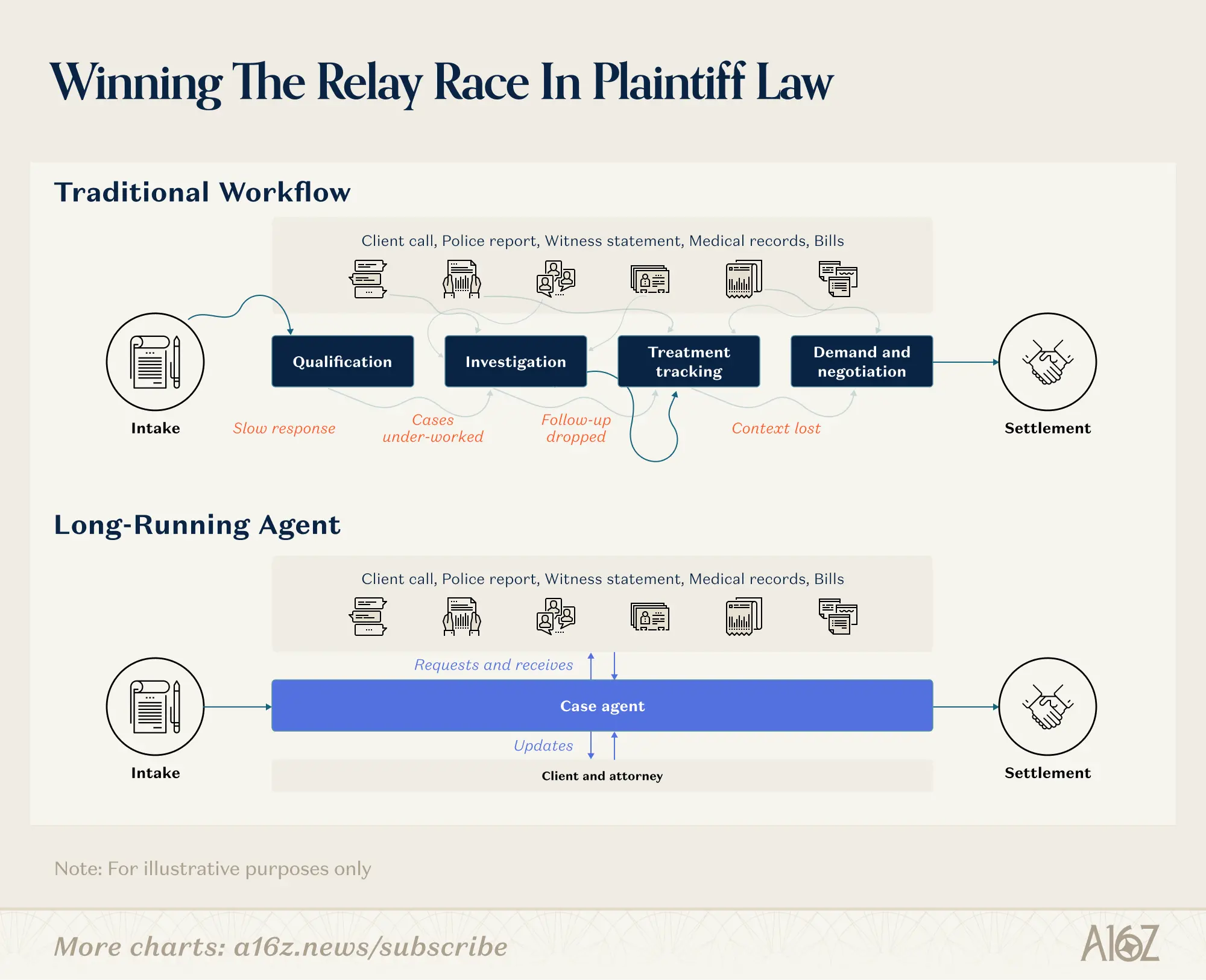
There are many types of businesses where creating value for customers requires many steps, spanning weeks or even months. Take the traditional case preparation process of a plaintiff law firm as an example. Potential cases usually come in as phone leads, and the intake specialist collects key information to pass on to a lawyer to evaluate whether to take on the client. Once the law firm signs the case, investigation and evidence collection begin: paralegals retrieve police reports, attempt to contact witnesses, and send evidence preservation letters to the defendant to retain evidence, while continuously updating the client on progress. Then the law firm has to wait for the client to finish treatment, draft a medical timeline, and submit the materials to the lawyer to complete the claim letter.
This process is what we used to call a "relay race": a long journey where each handoff carries the risk of loss or value degradation. Potential clients often call several personal injury law firms, usually signing with the one that responds the fastest. So if a client only hears voicemail or the qualification review is too slow, the case will leak out of the funnel. After the client signs, evidence collection involves multiple parallel leads, and the law firm may not have the patience to make a fifth call after four unanswered attempts. Additionally, human limitations may prevent the law firm from thoroughly reviewing every piece of evidence, especially in cases that seem routine and involve smaller stakes. If a careful reading of the doctor's records could reveal signs of brain injury, significantly increasing the settlement amount, the law firm might have accepted the opposing party's first offer outright. Ultimately, the case could drag on for several months, involving numerous participants, with information scattered across documents, personnel, and systems. This makes it nearly impossible for the law firm to maintain a holistic view of each client. The result is that important bills may not be included in the claim letter, treatment gaps go unexplained, and ultimately the settlement amount is depressed.
Opportunities for Long-Running Agents
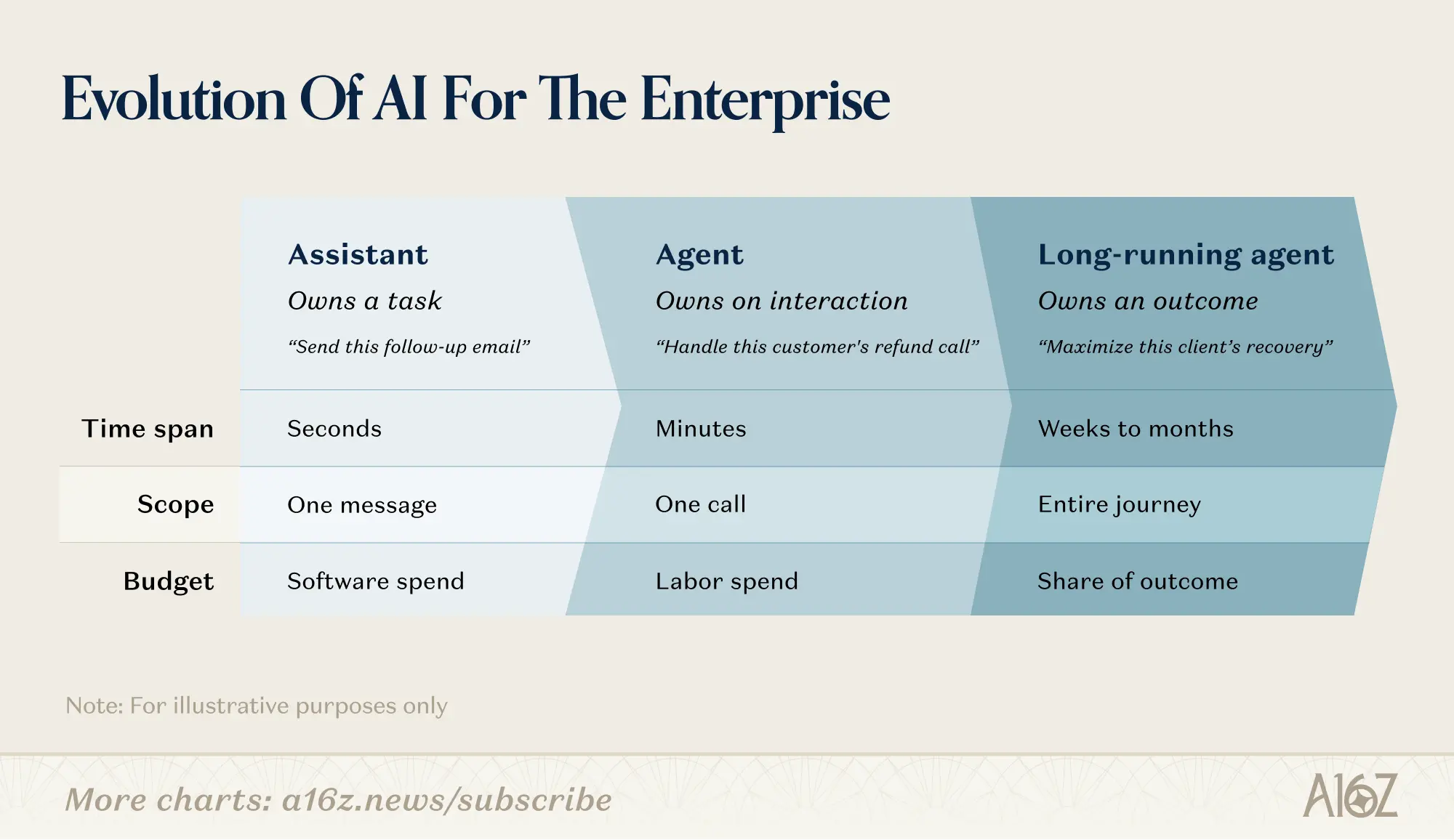
Until recently, AI agents mostly handled bounded tasks: "send this follow-up email," "summarize that call," "create this document," and interactions with a very narrow scope. For example, customer service became an excellent early application for AI because the problem space is clearly defined, allowing for high reliability while also being customizable according to company policies. Interaction times are short, results are verifiable, and if an AI agent encounters an edge case it cannot handle, a ready customer service team is usually available for escalation.
Now, long-running agents can pursue goals across dozens of steps, various modalities, and longer time spans, allowing them to run the entire relay race from start to finish. In the case of a plaintiff law firm, from the initial intake call, a long-running agent can be assigned to the case with the goal of maximizing the client's compensation amount. The agent will save and retrieve case background information as needed. It automatically wakes up based on events or deadlines, proactively dispatching sub-agents to contact witnesses, update clients, and communicate with lawyers via phone, email, or text. Then it integrates findings, plans the next steps, drafts documents for review, and drives the case toward the best possible outcome. Across clients, it continuously learns, with data generated from each case helping it handle the next case better than the current one.
The agent addresses the main points of value degradation observed in today's relay races. At the journey's starting point, clients no longer leak out due to slow case evaluations, as the agent is online at any time, any day of the week, and can almost instantly complete case evaluations. Evidence collection is no longer limited by human resources, as the case agent can always pull in an additional sub-agent to make the fifth, tenth, or even twentieth call. Since the agent can scale almost infinitely, even seemingly routine cases will be thoroughly processed, with every piece of evidence carefully reviewed, exposing potentially overlooked clues of brain injury. Finally, the agent retains a complete record of the case, from witness call recordings to police reports to medical records, ensuring that no information is lost.
Charging by Results
In addition to plugging these gaps, having a complete customer journey can also change the business model for agent providers. When agents can deliver results with higher quality and speed, they can bring revenue growth to clients, not just cost reductions. More importantly, since the impact is observable and attributable to the agent, providers can share the incremental value they create by pricing based on work products or results. In the case of a plaintiff law firm, individual cases are natural units of work, and the value of the final outcome, namely the settlement amount, is clearly identifiable. Furthermore, as agents occupy an increasingly larger share of the final work product, the results become easier to associate with the agents. Providers can thus share in revenue growth, achieving contract amounts that were previously unattainable through mere cost reductions.
Admittedly, transitioning to result-based pricing is not without friction. In the plaintiff attorney industry, most states prohibit non-lawyers from sharing legal fees, so pricing needs to align with settlement amounts but cannot directly share from them. In other verticals, providers may encounter resistance from procurement teams, as they do not yet have precedents for result-based contracts. Moreover, even if agents are closer to fully owning the results, attribution disputes may still arise in the early stages. Therefore, successfully deploying long-running agents is both a business challenge and a technical challenge.
However, charging by results in high-value customer journeys is not a new idea.
A Case for an AI-Native Red Ventures
Red Ventures (RV) is a great historical case. RV was founded by Ric Elias and Dan Feldstein, pioneering digital end-to-end outsourced sales operations for long-term consumer contracts. For example, in insurance, RV collects customer information when they search for these products (through owning websites like homeinsurance.com), proactively contacts customers, guides them through coverage options, and ultimately closes the policy. By fully owning this journey, RV receives a payment from the insurance company for every policy sold. This model was extremely effective: according to S&P Global data, RV generated approximately $3.7 billion in EBITDA from about $1.4 billion in sales in 2022.
Today, this model seems to face structural threats. At the top of the funnel, the way consumers discover products is changing. They no longer rely on Google searches or comparison websites to explore and compare products but can directly ask personal agents like Meta's Muse or Instinct for product recommendations, diminishing the value of previously owned exploratory sites. Looking further downstream, it is no longer hundreds of people operating a linear funnel; long-running agents can handle journeys that are far more complex than before. They can work across products, across communication methods, operate in parallel, support any language, scale massively, and possess infinite persistence. RV's EBITDA is projected to drop to about $160 million by 2025 due to customer churn and softening ad spending, which has already indicated the model's vulnerability, and AI will further change the entire industry.
Three Market Entry Paths
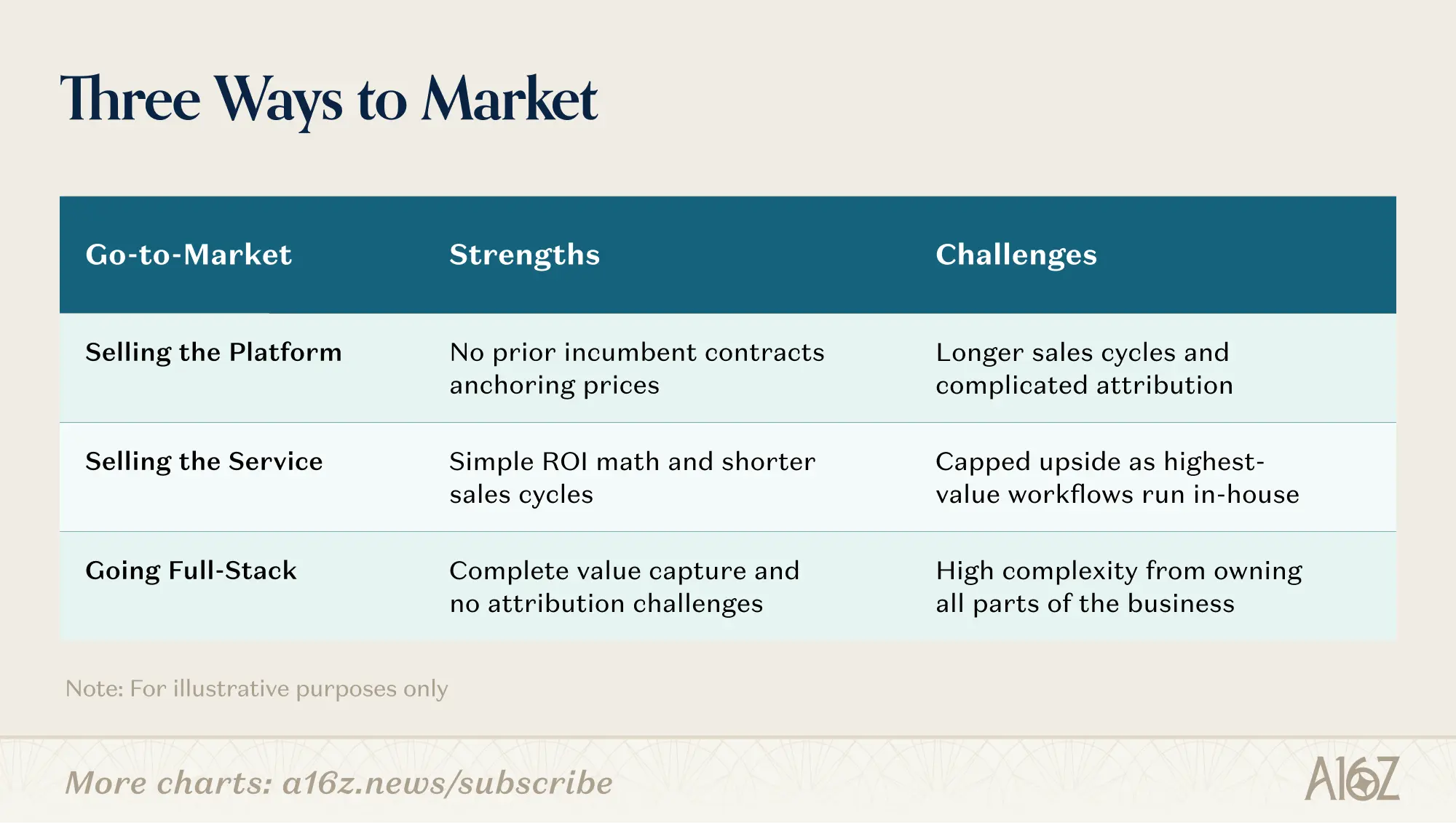
There are different ways to bring long-running agents to market:
(1) Selling Platforms: In this approach, providers sell long-running agents as software, supporting enterprises in using them within existing operations. In the plaintiff law firm case, integrating agents with existing teams and their workflows is a good example. Selling platforms can bring revenue upside potential because there are usually no comparable software or outsourcing service contracts to anchor pricing. However, this also lengthens the sales cycle, as new budget line items need to be created, and it becomes difficult to clearly attribute results when an agent interacts with multiple departments within an enterprise.
(2) Selling Services: Here, providers take over a service that has already been outsourced to deliver the expected results more effectively, just like Red Ventures owns the entire customer acquisition journey for insurance companies. This approach shortens the sales cycle because the buyer's ROI calculation is straightforward, and the BPO budget line items already exist. However, the existing pricing models prior to the emergence of AI may not reflect the true value that long-running agents can deliver, and today many high-value journeys are operated internally by enterprises, limiting the coverage of this approach.
(3) Full-Stack Entry: Full-stack means vertical integration, becoming an AI-native player. For example, instead of selling long-running agents to a debt collection company, it would be better to buy a debt portfolio and collect it yourself, allowing you to fully capture any upside brought by AI and resolve attribution issues. But this also means you have to take on service elements like licensing or compliance, which can add interference and operational complexity outside the actual customer journey.
It is still too early to determine which method will prevail, but we are confident that long-term operating agents will win in large-scale relay races and expand the AI-addressable market from a portion of labor budgets to a portion of revenues. The preparation of the plaintiff's case is just one example; we expect agents to drive results in other high-value journeys, such as mortgage issuance, insurance claims processing, complex enterprise sales, and countless other scenarios. If you are capturing this opportunity, we would love to hear from you!

 Risk warning




Popular articles





