Leave it to the curve, don't fight against the cycle: A review of 10 years of cryptocurrency investment by macro analysis master Raoul Pal
 Core Viewpoint

 Zoom out, eliminate distractions, control the vault, control the track, let the curve accomplish the work I have spent ten years trying to overcome.
Author: Raoul Pal, Co-founder and CEO of Real Vision
Original Title: 《Where Crypto Fits in the Exponential Age》
Compiled by: Hu Tao, ChainCatcher
Now, scrolling through your information feed, you will find the atmosphere is bleak. The cycle is over, cryptocurrencies are dead, the four-year cycle pattern has collapsed, and everyone who advised you to buy has been wrong. Price movements are vastly different from people's expectations, and when prices become confusing, people become pessimistic. This situation is not uncommon.
I've seen this movie countless times, and the ending is already determined. I have been in the cryptocurrency space for thirteen years and have made almost every possible mistake. So, before I tell you why I still have faith in cryptocurrencies, let me share how I messed up, because the real lessons lie within these mistakes.
I got into Bitcoin in 2013 when the price was $200 each. But the act of buying itself was not the focus. Before I purchased any Bitcoin, I sat down and wrote a report, which later became the first macro valuation report on Bitcoin in history.
By today's standards, this method was crude. I applied the reserves of gold above and below ground (just like assessing the value of a commodity) to Bitcoin. If Bitcoin ultimately becomes equivalent to gold, according to mathematical calculations, each Bitcoin would be worth a million dollars, while the price of gold would roughly remain the same as today.
That article quickly spread in Silicon Valley and the financial world because no one had previously built a macro framework for Bitcoin. It simply did not exist. Moreover, I not only wrote this article but also recommended it to all my GMI subscribers, including hedge funds and family offices. In 2013, recommending Bitcoin at $200 to this audience was no easy task.
This was my paper, and I must admit, I paid to get it published:
It is worth $200 today, and I think it could be worth $1 million, even conservatively deducting 90% for my own stupidity or market uncertainty, let's say it will be worth $100,000 in ten years.
It turns out my estimate was roughly correct. We reached the destination.
But predicting the correct destination and predicting the correct journey are two entirely different things.
Here's the thing. I bought in at a great price, it doubled, then quadrupled, and then plummeted by 84%. Well, I told myself this was a long-term investment, and I would do nothing. Then by the end of 2017, it started to soar again, and one day I looked at the screen and found it had risen to a number I could hardly believe. So, I sold.
Why? Because of fear, uncertainty, and doubt (FUD). The fork controversy, the voices saying "this is just a bubble," and that little voice telling me I was a hero for successfully completing a 10x dive and should celebrate, then I handed everything over again.
I sold. Then it went up another 10 times, and I didn't buy.
I tried to pretend I didn't feel like a complete idiot, but in reality, I did feel stupid.
Things got worse because when the stock market crashed again, I bought back in during the COVID pandemic, thinking I was a genius for panic buying. Not at all. I had sold at $2,000 and then bought back at $8,000 or $9,000. Buying, selling high, and those seemingly clever little trades around my positions… all of this hindered me from the only effective strategy.
I calculated once. If I had done nothing, that initial $200,000 should now be worth about $100 million. This is the power of compounding, and it proves I am a complete fool. The asset did its job, while I kept messing it up.
This is the lesson I learned at the cost of eight-figure returns:
Zoom out, eliminate the noise, and hold on. Dead people are the best clients for any brokerage because they do nothing.
This is my confession. Now, I understand some things that I did not fully grasp at the time.
Bitcoin is the vault
The articles I wrote about currency devaluation over the past few weeks are all related to this. Demographic changes lead to increased debt, debt leads to currency devaluation, and your cash will devalue by about 8% each year relative to long-term assets. If you want to understand the complete transmission mechanism, you can review my previous articles on currency devaluation. In short, holding cash is like holding a melting ice cube; the rational approach is to own something that cannot be printed.
Bitcoin is the purest form of this. Twenty-one million coins, eternal, with no committee to vote on whether to issue more. It is the rarest currency ever created by humanity. It is a vehicle for storing value, a vault.
But the capacity of the vault is limited, and understanding this upper limit is crucial. The potential market for Bitcoin is a global pool of savings seeking a safe haven. You can think of it as the approximately $35 trillion worth of gold, plus a portion of other assets that people hold for value preservation. Bitcoin's goal is to capture an increasingly larger share of this market pool over time, and I believe it is indeed doing so. Its only real competitor is Zcash, a private cryptocurrency based on the same idea, which may ultimately capture 10% of the share. The remaining share belongs to Bitcoin.
So, the vault exists, it operates well, and owning it is undoubtedly a great asset. But the problem is, the vault is only half of the story, and just a smaller part of it.
The economy develops on this basis.
Bitcoin is not programmable. Its design is focused on doing one thing well, and nothing else. Smart contract platforms are entirely different. There are many of these platforms, but the ones I support are Ethereum, Solana, and Sui. The biggest mistake people make is lumping them together with Bitcoin as "cryptocurrencies" and then asking which coin will win.
What people overlook is that they are not even competing for the same position. Bitcoin solves the storage problem, while smart contract platforms solve the coordination problem.
My article on the "Exponential Age" framework explains that artificial intelligence, robotics, energy, and cryptocurrencies are all entering the steep stages of their respective development curves simultaneously, and the economy is about to stop relying on human operation and shift to machine operation. Billions of AI agents will continuously trade, purchase computing resources, and settle with each other at speeds that humans cannot match.
Now, ask an obvious question: what do they trade with? Certainly not the banking system. You cannot rely on three-day settlements and weekend-closed agent banks and clearinghouses to run a machine economy. Agents need programmable, instantaneous, and always-online payment rails. This is where smart contract platforms come in. They are the settlement layer for the machine economy brought about by the exponential age.
So this is not a bet on a particular cryptocurrency, but a bet on the infrastructure that the next generation of the economy relies on. These tokens are not currencies but rather your stake in this network—the coordination layer of the digital age.
This means you cannot evaluate them in the same way you evaluate Bitcoin, nor can you assess them like a business. They are not a company but an economy, and the value of an economy depends on the volume of activity within it.
Now, compare these two potential markets together, as this is the essence of the entire argument.
Bitcoin is eyeing global savings. This prize is worth about $35 trillion, comparable to gold, and worth having.
Smart contract platforms act like rails that will ultimately support the trading of global real estate (about $400 trillion), global debt (about $325 trillion), and global stocks (about $125 trillion). This is not just a larger benefit, but a leap in magnitude.
So the conclusion is obvious. The total value of all successful smart contract platforms combined should ultimately be several times that of Bitcoin. This is not because Bitcoin has failed—it has not failed; it has perfectly fulfilled its mission. But because the economic system built on the vault is far larger than the vault itself. The vault stores your savings, while the rails carry the entire economic system.
But they are just utility tokens.
I can understand this opposition because it is the most common bearish argument, worthy of serious consideration rather than easy dismissal. The argument goes like this: Bitcoin is designed for value preservation, and that is its entire purpose, so it accumulates value like a currency. Ethereum, Solana, and Sui are merely utility tools, financial infrastructure, and infrastructure does not accumulate value like pure currency assets. The technology is good, but the investment value is low.
But the reverse logic also holds. Pure value storage methods are limited by the size of the savings pool seeking investment. This number is large, but the upper limit is fixed. The value of infrastructure assets, on the other hand, is limited by the total amount of things that can be built on top of them, and every time someone launches a new feature, this upper limit keeps increasing. Low fees do not mean low value. They are the cost of using existing infrastructure, and the value of this infrastructure lies precisely in its low cost, allowing for large-scale use.
There is a crucial distinction here. Applications, lending protocols, and exchanges built on Ethereum are businesses. They have revenue, competitive advantages, and you can reasonably assess their value using cash flow. But Ethereum itself is not. The value of Ethereum comes from the sum of all the businesses built on it. Shut down Ethereum, and you lose not just one company, but all layer two networks, most of the stablecoin market, the entire decentralized finance (DeFi) space, everything will disappear simultaneously. That is where the value lies. It is the foundation upon which all businesses rely, not just one business itself.
The same logic can explain why layer two networks do not accumulate value like layer one networks. Layer two networks rent security from the underlying chain and return most of the surplus to the underlying chain. Building a thriving layer two network on Ethereum actually increases Ethereum's value. Ultimately, the value will revert to the underlying chain.
So why is everyone bearish?
Back to our initial sentiment. If the long-term outlook is so bright, why does it feel so bad right now?
The market landscape had previously been very suitable: increased liquidity, a loose financial environment… but unexpectedly, returns did not materialize as anticipated. The crash on October 10 and the chaos caused by the government shutdown disrupted the market structure, leading to market delays. And people often interpret delays as market extinction.
There was nothing wrong with any part of the process. The gap between the current trading price of cryptocurrencies and the expected liquidity (which we call the "gap") has lasted longer than I expected, but the gap will close, not disappear.
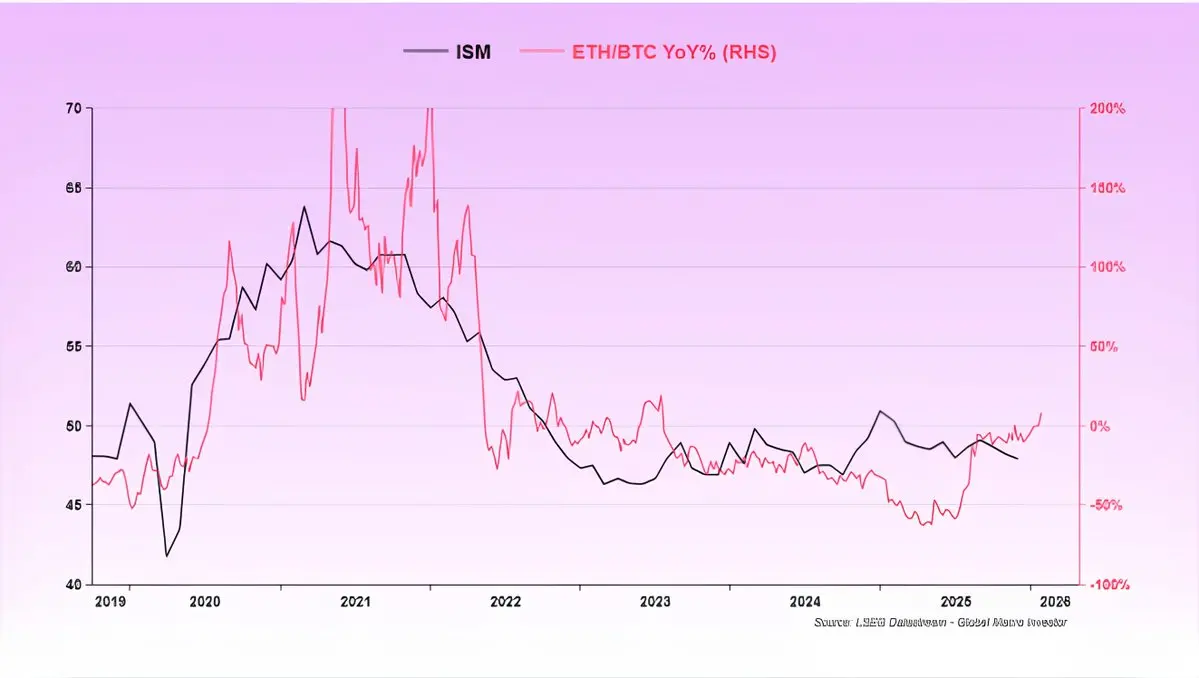
We have just emerged from a historical low of the ISM index below 50, when the business cycle was almost stagnant. The cryptocurrency market is driven by trading activity and investment, which means it needs the support of the business cycle. For a long time, it has failed to recover from this support. Moreover, Bitcoin's trading price has consistently been below its overall liquidity level, as is periodically the case. Bitcoin itself is more volatile than liquidity, so when liquidity is overheated, its price will rise excessively; when liquidity is too cold, its price will fall. But in the long run, its correlation with liquidity is about 87%.
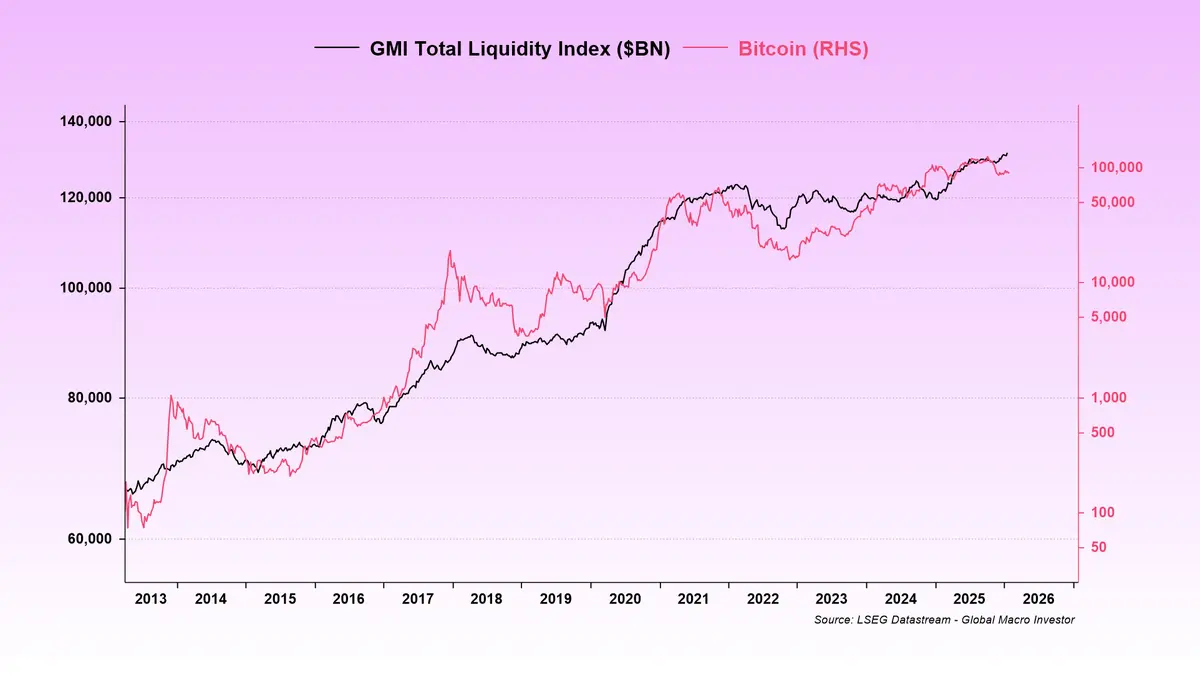
Currently, the market is sluggish, and people believe the investment thesis for cryptocurrencies has failed. But that is not the case. The business cycle has shifted. The ISM index has been in an expansion phase for six consecutive months, with July data at 53.3, and historical experience shows that cryptocurrencies thrive in such an environment. When the economic cycle rises, people turn to higher-risk investments, and the situation in the cryptocurrency space is no different from other areas. Junk bonds outperform government bonds, small-cap stocks outperform large-cap stocks, and Ethereum and smart contract platforms outperform Bitcoin, because increased economic activity raises the demand for block space, while increased savings raise the demand for Bitcoin.
What am I actually doing with all this?
I won't provide you with a portfolio, nor will I tell you when the market will bottom out. Thirteen years of experience tell me I cannot predict market timing, and neither can you; pretending you can will only lead you to sell at $2,000.
What I want to tell you is what my earlier confession really means. This is a long-term game, and it is full of emotions because all our livelihoods are intertwined with it. The ultimate winners are not those with the highest trading skills, but those who truly understand the assets they hold, firmly believe in the inevitability of network adoption, and can withstand the 50% drawdowns that occur every few years like clockwork.
Zoom out. Eliminate distractions. Control the vault, control the rails, and let the curve do the work I have been trying to conquer for ten years.
 Risk warning


Popular articles