Meta's AI Ledger: Why Can't $60.8 Billion in Revenue Support Its Stock Price?
 Core Viewpoint

 Revenue reached a record high of 60.8 billion, but Meta's stock plummeted after hours. What shocked the market was the massive "AI bill": capital expenditures soared, leading to a 91% drop in free cash flow, with negative territory imminent. Unlike Microsoft selling computing power, Meta's monetization through AI "mining" is too slow. When revenue growth can't keep up with the pace of spending, capital is losing patience with this seemingly bottomless heavy asset transformation.
Meta's Q2 revenue reached $60.8 billion, setting a new historical high, with a year-on-year growth of 28%. It fell 7% in after-hours trading.
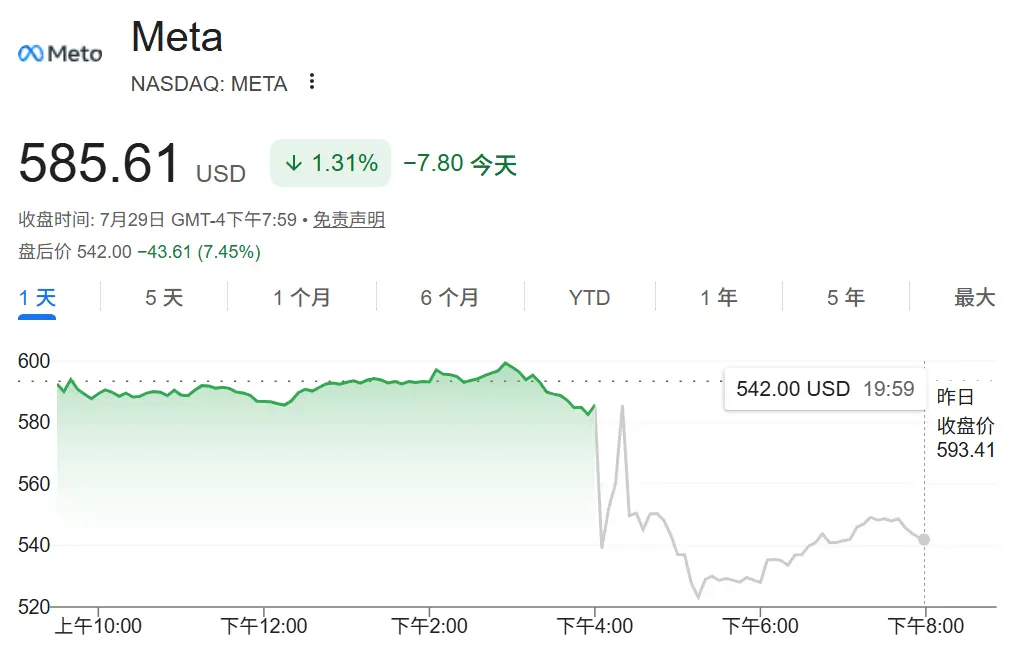
On the same day, Microsoft reported earnings, with cloud business exceeding expectations, rising over 8% in after-hours trading. Meta's revenue also surpassed Wall Street's consensus expectations, with advertising revenue at $59.4 billion, a growth rate of 27%, ad impressions up 14%, and prices up 12%. From a numerical perspective, there was not a single piece of bad news.
However, a divergence is occurring between the market and Meta regarding "who will pay the AI bill." Turning to the cash flow page of the earnings report reveals a stark change: operating cash flow for the quarter was $31.86 billion, and after deducting $31.08 billion in capital expenditures, free cash flow was only $784 million. This figure was $8.55 billion in the same period last year. In one year, it evaporated by 91%.
If this cash burn rate continues, it is almost certain that free cash flow will turn negative next quarter. Google already entered the negative cash flow zone in last week's earnings report—marking the first time in Google's history.
This is not a performance disaster; it is the bill for the AI arms race arriving.
"One-time expenses" cannot hide structural issues
CFO Susan Li explained the reasons for the profit decline during the conference call: total expenses in Q2 were $42 billion, a year-on-year increase of 55%, which included $2.4 billion in legal provisions and $1.18 billion in severance pay. Excluding these two items, operating profit should have increased by about 9% year-on-year.
This is a plausible explanation, but it stops there.
The truly noteworthy numbers are hidden in the expense structure: R&D expenses for the quarter surged to $21.66 billion, a year-on-year increase of 67%, accounting for 36% of revenue, up from 27% in the same period last year. This money is not for legal provisions or severance pay—it is the monthly payment Meta is making for AI, and it is increasing every month.
Capital expenditures skyrocketed from $17.01 billion in the same period last year to $31.08 billion, an increase of 83%. The company narrowed its full-year capex guidance from $125 billion to $145 billion to $130 billion to $145 billion, which appears to be a contraction, but in reality, the lower limit was raised from $125 billion to $130 billion, while the upper limit remained unchanged. In other words: at least $130 billion in annual AI investment has been locked in as the bottom line.
AI is indeed useful in advertising, but it cannot outrun the bills
Zuckerberg spent a long time during the conference call discussing the implementation of AI: the Advantage+ AI advertising tool has an annualized revenue run rate exceeding $75 billion, with 9 million advertisers using at least one Meta AI tool, LLMs being integrated into recommendation systems, and Instagram users experiencing double-digit growth in time spent.
These are real advancements, not just empty promises. However, the growth rate of the advertising business cannot keep up with the growth rate of capital expenditures—revenue increased by 27% year-on-year, while capex increased by 83%, a three-to-one gap. Including R&D expenses, the total investment related to AI is growing even faster. Meanwhile, revenue growth is slowing: Q1 was 33%, Q2 dropped to 28%, and the Q3 guidance median is $62.5 billion, corresponding to about 22% year-on-year—although it is still double-digit growth, the deceleration trend is clear.
Profit margins are also shrinking. Operating profit margin fell from 43% in the same period last year to 31%. AI advertising tools are indeed improving conversion rates and increasing ad prices, but they are also driving up inference costs. Unlike Microsoft and Google, Meta does not have a mature cloud business to directly monetize computational redundancy. Microsoft has Azure, Google has Google Cloud, and Meta has nothing.
Zuckerberg rejected the idea of "selling computing power for profit" during the conference call. He stated that the quotes received for computing power leasing were far higher than the cost price, but simply selling all computing power for short-term profits would be foolish. He is betting on another path—"selling intelligence" will have a long-term profit margin far exceeding "selling computing power." Logically, this makes sense. But the market is asking another question: before "selling intelligence" truly scales, who will bear the burden of free cash flow dropping from $8.5 billion to less than $800 million, potentially turning negative in the second half of the year?
Two narratives diverging on the same day of earnings reports
Microsoft and Meta reported earnings on the same day, with completely opposite reactions.
Microsoft's Azure continuous growth acceleration indicates that AI cloud services have a real, measurable, and pay-as-you-go business cycle, with enterprise demand for AI computing power directly translating into cloud revenue, creating a short and clear chain.
Meta's closed loop is much longer—AI improves ad recommendations, advertisers see better ROI, leading to increased spending and growth in ad revenue. Each link in the chain exists in reality, but the more links there are, the longer the cycle from investment to return, and the greater the uncertainty.
To put it more bluntly: Microsoft is selling shovels, while Meta is using shovels to dig its own mine.
Selling shovels allows for quick revenue collection; mining requires upfront investment, with returns dependent on the quality and price of the ore. Advertising is Meta's mine, and the ore itself is good—advertising prices rose 12% in Q2, impressions increased by 14%, and Instagram daily active users surpassed 2 billion. But mining costs are rising at a rate three times that of ore price increases.
3.6 billion daily active users: the deepest moat, but also the heaviest burden
Meta's family of apps has 3.6 billion daily active users, a year-on-year increase of 3%. Instagram's daily active users just surpassed 2 billion, Threads has over 500 million monthly active users, and WhatsApp peaked at 30 million messages per second during the World Cup final.
This user base means Meta has the largest global AI distribution and testing scenarios. Whether in recommendation algorithms, ad placements, or content generation, Meta has the most massive and diverse training data and feedback loops.
But the flip side of the coin is that the demand for AI inference from 3.6 billion users is also at the scale of 3.6 billion individuals.
Each personalized recommendation generation, each real-time bidding optimization for ads, and each feature extraction of user behavior all burn inference computing power. Revenue is increasing, but inference costs are rising even faster. For Meta, this manifests as the improvement in advertising efficiency not keeping pace with the growth rate of AI infrastructure bills.
What is the market really worried about?
The 7% drop in after-hours trading is not a punishment for a quarterly EPS miss; it is a shake-up of a core assumption. The market previously assumed that Meta's AI investments could be covered by revenue growth within 12 to 18 months, thereby maintaining or improving profit margins.
The answer given by Q2 is in the opposite direction: revenue growth is slowing (from 28% to 22%), capex is accelerating (83%), profit margins are compressing (from 43% to 31%), and free cash flow is nearing zero.
Zuckerberg's narrative framework—AI accelerating core business, next-generation personal intelligent agents, enterprise-level markets—is complete and logically coherent. But what the market wants is no longer just a narrative; it is numbers. Specifically, it is the point in time when revenue growth begins to outpace cost growth.
The Q2 earnings report did not provide this inflection point. The Q3 guidance did not either. Susan Li stated that 2026-2027 would be the "full-scale expansion" phase, and only after 2028 would there be "room for adjustment." Translated, this means: at least another 18 months of high-intensity investment.
Q3 is a very critical testing window. With free cash flow down to $784 million and capex only increasing, turning negative is almost a matter of time—at that point, how the market interprets this "negative" will determine the next direction of the stock price.
The trend of slowing advertising revenue is equally important. The Q3 guidance median of $62.5 billion corresponds to about 22% year-on-year; if the actual figure can approach the upper limit of 25%, it indicates that monetization efficiency is accelerating; if it falls to the lower limit or even misses, the pressure will not be just a one-day drop.
Zuckerberg claims "not to sell computing power for profit," but he also left himself an escape route during the conference call—providing APIs and intelligent agents to enterprises, "in the future, it may also directly sell computing power and other supporting services." If he truly starts to tap into this market, even if on a small scale, it would represent a new storyline for the market.
But more fundamentally, he has not provided a timeline on "when AI investment will begin to converge." At the point where free cash flow is about to turn negative, the market's valuation premium for long-term vision is fading, and patience is a luxury.
Meta is telling one of the boldest transformation stories in the history of giant tech companies: shifting from a light-asset advertising platform to a heavy-asset AI infrastructure operator and intelligent service provider. The foundation of $60.8 billion in revenue and 3.6 billion daily active users gives this story top-notch fundamental support.
However, the $31.08 billion in quarterly capital expenditures, along with the resulting 91% collapse in free cash flow, is also telling the market the same thing: this transformation cost is more expensive than anyone anticipated, and the bill has only reached the second page.
 Risk warning




Popular articles