Bitget UEX Daily Report|US and Iran may negotiate tomorrow, signals of an agreement in the Strait of Hormuz; Amazon completes $50 billion investment in OpenAI; Palantir's earnings report coming after hours

 August 3, 2026
I. Hot News
Federal Reserve Dynamics
Waller considers reducing the frequency of meetings, September rate hike probability rises to 73.6%
- According to The New York Times, Federal Reserve Chairman Waller is considering reducing the number of Federal Open Market Committee (FOMC) meetings from eight times a year, breaking a tradition that has continued since the Volcker era in 1981, which may compress the window for policy transparency and market guidance.
- CME's "FedWatch" shows that the probability of maintaining interest rates in September has dropped to 26.4%, while the cumulative probability of a 25 basis point rate hike has risen to 73.6%; by October, the cumulative probability of a 25 basis point hike is 62.1%, and the probability of a 50 basis point hike is 17.9%.
- The market is still digesting Waller's reaffirmation of the 2% inflation target and his downplaying of forward guidance.
Market Impact: Increased uncertainty in the policy path; if the frequency of meetings is reduced, it will further lower transparency, providing short-term support for the dollar and suppressing valuations of risk assets; rising rate hike expectations put pressure on high-valuation sectors like technology.
International Commodities
U.S. and Iran may negotiate tomorrow, signals of an agreement in the Strait of Hormuz, oil prices fall sharply
- Trump stated on Sunday Eastern Time that he canceled strikes against Iran at the request of Saudi Arabia, the UAE, Qatar, and Iran, saying, "If it weren't for their request, we would have launched a large-scale attack on Iran last night"; he also mentioned that there is already an agreement in the Strait of Hormuz, and a denuclearization agreement will also be reached, with negotiations starting tomorrow afternoon (Tuesday morning Beijing time).
- Iranian Foreign Minister Amir-Abdollahian stated that negotiations with Oman regarding safe navigation in the Strait of Hormuz are in the final stages and nearing completion.
- OPEC+ agreed to increase the September oil production quota by 188,000 barrels per day.
Market Impact: Easing geopolitical expectations quickly lowered the oil risk premium, with WTI crude oil falling nearly 5%. The progress of negotiations and the actual navigation situation in the Strait of Hormuz remain core variables for short-term oil prices; if an agreement is reached, it will further alleviate inflation concerns.
Macroeconomic Policy
U.S. and Japan coordinate to intervene in the yen, Yellen emphasizes economic security is national security
- U.S. Treasury Secretary Yellen confirmed last Friday that she coordinated with Japan to intervene in the yen to address its disorderly fluctuations; she stated that the U.S.-Japan alliance is built on economic security and national security, and encouraged expanding the scale of the FIMA repurchase tool.
- Trump stated that this intervention reflects U.S.-Japan friendship and expects the U.S. to gain economic benefits from it, comparing it to previous currency swap arrangements with Argentina.
- South Korea plans to inject about $14 billion into its sovereign wealth fund to invest in artificial intelligence and other fields.
Market Impact: Currency market intervention shows that Asian monetary authorities are highly concerned about exchange rate fluctuations; U.S.-Japan coordinated actions help stabilize short-term expectations; South Korea's AI investment plan reflects a willingness for long-term industrial layout.
II. Market Review
Commodity & Forex Performance
- Spot Gold: Approximately $4,055/ounce, +0.28%
- Spot Silver: Approximately $58.3/ounce, +1.14%
- WTI Crude Oil: Approximately $80.5/barrel, -4.8%
- Brent Crude Oil: Approximately $79/barrel, -3.17%
- Dollar Index (DXY): Approximately 99.637, -0.17%
Driving Factors Analysis: Expectations of U.S.-Iran negotiations and signals of an agreement in the Strait of Hormuz quickly lowered the oil risk premium, with both WTI and Brent falling nearly 5%, alleviating short-term inflation concerns. Gold and silver performed relatively steadily against the backdrop of falling oil prices and a slight weakening of the dollar, with safe-haven demand cooling but not showing significant selling. The asset linkage logic is clear: geopolitical easing → oil price decline → marginal cooling of inflation expectations → although Fed rate hike bets remain high, discussions of marginal easing are heating up. Short-term commodity volatility will heavily depend on the progress of U.S.-Iran negotiations and the actual agreement situation.
Cryptocurrency Performance
- BTC: Approximately $63,275, +0.53%
- ETH: Approximately $1,870, +1.04%
- Total Cryptocurrency Market Cap: Approximately $2.25 trillion, +1%
- Market Liquidation Situation: Total liquidation of $140 million in 24h, with $90 million in short liquidations
- Bitget BTC/USDT liquidation map: A large number of 100x short liquidation orders are concentrated in the $63,900-$64,500 range above the current price ($63,300); if it breaks through $64,000, it may trigger concentrated short covering and amplify the rise. The cumulative short liquidation scale above is about $330 million, lower than the $360 million in long liquidations below, indicating slightly higher pressure on longs; short-term focus should be on the densely packed short liquidation area near $64,000.
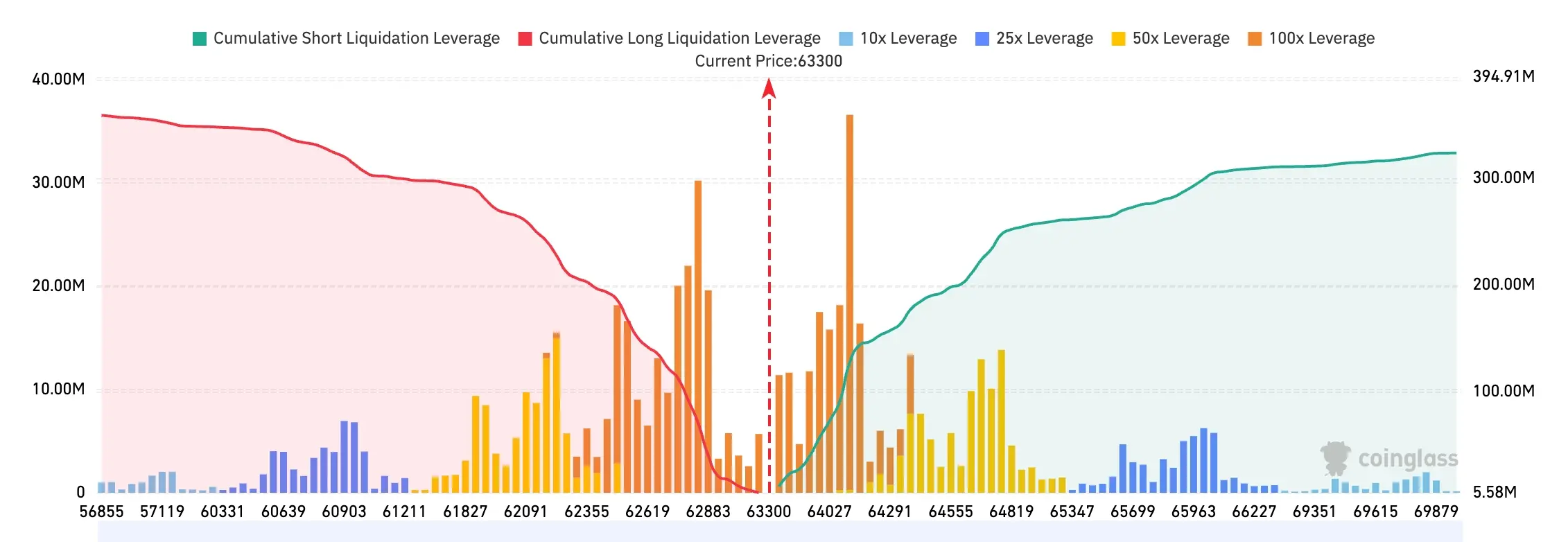
Driving Factors Analysis: Easing geopolitical tensions and a rebound in U.S. tech stocks boosted risk appetite, stabilizing and rebounding the crypto market overall. Both BTC and ETH closed higher, with ETH showing relative strength indicating a slight rotation of funds towards high-beta assets. The scale of leveraged liquidations significantly decreased, and the balance of long and short forces is trending towards equilibrium. Signs of improved ETF fund flows are emerging, with institutional attitudes becoming marginally positive. On the macro level, Fed rate hike expectations remain high, and short-term volatility may maintain a fluctuating pattern, with attention on how the results of U.S.-Iran negotiations affect risk asset sentiment.
U.S. Stock Index Performance

- Dow Jones: Closed at 52,485.03 points (+0.53%)
- S&P 500: Closed at 7,489.72 points (+0.70%)
- Nasdaq: Closed at 25,373.85 points (+1.00%)
Tech Giants Dynamics
- NVDA: Approximately $200.75 (+2.93%)
- AAPL: Approximately $308.91 (-7.35%)
- MSFT: Approximately $464.72 (+3.0%)
- GOOGL: Approximately $356.13 (+6.73%)
- AMZN: Approximately $271.58 (+15.32%)
- META: Approximately $556.71 (+3.28%)
- TSLA: Approximately $311.21 (+0.76%)
Performance Summary and Driving Analysis: U.S. stocks saw a V-shaped rebound on Friday, with significant differentiation within the tech sector. Amazon surged over 15% due to strong cloud business and the completion of a $50 billion investment in OpenAI, while Google rose nearly 7%, and Microsoft, Meta, and Nvidia followed suit; Apple fell over 7% due to service business and guidance falling short of expectations. Overall, driven by "earnings realization vs. guidance concerns," cloud and AI infrastructure investments received some validation, but hardware and consumer electronics remain under pressure. Market confidence in AI capital expenditure returns has been temporarily restored, but significant differentiation among individual stocks is evident.
Sector Movement Observation
Cloud Computing / Large Tech
- Representative Stocks: Amazon (+15.3%), Google (+6.7%), Microsoft (+3%)
- Driving Factors: Amazon's cloud business exceeded expectations and the completion of the OpenAI investment boosted confidence, while Microsoft continued its strong performance from the previous day.
Semiconductors
- Representative Stocks: Nvidia (+2.9%), Micron fell nearly 6%, AMD fell nearly 2%
- Driving Factors: Followed the tech rebound, but storage and some chips remain under pressure due to concerns over capital expenditure returns.
Optical Communication / Compound Semiconductors
- Representative Stocks: AXT Inc (surged nearly 29%), Coherent (+5%), Applied Optoelectronics (around +5%)
- Driving Factors: Expectations for AI data center optical module demand recovery, with a strong rebound after a previous day of overselling.
III. In-Depth Analysis of U.S. Stocks
1. Amazon (AMZN) - Completes $50 billion full investment in OpenAI, stock price surges over 15%
Event Overview: Amazon completed a total investment of $50 billion in OpenAI, holding about 5% of the shares. Previously, it had invested $1.5 billion in February and promised an additional $3.5 billion upon reaching specific milestones or an IPO; the latest disclosure shows that all funds are now in place. Meanwhile, AWS cloud business revenue grew 37% year-on-year to $42.2 billion in the second quarter, marking the fastest growth since 2021. The stock price surged about 15.3% to $271.58 on Friday, significantly increasing its market capitalization in a single day.
Market Interpretation: The full investment not only strengthens the equity and commercial ties with OpenAI but also further consolidates AWS's position as OpenAI's core cloud infrastructure provider. The accelerated growth of the cloud business directly validates that large-scale AI capital expenditures have begun to translate into quantifiable revenue, significantly alleviating previous market concerns about "over-investment and long return cycles." This stands in stark contrast to recent chip and storage stocks that have been pressured by expectation gaps, with funds quickly granting a dual premium for "earnings realization + strategic positioning."
Investment Insight: Progress in cloud and AI commercialization has been further validated; future tracking should focus on the rhythm of investment returns and whether AWS's growth can continue to absorb higher levels of capital expenditure.
2. Apple (AAPL) - Service business falls short of expectations, stock price drops over 7%
Event Overview: Apple's third-quarter revenue was $109.417 billion (up 16.4% year-on-year), net profit was $29.789 billion (up 27.1% year-on-year), and EPS was $2.02 (up 28.7% year-on-year). However, the service business and performance in China fell short of expectations, and the company provided cautious guidance for the next quarter. The stock price fell about 7.4% to $308.91 on Friday, becoming a major drag on the day.
Market Interpretation: Against the backdrop of strong rebounds in cloud and AI infrastructure stocks like Microsoft and Amazon, Apple's relative underperformance reflects a market reassessment of the sustainability of device demand and the quality of service growth. In the long term, Apple still enjoys robust cash flow and the "certainty premium" brought by its service business, but in the short term, funds are more inclined to chase cloud and AI-related stocks that have already realized revenue growth, leading to relative performance pressure.
Investment Insight: The earnings report highlights the divergence in growth quality. Future observations should focus on whether iPhone demand can stabilize and the actual impact of AI features like Apple Intelligence on replacement cycles and service revenue.
3. Microsoft (MSFT) - Continues strong performance, cloud business remains recognized
Event Overview: Microsoft's stock price continued to rise about 3% to around $464.72 on Friday, following a more than 15% surge due to Azure cloud business exceeding expectations, marking the largest single-day increase in years. The market continues to digest its progress in cloud and AI commercialization and relatively restrained capital expenditure guidance.
Market Interpretation: As a core representative of this round of "earnings realization," Microsoft continues to attract funds. The growth of Azure and free cash flow performance prove that large-scale AI infrastructure investments have begun to translate into revenue, contrasting sharply with hardware chains still under pressure from return cycle concerns. This has led to significant differentiation within the sector: companies that can prove commercialization receive premiums, while those relying on long-term demand narratives are under pressure.
Investment Insight: The matching of capital expenditure rhythm and cloud business growth rate remains a key pricing factor; continuous tracking of subsequent guidance and actual execution is necessary.
4. Google (GOOGL) - Rises nearly 7%, following tech rebound
Event Overview: Google's stock price rose about 6.7% to $356.13 on Friday, benefiting from the overall recovery in tech risk appetite and the AI-related sentiment boost from Amazon and Microsoft's performance.
Market Interpretation: Driven by cloud and AI infrastructure stocks, search and cloud businesses regained investor attention, with some differentiation within the sector easing. Market expectations for the recovery of its advertising business and the rollout of AI features have warmed, but compared to Amazon and Microsoft's "strong realization" narrative, Google's resilience stems more from sentiment recovery and sector rotation.
Investment Insight: Progress in AI commercialization and the recovery of the advertising business remain core to medium- and long-term pricing; subsequent cloud business growth rates and AI product monetization efficiency should be observed.
5. Nvidia (NVDA) - Follows rebound, rises nearly 3%
Event Overview: Nvidia's stock price rose about 2.9% to $200.75, benefiting from the positive tech sentiment boosted by Microsoft and Amazon's performance, ending a previous adjustment trend due to concerns over AI infrastructure costs and competition.
Market Interpretation: As a core supplier of AI computing power, Nvidia's stock price is highly sensitive to downstream cloud providers' willingness to spend and return expectations. The strong performance of Microsoft and Amazon provides important emotional support, but the market remains cautious about the capital expenditure return cycles in the hardware chain, leading to a relatively restrained rebound. Compared to cloud service providers that have "realized revenue," Nvidia relies more on major clients continuing to increase spending.
Investment Insight: The long-term demand logic for AI computing power remains unchanged, but short-term volatility still depends on downstream capital expenditure guidance and competitive landscape evolution; caution is needed regarding profit-taking after sentiment recovery.
IV. Market & Project Dynamics
Michael Saylor tweeted that Strategy is tracking Bitcoin's 200-week moving average and its premium. Since the introduction of the 200-week moving average, Bitcoin has been above the average for 92% of the time and is currently almost exactly at that line.
CryptoQuant analyst Darkfost stated that short-term holders of Bitcoin (STH) sent over 32,000 Bitcoins to exchanges at a loss on August 1. This is one of the largest loss liquidation events in the past 30 days.
The number of independent active trading wallets on the Solana network rose to the highest level in seven months in July, with a total of 609,000 independent wallets executing trades that month.
Analyst "AntiFragile" stated that the Bitcoin (BTC) order book currently shows strong buyer support, with a large number of patient buy orders concentrated in the 2%-20% range below the current price; these buy orders began appearing in early June and represent passive buying demand from early positioning. If the BTC price falls to these areas, these buy orders are expected to provide a buffer, reducing market volatility. The current order book structure shows that some investors are waiting for lower prices to enter rather than buying in line with the rising market, and these long-standing orders may become potential support in short-term market corrections.
On-chain analysis firm Glassnode reported that the Bitcoin three-month futures basis has consistently yielded lower than the U.S. two-year Treasury yield since February of this year, and this has continued for several months.
Morgan Stanley's chief economist for China, Xie Zhiqiang, recently shared his latest views at a media briefing. Xie believes that the recent volatility in the AI sector is not due to fundamental deterioration, but rather a result of crowded trades, large companies withdrawing financing, and rising oil prices amplifying rate hike expectations. He believes AI investment has entered a "mid-game adjustment," with the logic shifting from chasing upstream computing power chips to two new main lines: AI application (cost reduction vs. revenue) and HALO resource matching (energy, storage, raw materials).
Strategy founder and executive chairman Michael Saylor released information related to Bitcoin Tracker again yesterday. According to previous patterns, Strategy usually discloses changes in Bitcoin holdings the day after relevant news is released.
V. Today's Market Calendar
Data Release Schedule
|----|----|--------------------|-------| | After Hours | U.S. | Palantir (PLTR) Earnings Report | ⭐⭐⭐⭐⭐ | | This Week | U.S. | Relevant Economic Data | ⭐⭐⭐ |
Important Event Forecast
- U.S.-Iran Negotiations: Expected to start Tuesday morning Beijing time, focusing on the Strait of Hormuz agreement and denuclearization progress.
- Palantir Earnings Report: To be released after U.S. stock market hours today, with market attention on AI software commercialization and government order progress.
- OPEC+: The September production quota increase has been implemented; attention should be paid to subsequent execution.
Institutional Views:
Analysts generally believe that expectations for U.S.-Iran negotiations and signals of an agreement in the Strait of Hormuz have significantly lowered the oil risk premium, alleviating short-term inflation concerns and providing breathing space for risk assets. Amazon's completion of a $50 billion full investment in OpenAI and the announcement of strong cloud business further validate the return path of AI infrastructure investments, boosting sentiment in the tech sector; however, Apple's service business falling short of expectations highlights stock differentiation. The probability of a Fed rate hike in September has risen to 73.6%, and Waller's consideration of reducing the frequency of meetings increases policy uncertainty. The crypto market stabilizes following risk appetite, but macro and geopolitical developments will still dominate short-term volatility. The overall consensus is that geopolitical easing and earnings realization are the current main lines, and close attention should be paid to negotiation results and subsequent earnings reports.
Disclaimer: The above content is compiled by AI search, with human verification for publication, and should not be considered as any investment advice. The data in the text may inevitably contain deviations; please refer to real-time market data.
 Risk warning



Popular articles