Bitget UEX Daily Report | Trump claims U.S. military has 100% control of the Strait of Hormuz; oil prices surge, inflation concerns rise; U.S. stocks slightly adjust, technology under pressure (August 11, 2026)

 Bitget UEX Daily Report
# 1. Hot News
Federal Reserve Dynamics
The market focuses on this week's inflation data, with interest rate hike expectations still influenced by employment and oil prices.
- After the July non-farm data significantly missed expectations, the market has notably lowered the near-term interest rate hike probability.
- This week, the Consumer Price Index (CPI) and Producer Price Index (PPI) will be released, becoming key for the next policy pricing.
- Oil prices have surged due to the Hormuz impasse, potentially raising inflation expectations again.
Market Impact: Weakening employment and rising oil prices create a tug-of-war, leaving the Federal Reserve's short-term path uncertain, with increased market sensitivity to data.
International Commodities
Trump claims U.S. military has 100% control over the Strait of Hormuz, oil prices significantly rise.
- Trump stated that the only entity controlling the Strait of Hormuz is the U.S. Navy, with a "flawless" blockade, akin to a "steel wall," having cleared mines throughout the strait. The strait is open to non-Iranian vessels but does not allow entry to Iranian ports.
- Trump also demanded Iran compensate for casualties and damages caused by related conflicts, adding new variables to negotiations for reopening the strait.
- Iran reiterated its conditions for reopening and claimed that an agreement with Oman on new shipping routes is nearing completion.
Market Impact: Uncertainty over the actual navigation of the strait continues, oil prices rebound sharply, raising inflation and geopolitical risk premiums, with increased volatility in the energy market in the short term.
U.S. Stock Market Macro
U.S. stocks retreated on Monday, with divergence in technology and energy sectors.
- Influenced by inflation concerns stemming from rising oil prices, the three major U.S. stock indices closed slightly lower.
- Intel announced it may sell $15 billion in stock to support AI and manufacturing businesses, putting pressure on its stock price.
- Berkshire Hathaway and other stocks with better-than-expected earnings performed relatively well.
Market Impact: Geopolitical and inflation expectations dominate sentiment, with funds rotating between energy and technology, while the overall market remains cautious.
# 2. Market Review
Commodity & Forex Performance
- Spot Gold: Approximately $4,414/ounce, +0.6%
- Spot Silver: Approximately $65/ounce, +0.2%
- WTI Crude Oil: Approximately $82.2/barrel, +0.07%
- Brent Crude Oil: Approximately $83.98/barrel, 0.12%
- U.S. Dollar Index (DXY): Approximately 99.75, -0.06%
Driving Factors Analysis: Trump's claim of U.S. military having 100% control over the Strait of Hormuz and maintaining the blockade, combined with disagreements over compensation, leaves the outlook for reopening the strait unclear, driving a significant rise in crude oil prices. Gold is caught between a strengthening dollar and safe-haven demand, showing relatively restrained performance. The asset linkage logic is reflected as: geopolitical impasse → rising oil prices → rebound in inflation expectations → support for the dollar, while risk assets face pressure. Short-term commodity volatility will highly depend on the actual navigation progress of the strait and this week's inflation data.
Cryptocurrency Performance
- BTC: Approximately $64,037, -1.55%
- ETH: Approximately $1,874, +2.12%
- Total Cryptocurrency Market Cap: Approximately $2.27 trillion, -0.4%
- Market Liquidation Situation: Total liquidation of $205 million in 24 hours, with $59.25 million in short liquidations.
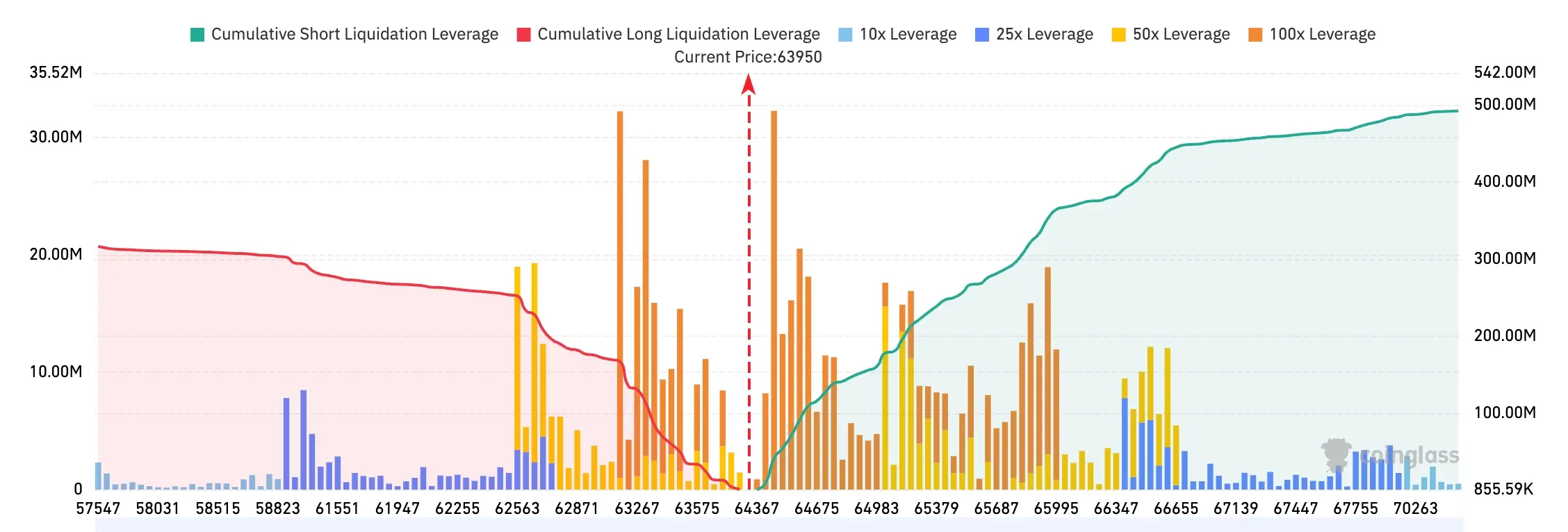
- Bitget BTC/USDT Liquidation Map: Current BTC price is approximately $63,950, with significant long liquidations around $63,300--$63,700. A drop below $63,500 may trigger consecutive long liquidations. Significant short liquidation pressure is evident above $64,300--$65,000; if it breaks $64,400, it may further trigger a short squeeze, with high short-term volatility risk.
- Spot ETF Net Inflow/Outflow: BTC spot ETF saw a dynamic net outflow of $0.91 million in 24 hours.
Driving Factors Analysis: The surge in oil prices and rising geopolitical uncertainty have led to a contraction in risk appetite, with the cryptocurrency market maintaining high-level fluctuations overall. BTC holds above $64,500, while ETH shows limited elasticity. Continuous net inflow of ETF funds provides support, and the scale of leveraged liquidations is manageable. On a macro level, weakening employment and rising oil prices create a hedge, with cryptocurrencies likely continuing to consolidate in the short term, focusing on the impact of this week's inflation data on liquidity expectations.
U.S. Stock Index Performance

- Dow Jones: Closed at approximately 53,976 points (-0.1%), slight retreat.
- S&P 500: Closed at approximately 7,753 points (-0.1%), retreating from record highs.
- Nasdaq: Closed at approximately 26,605 points (-0.3%), technology under pressure.
Technology Giants Dynamics
- NVDA: Approximately $217.55 (-2.86%)
- AAPL: Approximately $308.26 (-1.62%)
- MSFT: Approximately $506.06 (+1.21%)
- GOOGL: Approximately $357.52 (+0.91%)
- AMZN: Approximately $278.09 (+1.32%)
- META: Approximately $594.92 (+0.48%)
- TSLA: Approximately $330.88 (+0.70%)
Performance Summary and Driving Analysis: U.S. stocks slightly retreated on Monday, with the Nasdaq showing a relatively larger decline. Nvidia and Apple faced significant pressure, while Microsoft, Amazon, Google, Meta, and Tesla recorded gains, continuing the internal divergence in technology. The sharp rise in oil prices raised inflation concerns, partially offsetting the interest rate cut expectations brought by previously weak employment data. The market weighs geopolitical risks against macro data, with funds leaning towards cloud and software stocks with higher earnings certainty.
Sector Movement Observation
Energy
- Representative Stocks: Related oil and energy stocks generally strengthened, with some leading in gains.
- Driving Factors: Trump's claim of U.S. military having "100% control" over the Strait of Hormuz and maintaining the blockade, combined with disagreements over compensation, leaves the outlook for actual navigation unclear. The market re-accounts for geopolitical risk premiums, leading to a significant rise in oil prices, directly boosting the energy sector's performance. Short-term reliance remains high on negotiation progress and actual navigation recovery.
Semiconductors
- Representative Stocks: Nvidia (-2.86%), related chip stocks generally retreated.
- Driving Factors: Oil prices surged due to the Hormuz impasse, raising concerns about inflation expectations, which may affect subsequent liquidity and Federal Reserve policy paths. Previous weak non-farm data had led to a recovery in sentiment, but the rapid switch in macro narrative caused high-valuation AI hardware to face profit-taking and position adjustments first, putting overall pressure on the sector.
Technology Software/Cloud
- Representative Stocks: Microsoft (+1.21%), Amazon (+1.32%) relatively resilient.
- Driving Factors: In an environment of rising geopolitical and inflation uncertainty, funds prefer stocks with realized revenues and clear commercialization paths. The sustained high growth of Azure and AWS allows cloud giants to exhibit relative defensive attributes, contrasting sharply with the high volatility and high valuation of hardware stocks.
# 3. In-Depth Analysis of U.S. Stocks
1. Nvidia (NVDA) - Down nearly 3%, semiconductors under pressure
Event Overview: Nvidia's stock price fell approximately 2.86% to $217.55, becoming one of the weaker performers among large tech stocks. The market is concerned that the Hormuz impasse will raise oil prices, potentially reigniting inflation expectations, which could affect subsequent liquidity and Federal Reserve policy paths.
Market Interpretation: Previous weak non-farm data had driven a recovery in risk appetite, with sentiment around AI hardware improving. However, the sharp rise in oil prices quickly changed the macro narrative, prompting funds to reassess interest rate paths and valuation pressures. As a high-valuation, high-elasticity leader in computing power, Nvidia often faces pressure first when inflation concerns rise. The long-term logic of AI computing demand remains unchanged, but short-term stock prices are highly sensitive to macro liquidity and interest rate expectations, with profit-taking and position adjustments acting together.
Investment Insight: Focus on this week's CPI and PPI data's impact on inflation expectations, and whether major clients' capital expenditure guidance can continue to support the demand narrative. Volatility may intensify around data releases.
2. Apple (AAPL) - Down over 1.6%, relatively lagging
Event Overview: Apple's stock price fell approximately 1.62% to $308.26, underperforming most tech giants and continuing its recent relative lagging trend.
Market Interpretation: In a phase where risk appetite is contracting and funds are leaning towards cloud and software stocks, the elasticity of consumer electronics and hardware companies is usually limited. Although Apple has robust cash flow and a moat in its services business, the market is currently more focused on marginal changes in its hardware demand and the actual impact of AI features on upgrade cycles. Compared to companies with realized cloud revenue growth, Apple is relatively less favored for funding in the current macro environment.
Investment Insight: Continuous observation is needed on the sustainability of the upcoming product cycle, the growth of service business, and the tangible impact of AI features like Apple Intelligence on user upgrade willingness.
3. Microsoft (MSFT) - Up over 1%, relatively resilient
Event Overview: Microsoft's stock price rose approximately 1.21% to $506.06, showing stable performance amid the overall tech sector retreat, making it one of the relatively resilient large tech stocks.
Market Interpretation: Microsoft is viewed as a high-certainty stock in the current tech sector due to the sustained outperformance of its Azure cloud business and the actual commercialization of AI. In an environment where rising oil prices raise inflation concerns and risk appetite declines, cloud and software giants with clear revenue realization paths often receive relative premiums. This sharply contrasts with hardware stocks, which face pressure due to valuation and macro sensitivity.
Investment Insight: The ability to realize performance remains the core standard for current market pricing. Future focus should be on whether cloud business growth can continue to absorb capital expenditures and the visibility of AI-related revenue contributions.
4. Amazon (AMZN) - Up over 1.3%, following cloud logic
Event Overview: Amazon's stock price rose approximately 1.32% to $278.09, significantly outperforming the hardware sector, continuing its relative strength driven by cloud business.
Market Interpretation: The long-term logic of AWS's high growth and AI infrastructure investment continues to support the stock price. In the context of rising geopolitical and inflation uncertainty, funds prefer stocks with realized revenues and clear commercialization paths. As a result, Amazon demonstrates strong defensive growth attributes, contrasting with high-volatility, high-valuation hardware stocks.
Investment Insight: Focus on whether AWS growth can continue to absorb capital expenditures and the resilience of retail and advertising businesses amid macro fluctuations. The alignment of cloud and AI commercialization remains the core of medium- to long-term pricing.
5. Tesla (TSLA) - Slightly higher
Event Overview: Tesla's stock price rose approximately 0.70% to $330.88, showing relatively stable performance without significant fluctuations.
Market Interpretation: Tesla encompasses multiple narratives of electric vehicles, autonomous driving, and humanoid robots, with its high beta attributes making it particularly elastic during rapid recoveries in risk appetite. However, during declines in risk appetite or rising macro uncertainty, its gains are often limited. The current market remains cautious amid rising oil prices and inflation concerns; while Tesla has not significantly retreated, it has also not continued its previous strength. The long-term narrative remains, but short-term pricing is more influenced by sentiment and macro liquidity.
Investment Insight: With high stock price volatility, continuous tracking of actual delivery data, autonomous driving progress, and the commercialization pace of Optimus is necessary to validate the progress of the long-term narrative.
# 4. Market & Project Dynamics
The U.S. Securities and Exchange Commission (SEC) will hold a public meeting on August 14 at 10 AM (Eastern Time) to consider whether to issue new rule proposals to create a customized issuance system for specific investment contracts involving crypto assets.
A whale transferred 1,275 BTC ($81.5 million): of which 500 BTC ($32 million) were transferred to FalconX, 274 BTC ($17.5 million) to the Cumberland OTC trading platform, and 500 BTC ($32 million) to a new address (possibly later transferred to Galaxy Digital).
Contract whale "Set 10 Big Targets" (@jasonleo) stated that the medium- to long-term trend judgment has not changed, still believing the current area is a phase bottom. Without extreme structural collapse, their judgment of this round's BTC bottom area remains around $58,000. They indicated that they reduced two-thirds of their position near the $64,000 cost area, not to change direction, but to actively control position risk and leave room for extreme situations. If subsequent trends align with expectations, they will seek opportunities to gradually buy back previously reduced positions.
Strategy CEO Phong Le stated that the company has adjusted its strategy and currently holds $4.75 billion in cash, covering about 2.7 years of preferred stock dividends. Le initially believed investors would highly value Bitcoin for its liquidity and long-term appreciation, but institutional investors place more emphasis on cash, prompting the company to adjust its strategy. Le positions Strategy as a financial platform built around Bitcoin, rather than just a leveraged Bitcoin proxy, aiming to become "the JPMorgan of digital finance," envisioning an ecosystem similar to Apple's iPhone—where other companies can develop financial products based on Strategy's offerings. Le stated that DeFi could expand this ecosystem, ultimately bringing more capital into Bitcoin. The company currently holds approximately 840,000 BTC (about 4% of the final supply), with Le stating, "We are now the bellwether, the central bank of Bitcoin."
Bitwise Research Director Ryan Rasmussen stated that as the stablecoin market expands to trillions of dollars, Circle's value is underestimated by the market. Rasmussen expects the stablecoin market to grow from about $300 billion to $3 to $5 trillion, with Circle holding a first-mover advantage in the evolving U.S. stablecoin regulatory landscape. He believes Circle will not only become a stablecoin giant but also a payment giant—the payment infrastructure it is building will play a key role in a stablecoin-driven financial system, but investors remain overly focused on its reserve business.
BlackRock Digital Assets Head Robert Mitchnick stated that Bitcoin market sentiment has shown a noticeable but subtle improvement over the past month, with the correlation between Bitcoin and U.S. stocks weakening, which is healthy for Bitcoin as a portfolio diversification tool and tail risk hedge. He pointed out that Bitcoin significantly outperformed when the AI sector saw a major pullback in July, reflecting this decoupling. Despite Bitcoin's nearly 30% drop this year and about a 50% decline from a year ago, ETF investors continue to buy—last week, the U.S. spot Bitcoin ETF recorded $853.5 million in inflows, marking the best weekly performance since mid-April, with BlackRock's IBIT contributing $693.7 million (over 80%) and Fidelity's FBTC contributing $116.4 million. Bloomberg analyst Eric Balchunas noted that several funds recorded net inflows daily after the Coldcard vulnerability was exposed, "it's hard not to see it as a causal relationship."
Insiders revealed that OpenAI has completed a transaction for employee shares worth about $7 billion, as the company is considering going public on Wall Street. Two insiders stated that in this employee share buyback, the ChatGPT developer did not bring in external investors but repurchased shares held by current and former employees. They said this transaction values OpenAI at $852 billion, consistent with its valuation during the recent funding round. Large non-public AI companies regularly allow insiders to sell part of their holdings for cash. In the past, OpenAI has brought in investors like Thrive Capital and SoftBank Group to buy shares from employees.
# 5. Today's Market Calendar
Data Release Schedule
|----|----|-------------|-------| | This Week | U.S. | CPI, PPI Inflation Data | ⭐⭐⭐⭐⭐ | | Focus | Global | Hormuz Navigation Progress | ⭐⭐⭐⭐⭐ |
August 11 (Tuesday)
- U.S. ADP employment change for the week ending July 25, July existing home sales;
- ★★★★Super Micro Computer (SMCI), CoreWeave, Lumentum to release earnings after hours, core verification of AI server order conversion, data center production/power/financing costs, 800G/1.6T optical modules and data center optical communication demand;
- Sea, Tencent Music pre-market; CAVA after hours.
August 12 (Wednesday)- ★★★★★ U.S. to release July CPI (market expectation overall year-on-year about 3.4%, previous value 3.5%; core year-on-year about 2.5%, previous value 2.6%; month-on-month overall about 0.1%, core about 0.2%), taking over from last week's non-farm data as the most important macro data of the week, directly related to September's Federal Reserve interest rate pricing (current implied probability about 44%);
- Tencent Holdings to announce earnings (focus on gaming, advertising, fintech, and AI capital expenditure/progress);
- ★★★★Coherent, Cisco, Nebius to release earnings after hours (and some before market), testing AI network equipment and high-speed optical communication demand; API/EIA crude oil inventories, IEA/OPEC monthly reports to be released intensively.
August 13 (Thursday)- U.S. to release July PPI, initial jobless claims for the week;
- ★★★★★ SanDisk Investor Day (evening Beijing time), focusing on NAND supply and demand, capital expenditures, high bandwidth flash (HBF) roadmap, and long-term profit margin targets, setting the tone for the storage sector;
- Google Made by Google launch event (Pixel 11 series and wearables, Gemini deep integration);
- Federal Reserve officials Harker and Barkin to speak;
- ★★★★Applied Materials (AMAT) to release earnings after hours, focusing on wafer manufacturing, DRAM, advanced packaging, and semiconductor equipment spending guidance; JD.com, SMIC, Hua Hong and other Chinese concept/semiconductor earnings to be released simultaneously.
August 14 (Friday)- ★★★★ U.S. to release July retail sales month-on-month, August University of Michigan consumer sentiment index preliminary value and 1-year inflation expectations, testing consumption resilience after employment cools;
- Deadline for U.S. institutions to disclose Q2 13F holdings, observing changes in large fund allocations in technology, energy, and other sectors.
This week's core theme in the U.S. stock market revolves around the "big test" of July inflation data (CPI taking over from non-farm data, PPI and retail sales continuously verifying costs and consumption), signals from Federal Reserve officials and the September policy path, as well as the AI infrastructure chain (CoreWeave, Lumentum, SMCI, Coherent, Cisco, Applied Materials) and storage (SanDisk Investor Day) earnings/events intensively verifying.
Note: After last week's unexpected reduction of 23,000 non-farm jobs, interest rate hike expectations have cooled. If CPI/core continues to decline and consumption remains resilient, soft landing trades and growth stocks are likely to continue; conversely, tightening pricing may be raised again, testing high-valuation sectors. Market volatility is expected to intensify, with a focus on data and AI guidance exceeding or falling short of expectations in pricing reactions.
Institutional Views:
Analysts generally believe that Trump's claim of U.S. military having 100% control over the Strait of Hormuz and maintaining the blockade leaves the outlook for reopening the strait unclear, with oil prices rising significantly, reigniting inflation concerns. The previous interest rate cut expectations brought by weak employment data have been partially offset. U.S. stocks slightly retreated, with internal divergence in technology continuing, while cloud and software stocks remained relatively resilient, and hardware faced pressure. The cryptocurrency market maintained high-level fluctuations, with ETF inflows providing support. The overall consensus is that geopolitical and inflation data will become the short-term mainline, with potential for increased market volatility.
Disclaimer: The above content is compiled by AI search, with human verification for publication, and does not constitute any investment advice. The data in the text may inevitably contain deviations; please refer to real-time market data.
 Risk warning