








DGrid AI Deep Dive: How Decentralized AI Infrastructure Makes Services "Callable, Verifiable, and Settled"
 Core Viewpoint

 DGrid AI: An interface that calls over 200 models, PoQ on-chain verification of service quality. $23 million in revenue, over 15,000 paid users verifying demand, TGE is imminent, and AI services are evolving towards a callable, verifiable, and settleable open network.
A developer needs to register accounts on four platforms, manage four sets of API keys, handle four billing logics, and cope with four rate-limiting rules to call Claude, GPT, Gemini, and DeepSeek.
When a model service provider experiences a failure or adjusts its pricing, developers need to manually switch to a backup solution. If using a third-party platform, it is difficult for developers to verify whether the centralized platform is actually calling the model they paid for—did you pay for Claude Opus 5, but the platform secretly switched to a cheaper model? This is nearly impossible to verify technically.
DGrid AI's starting point is to solve these three infrastructure problems: making AI services callable, verifiable, and settleable.
As of the first half of 2026, DGrid AI has served over 15,000 paying users, generating $23M in economic revenue, and AI Arena has attracted over 500,000 users to participate in model evaluations. While most AI x Crypto projects are still at the white paper stage, DGrid has validated the demand for payment and its self-sustaining ability through real products.
With the announcement of the $DGAI token economic model and the upcoming TGE, DGrid is evolving from an "AI service aggregation platform" to a "decentralized AI infrastructure network." This article will systematically break down DGrid's product architecture, technical mechanisms, economic model, and competitive advantages.
### 1. What problems does DGrid solve?
The current AI service market has three structural problems:
1. Fragmented Calls: Developers need to connect with model providers one by one
Each model provider has its own API specifications, authentication methods, billing logic, and rate-limiting strategies. Developers who want to flexibly switch models or implement multi-model calls need to maintain a complex adaptation layer, increasing development costs and system fragility.
DGrid's solution: AI Gateway
DGrid AI Gateway provides a unified OpenAI-compatible API interface, allowing developers to access over 200 models, including Claude, GPT, Gemini, MiniMax, DeepSeek, Kimi, GLM, and other mainstream commercial models with just one API key. By simply modifying the base_url parameter, migration can be completed without refactoring existing code.
2. Quality Black Box: Unable to verify the authenticity of services and output quality
Centralized platforms control the entire process of model calls, and users cannot verify:
Did the platform really call the model you paid for?
Were the returned results tampered with or downgraded?
Did the service quality (response speed, stability, format compliance) meet the standards?
This information asymmetry gives the platform pricing power and quality explanation rights, leaving users to passively accept.
DGrid's solution: Proof of Quality (PoQ)
PoQ is DGrid's unique on-chain quality verification mechanism and is currently the only quality verification protocol implemented in AI infrastructure, supported by five professional technical papers.
How PoQ works:
DGrid maintains a question bank and randomly selects questions to blind test the model services provided by nodes.
Evaluation dimensions include: output quality, response speed, stability, format compliance.
Verification results are recorded on-chain as the basis for node reputation scoring and incentive distribution.
If a node commits fraud (claims to provide GPT-5 but actually calls GPT-4), it will be detected and punished.
PoQ does not touch the user's real call data but conducts random checks on the services claimed by nodes, protecting privacy while establishing verifiable quality standards.
3. Value Closure: Developers and users cannot participate in the distribution of underlying value
Centralized platforms control model entry, pricing power, and data control. Model providers can only accept the procurement prices set by the platform, developers cannot directly connect to upstream resources, and users cannot participate in ecological profit distribution.
DGrid's solution: On-chain settlement + Open Market
DGrid Model Marketplace: Any model provider can list models, set their own prices, and directly obtain call revenues, with settlement completed through on-chain smart contracts.
Decentralized node network: Node operators participate in the network by staking $DGAI and receive incentives based on service quality and call volume.
Token economic closed loop: User payment → Node revenue → Ecological incentives → Governance participation, all links connected through $DGAI.
These three solutions constitute DGrid's core positioning: not just an AI model aggregation platform, but a decentralized infrastructure network that makes AI services callable, verifiable, and settleable.
### 2. Product Matrix: From Developer Tools to AI Service Ecosystem
DGrid's product architecture is not a single-point tool but a multi-layer ecosystem built around different participants:
1. DGrid AI Gateway: A Unified Model Entry for Developers
Target Users: Developers and enterprises that need to flexibly call multiple AI models.
Core Capabilities:
Unified OpenAI-compatible API, one interface to call over 200 models.
Intelligent routing: Automatically selects the optimal model based on task type, cost budget, and latency requirements.
Load balancing and fault tolerance: Automatically switches to backup nodes when a specific upstream service provider fails.
Transparent billing: Standardizes the pricing of different models through the Compute Unit mechanism.
Typical Scenarios:
SaaS products need to support Claude (code generation), GPT (conversation), and DeepSeek (cost optimization) simultaneously.
AI Agents need to dynamically select the most suitable model based on tasks.
Enterprises want to avoid vendor lock-in and maintain supply chain flexibility.
2. DGrid Model Marketplace: An Open Shelf for Model Providers
Target Users: Providers with idle computing power, fine-tuned models in vertical fields, or exclusive model resources.
Core Capabilities:
Anyone can list models, set their own prices, and establish calling rules.
On-chain settlement: Call revenues are automatically distributed through smart contracts without platform custody.
PoQ endorsement: Listed models will be verified by PoQ, with quality signals being publicly transparent.
Long-tail model discovery: Users can filter models based on performance, price, use case, and community ratings.
Typical Scenarios:
Fine-tuning model teams in vertical fields like healthcare, law, and finance can directly reach paying users through the Marketplace.
Institutions or individuals with idle GPUs can deploy computing power as inference services and monetize it.
Developers seek small models optimized for specific tasks rather than general large models.
3. DGrid AI Arena: Model Evaluation and Data Feedback from the User Side
Target Users: General users, AI enthusiasts, and decision-makers who want to understand model capability differences.
Core Capabilities:
Anonymous model battles: Users input the same prompt, and two models return results simultaneously, with users voting for the better answer.
Real preference data: Over 500,000 users have participated, generating a large amount of human preference annotation data.
Feedback to PoQ: Data collected by the Arena can be used to optimize DGrid's model routing strategy and quality assessment system.
Typical Scenarios:
Enterprises compare the performance of different models in actual business scenarios through the Arena before procuring AI services.
Ordinary users participate in model evaluations while contributing data to the ecosystem and receiving incentives.
DGrid continuously optimizes recommendation algorithms and quality standards using real user feedback.
4. DClaw: One-click Deployment of Personal Agents and On-chain Identity
Target Users: Individual developers and non-technical users who want to quickly create and deploy AI Agents.
Core Capabilities:
One-click deployment of personal Agents without managing servers and API configurations.
Access to the ERC-8004 Agent Identity standard on BNB Chain, giving Agents on-chain identities.
Agents can autonomously call DGrid's model services, pay fees, and accumulate reputation.
Typical Scenarios:
Individual creators deploy dedicated AI assistants to handle emails, content generation, data analysis, and other tasks.
Agents establish trust relationships through on-chain identities, forming an Agent collaboration network.
As a member of the BNB Chain AI Landscape, DClaw extends DGrid's service capabilities to the on-chain Agent ecosystem.
From a product logic perspective, the AI Gateway addresses developer calling issues, the Model Marketplace resolves supply-side openness and value distribution issues, the AI Arena tackles quality assessment and user feedback issues, and DClaw Deployment solves Agent deployment and on-chain identity issues. These four products are not isolated modules but form a closed-loop ecosystem built around "making AI services circulate in an open network."
### 3. DGrid vs. Competitors: Where is the Differentiation?
The AI infrastructure track has seen multiple players emerge, and DGrid's differentiated advantages are reflected in three aspects:
1. vs. OpenRouter: Open Market vs. Closed Transit
OpenRouter is currently the most mature AI model aggregation platform and has just announced its acquisition by Stripe for $7 billion.
Core Differences:
OpenRouter is a closed transit station: the platform decides which models to integrate and how to price them, and users can only choose from existing options.
DGrid is an open market: anyone can list models, set their own prices, and compete openly, with the supply ceiling depending on how many people globally are willing to provide services.
Quality Verification:
OpenRouter has no quality verification mechanism; users can only rely on the platform's credibility.
DGrid independently verifies all listed models through PoQ, with results recorded on-chain and made public.
2. vs. Akash / Render: AI Inference vs. General Computing Power
Akash and Render are representative projects of decentralized computing networks, focusing on general computing and rendering tasks.
Core Differences:
Akash provides raw computing resources (CPU/GPU leasing), requiring users to deploy models and manage inference services themselves.
DGrid provides packaged AI services (directly calling model APIs), allowing developers to focus on application without worrying about underlying resource scheduling.
Applicable Scenarios:
Akash is suitable for teams that need long-term computing power leasing and self-built model services.
DGrid is suitable for developers who need on-demand calls, quick integration, and flexible model switching.
3. vs. Centralized AI Platforms (OpenAI, Anthropic): Transparency and Bargaining Power
Core Differences:
Centralized platforms hold pricing power, service explanation rights, and data control, offering a relatively limited variety of models.
DGrid makes service quality verifiable through PoQ, returns pricing power to the market through the Marketplace, and ensures transparency in revenue distribution through on-chain settlement.
Long-term Advantages:
As AI models proliferate and vertical models become increasingly important, the supply ceiling of an open market far exceeds that of a platform procurement model.
As regulations demand higher transparency for AI services, verifiable mechanisms like PoQ may become standard compliance requirements.
### 4. Team Background and Commercial Validation: Technical Accumulation + Revenue Proof
Team and Research Accumulation
The core members of the DGrid AI team have PhD backgrounds from institutions like Stony Brook University, focusing on the underlying mechanism research of decentralized AI infrastructure.
The team has published five peer-reviewed papers covering:
Proof of Quality (PoQ) quality verification mechanism.
Optimistic TEE-Rollups verifiable inference architecture.
Decentralized service evaluation and incentive design.
These research results are not just academic but have been directly implemented in DGrid's product architecture: the PoQ mechanism is already operational in the Model Marketplace, providing technical support for quality verification and incentive distribution.
Financing and Investors
In 2026, DGrid AI completed a $5M seed round financing, with investors including:
Waterdrip Capital
IoTeX
Paramita VC
Zenith Capital
CatcherVC
4EVER Research
Abraca Research
The investors cover Web3 infrastructure, DePIN (Decentralized Physical Infrastructure Networks), and the crypto research ecosystem, reflecting market recognition of DGrid's positioning of "AI + Decentralized Infrastructure."
Commercial Validation: $23M Revenue + 15,000 Paying Users
For the AI x Crypto track, most projects are still in the "storytelling" phase, and real revenue data is extremely scarce.
DGrid has validated the demand for payment through product-side revenue:
Revenue in the first half of 2026: $23M.
Number of paying users: 15,000+.
Users participating in AI Arena: 500,000+.
These data indicate:
DGrid's AI Gateway and Premium services have been adopted by real users and enterprises.
The project has self-sustaining capabilities and does not rely entirely on financing and token incentives to maintain operations.
With a relatively limited financing scale ($5M), DGrid has demonstrated high capital efficiency.
The key question is: Can DGrid further convert this revenue and user base into sustained call volume for the decentralized network, supply-demand flow in the Marketplace, and real use cases for $DGAI in payments, incentives, and governance? This will be the core indicator to judge whether DGrid successfully transitions from a "centralized product" to a "decentralized network."
### 5. $DGAI Economic Model: Why Design It This Way?
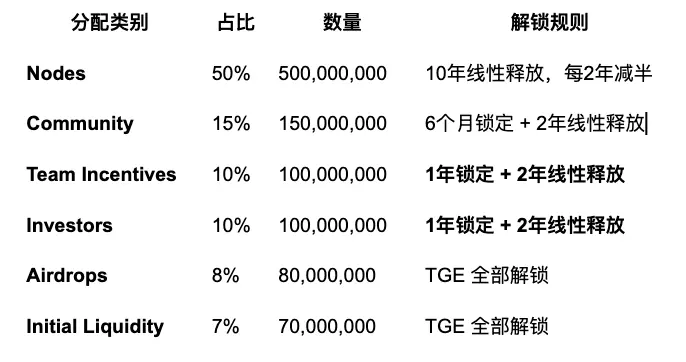
$DGAI is the native token of the DGrid AI network, with a total supply of 1 billion tokens.
Token Distribution Structure
Four Major Functions of $DGAI
1. Node Staking
Node operators and model providers need to stake $DGAI as a service deposit. The staking mechanism ensures:
Nodes have a cost of wrongdoing (providing subpar services will result in the forfeiture of their stake).
PoQ verification results will affect the incentive weight of nodes.
Users can delegate $DGAI to high-quality nodes and share in the revenue.
2. Service Payment
Users can use $DGAI to pay when calling AI services, usually enjoying discounts.
This creates real demand for the token:
Developers will hold and use $DGAI to save costs.
Payment flows will enter nodes, model providers, and protocol treasury.
The more it is used, the higher the token circulation speed and demand.
3. Ecological Incentives
Node operators, model providers, Agent developers, and community contributors receive $DGAI rewards based on the following dimensions:
Service call volume and stability.
PoQ quality scores.
Community contributions (Arena participation, content creation, technical support, etc.).
Incentive distribution is not "egalitarian" but differentiated based on real contributions and quality.
4. Protocol Governance
$DGAI holders can participate in key protocol decisions:
Fee structure adjustments.
PoQ verification rules.
Which new models to support.
Ecological incentive plans.
Use of treasury funds.
As DGrid evolves towards decentralization, governance weight will gradually shift from the team to the community.
Value Cycle Logic
A healthy token economic model needs to form a value closed loop:
Users call AI services (paying $DGAI)
↓
Nodes provide inference services (earning $DGAI revenue)
↓
PoQ verifies service quality (affecting incentive distribution)
↓
High-quality nodes receive more incentives (attracting more nodes to join)
↓
More nodes → Better services → More user calls
↓
Token demand increases → Node revenue rises → Ecosystem expands
DGrid's key challenge: Can $DGAI transform from an "incentive asset" to a "utility asset," meaning the token's value relies not only on incentive distribution but also on the real payment demand generated by actual AI service calls?
### 6. Current Stage and Future Roadmap
Current Stage: From Product Validation to Network Launch
DGrid is currently at a critical turning point:
Product Side: AI Gateway, Arena, and DClaw are online and have accumulated real users.
Business Side: $23M in revenue proves the demand for payment.
Technical Side: The PoQ mechanism has been implemented, with five papers supporting technical credibility.
Token Side: The $DGAI economic model has been announced, and the TGE is about to launch.
Key upcoming actions include:
Node network launch: Open node staking and inference services.
Model Marketplace expansion: Attract more model providers to list.
Governance launch: Gradually open community governance rights.
Long-term Vision: Decentralized AI Service Network
DGrid's long-term goal is to become the decentralized infrastructure layer for AI services:
Anyone can provide AI services and earn revenue.
Anyone can call AI services and verify quality.
Anyone can participate in protocol governance and value distribution.
The realization of this vision depends on three key indicators:
Network call volume: Whether real AI service calls continue to grow.
Supply-side diversity: Whether the Marketplace attracts enough model providers.
Token utilization rate: Whether $DGAI is truly used for payments, staking, and governance, rather than merely as a speculative asset.
### Conclusion
DGrid AI provides a unique sample for observing the AI x Crypto track:
It does not start from the token to backtrack scenarios but begins from real product demand, validating developer calling needs through the AI Gateway ($23M revenue), user participation willingness through the AI Arena (500,000 users), and the feasibility of the quality verification mechanism through PoQ (five papers + actual deployment).
Now, with the launch of $DGAI, DGrid is integrating these validated capabilities into a decentralized network.
The core question is: Can DGrid turn "callable, verifiable, and settleable" from product features into network protocols, allowing AI services to truly circulate in an open market?
This is not only DGrid's challenge but also a necessary question for the decentralization of the entire AI infrastructure.
 Risk warning


Popular articles





