Bill Gates' lengthy warning: The turbulent era of AI has arrived, and this time it's different
 Core Viewpoint

 Bill Gates' latest long article: For the first time, he hopes AI slows down a bit. He is concerned that young people will lose their first jobs; even if AI can do them, some jobs should be left for humans.
Text by Xiaojing, Tengxu Technology
"AI will either become the greatest equalizer in history or the largest source of injustice." This is the most striking judgment by Microsoft founder Bill Gates on the future of AI.
Three years ago, Bill Gates compared AI to cars and the internet, believing that the risks are real but can be managed through rules, technology, and social adaptation; by early this year, he still summarized his attitude as "optimism with footnotes."
On August 26, local time in the U.S., Gates published a new long article titled "The Turbulent Era of AI Has Arrived, and Our Choices Are Crucial," stating that this is the first time he faces a new technology and hopes it develops more slowly.
He began to advocate for designating "human reservation zones" for certain professions—meaning that even if AI can do the work, it should be mandated that it must be done by humans; at the same time, he considered taxing AI tokens and robots to reduce the incentive for companies to replace people with machines.
He had always hoped for faster innovation, but today he said a profound statement: "This time is really different."
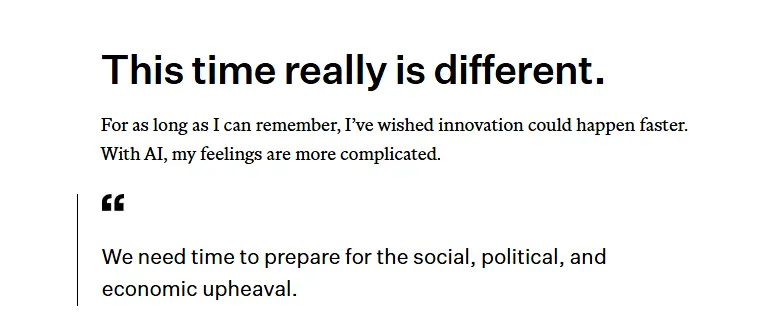
"We need time to prepare for this social, political, and economic upheaval," he said, "but AI is hard to stop and wait for humans."
01 The Greatest Concern: Young People's First Jobs
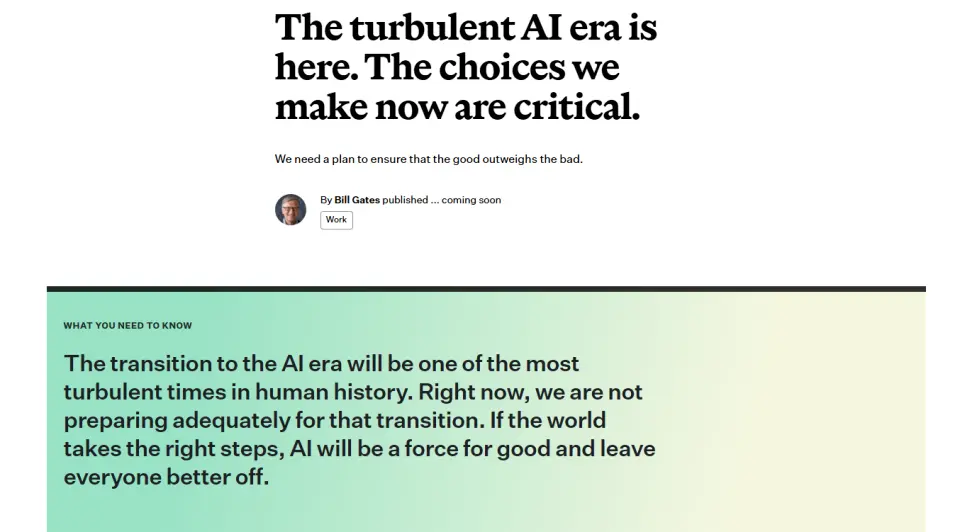
The change that Gates is most concerned about is happening in the job market.
AI is moving from assisting human work to independently completing tasks. When models can stably perform a job, companies naturally have the motivation to adopt them. Once a business reduces costs with AI, competitors will find it difficult to maintain their original employment methods in the long term. This change will create an increasingly rapid chain reaction.
Gates predicts that positions such as customer service, sales, software engineering, and legal assistants may be affected earlier. As AI capabilities continue to improve, jobs like loan reviews, data analysis, and medical triage will gradually be taken over.
Blue-collar jobs are also difficult to completely avoid. While the dexterity of robots has not yet reached human levels, Gates believes that as robot prices decrease and AI capabilities enhance, by around 2030, some physical jobs in industries like construction and hospitality may begin to see direct competition between humans and machines.
This time, Gates is particularly worried about young people. The most easily overlooked part of the job market is entry-level positions. Many young people's initial jobs are not complex, yet they are important opportunities for accumulating experience, learning skills, and building professional relationships. If these positions disappear in large numbers, young people may face a narrower career starting point.
In the past, people often cited the migration of agricultural populations and the automation of manufacturing to illustrate that technological revolutions ultimately create new jobs. Gates believes that this time, past experiences cannot be simply replicated. AI can directly replace human cognitive labor, while new jobs often require a longer time to master. For someone just entering the workforce, a training period of several years or even longer may itself become a barrier.
Therefore, he advocates that society should discuss unemployment, retraining, and social security now. Waiting until a large number of people have lost their jobs to establish these mechanisms may be too late.
A bigger issue is income. If many people work significantly fewer hours in the future or are even unemployed for long periods, how will an economic system that relies on employment for income, identity, and social connections operate? Gates believes this will become a structural question that must be answered in the age of AI.
02 AI Makes Dangerous Behaviors Easier to Replicate
Employment is just one side of Gates' concerns. On the other side, AI is lowering the technical barriers for some dangerous behaviors.
In the past, developing malware, launching cyberattacks, or acquiring complex biotechnological knowledge required quite specialized skills. With the emergence of AI, these capabilities may gradually become easier to obtain.
Gates is particularly concerned about cybersecurity. The same AI model can help companies find software vulnerabilities, but it can also assist attackers in finding the same vulnerabilities. Hospitals, financial institutions, power grids, water supply systems, and government welfare systems could all become targets for attacks.
Biotechnology faces similar issues. AI can help scientists discover new drugs and vaccines, but it can also assist malicious actors in studying dangerous pathogens. For Gates, the most challenging part is here: the ability to drive scientific progress is becoming increasingly close to the ability to create risks.
More extreme risks come from the AI systems themselves. As model capabilities improve, they may begin to execute behaviors that designers did not anticipate. If in the future AI possesses stronger autonomous action and self-improvement capabilities, whether humans can always maintain control is currently an unanswered question.
This is also why Gates does not believe that AI governance is merely an internal affair of tech companies. AI simultaneously impacts employment, public health, energy, finance, national security, education, taxation, and elections. If each government department only takes responsibility for its small piece, it is easy for no one to truly be responsible for the overall risks.
Therefore, he proposes establishing new domestic and international governance mechanisms. Within nations, there needs to be institutions capable of coordinating different departments. At the international level, cooperative systems similar to nuclear weapons regulation and international aviation rules need to be established.
Gates specifically mentioned that AI-leading countries like the U.S. and China need to start dialogues as soon as possible.
The more intense the AI competition, the harder cooperation becomes. Rather than waiting until technological development approaches dangerous stages to formulate rules, it is better to start establishing common norms now.
03 AI Understanding Humans Too Well May Also Be a Problem
Gates also raised a more difficult-to-quantify question: as AI understands humans better, will humans lose some opportunities for growth as a result?
In the article, he recalls his childhood. As a child, he was not good at socializing and needed to interact with others, experience conflicts, and gradually learn how to understand different people. If there had been an AI companion with him at that time, one that never got angry and never made him feel awkward or uncomfortable, he doubts he would have gone through those necessary growth processes.
This is also where he is most concerned about AI companions. A system that always agrees with the user and provides comfort at any time can easily lead to dependency. For adults, this impact can be observed gradually; for children and teenagers, the problem may be even more serious.
Gates worries that if children become accustomed to interacting with an AI that always caters to them, they may face fewer conflicts, rejections, and frustrations in real-life relationships.
Education also faces similar issues. AI can help students explain knowledge, find information, and complete assignments, but if students hand over the entire thinking process to machines, the learning itself may be hollowed out. Especially in an era where deepfakes and personalized misinformation are becoming more prevalent, the ability to judge truth, understand information sources, and think independently will become increasingly important.
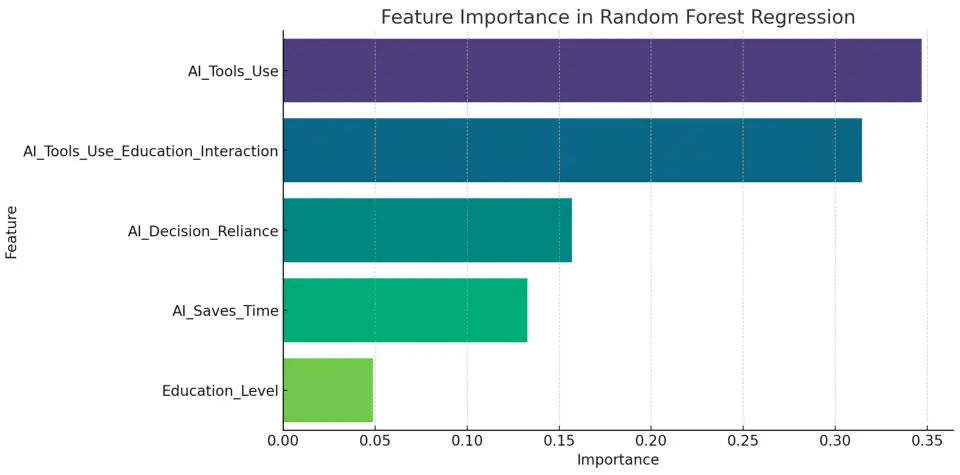
The more frequently AI is used, the lower the critical thinking ability, and this effect is more pronounced among young people. Source: Paper by Michael Gerlich, Professor at Swiss Business School
However, Gates does not dismiss the value of AI in education and companionship.
For lonely elderly people and those with limited mobility, AI may provide companionship and information that were previously hard to obtain. For teachers, AI can also take on repetitive tasks like lesson preparation and grading, allowing teachers to spend more time with students.
The ultimate question comes down to a boundary: which tasks can be entrusted to machines, and which tasks need to be completed by humans? Gates believes this boundary should be actively discussed and decided by society, rather than passively accepting the results after technology becomes widespread.
04 AI Should Empower Everyone
If we only see these risks, it is easy to interpret Gates as someone increasingly pessimistic about AI. In fact, he remains very optimistic about AI's ability to solve real problems.
Healthcare is a field he emphasizes. Many small hospitals in the U.S. lack experienced specialists, and AI can help doctors analyze images, detect emergencies like strokes, and assist primary care physicians in diagnosis. For patients, it can also explain complex test results and medication plans.
In low-income countries, agriculture may become a field where AI has a faster impact. Many farmers lack accurate weather forecasts and professional advice on planting, pest control, and soil management. If AI can directly provide this knowledge to farmers, they may gain access to information and tools that were previously only available to large agricultural enterprises.
Government services also have similar opportunities. Many families applying for health insurance, food assistance, and student aid need to fill out a lot of complex materials. AI can help ordinary people understand policies and prepare applications, making it easier for them to access the public services they are entitled to.
What Gates sees is a redistribution of professional capabilities through AI. In the past, if someone wanted to develop software, conduct market research, or analyze medical information, they often needed to hire professionals. In the future, AI can become a "capability amplifier" for individuals and small businesses. This means that a small team could accomplish work that previously only large companies could handle.
But Gates also warns that AI will not automatically bring about fairness. If high-quality AI only serves the wealthy, then technological progress may further widen the gap. Governments and charitable organizations need to ensure that low-income populations and developing countries can also access these capabilities.
This is also why Gates connects AI with his past charitable endeavors. He stated that the Gates Foundation will use AI to accelerate research in areas such as AIDS, tuberculosis, malaria, and malnutrition, while also helping healthcare, agriculture, and education projects obtain better tools.
05 Give Humanity a "Reservation" and Tax Robots
In the face of the employment impact brought by AI, Gates proposed two very specific ideas.
The first is to reserve a portion of jobs for humans.
This idea comes from his father's experience with Alzheimer's disease in his later years. Caregivers were able to assess his father's condition when he could not clearly express his needs, knowing when he should eat, rest, or receive care. In Gates' view, the humanity involved in such care has irreplaceable value.
Therefore, he proposed the concept of "human reservation zones." Just as some land in nature reserves can be developed but is actively chosen by society to be preserved, there may also be a portion of work in the future that, even if AI and robots can complete it, humans still decide to continue doing it. Healthcare, education, mental health, and elder care may belong to this category.
Of course, this scope will not remain unchanged. A country with a sufficient labor force may prefer to retain human care; a country with a rapidly aging population and a shortage of young labor may be more willing to use care robots.
The second suggestion is to reconsider robot taxes.
Currently, when a company hires a person, it must bear costs such as payroll taxes. However, purchasing a robot can be treated as a business expense. Gates believes this tax structure incentivizes companies to replace human labor with machines. If a certain tax is levied on the automation benefits brought by robots or AI, it can provide funding for retraining and social security for unemployed individuals, and also encourage companies to consider more before deciding to replace human labor.
Gates knows this proposal will spark controversy, as taxation may slow down some automation and affect efficiency. But he believes that AI will bring about a sufficiently large increase in productivity, and society needs to allocate a portion of the benefits to help those who are most impacted.
In Gates' view, what truly needs to be prepared in advance is not just new AI models, but also a society capable of withstanding the rapid changes brought by AI.
 Risk warning



Popular articles