Gate Research Institute: Crypto Cards monthly transaction volume exceeds one billion dollars, Gate Card connects multiple account payment scenarios

 The monthly transaction volume of encrypted payment cards has exceeded $1 billion, with a year-on-year increase of 359%, accumulating over $10 billion, marking the industry's explosive growth period.
Summary
The total transaction volume of the Crypto Cards project has exceeded $10 billion, with a monthly volume exceeding $1 billion and over 10 million transactions in July 2026; the total transaction volume for 2025 was approximately $3.802 billion, a year-on-year increase of about 359%.
The market shows a high concentration, with RedotPay's total transaction volume exceeding $6 billion, accounting for about 56% of the recorded market; Ether.fi, KAST, MetaMask, and Gnosis Pay have entered the market through collateralized credit, stablecoin accounts, and self-custody payments.
Crypto Cards mainly adopt models such as preloading, instant exchange, stablecoin settlement, smart contract deductions, and crypto asset collateralized credit. Product differences focus on fund control, conversion costs, payment stability, issuing regions, and refund processing.
The Gate Card adopts a multi-region, multi-card product structure, connecting payment accounts, spot accounts, and Simple Earn flexible term balances, providing instant consumption, prepayment models, and T0 to T5 tiered cashback. Its advantages come from the Gate account system, asset liquidity, and the synergy between trading, wealth management, and payment products.
Crypto Cards are a collection of products that connect digital asset accounts with bank card payment networks. Users can use stablecoins, BTC, ETH, platform tokens, or on-chain yield assets as funding sources to pay merchants through networks like Visa and Mastercard. Merchants typically receive payments in USD, EUR, or local fiat currencies, with asset conversion and fund settlement completed in the background by crypto platforms, wallet service providers, issuing institutions, and partner banks.
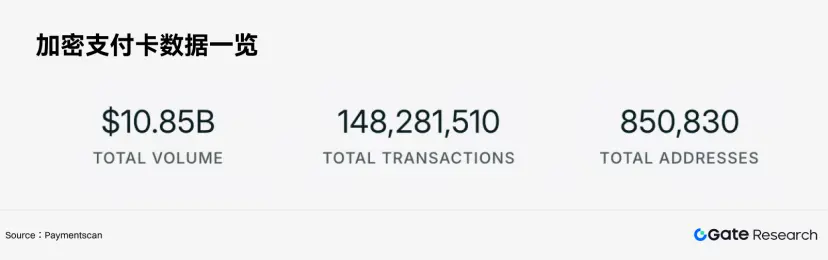
Paymentscan data shows that since March 2023, the total transaction volume of the Crypto Cards project has exceeded $10 billion, with monthly transaction volumes growing from tens of millions to over $1 billion in July 2026, and monthly transaction counts increasing from just over 500,000 to over 10 million, with active addresses exceeding 260,000 and total addresses exceeding 850,000.
In terms of complete annual statistics, the transaction volume for 2024 is approximately $828 million, increasing to about $3.802 billion in 2025, a year-on-year increase of about 359%. The cumulative volume for the first seven months of 2026 reached approximately $5.482 billion, surpassing the total for 2025. The volume in July 2026 grew by about 206% compared to July 2025, with stablecoin cards entering the billion-dollar transaction phase in a single month.
Market concentration remains high. RedotPay's cumulative transaction volume exceeds $6 billion, accounting for about 56% of the market share; Ether.fi and KAST reached approximately $754 million and $684 million, respectively, with the top three projects accounting for nearly 69%. RedotPay has established scale advantages through stablecoin accounts, extensive regional coverage, and high-frequency small transactions; Ether.fi, MetaMask, and Gnosis Pay focus on self-custody, smart contract accounts, collateralized credit, and yield asset consumption; KAST represents a product route combining stablecoin financial accounts and bank cards.
It is evident that product competition has expanded to include funding efficiency, fees, regional coverage, payment stability, and asset control. The first generation of Crypto Cards primarily adopted a preloading model, where users first sell digital assets and then use the fiat balance for consumption; the new generation of products has begun to adopt automatic conversion at the time of consumption, stablecoin backend settlement, smart contract deductions, and crypto asset collateralized credit. Users can allow part of their funds to continue participating in on-chain yields or platform wealth management while retaining payment capabilities.
The Gate Card is a series of crypto asset payment card products launched by Gate for different markets, combining platform accounts with payment cards. Specific cards may adopt instant consumption or prepayment models and are connected to the Visa network by different issuing institutions. Users can choose Gate Pay, spot accounts, or Simple Earn flexible term balances as funding sources in instant consumption mode, or convert assets into card fiat balances through prepayment. The product supports virtual cards, physical cards, and the Visa network, establishing cashback tiers from T0 to T5, with eligible consumption earning up to 8% cashback.
The competitive foundation of the Gate Card comes from the account system, trading liquidity, and product synergy of the leading exchange Gate. Users who already hold assets on Gate do not need to repeatedly transfer to external card platforms or complete multiple exchanges in advance. The payment entry can connect with spot, wealth management, and Gate Pay balances, shortening the path from holding digital assets to real-world consumption.
I. Global Market Size and Competitive Landscape
1.1 Market Size Enters Accelerated Expansion Phase
The monthly transaction volume of Crypto Cards remained at a relatively low level in 2023. The volume was approximately $9.27 million in December 2023, increasing to $153.4 million in December 2024, reaching $521.2 million in December 2025, and rising to $1.038 billion in July 2026.
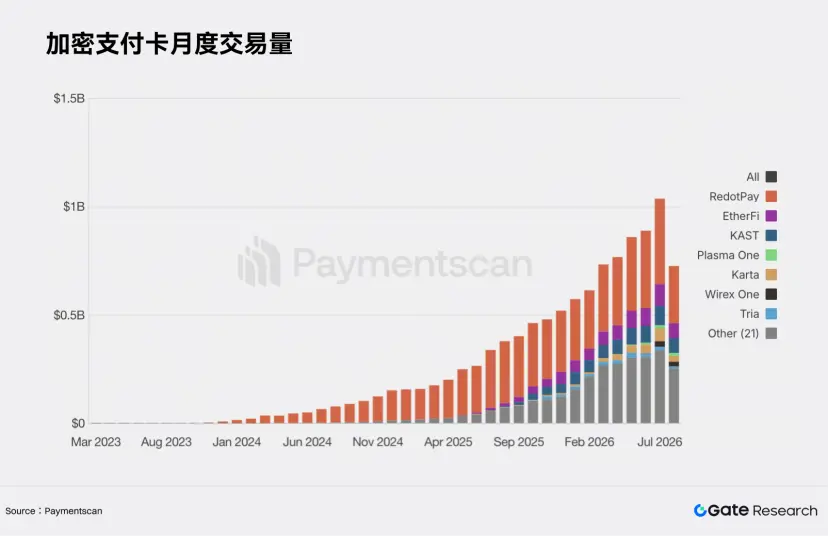
The increase in transaction counts is also significant. In January 2024, there were approximately 540,000 transactions, increasing to 2.78 million in January 2025, reaching 7.41 million in January 2026, and exceeding 10.51 million in July 2026. Based on the transaction volume and counts in July 2026, the average transaction amount is close to $100.
The transaction amounts indicate that Crypto Cards have covered consumption types beyond everyday retail, including hotels, flights, electronics, software subscriptions, advertising expenses, and cross-border bills. Virtual cards and mobile wallets lower the barriers for online and contactless payments, while physical cards cover ATMs, hotel pre-authorizations, car rentals, and traditional offline terminals.
Market expansion is driven by five types of demand:
Stablecoin holders need direct consumption channels;
Cross-border workers need to connect on-chain income with local living expenses;
Crypto platforms want to increase account usage frequency;
Wallet projects aim to bring self-custodied assets into real-world consumption;
Enterprises and Web3 teams need stablecoin funding and business expense management tools.
Crypto Cards enable crypto assets to transition from trading and storage tools into high-frequency consumption scenarios. Payment behavior can increase platform daily active users, asset retention, and user retention, while also providing issuers with revenue from exchange fees, conversion income, membership income, and cross-selling opportunities.
1.2 Market Participants
According to incomplete statistics, there are currently at least over 250 projects or companies involved in the Crypto Cards field.
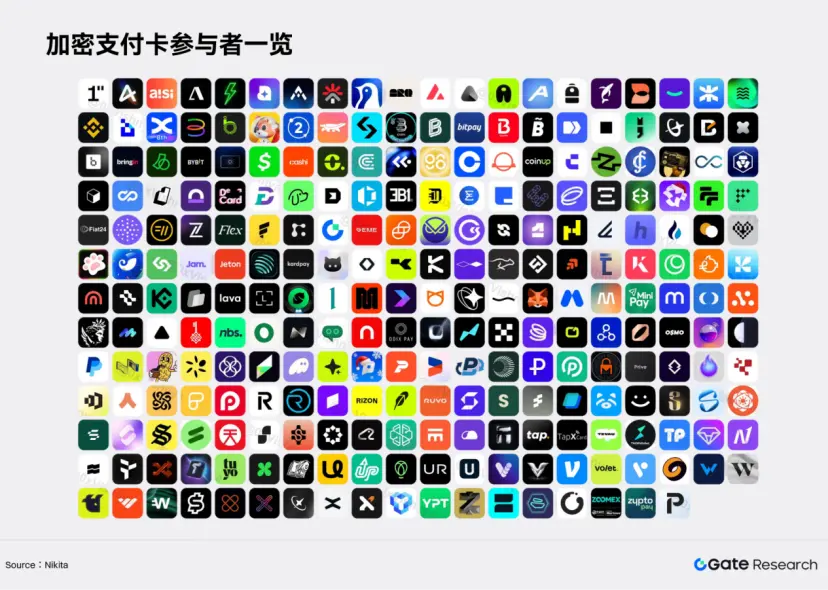
Based on the attributes of the companies behind them or their respective sectors, Crypto Cards can be roughly divided into three categories of participants.
The first category is exchanges and centralized platforms. Representative products include Gate Card or co-branded cards from some exchanges. Advantages include user base, trading liquidity, multi-asset support, and a unified account experience. Limitations mainly come from custody risks, regional regulations, and platform account restrictions.
The second category is wallet and on-chain finance projects. Representative products include MetaMask Card, Gnosis Pay, and Ether.fi Cash. Advantages include self-custody, on-chain transparency, smart contract permissions, and DeFi composability. Users need to understand wallet security, contract authorizations, gas fees, and collateral risks.
The third category is stablecoin accounts and payment fintech companies. RedotPay and KAST are representative. These products emphasize stablecoin balances, cross-border funds, and bank card consumption, typically focusing more on payments than exchange cards and being closer to conventional financial applications than on-chain cards.
Additionally, there is a layer of issuing infrastructure in the industry. Institutions like Rain, Bridge, Wirex, UR, Kulipa, and Immersve provide issuing, settlement, or payment processing capabilities for multiple card brands. Paymentscan shows that KAST, Karta, Tria, and some other projects use Rain-related issuing infrastructure; MetaMask Card collaborates with Baanx, Monavate, and Mastercard.
The concentration of issuing capabilities lowers the cost for new brands to enter the market and creates dependency on partners. Brand owners need to establish differentiation in product experience, compliance, liquidity, and user operations, while issuing infrastructure providers control banking relationships, card organization access, and regional expansion capabilities.
1.3 RedotPay Establishes Scale Leadership
RedotPay entered a rapid growth phase at the end of 2023, with cumulative consumption exceeding $6 billion and cumulative transaction counts exceeding 100 million, with a monthly consumption volume of approximately $139.8 million in December 2024, increasing to $282.2 million in December 2025, and reaching $395.1 million in July 2026; during the same period, monthly transaction counts reached approximately 6.205 million.
RedotPay's product positioning targets a wide range of stablecoin users. Users can apply for virtual or physical cards, use crypto assets for bank card consumption, and connect to mobile wallets like Apple Pay and Google Pay. Wide coverage, relatively standardized products, and a stablecoin account experience help it attract a large number of high-frequency users.
Scale advantages come with certain costs. RedotPay's official help center shows that the issuance fee for virtual cards is $10, while the issuance fee for physical cards is $100; the crypto asset conversion fee is about 1%, and a fee of 1.2% may apply when using non-card priced currencies; physical card ATM withdrawal fees are typically 2%, with some high withdrawals subject to a 3% fee. Merchant refunds typically do not return conversion or transaction fees incurred during payment.
RedotPay is suitable for users who value regional availability, stablecoin balances, and consumption convenience. For price-sensitive users or those frequently making cross-currency purchases, conversion fees, foreign exchange fees, and ATM fees can significantly impact total costs.
1.4 Ether.fi and KAST Accelerate Growth
Ether.fi Cash began to scale in 2025, with a cumulative transaction volume of approximately $754 million and about 9.51 million transactions, with a monthly volume of approximately $10.82 million in July 2025, increasing to $10.03 million in July 2026, growing more than eightfold over twelve months; active addresses in the same month exceeded 40,000.
Ether.fi Cash integrates payment cards, on-chain assets, and collateralized loans into a single product. Users can use USDC, USDT, EURC, ETH, WETH, weETH, eBTC, eUSD, and some yield-generating assets to fund their payment balances or support loans. The growth of this product indicates that some crypto users are willing to use more complex structures in exchange for asset control, yield, and credit limits.
KAST's cumulative volume is approximately $684 million, with a monthly volume of about $2.18 million in July 2025, reaching $89.6 million in July 2026. KAST offers a 2% base cashback, with a maximum of 3% cashback, supporting Apple Pay and Google Pay, with foreign exchange fees ranging from about 0.5% to 1.75%, and ATM fees of $3 plus 2%.
KAST uses stablecoin financial accounts as its product entry point, emphasizing the integration of receiving, holding, converting, and spending. Its growth shows that the needs of Crypto Cards users are expanding to account functionalities, such as salary receipts, cross-border transfers, stablecoin savings, and multi-currency fund management.
1.5 Regional Markets Have Different Demand Structures
Europe has formed a Crypto Cards product cluster earlier. SEPA transfers, multi-country cross-border consumption, euro settlements, and electronic money institution systems have provided conditions for product issuance. MetaMask Card covers multiple countries in the European Economic Area and regions like Switzerland and Monaco; the early European version of Gate Card expanded to 29 countries in the European Economic Area.
The Latin American market focuses more on stablecoin storage, overseas income usage, and international online payments. MetaMask Card has covered markets such as Argentina, Brazil, Chile, Colombia, Mexico, and Uruguay. For local users, Crypto Cards can reduce the costs of stablecoin conversions and bank transfer steps.
The U.S. market has a mature bank card, mobile wallet, and credit system, with higher entry requirements. Gate US launched the U.S. version of Gate Card in July 2026. This product is a prepaid Visa debit card issued by Lead Bank, with Bridge serving as the project management and stablecoin infrastructure partner, and Gate US responsible for platform access, customer compliance, risk management, and transaction monitoring. Users can use supported assets like USDC to provide payment funds, with the system completing dollar conversions during transactions.
The Asia-Pacific, Middle East, and Africa regions have strong cross-border payment and stablecoin demands, but there are significant differences in regulations regarding crypto assets, bank card issuance, and foreign exchange management in different countries. Products may be usable at local merchants, but this does not mean that local residents can necessarily apply for them. Application regions, consumption regions, and issuing regions need to be verified separately.
II. Card Types, Funding Models, and Applicable Scenarios
Crypto Cards products can be analyzed from two dimensions: card types and funding models. Card types are determined by issuing institutions, account structures, and credit relationships; funding models describe how user assets are converted into usable payment balances. There is no fixed correspondence between the two, and the same product may support multiple funding models simultaneously.
2.1 Card Types
2.1.1 Debit Card
Debit Cards complete deductions based on the user's available funds and do not provide users with revolving credit limits. Payment amounts typically come directly from fiat balances, stablecoin balances, platform accounts, or wallet assets, and transactions will be rejected if the account balance is insufficient.
Crypto Debit Cards differ from traditional debit cards mainly at the funding end. Traditional debit cards usually connect directly to bank deposit accounts; Crypto Debit Cards can connect to stablecoin accounts, exchange accounts, or self-custody wallets, completing crypto asset conversions during payment.
For example, the MetaMask Card is a self-custody Debit Card. User assets are retained in the MetaMask wallet before payment, and selected assets are converted into the merchant's settlement currency when the transaction occurs; some instant consumption cards in the Gate Card product series also have similar deduction characteristics.
Debit Cards are suitable for everyday consumption, online shopping, stablecoin income usage, and budget management. Users do not incur borrowing interest, and the main costs come from asset conversion fees, foreign exchange fees, and transaction fees.
2.1.2 Credit Card
Credit Cards allow users to complete consumption within a credit limit and then repay according to the bill or agreement. The credit limit can come from traditional credit assessments or be secured by crypto assets.
The Credit attribute in crypto credit cards is determined by the issuing and credit relationships. Some products may allow users to pay using collateralized loans, but the card may still legally or at the issuing level belong to a Debit Card or Prepaid Card.
For example, Ether.fi Cash positions its product as a crypto-native Credit Card. Users can use crypto assets to support credit limits and borrow USDC or EURC through Borrow Mode to complete card consumption, with unpaid balances accruing interest at the corresponding rate. Users can defer repayment of the consumption balance but must bear borrowing interest, changes in collateral rates, and potential liquidation risks.
Credit Cards are more suitable for users with stable cash flow, larger asset scales, and familiarity with collateral management. Scenarios such as hotel pre-authorizations, car rentals, and travel bookings are usually more accepting of credit cards.
2.1.3 Prepaid Card
Prepaid Cards require users to first deposit funds into the card account and then complete consumption from the pre-deposited balance. User spending is limited by the available balance on the card, typically not forming credit liabilities and not directly connecting to traditional bank checking accounts.
Crypto Prepaid Cards can be funded from stablecoins, fiat obtained from crypto asset conversions, or platform account balances. Users first complete the recharge, and the issuing system records the balance according to the card's pricing currency.
The Gate US version is a prepaid Visa debit card issued by Lead Bank. Users provide funding using supported crypto assets, and related asset conversions and card balance management are executed according to the rules of its U.S. version cards.
Prepaid Cards are suitable for consumption budget management, virtual card subscriptions, travel reserves, and corporate expense control. Their limitations include the need for prior recharging, potential idle balances, and possible additional costs during the recharge, conversion, and refund processes.
2.2 Funding Models
2.2.1 Instant Pay / Direct Pay
The Instant Pay or Direct Pay model allows users to directly use assets in platform accounts or wallets at the time of consumption. When the system receives a bank card authorization request, it checks the balance, calculates the required amount, and completes the deduction, conversion, and fiat settlement of digital assets.
The operational process can be summarized as:
Initiate Payment → Check Account Assets → Determine Exchange Rate → Deduct or Freeze Assets → Complete Card Authorization → Background Settlement
This model does not require users to maintain an independent card balance long-term, reducing the capital occupation caused by preloading. The platform needs to have rapid quoting, account deduction, asset conversion, and settlement liquidity to meet the authorization speed requirements of the bank card network.
The multi-account payment function of the Gate Card belongs to this type of model. Users can choose payment accounts, spot accounts, or Simple Earn flexible term balances as funding sources, completing deductions and conversions according to specific card rules during payment. The supported assets listed by Gate include USDT, USDC, BTC, and ETH, with the actual range depending on the card type and issuing region.
MetaMask Card also adopts the Direct Pay model, where users retain wallet assets before consumption, and asset conversion is completed through the authorized account when payment occurs. The difference between the two is that the Gate Card connects internal accounts of the exchange platform, while the MetaMask Card connects to self-custody wallets.
Instant Pay is suitable for users looking to improve capital utilization efficiency. Major risks include price fluctuations at the time of payment, temporarily unavailable assets, insufficient account balances, and system authorization failures.
2.2.2 Top-up First
The Top-up First model requires users to recharge funds into the card balance before consumption. The recharge process typically includes crypto asset conversions, stablecoin transfers, or platform account transfers. After completing the recharge, bank card transactions are directly deducted from the pre-stored balance.
The operational process is:
Select Recharge Asset → Convert or Transfer → Form Card Balance → Initiate Payment → Deduct Pre-stored Balance
Top-up First brings asset conversion forward to the recharge phase, reducing the pressure of temporary conversions and liquidity handling during payment authorization. Users can determine available balances in advance, and the platform can also prepare settlement funds ahead of time. Its costs include early capital occupation, recharge fees, conversion fees, and balance management costs.
The prepaid mode of the Gate Card belongs to Top-up First. Users can convert assets from Gate Pay or spot accounts into the corresponding fiat currency and then recharge to the card balance. Stablecoin cards like RedotPay also widely use recharge or pre-stored balance structures.
This model is suitable for travel budgets, subscription expenses, advertising accounts, and team expense management. Users can limit card balances to planned consumption ranges, reducing exposure of main account assets.
2.2.3 Borrow-to-Pay
The Borrow-to-Pay model provides funding for card consumption through borrowing. Users can obtain unsecured credit limits or lock BTC, ETH, stablecoins, or yield-generating assets as collateral to borrow USDC, EURC, or fiat balances.
The operational process is:
Deposit or Designate Collateral Assets → Calculate Available Credit Limit → Initiate Card Consumption → Form Borrowing Balance → Pay Interest and Repay
This model allows users to retain their original asset positions while using borrowed funds for consumption. Users do not need to sell BTC or ETH for each payment but will incur interest, collateral rate declines, additional collateral requirements, and liquidation risks.
Ether.fi Cash's Borrow Mode is representative. Users can use digital assets in their wallets to support borrowing, borrowing USDC or EURC for card consumption, and paying interest on unpaid balances.
Borrow-to-Pay is suitable for users who wish to maintain long-term asset exposure, have repayment capabilities, and can manage collateral risks, but it is not suitable for users who cannot continuously monitor collateral rates or use all liquid assets as collateral.
2.3 Self-Custody Cards vs. Platform Custody Cards
Beyond funding models, Crypto Cards can also be divided into platform custody and self-custody based on custody methods.
Self-custody cards manage funds through wallets and smart contracts. Users need to authorize card services to use assets within specific limits while retaining wallet control before payment. Products like MetaMask Card, Gnosis Pay, and Ether.fi Cash have strong self-custody or on-chain account attributes.
Self-custody structures reduce the need for assets to be stored long-term on centralized platforms, and transaction records and account balances are easier to verify on-chain. Users need to protect mnemonic phrases and device security and manage contract authorizations. Smart contract vulnerabilities, overly broad authorizations, and on-chain congestion can all impact payments.
Platform custody cards complete balance checks, asset conversions, and payment authorizations through centralized accounts. Products like Gate Card and RedotPay are closer to this structure. Their operational thresholds are lower, allowing platforms to quickly complete conversions using internal accounts and liquidity, and they can more easily provide customer service, risk control, and account recovery.
Custody structures require users to trust the platform's asset management, compliance, and account control mechanisms. When accounts are subject to risk control reviews, card and other platform functionalities may be restricted simultaneously.
It is worth noting that custody structures are not entirely binary; some products allow users to control on-chain wallets or smart contract accounts while being managed by licensed institutions for fiat settlement and bank card accounts, forming a hybrid structure that combines on-chain fund control with traditional issuing systems.
2.4 Virtual Cards vs. Physical Cards
Virtual cards are suitable for e-commerce, software subscriptions, mobile wallets, and online advertising. Card numbers can be generated quickly after application review, with lower issuance costs, allowing users to freeze or replace cards quickly. One-time virtual cards can also reduce the risk of card number leakage.
Physical cards are suitable for ATM withdrawals, hotels, car rentals, offline terminals, and regions where mobile payments are not available. Physical cards involve production, mailing, reissuing, and PIN management, so issuance and replacement fees are usually higher.
Mobile wallets enable virtual cards to have offline payment capabilities. Gate Card, MetaMask Card, Ether.fi Cash, KAST, and RedotPay all provide or support one or both of Apple Pay and Google Pay. For urban daily consumption, virtual cards combined with mobile wallets can cover most scenarios.
2.5 Product and Scenario Matching
Product selection needs to consider both explicit fees and implicit costs. Explicit fees include issuance fees, monthly fees, transaction fees, ATM fees, and foreign exchange fees; implicit costs include exchange price differences, recharge waiting times, opportunity costs of lost asset yields, refund losses, and the capital costs of holding platform tokens.
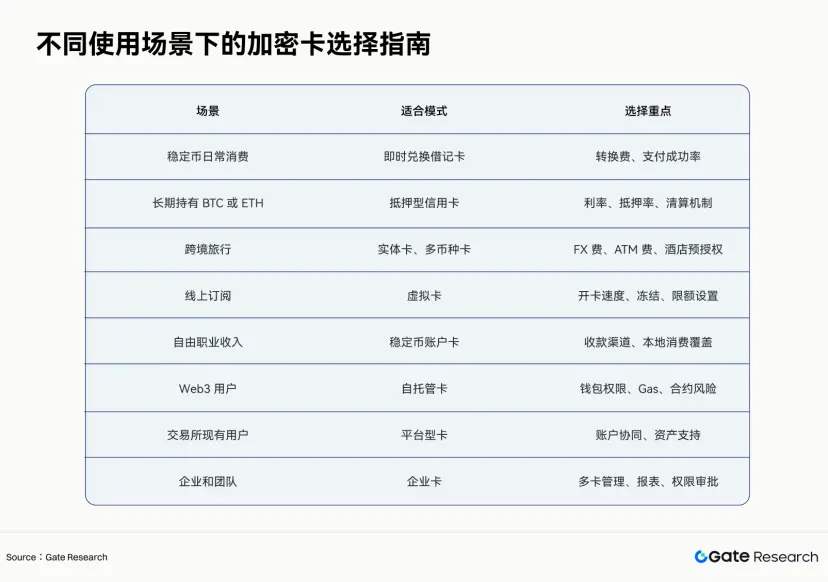
III. Issuing Models and Underlying Operating Mechanisms
3.1 Participant Structure
A Crypto Card payment typically involves the following entities:
Users and their wallets or platform accounts;
Crypto Card brand owners;
Digital asset custodians or smart contract accounts;
Asset exchange and liquidity service providers;
Partner banks or electronic money institutions;
Issuing processors and BIN sponsors;
Visa or Mastercard;
Acquiring institutions;
Merchants.
What users see is a card and a balance page, while the backend needs to coordinate crypto assets, fiat accounts, and bank card networks. Card brands are responsible for product entry, user management, and asset sources, licensed institutions bear issuing and related compliance responsibilities, card organizations handle transaction routing and global merchant networks, and liquidity service providers manage the conversion between digital assets and settlement currencies.
3.2 Fiat Pre-conversion Model
Users first sell crypto assets and deposit the resulting fiat into the card account. After merchants submit payment requests, the issuing institution checks the fiat balance and completes authorization, followed by settlement through the bank card network.
The operational chain of this model is:
Sell Crypto Assets → Obtain Fiat Balance → Card Authorization → Fiat Settlement → Merchant Receives Payment
Its technical and compliance structure is similar to traditional prepaid cards, with no need to temporarily process on-chain transactions during payment. Users bear the costs of early conversions, and balances typically do not continue to earn on-chain yields while waiting for consumption.
3.3 Instant Exchange Model
The instant exchange model allows users to continue holding crypto assets until payment occurs. When the system receives a bank card authorization request, it calculates the required fiat amount, determines the deduction assets and exchange rates, freezes or deducts the corresponding assets, and then approves the transaction.
The operational chain is:
Merchant Requests Authorization → Check Account Assets → Lock Quote → Deduct or Freeze Assets → Complete Card Authorization → Background Exchange and Settlement
Bank card authorization requires a quick response, and the platform needs to arrange liquidity in advance or use internal ledgers. If each transaction waits for public chain confirmation, payment speed and success rates will be affected by block congestion. Centralized platforms can first complete deductions in internal accounts and then process external funds and settlements in bulk.
The instant consumption mode of the Gate Card allows users to choose Gate Pay, spot accounts, or Simple Earn flexible term balances as funding sources. During payment, the system completes asset conversion and settlement according to card rules. The instant consumption mode supports mainstream stablecoins like BTC, ETH, and USDT, while the prepaid mode can support a wider range of assets, with specific types depending on the card and region. Among them, Simple Earn as a source of payment funds improves capital scheduling efficiency. Users do not need to manually redeem, transfer to spot accounts, sell assets, and recharge cards in advance. The product needs to handle the timing relationships between available balances, redemption sequences, and payment authorizations in the background. User experience depends on whether funds can be immediately released during payment and when balances are restored after failed transactions.
3.4 Stablecoin Settlement Model
Stablecoin settlement uses USDC, USDT, or EURC to connect on-chain funds with fiat payments. Users provide funds in stablecoins, and the platform or infrastructure service providers convert stablecoins into the merchant's settlement currency at the time of consumption.
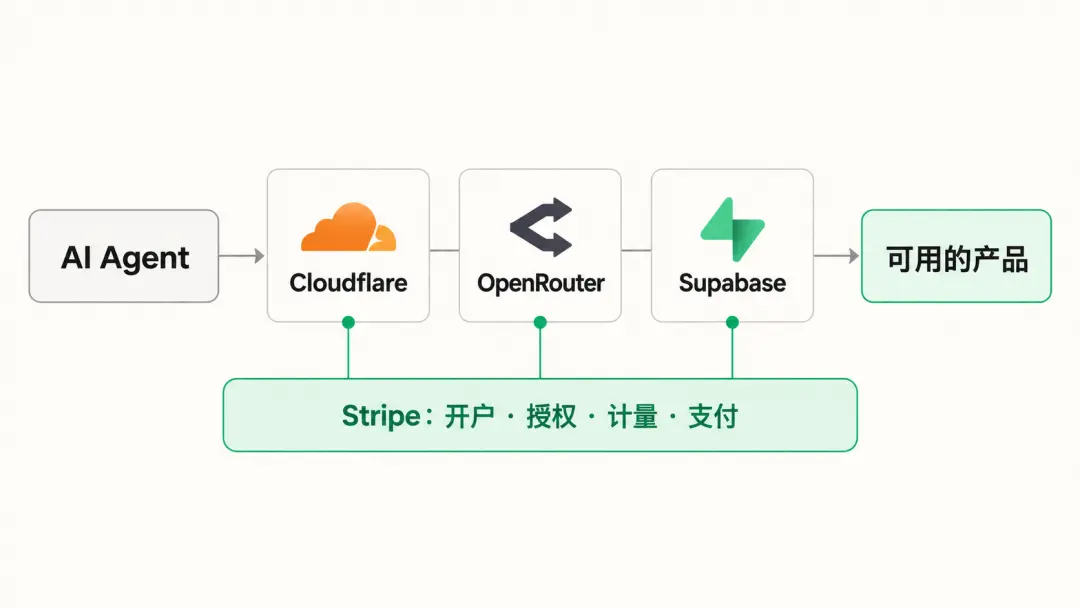
The Gate US version provides a clear cooperation structure. Gate US is responsible for user access, compliance, risk management, and transaction monitoring; Bridge provides stablecoin infrastructure; Stripe participates in payment technology; Lead Bank is responsible for issuing; and Visa provides the payment network. Users utilize supported assets like USDC, completing dollar conversions during consumption.
Stablecoins reduce the impact of BTC or ETH price fluctuations on authorized amounts and facilitate the platform's cross-regional allocation of dollar liquidity. Related risks include the credit of stablecoin issuers, address freezes, reserve regulations, de-pegging, and the costs of converting stablecoins into local fiat currencies.
3.5 Smart Contract Deduction Model
Self-custody cards typically require users to set payment permissions for smart contracts. The system deducts corresponding assets from the user's wallet based on spending limits, asset priorities, and card authorization requests.
Smart contracts can provide the following functions:
Daily or single transaction spending limits;
Whitelist of deductible assets;
Validity period of payment authorization;
Card freezing and permission revocation;
Multi-signature or team approval;
Gas fee payment;
Automatic conversion;
Backup asset order when balances are insufficient.
This design enhances the programmability of accounts and expands security boundaries. Users need to protect wallet signing permissions, and projects need to continuously audit contracts. Issuers still bear KYC, sanction screening, merchant disputes, and bank card network compliance responsibilities, which cannot be replaced by on-chain accounts.
3.6 Collateralized Credit Model
Collateralized cards first calculate the value of user assets and then provide consumption limits based on collateral rates. If a user deposits ETH worth $10,000, the platform may only open part of it as available credit to cope with price fluctuations.
Key risk parameters include:
Initial loan-to-value ratio;
Maintain collateral rates;
Additional collateral requirements;
Liquidation thresholds;
Borrowing interest rates;
Acceptable collateral assets;
Repayment currencies;
Price oracle sources.
The platform must confirm that users still have sufficient available credit at the time of payment authorization. During rapid market declines, the value of collateral assets may drop after bank card transactions are completed. Projects need to prepare risk buffers, liquidation mechanisms, and liquidity.
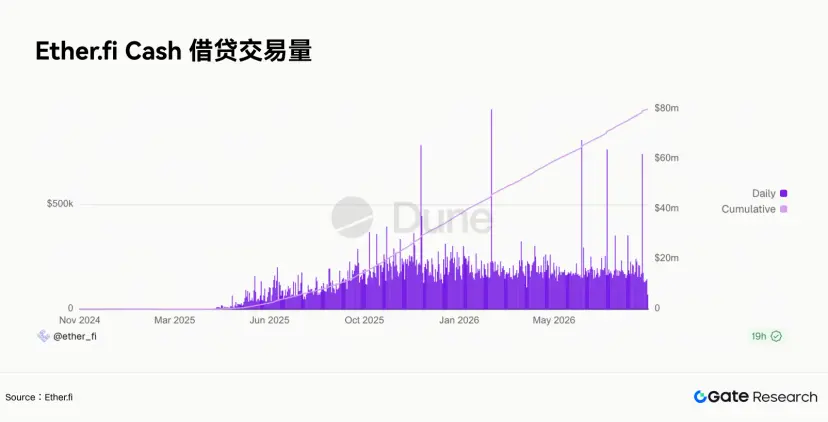
For example, Ether.fi Cash allows users to borrow USDC or EURC for card consumption while retaining assets in its treasury structure, with daily borrowing transaction volumes reaching hundreds of thousands of dollars. This model is suitable for users who wish to maintain asset exposure while introducing DeFi lending risks into everyday payment accounts.
3.7 Refund and Chargeback Mechanisms
Bank card payments support cancellations, refunds, and chargebacks, while on-chain asset transfers are usually irreversible. Crypto Cards projects need to establish accounting processing methods between the two sets of rules.
After a user pays with ETH, the platform may have already sold ETH and completed settlement with fiat. When a merchant refunds days later, the platform can return fiat, stablecoins, or purchase ETH at the refund price. Each processing method will incur exchange rate and asset quantity differences.
As RedotPay explains, the approximately 1% fee incurred during payment is not refunded with merchant refunds. The amount users receive may be less than the initial deduction amount.
Hotels, gas stations, and car rental companies also use pre-authorizations. Merchants may first freeze an amount higher than the final consumption and then release the difference days later. Crypto Cards platforms need to decide how many digital assets to freeze, which exchange rate to lock at which point in time, and how to restore balances after pre-authorization cancellations; these details will directly impact the payment experience.
IV. Gate Card Competitiveness and Comparison with Mainstream Products
4.1 Overview of Mainstream Products
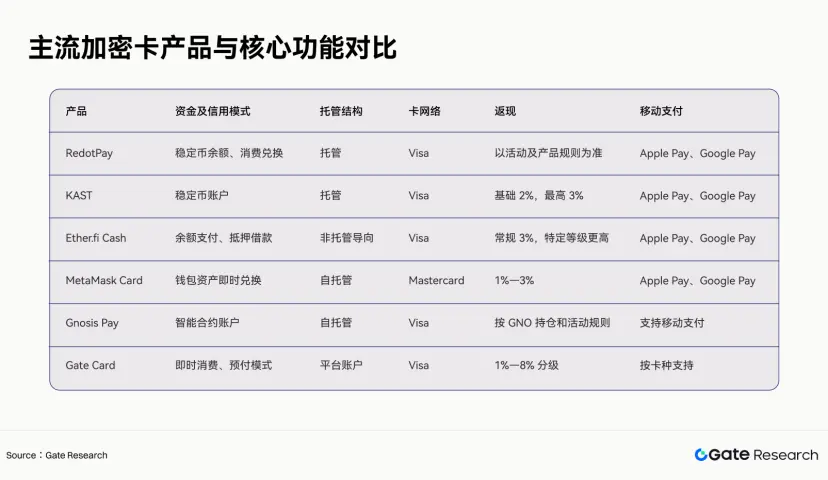
Note: Cashback figures cannot independently represent product costs. KAST has FX fees of about 0.5% to 1.75%; Ether.fi incurs foreign exchange costs in specific non-USD, non-EUR transactions; MetaMask may incur small fees per transaction; RedotPay includes conversion, foreign exchange, and ATM fees; different card types and regions of Gate Card adopt different rates.
4.2 Gate Card's Product Portfolio
Gate Card serves different markets through various card schemes, covering virtual cards and physical cards in some markets, and connects to the Visa network based on card types, with physical card, ATM withdrawal, and mobile wallet support determined by issuing regions and specific card types. Users need to complete secondary identity verification, and some products require proof of address from the last three months.
Funding sources are divided into two types:
Instant Consumption Mode allows users to select funding from Gate Pay, spot accounts, or Simple Earn flexible term balances. The system performs asset conversion and settlement during consumption.
Prepayment Mode requires users to convert assets from Gate Pay or spot accounts into the corresponding fiat currency for consumption.
The instant mode reduces capital occupation from preloading, while the prepayment mode increases balance certainty. The parallel use of both allows Gate to configure products according to issuing institutions and regional regulatory requirements.
4.3 Gate Card's Cashback System
Gate launched a six-tier cashback system from T0 to T5 in July 2026.
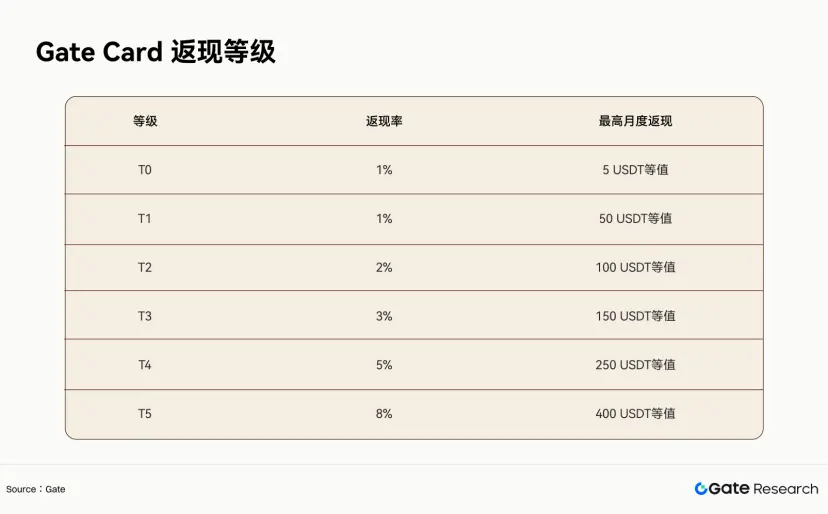
Tiers are determined based on Gate VIP levels or monthly card consumption, with the system adopting the tier that is more favorable to users. Eligible consumption earns points, which can be redeemed for USDT, gold stablecoins, and over 13 high-net-worth assets like SpaceX, Nvidia, and Tesla. Recharge, withdrawal, handling fees, fiat payments, and certain merchant categories do not participate in point accumulation.
The maximum cashback of 8% is attractive to high-frequency users, while the monthly cap of 400 USDT means that after reaching a certain consumption amount, additional spending does not increase rewards. When assessing actual returns, users need to consider their corresponding tier, eligible consumption ratio, and card fees.
Using the public rates for Classic or Platinum cards for static calculations, a T2 user consuming $3,000 and meeting all cashback conditions could receive $60 in cashback. If paid with digital assets, the cost calculated at a 0.9% fee for converting crypto assets to fiat would be $27, resulting in a cashback of $33 after deducting that fee. If the transaction currency is not USD, an additional 0.4% foreign currency transaction fee would reduce net returns to about $21. This calculation does not account for merchant category exclusions, exchange price differences, and other third-party fees, nor does it apply to the U.S. version or other rate plans.
4.4 Gate Card's Competitive Advantages
Gate Card is backed by the leading crypto exchange Gate, and its competitive advantages include:
Account Synergy. Users can use Gate Pay, spot accounts, and Simple Earn flexible term balances to provide payment funds, and use the card through WeChat Pay, Alipay, and related online consumption platforms. This structure connects Gate's internal asset accounts with external consumption entry points, reducing manual conversions, account transfers, and repeated recharging steps.
Liquidity. Gate provides a multi-asset trading market capable of handling conversions of mainstream stablecoin assets like BTC, ETH, and USDT. The card can utilize the platform's internal pricing and account system for quick deductions.
Instant Consumption and Prepayment Parallel. Instant consumption emphasizes capital efficiency, while prepayment mode emphasizes certainty. Different users can choose according to their usage habits, and Gate can also configure based on regional cooperation structures.
Connection of Cashback and VIP Systems. Existing VIP users can obtain higher card tiers, and card consumption can increase user frequency of platform account usage. Rewards can be redeemed for digital assets and enter trading, wealth management, or further consumption.
Multi-Regional Cooperation Capability. Gate can adopt different issuers, card networks, and settlement structures for different markets. The U.S. version collaborates with Visa, Stripe, Bridge, and Lead Bank, while other regions operate based on local card schemes.
4.5 Payment Scenarios and Recent Product Upgrades
Gate Card's recent upgrades have expanded the applicability of third-party payment platforms and online services. Related cards now support binding WeChat Pay and Alipay and can be used on consumption platforms like Meituan and Taobao, enabling the card to cover dining, travel, online shopping, and other daily payment scenarios. Accessing local payment tools helps increase the availability of Gate Card among commonly used consumption platforms in Chinese-speaking markets. Additionally, mobile payment functionality continues to be supplemented, with related cards expected to integrate Apple Pay by the end of August to early September.
In terms of digital services, Gate has completed payment tests for some AI-related services, including overseas software subscriptions, cloud services, and digital content payments, which place high demands on the online transaction, continuous deduction, and cross-border payment capabilities of virtual cards. Adapting to AI services can expand the usage scope of Gate Card beyond traditional retail.
4.6 Key Links in User Experience
The complete experience of Gate Card includes application, KYC, card review, funding account selection, first payment, mobile wallet binding, refunds, and dispute resolution.
Virtual card applications can typically be completed quickly after review, suitable for online and mobile payments. Physical cards provide ATM and traditional terminal capabilities but require waiting for delivery. Users select the account and assets to be deducted in the multi-account payment function. Insufficient account balances, temporarily unavailable assets, or card risk control restrictions may lead to authorization failures.
The refund experience depends on the issuing institution and card type. Users need to understand whether refunds are recorded in fiat, stablecoins, or other balances, whether original payment fees are refunded, and when pre-authorizations are released. Users with large transactions should also verify single, daily, monthly, and ATM limits.
The fee schedule for the Gate US version shows that virtual cards are free, with no monthly or idle fees, a recharge fee of 0.9%, a transaction fee of $0.1, and a chargeback fee of $35; the basic daily consumption limit is $2,000, which can be increased to $5,000 upon meeting transaction history or cumulative consumption conditions. This rate only applies to the corresponding U.S. card scheme.
Different Gate Card schemes have varying fees and limits. Users in Europe, the U.S., and other regions should check their respective application pages and cannot reference rates from other regions to assess their own usage costs.
4.7 Competitive Boundaries of Gate Card
MetaMask and Gnosis Pay are stronger in self-custody and on-chain transparency, Ether.fi is deeper in collateralized consumption and yield assets, RedotPay leads in observable transaction volume and mass user coverage, KAST focuses on stablecoin financial accounts, while Gate Card has advantages in platform users, funding sources, and cashback.
Gate Card is suitable for the following users:
Those holding or trading crypto assets on exchanges like Gate;
Those wishing to consume using spot, Gate Pay, or Simple Earn flexible term balances;
Those needing virtual cards and mobile payments;
Those with high consumption frequency or Gate VIP levels;
Those concerned with multi-asset support and internal fund scheduling.
V. Risks and Development Directions
5.1 Issuing Cooperation Risks
Crypto Cards brands need to cooperate with banks, electronic money institutions, issuing processors, and card organizations. Changes in cooperative relationships may lead to the suspension of new applications, card migrations, service area reductions, or fee adjustments. For example, the issuing party Fiat24 suspended account openings and crypto recharge services in certain countries or regions in June and July, affecting multiple Crypto Cards that cooperated with Fiat24, leading to closures, forcing users to seek new payment cards.
When multiple brands use the same infrastructure, risks can concentrate on a few service providers. Platforms can reduce reliance on single partnerships through multiple issuers, regional entities, and dual networks of Visa and Mastercard. Users should verify the actual issuing institutions of cards, the legal attributes of funds, and the entities responsible for dispute resolution.
5.2 Asset and Custody Risks
Platform custody cards require users to store assets in platform accounts. Platform risk control, withdrawal policies, and account reviews may affect card usage. Self-custody cards reduce exposure to platform custody but increase risks related to wallet private keys, smart contracts, and authorization security.
Collateralized cards also carry market risks. A decline in the prices of ETH, BTC, or other collateral assets may reduce available limits and trigger liquidation. Cashback earnings may not cover significant price fluctuations or borrowing interest.
5.3 Stablecoin Risks
Stablecoins improve payment pricing and settlement efficiency but still carry issuer, reserve, regulatory, and de-pegging risks. Centralized stablecoin issuers may also freeze addresses based on sanctions or enforcement requirements.
Card platforms need to avoid reliance on a single stablecoin, establish conversion capabilities between stablecoins and bank deposits, and maintain sufficient fiat settlement liquidity. Users should distinguish between stablecoin balances and bank deposits. The Gate US announcement clearly states that USDC and other crypto asset balances do not constitute bank deposits and do not enjoy FDIC insurance; relevant insurance only applies to funds held by Lead Bank that meet certain conditions.
5.4 Sustainability of Fees and Cashback
Cashback typically comes from platform subsidies, exchange fee income, membership conditions, or platform token economics. Visa and Mastercard exchange fees are subject to regional regulatory restrictions, and relying solely on exchange fees is unlikely to sustainably support general cashback of 5% to 8%.
High cashback products usually control costs through tiers, monthly caps, merchant category exclusions, and holding requirements. Users should focus on long-term base cashback and avoid treating short-term promotional rates as sustainable income.
5.5 Tax and Accounting Treatment
Using volatile digital assets for consumption may generate asset disposal records. Users need to keep records of purchase costs, prices at the time of consumption, conversion fees, refunds, and cashback data. Frequent small payments can create a large number of records, raising demands for tax management.
The tax treatment of stablecoin consumption depends on the jurisdiction. Collateralized borrowing may have different treatments from direct asset sales, but interest, liquidation, and collateral disposal may still generate reporting obligations. Platforms providing exportable transaction details will become competitive factors.
Corporate cards also need to handle employee expenses, invoices, merchant categories, departmental budgets, and crypto asset accounting. Products with multi-card management, approval, limits, and reporting functions are more likely to enter the Web3 corporate spending market.
5.6 Product Development Directions
Stablecoins will continue to serve as the primary backend settlement assets. The front end can support BTC, ETH, platform tokens, and yield-generating tokens, while the backend uses USDC, USDT, EURC, or fiat for authorization and settlement. The asset conversion efficiency of the platform will directly impact payment costs.
Self-custody cards will increase account abstraction, gas fee payments, session keys, and revocable authorizations. Users can set independent limits and asset ranges for cards without opening all wallet assets to payment contracts.
Yield-generating balances will enter payment accounts. Users can allow stablecoins, RWA tokens, or staked assets to generate yields while retaining some instant consumption capabilities. Projects need to manage redemption liquidity and asset depreciation under market pressure.
Collateralized consumption will expand to more assets, including BTC, ETH, liquid staking tokens, and tokenized government bonds. Loan-to-value ratios, interest rates, and liquidation mechanisms will become key parameters in credit card competition.
The corporate card market will expand. Stablecoins are already widely used for cross-border funds and employee salaries in Web3 enterprises, and corporate cards can connect them to cloud services, travel, advertising, and vendor expenses. The barriers in this field include accounting, permissions, compliance, and risk control.
Conclusion
Overall, the competition in the Crypto Cards industry can be summarized into six capabilities:
Stability of issuing and banking cooperation;
Supported countries and application qualifications;
Asset conversion prices and payment fees;
Payment success rates, refunds, and dispute handling;
Custody security and smart contract security;
Degree of synergy between accounts, transactions, yields, and payments.
Gate Card has a strong foundation in the sixth capability. Gate already possesses spot trading, digital asset liquidity, Gate Pay, and Simple Earn, allowing cards to directly utilize these accounts as funding sources. Instant consumption and prepayment modes cover different fund management needs, tiered cashback enhances high-frequency user motivation, and multi-regional issuing structures support further expansion.
The future competitiveness of Gate Card depends on rate transparency, consistency of regional products, refund efficiency, continuity of issuing cooperation, and the long-term costs of high cashback systems. If the platform can maintain stability in these areas, Gate Card can continue to serve as a gateway for crypto asset consumption, a tool for platform user retention, and a product for cross-border payments, strengthening Gate's product coverage in the payment field.
Reference Links
Paymentscan, https://paymentscan.xyz
Dune, https://dune.com/ether_fi/etherfi-cash
Gate Card, https://www.gate.com/zh/card
RedotPay, https://helpcenter.redotpay.com
Metamask, https://support.metamask.io/trade/metamask-card/card-faq/
Ether.fi Cash, https://www.ether.fi/app/cash
Gate Research Institute is a comprehensive blockchain and cryptocurrency research platform that provides readers with in-depth content, including technical analysis, hot insights, market reviews, industry research, trend forecasts, and macroeconomic policy analysis.
Disclaimer
Investing in the cryptocurrency market involves high risks. Users are advised to conduct independent research and fully understand the nature of the assets and products they purchase before making any investment decisions. Gate does not bear any responsibility for losses or damages resulting from such investment decisions.
 Risk warning


Popular articles