Stripe's next card: building a foundation for AI payments
 Core Viewpoint

 When agents move from answering questions to doing tasks for others, all AI companies will eventually encounter payment.
Let Agents buy and let merchants dare to sell.
Yesterday, I compiled the video materials and content from the Stripe Tour, revisiting several demos from the live presentation, and I found them quite interesting.
In the first demo, Annice Liu, a Solutions Architect for Greater China at Stripe, told Kimi: "Help me launch a family travel service." This service would generate a personalized weekly family travel report based on parents' preferences and the latest local information.
Next, the Agent began to find the needed services: registering a domain name, deploying the domain to Cloudflare, connecting to the model via OpenRouter, and then connecting to Supabase to save user preferences. A few minutes later, an idea that originally existed only in conversation became a real website.
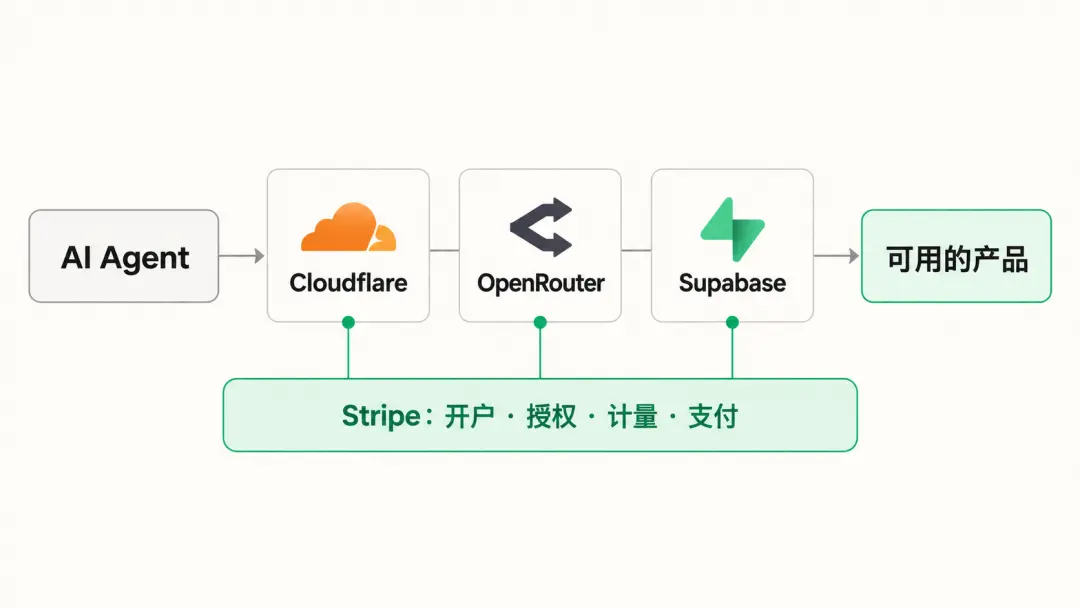
In this demo, we also saw the ecosystem of overseas software. It does not require the Agent to enter a company's closed platform to find all the prepared functions inside, but rather allows it to combine a set of independent services.
Cloudflare provides domain and deployment, OpenRouter provides cross-model access, Supabase provides the database, and Stripe Projects ties together the activation, configuration, and payment of these services. Each company focuses on what it does best, and the Agent stitches them into a complete product based on the task.
Patrick Collison, co-founder and CEO of Stripe, previously mentioned that Stripe Projects was inspired by the way Claude Code works: when an Agent writes a product, it will quickly need external services like logging, hosting, databases, and models. What Stripe aims to do is to allow Agents to directly discover and activate these services.
From idea to public release, Stripe Projects was completed by two or three engineers in about two months, integrating around 50 services during that time. He estimated that in the past, this would have required a larger team and at least six months.
The more common path in China starts from within a super app. Accounts, payments, merchants, content, and life services are originally in the same ecosystem, making it easier for Agents to complete the closed loop from demand to transaction within the platform. The advantage is a shorter link, and users do not need to manage multiple accounts; the downside is that what the Agent can call and how data flows often rely more on the boundaries of a single platform.
This combination overseas is not inherently easier either. Each time an Agent connects to a new service, it introduces a new set of identity, authorization, billing, and risk issues. In the past, developers handled these matters one by one; if an Agent wants to build a product itself, it needs a layer of infrastructure to turn different services into resources that can be discovered, activated, measured, and paid for.
This perspective also provides another angle on Stripe's acquisition of OpenRouter. In the demo, OpenRouter appears to be just a model interface, allowing the Agent to connect without separately accessing different model companies. But for Stripe, it represents one of the most frequent types of consumption during AI product operation: each model call requires a choice between price, speed, reliability, and effectiveness, and incurs a measurable token cost.
If model routing, token measurement, billing, and payment are connected, what Stripe manages is no longer just how to collect money after a product is sold, but also how to choose and purchase model capabilities during the operation of an AI product.
From this perspective, what Stripe wants to do is more like providing a common funding, measurement, and permission system for an open ecosystem, allowing Agents to have a coherent experience even when crossing multiple companies, similar to that within a super app.
The other demo is Meta's personal Agent, Muse. The user asks it to find a round-trip flight from Boston to Dublin, and Muse finds an option for a total price of $470, confirms the passenger information, and then asks the user if they want to complete the booking.
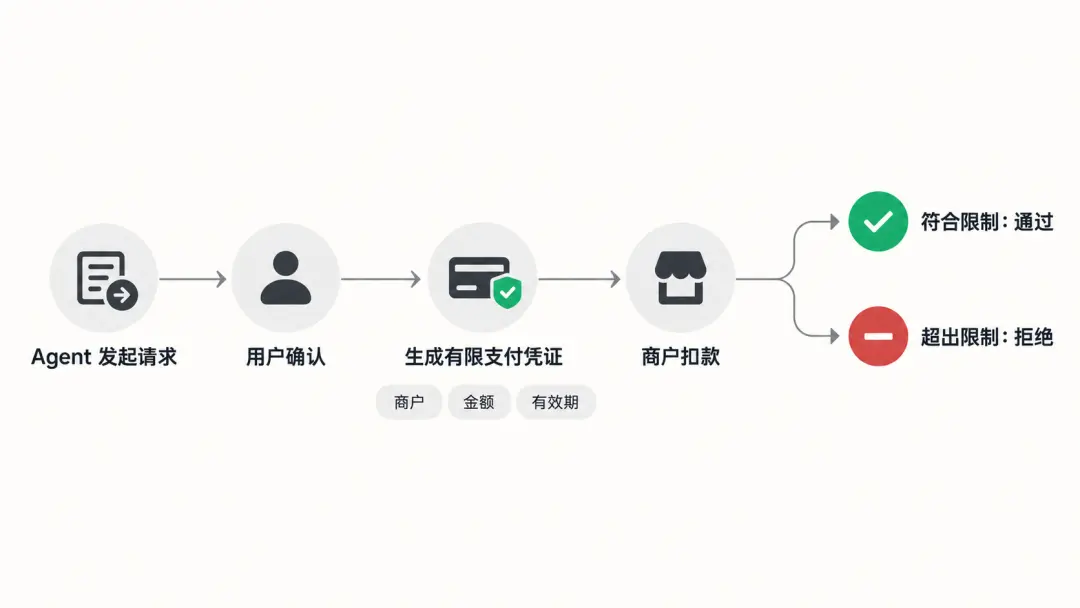
At the payment stage, it does not ask the user to send their credit card number to the AI. Stripe's agent wallet, Link, pops up an authorization page. The user can see the amount, which card is being used, and choose between "Deny" and "Allow." Only after the user approves does the Agent receive the payment credential needed to complete the transaction, ultimately booking the flight.
Putting these two demonstrations together resembles a snapshot of Stripe's vision for the AI economy.
On one side, Agents can build products, call services, and generate revenue; on the other side, Agents can also search for goods on behalf of others, create orders, and initiate payments. What Stripe aims to do is not just add a payment button to chatbots but to integrate Agents from "talking software" into real commercial systems.
If we connect the products, protocols, and demos that Stripe has announced this year, we can see that it has made various attempts in AI payments.
Turning Merchants' Products and Checkout into Interfaces Understandable by Agents
When AI helps people shop, the first problem encountered is not how to swipe a card, but how to accurately know what the merchant is selling.
Humans can open a webpage, view images, filter sizes, understand shipping costs, and then click checkout. If an Agent can only mimic humans finding buttons on a webpage, it can easily select the wrong specifications, read outdated prices, or become invalid after the page updates.
In 2025, Stripe, in collaboration with OpenAI, launched the Agentic Commerce Protocol, or ACP. It transforms product catalogs, inventory, prices, and the checkout process into a set of processes that machines can call. The first public use case at that time was Instant Checkout in ChatGPT.
The importance of this step lies not in "being able to buy things in ChatGPT," but in Stripe starting to turn Checkout from a page meant for humans into a commercial interface that Agents can call.
Stripe also launched the Agentic Commerce Suite, aiming to allow merchants to connect once and face different AI entry points without needing to redo a set of product and checkout systems for ChatGPT, Gemini, Copilot, or the next Agent.
Merchants remain the merchant of record, continuing to control inventory, taxes, delivery, refunds, chargebacks, and customer relationships. The AI platform is responsible for generating demand and bringing in orders, while Stripe is responsible for translating the natural language requests back into the merchant's existing transaction system.
This is also the biggest difference between Stripe and pure AI platforms. OpenAI, Google, and Meta are competing for user entry points; Stripe wants to become the commercial infrastructure that can be used behind all entry points. It does not need to predict which Agent will win; it only needs more and more Agents to start participating in transactions.
Muse follows a similar access path: first operating the website through a browser, allowing merchants that have not yet been specifically adapted to be accessed; then connecting APIs with important partners to make the process faster and more stable. Zuckerberg's judgment is that in the future, businesses will have their own Agents, just as they have websites, email accounts, and social accounts today.
Browser operation solves the question of "can it be used now," while direct interfaces address "can business be done stably in the future." This is also why Stripe wants to transform products, checkout, and payment capabilities into Agent interfaces.
No Need to Trust Agents, Write Restrictions Directly into Payment Credentials
Once Agents can form orders, the next question is: how can they use the user's money?
Traditional online payments often treat "having the correct card number" as an important trust signal. But for Agents, holding a payment credential does not equate to obtaining authorization for the current transaction.
To address this, Stripe created the Shared Payment Token, abbreviated as SPT. It does not give the real card number to the Agent but generates a restricted payment credential. This credential can limit the merchant, amount, currency, and validity period, and can also be revoked. The Agent can use it to make payments but cannot turn it into a card that can be used everywhere.
Stripe demonstrated this intuitively at Sessions 2026: the token limit is $25. When the merchant charges $25, the transaction succeeds; if the amount is changed to $50, Stripe directly rejects it.
This may seem like just a limit feature, but it is actually one of the most critical designs of Agentic Payment.
If the budget is only written in the prompt, it merely requires the Agent to comply; if the limit is written into the payment credential, even if the model makes a wrong judgment or is influenced by malicious instructions, the payment system will not release it.
The large model is responsible for understanding vague intentions, while the payment system is responsible for executing definite rules.
This year, Stripe expanded SPT to include Agentic Tokens for Visa and Mastercard, as well as buy now, pay later options like Affirm and Klarna. What it aims to do is not to recreate a payment network but to authorize Agents from different networks and uniformly translate them into payment credentials that merchants can accept.
Transforming Link from a Quick Payment Tool into an Agent Wallet
SPT solves the problem of "how merchants can safely collect money," but consumers still need a place to manage: which Agents can request payment from me, what I have approved, and how much it ultimately cost.
This is where the Link Agent Wallet comes in.
Agents can first initiate a "spend request" to Link, clearly stating the merchant, amount, and purpose of the purchase. The user reviews it on the webpage or mobile phone, and after approval, Link returns a one-time virtual card or SPT to the Agent. The user's original credit card information will not be exposed to the Agent.
The second demo above is an example; Stripe also showcased a smaller example at Sessions: Claude wrote a letter containing a cold joke to the presenter's daughter and then called PostalForm to mail the PDF. A request for $3.40 popped up on Link's mobile app, and the user saw the merchant and purpose, approved it with Face ID, and the Agent subsequently completed the payment and mailing.
These two examples, one for a flight and one for postage, have different amounts, but the underlying logic is the same:
Users are not handing their wallets over to AI for the long term; instead, they are approving a specific task with context, amount, and recipient.
Every expense from the Link Agent Wallet still requires user confirmation for each transaction, and in the future, there may be rules for increased budgets and exemptions from individual approvals. By September, Muse, Grok Bot, and Instinct were already using the Link Agent Wallet. The Agentic purchases completed through Link also grew 38 times within a month.
The growth is rapid, but I think the absolute transaction volume is still in its early stages; however, this remains a direction worth "fantasizing" about.
From the Demo of Muse to actually starting to use Muse
When I saw this Demo during the Stripe Tour, I had not yet used Muse. I recently started using Muse to help me create short videos and plan my trip to the United States, and the entire process was quite smooth. It doesn't just give me a few suggestions; it can remember previous requests and continue to search for and organize subsequent arrangements. The Personal Agent may really become a new entry point for consumption.
Meta's commercialization vision for Muse has also become clearer. Zuckerberg mentioned that the basic version of Muse will strive to remain free, while Muse Wonder will charge through subscriptions. Looking further ahead, when Muse helps users save money, earn money, or complete transactions, Meta hopes to take a small portion of the value it creates.
Zuckerberg also gave a very specific example: he used to hardly use Instacart, but to allow Muse to purchase ingredients for cooking based on conversations, he specifically registered an account, and now he uses it once or twice a week. He suggested that the Agent brings not only higher conversion rates but also potentially creates transactions that would not have occurred otherwise. In the future, account relationships may no longer belong solely to people; Agents may gradually have their own accounts.
Of course, wanting to make money from transactions does not mean that this business is easy to establish.
If merchants pay commissions, Muse must answer a very practical question: does it recommend a certain hotel or product because it is the best fit for the user, or because the commission from the other party is higher? If it charges users, it must prove that the time and money it saves are indeed worth the extra fee. Furthermore, there are issues like wrong purchases, price changes, cancellations, refunds, and after-sales service; any mishandling of these aspects will consume users' trust in the Agent.
It is also important to distinguish that Muse and Stripe are not competing for the same money. Muse is closer to a transaction entry point, hoping to gain subscription or transaction revenue from "helping users get things done"; Stripe provides payment credentials, authorization, card issuing, risk control, and transaction processing, earning money from infrastructure.
However, for Stripe, this is still a very different opportunity. The acquiring business is already handling consumer payments, and Link has long directly saved consumers' payment methods. In the past, Stripe's relationship with consumers occurred more on a merchant's checkout page: users completed payments, and Stripe helped merchants collect the money.
The Agent Wallet has pushed this relationship forward. Stripe is now directly managing the connection between consumers and Agents: which Agents I allow to request payments, what can be purchased this time, how much it costs, whether further confirmation is needed, and whether there is protection against wrong purchases. The change is that it is moving from processing a consumer payment to further participating in how consumers delegate payment authority to Agents.
If the Personal Agent truly becomes the entry point for people to search, compare, and purchase services, Stripe may not even need to create the most popular Agent itself. It just needs to become the wallet that different Agents are willing to connect to and that consumers are willing to trust, transitioning from being the payment processor behind merchant checkouts to becoming the infrastructure that consumers authorize Agents to spend money with.
This path is certainly challenging; handling merchant-initiated collections and continuously managing consumer authorization for Agents is not the same product relationship. The latter also has to face issues of brand, experience, privacy, and user trust that can change daily. But precisely because Stripe is moving from "completing this payment" to "managing who can pay for me," once the Link Agent Wallet truly occupies the payment entry of the Personal Agent, the imaginative space it brings will be much larger than just adding another payment product.
Allowing Machines to Directly Purchase APIs, Data, and Services
When consumers let Agents buy plane tickets, it still involves a familiar e-commerce transaction. But Agents will also consume themselves.
They may temporarily need a weather data report, an image generation, a model inference, an identity verification, or to call upon capabilities provided by another Agent. These transactions often only cost a few cents or a few dollars and occur very frequently.
The traditional API purchasing process is not friendly to machines; it typically requires account registration, API Key application, monthly plan selection, and card binding, which usually need human intervention. An Agent that only wants to query data once should not have to buy a whole year's subscription first.
Stripe, in collaboration with Tempo, launched the Machine Payments Protocol, or MPP. It utilizes HTTP 402 "Payment Required" to let services inform Agents in the same request: this resource requires payment, what the price is, and how it can be paid. The Agent completes the payment based on existing authorization and then receives the result.
One Agent creates and deploys an API service, while another Agent uses MPP and Link to pay $2 for a one-time code review. In another demonstration, an Agent purchases weather data for a very small amount. Payment methods can be through a bank card handled by SPT or stablecoins.
This line and "AI helping me shop" are actually two different businesses.
The former involves Agents consuming on behalf of people, focusing on user identity, authorization, after-sales service, and responsibility; the latter involves software purchasing resources to complete tasks, focusing on programmability, micropayments, observability, and automatic reconciliation.
Stripe is pursuing both lines because it judges that in the future, Agents will not only be new shopping entry points but will also become new enterprise clients and software buyers.
Patrick Collison listed very specific next questions: how Agents register and use Stripe, whether MCP is sufficient, how Stripe CLI should adapt, and how Agents pay each other and what currency to use. His judgment is that within the next three years, based on transaction volume, most parties in transactions may be Agents. This does not mean that Agents will occupy most transaction amounts; it is more likely that there will be a large number of small Agent-to-Agent payments.
This will transform payments from a single purchasing action into a fundamental protocol in the collaborative process of Agents. An Agent may continuously call models, data, software, and other Agents to complete tasks; behind each call, identity, authorization, billing, and settlement will be required.
Not Just Making Agents Pay, But Also Handling What Happens When Errors Occur
Real transactions do not end with payment.
Airline ticket prices may increase due to baggage fees at the last step; bank cards may trigger 3D Secure; products may be out of stock; Agents may purchase the wrong size; users may request returns; merchants must also determine whether this is a trustworthy Agent or an automated attack masquerading as an Agent.
The recent updates to the Link Agent Wallet have begun to bring these issues to the forefront.
If the final price increases due to taxes, shipping fees, or additional services, Agents can request to raise the authorized amount instead of reordering and freezing another amount of money. If payment requires additional verification, Link can provide Agents with a link to take users back to the 3D Secure or identity verification process. If the original card is declined, Agents can also ask users to switch cards and re-initiate the spending request.
At the same time, it has also started allowing Agents, with user permission, to read consumption records to determine frequently visited merchants, budgets, and product preferences. This will help personal assistants understand users better, but it will also introduce new questions: how much financial data should a shopping Agent see? Can it use past consumption habits to influence future choices? Do users truly understand what they have opened up?
More importantly, there is purchase protection; eligible Link Agent transactions already cover situations like accidental damage, item loss, price drops, and fee-free returns, with Muse being the first Agent to access this protection.
This indicates that the real competition in Agentic Payment is no longer just "who can make AI spend the first dollar," but rather "who is responsible when AI makes a wrong purchase."
The most difficult aspect of the payment industry to replicate has never just been a payment button, but the authorization, risk control, refunds, disputes, and responsibility allocation behind the payment.
What Stripe Is Really Competing For Are Four Interfaces
Looking back at Stripe's attempts over the past year, they can roughly be categorized into four areas:
• How Agents discover and understand products;
• How merchants receive orders from Agents;
• How users safely delegate part of their payment authority to Agents;
• How machines directly purchase APIs, data, and computing resources.
ACP and the Agentic Commerce Suite address the first two issues, SPT and Link Agent Wallet tackle the third issue, and MPP addresses the fourth issue. Radar, Checkout, Issuing, Financial Connections, and Stripe's existing refund and dispute systems reconnect these new entry points back to the traditional payment world.
Putting these together completes this picture from both ends. Zuckerberg judges that Agents will gradually have their own accounts and create new consumption; Patrick judges that the parties in a large number of transactions may ultimately be Agents. The former describes where new demands come from, while the latter raises what payment systems will face. They are currently both directional judgments rather than established market facts, but they also explain why Stripe is simultaneously laying out merchant interfaces, personal authorizations, and machine payments.
Stripe does not just want AI to use Stripe; it wants any AI platform entering transactions to go through the layer that Stripe is already good at: turning a vague purchasing intention into a transaction that merchants are willing to accept, users can revoke, and systems can hold accountable.
━
But we are not yet in the mature stage of "AI can spend money on its own."
Currently, Agents can not only generate shopping lists, create orders, or take people to the checkout. They can indeed obtain restricted credentials after user approval and continue executing subsequent transactions.
However, this is still far from "AI can autonomously manage users' money."
Today, most public cases still rely on individual confirmations, and exemption from confirmation budgets remain in the planning stage rather than being a default capability. Cross-platform refunds, duplicate orders, identity impersonation, and responsibility determination have not been thoroughly resolved.
Therefore, perhaps 2026 can be called the inaugural year of the protocols and infrastructure for Agentic Payment. The changes happening now indicate that Agents have entered transaction decision-making and begun to engage with payment credentials; payment companies are rewriting the inherent trust from the human world into rules that machines can execute.
The future of mature Agentic Payment is unlikely to be "give AI a card and let it run wild."
It is more likely to be something else: users first define goals and boundaries, the Agent is responsible for searching, comparing, and executing, while wallets and payment networks are responsible for checking the amount, merchant, time, and purpose at the last moment; if an error occurs, there are clear refund, dispute, and liability chains.
On the big screen in Shanghai, this just looks like a smooth flight booking,
but what Stripe really wants to sell is why this transaction can be confidently approved.
The content of this article is solely personal observations and thoughts and does not constitute any investment or business advice. Readers are encouraged to rationally reference their own understanding and information sources.
 Risk warning