CZ talks about stress resistance, adaptability, and lifelong motivation: Personnel leave it to fate, just do your best and you will win effortlessly
 Core Viewpoint

 Binance founder CZ attended the Demo Day event of the fourth season EASY Residency hosted by YZi Labs in Thimphu, the capital of Bhutan, this week, which is a concentrated showcase of its incubation projects. At the same time, YZi Labs is looking for founders in four core areas: programmable capital and on-chain markets, AI infrastructure and computing economy, AI interfaces and consumer layers, as well as AI × biology and programmable science. During the event, CZ appeared on the podcast "Meanders," where he discussed the pressures, adaptability, and lifelong motivation in the crypto field. CZ stated that this year has not been a good year for the crypto industry, and company performance may decline, but they have done their best and have not been lazy. CZ also expressed that he still believes in the value of Bitcoin, but payments and on-chain rights confirmation have not reached the early expectations, and RWA and stablecoins are concepts he understood later.
Original source: “Meanders” podcast
Original compilation: BlockBeats
TL;DR:
Casual chat about Bhutan, CZ says he no longer considers himself the busiest, but replies to messages as soon as he sees them; regardless of progress, he only keeps those who push themselves forward, focusing on three to five things he needs to do. If he were to redo a global trading platform: from day one, he would avoid U.S. users; contracts and financial products would be launched earlier and more comprehensively, while blocking certain regions. The feelings during that time are not clearly expressed in the book “Binance Life.” The two most stressful periods: the ICO launch crash and the more than ten months stuck in the U.S. — the real pressure comes from uncertainty. Coping with pressure relies on separating tasks, not setting wealth goals, and believing in simulation theory: do your best and leave the rest to fate. Founders often underestimate difficulties and must be adaptable and passionate; diligence for peace of mind can be avoided. He still believes Bitcoin has value, but payments and on-chain rights confirmation have not reached early expectations; RWA and stablecoins are concepts he understood later. He continues to work because helping others brings him joy — the Gogo Academy has grown from over 100,000 children at the beginning of the year to about 1.2 million now.
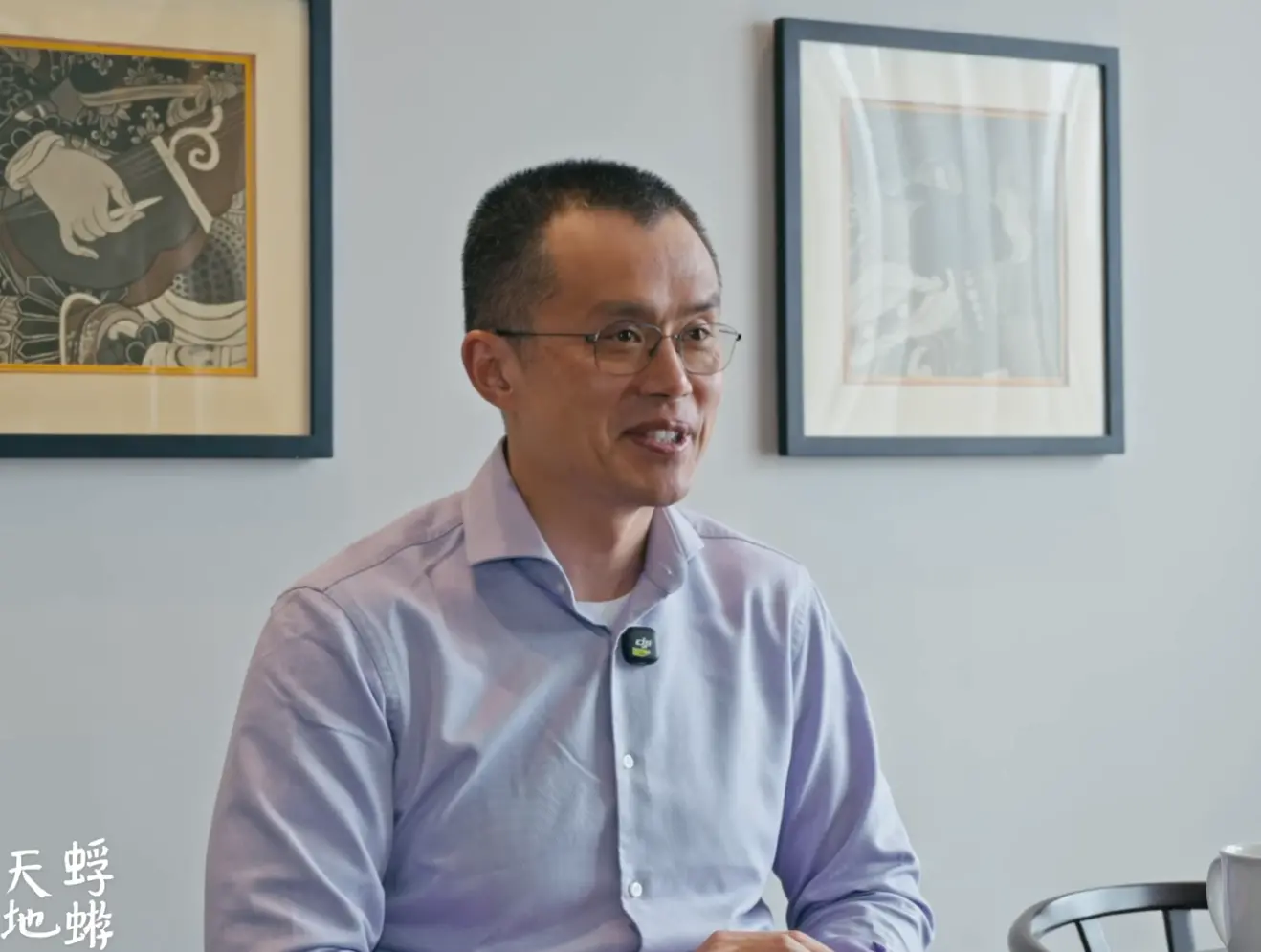
CZ appeared on the “Meanders” podcast, discussing stress management, adaptability, and lifelong motivation. The full conversation between host Han Yang and CZ is as follows:
Busy or Not, How to Reply to Messages, How to Manage
Han Yang: I have a small question, are you tired right now?
CZ: Not really, just a little bit, but it's okay.
Han Yang: Do you think you are one of the busiest people in the world?
CZ: No, I definitely am not. I think a few years ago I might have been considered one of the busier ones, but I shouldn't be that busy these past two years.
Han Yang: It’s been three years since I met you. No matter what time I message you, you can always reply, which makes me feel like you don’t have a time zone.
CZ: I reply as soon as I see the message. If I see a message and don’t reply, I’ll forget later. After meetings, I might take a few minutes to check and reply to messages. I do this in the morning when I wake up and before I go to bed at night. I’ll check when chatting with friends for a bit. But if I’m doing something serious, I won’t check. If your message is quick to reply, I’ll respond first, otherwise, I’ll forget.
Han Yang: Do you think you can reply to 500 messages in a day?
CZ: Yes, absolutely, definitely more than that. Sometimes right after I reply to one message, I have to scroll down for a long time to find a previous message I replied to. I can reply to many messages within a few minutes.
Han Yang: I can imagine you must be handling a lot of things at the same time. How do you ensure your mind can keep up with everything? Like, where is each task at?
CZ: I still have a lot of miscellaneous tasks now, and as CEO, there are many miscellaneous things, so I don’t track them very well. When someone comes to me, I tell them what to do, but I generally won’t follow up proactively after a day or a week. I usually don’t do that. So I need the people I work with to be very proactive; they need to push you forward. If we need to have another meeting tomorrow or the day after, they need to schedule it, not me going to find them tomorrow. If anyone works with me, I need to ask them about the project’s progress; I generally won’t keep that person. And usually, in such cases, the project has some issues. So I hope this person has updates tomorrow or in a week, and they message me, then I’ll remember. I need very self-motivated people, proactive people. The people around me are quite proactive. Additionally, it’s very important for me: you can remember three to five important things in your mind, but those three to five things are what I need to do, and the rest are what they need to do, and they need to report to me proactively.
If You Were to Redo a Global Trading Platform with Today's Experience
Han Yang: Speaking of three to five things, my second question is related to this. I previously wrote about Binance and checked a lot of your public statements. What impressed me deeply is that around 2017-2018, you emphasized that the main idea for Binance was to become a faster, more user-friendly, and safer company. But looking at your statements in 2025, especially this year, you emphasize that you might have underestimated legal, compliance, and political aspects to some extent back then. Assuming today you could take all your current experience back to 2017 and restart a global crypto trading platform, what constitutional rules or absolutely unshakeable principles would you set for yourself?
CZ: Looking back from hindsight, it’s clearer. I think the first rule would be: avoid U.S. users. From day one, avoid U.S. users. Their definition of centralized financial platforms is: if you touch U.S. users, you need to be subject to U.S. regulation and need to obtain a license in the U.S. They don’t implement this 100% of the time, but they have the right and ability to do so. Additionally, looking back now, in some places, we still didn’t execute quickly enough. Yesterday someone asked me online, aren’t these two conflicting? Should you be more careful or faster? If I could look back with today’s experience, some things I wouldn’t hesitate on, and some things I wouldn’t do.
Han Yang: Can you give an example? What would you not hesitate on if you could do it again?
CZ: Many small product features. I might launch contracts a bit earlier. Even some other financial products might be launched earlier, and the coverage of financial products would be broader. But I would block certain regions entirely. Additionally, communication with regulators might be done more thoroughly. First, I’m not good at this, and second, we’re not in one country; we need to communicate with over 100 countries, which is hard to manage. So we might do more in this area.
Han Yang: But from a third-party perspective, Binance is already one of the trading platforms that communicates the most with regulators.
CZ: Binance definitely is the most, even without a doubt.
Han Yang: But you still feel it’s not enough?
CZ: The coverage is still a bit lacking. And if you really want to do this, the cost is very high. It’s not just a matter of money; you need to hire good people, spend a lot of time, and manage this well. When you hire a lot of people to do this, the CEO of the company might spend a lot of time overseeing this. These are all costs. If you do this, you might have fewer products. Because Binance covers the globe, there are many countries to communicate with. Most companies only need to deal with one regulatory body. The expectation from regulators is: most traditional companies spend 30% of their time on me, and they expect you to spend 30% of your time on them. But if you have to spend 30% of your time on over 100 of these, it’s very difficult. So it’s not just about adding people. You can’t expect everyone in every place to act independently; they still need to report up, and many decisions need to be made, so senior management will spend a lot of time on this. There might be other ways to do this better.
Things That Were Hard to Express When Writing “Binance Life”
Han Yang: I had a particularly strong feeling when I read your “Binance Life.” Sometimes when writing about past events, you can get into a feeling of not knowing how to express it. Some things are too complex to explain to others. Is there anything that you now see as particularly important from back then, which people today might underestimate, but as the author, you find it hard to convey to readers?
CZ: I definitely have that feeling. Sometimes, the feelings at that time cannot be expressed. For example, in 2019, there was a time when we were hacked, and we couldn’t withdraw funds for an entire week, but trading continued, and the whole system was upgrading. I basically didn’t sleep for those seven days; I slept a little here and there, and the engineers basically didn’t sleep for seven to five days. The pressure during that time, I feel, is not clearly expressed in the book. Also, with a few law enforcement agencies from certain countries. Some law enforcement agencies are very unreasonable, and some are even illegal. They used public funds to trade, lost money, and wanted us to compensate. The communication pressure is very high. Some of these are described in the book, but some are not in the book for various reasons and cannot be included yet. So writing a book always has many things that can’t be included. The things that are included sometimes can’t be described comprehensively. But that’s just how it is.
Han Yang: Your answer is very interesting to me. I understand that your answer might be about a specific thing that is underestimated, but listening to it, you seem to feel a certain regret that the feelings of that moment are hard to express in words.
CZ: Yes. I feel my expressive ability is not that strong, and my writing skills are also limited, so many of those internal pressures or thoughts at that time are generally not clearly expressed in the book. I wrote this book in relatively simple language because my proficiency in Chinese and English is limited, so I described what happened in very simple terms. At the same time, I also didn’t want to spend too much effort on describing how I felt. I just wanted the readers to read and feel what it might have been like at that time.
The Two Most Stressful Periods
Han Yang: After everything you’ve been through, looking back at all those events, which one do you think truly caused you the most stress?
CZ: I think there are probably two, which is quite simple. One is the ICO. After our ICO, when trading opened, the price dropped. The pressure during those two weeks was very high. Then it was dealing with the situation in the U.S. I was basically stuck there for over ten months. They told me at the time that when I came, I would have to wait six months and then sit in jail for four months. If it were 100% certain, you would know what was going on. When I went, I felt the chance of going to jail was very small because no one has ever gone to jail for violating the U.S. Bank Secrecy Act just once; I was the only one. We didn’t commit fraud, and no users were harmed. So I thought I might be under house arrest in the U.S. for a few months. Being under house arrest is very simple for me because I don’t like going out; as long as I can go online at home, that’s fine. The most stressful part during that time in the U.S. was the uncertainty. I wasn’t sure if they would eventually let me go, or if they would keep adding more things, just continuously messing with you. The pressure from that uncertainty was very high.
Han Yang: So it sounds like you didn’t sleep well?
CZ: I usually sleep well. I haven’t been sleeping well these past couple of days, but I generally sleep well in phases. About 80% of the time, my sleep is still good. I usually sleep about six hours at night, and I take a nap during the day for about half an hour to an hour, so that adds up to six or seven, or seven to eight hours. I rarely get eight hours; usually, I get about seven.
How CZ Copes with Pressure
Han Yang: Before I met you for the first time, I had already written an article about Binance. Many friends asked me what questions to ask you if I met CZ. The vast majority wanted me to ask: as a founder of a company that has grown so quickly, you must experience tremendous changes in a short time and face a lot of pressure. They want to know how you handle this pressure and transition.
CZ: First, in the early years, I did sleep a bit less and it was more fragmented. Sometimes I would sleep three to four hours at night, and the pressure would be greater then. But I’ve always had a habit of taking naps; if I sleep for half an hour during the day, I feel much more awake. Additionally, regarding this pressure, I don’t know how I developed this personality, but I am a very resilient person. I’ve been like this since I was young.
For example, when my parents argued at home, my sister and I would see them fighting, and both of them might not be in a good mood. When we went to school together, my parents’ arguments would affect my sister’s mood at school. When I got to school, my friends wouldn’t notice that I was in a bad mood; they wouldn’t realize my parents were arguing. My sister’s friends would ask her why she was in a bad mood. So I would isolate that and separate the two issues. When I handle company matters, many people have told me: the first meeting might be dealing with a very high-pressure situation, like how to negotiate with U.S. lawyers, how to litigate, how to handle this U.S. case; the next meeting might be a product meeting. Maybe one or two people attended both meetings, and they would say, wow, how are you so calm in the product meeting? For me, they are just two different matters. There is still pressure, and I can definitely feel it, but I generally separate these matters quite well.
Secondly, in terms of resilience, my worldview has always been like this. I rarely set goals for myself. I don’t say I must rank a certain number, must have a certain amount of money, must earn a certain amount, or must grow by a certain percentage each year. I generally don’t set those goals. I just do my best. If the market is bad this year, the company’s performance might decline, but I did my best; I didn’t slack off, and I didn’t make major mistakes. I handle problems the same way. No matter how difficult the problem is, I just try my best to deal with it.
I mentioned in my book that I believe in simulation theory; I believe this world is simulated, so it’s like a game. It’s simulated, but that doesn’t mean this game isn’t important. But in this game, I just need to do my best; what else can I do? When I encounter difficult problems, I try my best to solve them; when I encounter simple problems, I also try my best to solve them. As long as I’ve done my best, whatever the consequences of the difficult problem, I leave it to fate. Once I have this mindset, the pressure is greatly reduced. There is still pressure, but I just accept my fate. Whatever happens later, happens. You do your best to handle it, and after handling it, you can only wait and let it play out.
Things Founders Often Underestimate, and Whether Effort is Truly Useful
Han Yang: How’s your gastrointestinal health?
CZ: My gastrointestinal health is pretty good. My intestines can be a bit off sometimes, but my stomach is fine.
Han Yang: We are quite similar. Sometimes if I eat raw fish or something that isn’t particularly fresh, my intestines can be a bit off, but my stomach is fine. Because I’m increasingly discovering that the more excellent founders you talk to, the more you realize that resilience is a particularly important prerequisite. People usually talk about entrepreneurship in terms of PMF and growth, but many overlook the founder’s resilience. In fact, I think in entrepreneurship, product, technology, or IQ, or EQ, these are all easily seen. But many times, they don’t mention resilience. I think for any successful founder, they have to bear a lot of pressure. As a founder, I want to ask a question about founders. You are now investing and must meet many founders; you are also an excellent founder. What do you think are the things a founder should know — including what you should have known when you first started — but perhaps those who haven’t succeeded particularly well, who haven’t gone through this journey, can’t imagine?
CZ: Most people underestimate the difficulty of doing something. Most people starting a business often think that an ordinary case is actually a good case. Ninety percent of startups fail, but as a founder, they tend to be more optimistic. I think the first is being optimistic, the second is resilience, and the third is adaptability. Some people are very smart, but sometimes they can’t adapt. They may have high IQs, but their ability to change is very weak; they need a structure, and that structure is hard to change. But in entrepreneurship, you not only need to be smart, but you also need to be able to adapt, accept change, and adjust at any time. Additionally, founders need to love what they are doing. Without that passion, it’s hard to persist. This work is too exhausting; all entrepreneurship is exhausting.
Han Yang: You also mentioned that you need to do your best at work. How do you ensure that when you were doing Binance, some things you worked on — there’s a saying that goes, don’t use tactical diligence to cover up strategic laziness — how do you ensure that what you are doing is useful on a macro level, or are there things that just give you peace of mind, making you feel like you are working hard?
CZ: Anytime you feel that something is just for your own peace of mind, you don’t need to do it. What you do must have meaning. If at any time you feel that this is just something you did to make yourself happy, then you basically don’t need to do it. You might as well do nothing and take a break. Sometimes when you’re very tired, you can take a break. This isn’t being lazy. If you don’t take a break, you can’t go further. As an entrepreneur, there’s no need to deceive yourself. Most investors won’t watch how many hours you work, etc. So this is entirely self-management. Most entrepreneurs don’t need external forces to push them. From my perspective, if I have nothing to do, I just listen to audiobooks. I generally don’t listen to music. Sometimes I can take a break.
Han Yang: Do you watch short videos now?
CZ: Occasionally, but not too much. One advantage I have is that when I scroll through them, I find them boring. Because the current recommendation algorithms are too uniform; after watching three or four videos, they are all the same, and I lose interest.
The “Consensus” in the Crypto World Today
Han Yang: Let me ask a blockchain question. Back then, many pioneers in the blockchain and crypto world had various imaginations about the entire blockchain world, some of which have been realized, and some have not. One term that people often mention is consensus. My own feeling is that the consensus about consensus has changed significantly over the past ten years. What do you think today, especially for you, when we mention consensus regarding the crypto world and blockchain, what does that consensus refer to? What do you still believe in? What do you think we are still not doing well enough?
CZ: The term consensus has a special definition in blockchain: blockchain is the first technology that allows a group of people to maintain a ledger together without trusting each other. So that is a form of consensus. Additionally, regarding some industry consensus, I think some have been reached, and some have not. The core consensus that has been reached is: Bitcoin has not disappeared. Bitcoin has value. Whether it is currency or commodity, that is labeled by others; each country can label it differently, but it is something of value, it has utility, it has worth.
Moreover, the industry has been growing. This is a new technology for money. So from the most fundamental aspect, there’s no problem. Some consensus has not occurred. For example, payments are still very small. It hasn’t completely failed to happen, but it hasn’t reached our expectations: about ten years later, it should be everywhere. This is also because the current payment systems in most countries are still quite good; most people don’t do cross-border payments. The people doing cross-border payments are slowly growing. Additionally, some things have not been realized. For example, because this is a consensus mechanism, should government real estate certification use blockchain? Using blockchain would make it much easier. Anything that needs certification can be blockchainized. This area seems to have not been implemented very much so far. It doesn’t mean it can’t be realized in the future; it’s just that the current implementation progress isn’t very much.
As for blockchain itself, I think the performance improvements, etc., are still too slow. Creating a new blockchain and upgrading new technology on Bitcoin is quite difficult. Because once you upgrade Bitcoin, community voting could lead to forks, etc., so Bitcoin upgrades are relatively slow. But because it upgrades slowly, it is particularly stable, which is also an advantage. So there are advantages and disadvantages. In many of our early ideas, many have been realized, and many have not. But the entire industry is still developing continuously, and many things we can’t even imagine are happening. The RWA thing, even a year and a half ago, I would have doubted whether RWA could succeed, but now it’s growing rapidly.
To be honest, I might have doubted stablecoins five years ago, wondering how long they could last; at that time, I didn’t fully understand them. Stablecoins have their uses. So these few things are things we didn’t think of before. I didn’t think of them before.
Who is Underestimated Outside the Industry
Han Yang: Because whenever blockchain is mentioned, several names come up, like you, like Vitalik, and others. In your view, including when you were writing your book, did you think of many people who are underestimated by those outside the industry? For example, someone who is very important to this industry but is unknown outside of it. Or are there any events like this?
CZ: Yes. I haven’t thought about this question in detail, but there are definitely many. There are many technical people who were once very active but have become less so over time. Especially the core Bitcoin developers. Initially, there were about ten people who had direct email interactions with Satoshi Nakamoto. Among them, several have launched projects, some successfully and some not so much, but several have gradually stepped back. These people have made many contributions. Additionally, many entrepreneurs may have started early and contributed significantly to the industry, but their companies were sold or transferred. For example, there was a young man from Blockchain.info who created the largest Bitcoin traffic website at the time, which was also a wallet and very popular. This young man was called Ben Reeves. Later, he was a very introverted person, so he gradually sold the company and stepped back. He is British and has become quite quiet. I estimate that if we really dig, we could find hundreds of such people.
Reasons for Continuing to Work
Han Yang: I have one last question. What do you think continues to motivate you to work today? Because you could completely stop working, but you are clearly not one of the busiest people, yet you are still a very busy person. What makes you happy?
CZ: I think it’s just about living; we definitely need to seek happiness. We could play golf all day or spend all day at the beach, but those things can become boring. Occasionally doing them might make you happy, but you can’t do them 100% of the time and expect to be particularly happy. In my understanding, any animal that can help its kind will feel happy. Our genes are designed this way. If we don’t help our kind, the overall fighting power of the species becomes weak and may be naturally eliminated. So our genes are naturally selected: when we can take care of ourselves and can take care of our kind, we take care of others, and at that moment, we will feel a very happy feeling inside. Whether others say thank you or not, you don’t have to care. At least for me, that’s how I see it. So our genes are designed this way; it’s a very fundamental thing. And how do you utilize this? For me, if I do something that I feel helps many people, I will feel happier. This has little to do with making money or fame. I feel that if I’ve done this, I’m happy.
Just like why I still spend a lot of time on this free education platform, Gogo Academy. Every time I have a meeting with them, I feel happy. When I hear that we are now teaching 1.2 million children, and at the beginning of the year there were only over 100,000 children, when I hear that number and look at the app, I feel very happy. So why do I still do it? Just because it makes me happy. What else makes me happy? I enjoy good food, but I can’t eat too much; I’ve already gained too much weight. There are many things you can do, but doing things that contribute positively to society and humanity is basically limitless. The only limits are my energy and time. So I just do my best; I’ll do as much as I can with the time I have.
Han Yang: Is your back feeling better now?
CZ: My back is much better now. I’ve had two surgeries, two minor surgeries for a herniated disc. It took about two years for me to slowly recover and rehabilitate. I still feel discomfort in my back if I sit for too long, and I still feel my back is relatively weak when I move; it’s weaker than normal people. But I’ve recovered to a point where I can go skiing, I can go kitesurfing, and I can sit here for one or two hours for an interview. But most of the time when I work from home, I lie in bed while making phone calls in the morning, using a small stand to hold the computer on my lap.
Fixed Ending of the Program: Which Building to Leave Behind
Han Yang: At the end of all our interviews, we ask the same question: if you could choose one building in the world to model and leave behind forever, which building would you choose? This isn’t limited to your own; you can choose freely. Many people choose their own room, their school, and so on.
CZ: I’m not an expert on this. I think many buildings have significant modeling meaning, but from my perspective, the older they are, the more meaningful they are for modeling because the older they are, the more likely they are to deteriorate. Like the Acropolis of Athens in Greece, and Machu Picchu in Peru, which I haven’t visited. I’ve seen the one in Greece. Then there’s the Taj Mahal in India, which they say is one of the Seven Wonders of the World. I think these are all significant, but these things have already been modeled by many people. But I think the quality of your modeling is quite high; it’s fine to model them a few more times. Just like we are in Bhutan now, the buildings you see outside are very culturally rich, and there are many old buildings, which I think are quite good. So I think I’m not an expert on this; I’m just saying it casually.
Han Yang: Okay, thank you.
CZ: Thank you.

 Risk warning