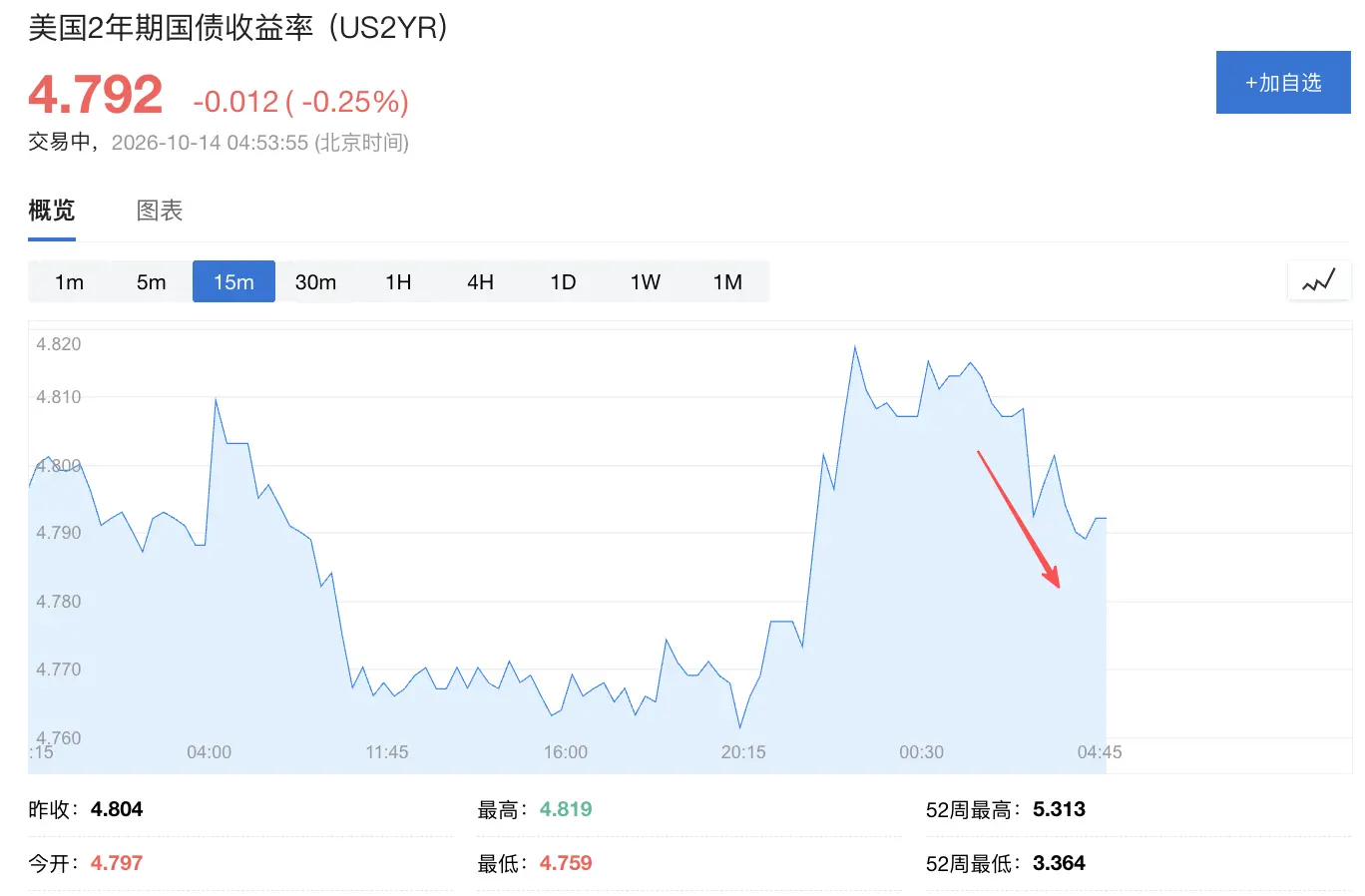
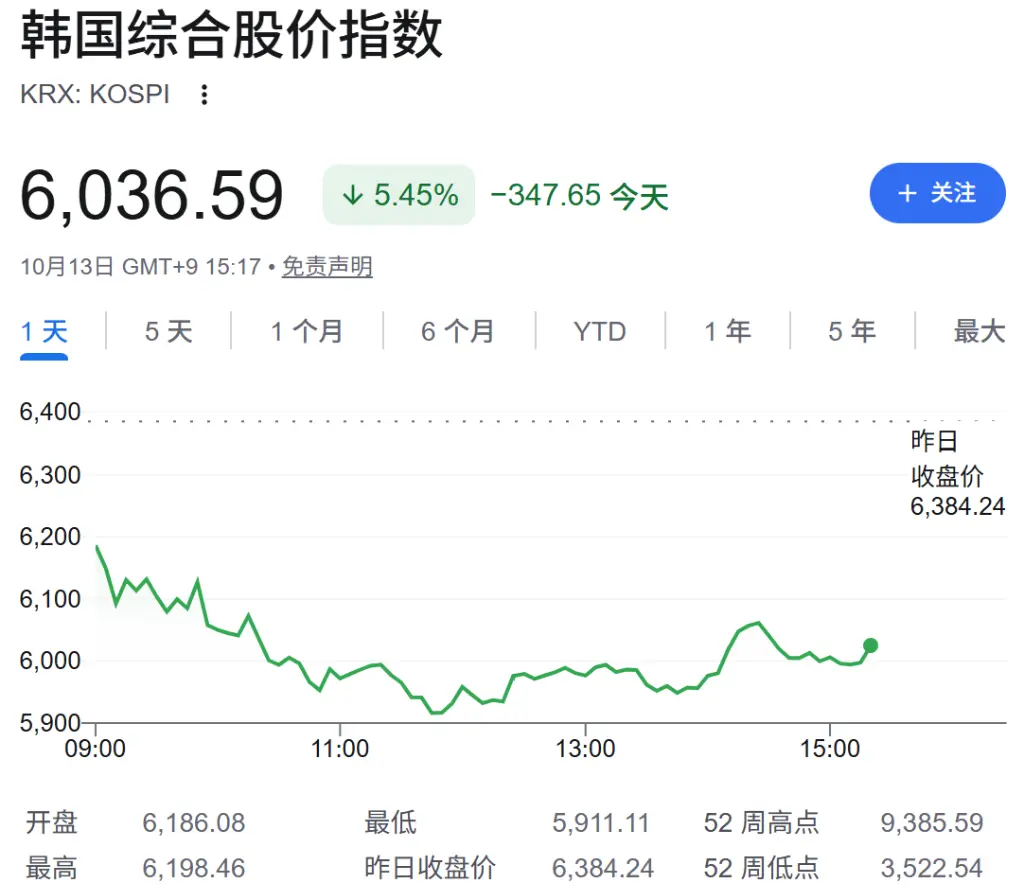
Morning Report | BlackRock has overweighted short-term U.S. Treasuries for the first time in six years and downgraded its rating on U.S. stocks; Wintermute: Bitcoin has lost support from capital inflows, and a cautious outlook on altcoins is advised in the short term

 October 13 Market Important Events Overview
Compiled by: ChainCatcher
What important events have occurred in the past 24 hours?
BlackRock Overweights Short-Term U.S. Treasuries for the First Time in Six Years, Downgrades U.S. Stock Rating
According to ChainCatcher, BlackRock Investment Institute, the largest asset management company in the world, has adjusted its U.S. asset allocation, ending its underweight position on U.S. Treasuries that has lasted nearly six years. The institution has upgraded its rating on short-term U.S. Treasuries to overweight, while upgrading long-term U.S. Treasuries from underweight to neutral. At the same time, it has downgraded its ratings on U.S. stocks and U.S. agency mortgage-backed securities (MBS) from overweight to neutral. BlackRock strategists stated that current U.S. Treasury yields have risen to attractive levels, and the interest rate swap market's expectation of the Federal Reserve raising rates at least three times in the next 12 months, each by 25 basis points, may be excessive. The downgrade of the U.S. stock rating is mainly to address potential market volatility brought about by infrastructure construction related to artificial intelligence and the recent risk of rising financing costs, but the institution still holds a constructive view on the long-term investment prospects in AI-related fields. Additionally, BlackRock has also reduced its underweight position in Japanese government bonds.
Wintermute: Bitcoin Loses Support from Capital Inflows, Cautious Outlook on Altcoins in the Short Term
According to ChainCatcher, Wintermute stated that the Federal Reserve's meeting minutes show that most officials expect to raise rates again within the year, with the market pricing the probability of a rate hike at the end of October at about 20%. The yield on the U.S. 10-year Treasury has risen to 5.24%. Against this backdrop, the S&P 500 index rose 1.2% last week, reaching a new all-time high, while the cryptocurrency market performed weakly. The rise in U.S. stocks was supported by expectations of corporate earnings growth, while the cryptocurrency market lacks similar earnings support and relies more on new capital inflows. With the reversal of capital flows, the previous six-week upward momentum in crypto assets is difficult to sustain. Bitcoin fell from around $86,000 to $87,000 last week, dropping to about $80,400 on Thursday before rebounding above $83,000 and re-entering the $82,500 range high. The U.S. spot Bitcoin ETF saw a net outflow of about $679 million last week, the largest single-week outflow since late June, while the Ethereum ETF had a net outflow of about $542 million. The cryptocurrency market has lost support from capital inflows, while U.S. stocks still have earnings growth as a cushion. Therefore, in the short term, the market will only be optimistic if long-term Treasury yields stabilize and spot ETF funds return to net inflows. Before these two conditions are met, Bitcoin remains an asset more sensitive to fluctuations in U.S. stocks, with higher downside risks, and it is not recommended to chase low-quality altcoins. If the 30-year Treasury yield breaks above the 5.64% reached on September 30, or if Bitcoin continues to face resistance around $82,500, Wintermute will adopt a cautious stance. This week, attention should be focused on the U.S. September CPI data to assess whether energy inflation is spreading to core inflation, as well as the financial performance of institutions and AI-related companies.
TD Cowen: CFTC's Cryptocurrency Regulatory Framework May Not Be Completed Before 2028
According to ChainCatcher, Jaret Seiberg, Managing Director of the Washington Research Group at investment bank TD Cowen, stated in a report released on Monday that the proposed rulemaking notice issued by the CFTC last week is a positive step for cryptocurrency platforms, but the agency may not complete the rulemaking until early 2028. As the 2028 election cycle approaches, there is a risk that the rule may ultimately not be implemented. Seiberg noted that "time is running out," and it is expected that the CFTC will not release proposals until the end of the first quarter or early second quarter of 2027, with final rules possibly not being finalized until early 2028. Last week, the CFTC proposed a federal regulatory framework for cryptocurrency platforms but avoided direct jurisdiction over spot market trading. According to Seiberg, the proposed rules will require platforms to maintain "proof of reserves audits" and grant the CFTC jurisdiction over state-licensed platforms. Previously, the U.S. Senate failed to pass legislation granting the CFTC broad powers over spot cryptocurrency trading in a preliminary vote, leading the CFTC and SEC to intervene in regulating the cryptocurrency industry, including the introduction of long-awaited innovation exemptions, but both agencies lack the permanence that legislation could provide. Seiberg also pointed out that if the CFTC decides to expedite the rulemaking process, it may increase the risk of court intervention. He stated that accelerating this process would raise the risk of judges blocking the rule on procedural grounds, even if the agency is cautious, and legal challenges could extend beyond 2028.
CoinShares: Correlation Between Bitcoin and Nasdaq Rises to 40%, CPI Data May Become a Key Variable in the Short Term
According to ChainCatcher, CoinShares noted in its latest bi-weekly market report that last week, the U.S. spot BTC ETF saw a net outflow of $679 million, with a single-day net outflow of $485 million on Wednesday, setting a record for the largest single-day outflow since June; the ETH ETF had a net outflow of $542 million last week, accumulating nearly $700 million in outflows over nine consecutive trading days. Bitcoin approached $87,000 on October 5 before falling back to around $80,300, then rebounding to about $83,500. The report shows that the correlation between Bitcoin and the Nasdaq index has risen to about 40% of its long-term average, while the correlation with inflation-linked bonds continues to strengthen. CoinShares believes that the U.S. CPI data to be released this week will become an important variable: if core CPI rises by 0.3% month-on-month, it may strengthen market expectations for a Federal Reserve rate hike in October, putting Bitcoin at risk of testing $80,000 again.
Strategy: Global Bank Bitcoin Adoption Index Rises to 34%, BTC Custody and Lending Services Continue to Expand
According to ChainCatcher, Strategy reported that its "Bitcoin Banking Adoption Index" rose to 34% in the third quarter of 2026, indicating that major banks worldwide are increasingly adopting Bitcoin and digital asset-related services, although overall it remains in the early stages. Fidelity ranks first at 77%, followed by JPMorgan Chase at 47% and BNY at 46%. Strategy stated that the increase in the index this quarter was driven by several advancements, including the expansion of Bitcoin ETF/ETP product access, increased institutional custody services, and the development of lending businesses using BTC as collateral. Additionally, progress in stablecoins and asset tokenization has also contributed to the index's increase. As traditional financial institutions gradually explore digital asset infrastructure, Bitcoin-related services are extending from investment products to custody, financing, and financial application scenarios.
Fibank Partners with Bitpanda to Access Crypto Assets
According to ChainCatcher, on October 12, 2026, Bulgarian bank Fibank (First Investment Bank) signed a strategic cooperation agreement with Austrian licensed crypto asset service provider Bitpanda GmbH. The partnership will allow Fibank customers to directly access crypto asset service technology provided by Bitpanda through the My Fibank mobile application. The article states that Fibank thus becomes the first bank in Bulgaria to offer integrated access to crypto asset trading for its customers. After applying and being approved, customers can use the related services through the embedded Bitpanda interface in My Fibank around the clock, with a minimum investment threshold of 1 euro. The crypto asset services are provided by Bitpanda, and access depends on Bitpanda's acceptance of potential customers and its applicable terms and standards. The article explains that these digital products differ from traditional deposits and financial instruments and do not come with guarantees or compensation plans. Fibank's CEO Nikola Bakalov stated that the cooperation with Bitpanda is the next step for My Fibank to expand financial services as a digital platform and emphasized collaboration with European technology partners and compliance with applicable regulatory requirements. Nadeem Ladki, Global Head of Bitpanda Enterprise, stated that both parties will bring crypto services to over 1 million customers in Bulgaria. Fibank claims to be the largest bank in Bulgaria by capital holdings, with core operations in Bulgaria and branches in Cyprus and subsidiaries in Albania.
INFINIT Launches Custodial Trading Vault on Hyperliquid
According to ChainCatcher, strategy and vault infrastructure provider INFINIT launched a custodial trading vault framework on October 12, 2026, with the first named vault being APEX Multi-Strategy. The vault is limited to qualified Hyperliquid markets with an open interest of at least $100 million. Depositors enter with USDC during a specified window and receive receipt tokens representing their shares. Strategy managers trade within a fixed period, and at the end of the term, holders can redeem their shares based on the vault's USDC value after deducting fees. Managers set fees, lock-up periods, deposit windows, risk limits, and strategies before opening deposits. INFINIT states that deposits are held by a 3-of-4 multi-signature, with keys distributed between INFINIT and the operations team. Trading vouchers can be opened and closed, but depositor funds cannot be withdrawn. The company announced a shared trading wallet and provides weekly performance reports to depositors. The shared infrastructure INFINIT OS covers strategy research and testing, vault setup, share accounting, controlled execution, risk monitoring, and investor reporting, and can provide legal frameworks, regulated fund licenses, and fund management support for strategy managers. Managers must comply with INFINIT Standard to accept deposits, including completing identity verification and screening, contributing to initial loss capital alongside depositors, demonstrating real trading records, and declaring market, leverage, exposure, and drawdown limits. The first vault is operated by Apex Quantitative Capital, with a strategy based on a systematic CTA momentum model, covering stocks, commodities, and crypto through Hyperliquid perpetual contracts, maintaining a dollar-neutral book.
Panduo Solana Spot ETF Listed on Hong Kong Stock Exchange, Code 2831.HK
ChainCatcher reports that according to an announcement from HashKey Exchange, the Solana spot ETF under Pandu was officially listed on the Hong Kong Stock Exchange on October 13, with the stock code 2831.HK. The fund directly holds SOL, with an annual management fee of 0.6%. HashKey cites SoSoValue's closing data on that day, stating that based on assets under management, the fund has become the largest product among listed and regulated Solana spot ETFs in Asia. HashKey Exchange serves as the digital asset trading platform for the fund, while HashKey Custody Services provides secondary custody services for SOL, supporting the custody, trading, and redemption settlement of the underlying assets.
Embodied Intelligence Company Zhiyuan Innovation Starts New Financing Round, Valuation Approximately 50 Billion Yuan
ChainCatcher reports that according to a financial magazine, the embodied intelligence company Zhiyuan Innovation has recently initiated a new round of financing, with an amount of approximately 1 billion to 1.5 billion yuan. This round of financing is nearing completion, with the latest valuation around 50 billion yuan. Regarding the new financing, valuation, and IPO progress, a relevant person from Zhiyuan stated that there is no response at this time. In July 2026, Zhiyuan announced the initiation of preparations for a Hong Kong stock listing. At that time, investors indicated that Zhiyuan expects to list as early as August, targeting a valuation of 40 billion to 50 billion Hong Kong dollars. According to relevant requirements from the Hong Kong Stock Exchange, if a company completes new financing after submitting its listing application and before going public, it must wait 120 days after the financing is completed to be listed unless a special exemption is obtained. The aforementioned investors stated that the new round of financing means Zhiyuan will not be able to complete its IPO within this year.
Collaboration Platform Airtable to Lay Off Most of the Team Before Acquisition
ChainCatcher reports that Airtable's product head Alessandro Savarese stated on October 12 that he joined after the acquisition by Bending Spoons in early September and is responsible for product development. The team has communicated with customers, builders, account administrators, and partners to determine the focus for the remainder of 2026 and most of 2027. The vision is to place teams, data, workflows, and agents on the same platform, with investment directions including continuous improvement of core products, enabling AI to collaborate with humans, and strengthening centralized control at the account level. Organizationally, Airtable will part ways with a large portion of the pre-acquisition team, with relevant personnel leaving by the end of that week and receiving severance compensation, stating that this does not reflect their work quality. Bending Spoons has sent experienced engineers, product managers, and designers. For customers, packages, pricing, and service content remain unchanged, and the customer-facing organization is unaffected. Bending Spoons S.p.A. has the NASDAQ code BSP and has completed the previously announced acquisition, with Airtable being used by over 500,000 organizations. In terms of products, the Speedy Squad released over 30 improvements in the past three weeks, including increasing automation limits, automating the addition and deletion of record actions, and more detailed editing permissions on list pages; this group will be merged into the Core team led by long-time employee Akshar Patel.
Asian Chip Stocks Plunge Leading to $800 Million Liquidation, SanDisk Contracts Liquidated Exceed XRP
ChainCatcher reports that according to CoinGlass data, approximately $803 million in leveraged positions were liquidated across 10 exchanges in the past 24 hours, with long positions accounting for $694 million, representing 86%, affecting a total of 172,100 traders. About $595 million, nearly three-quarters of the total amount for the day, was liquidated in the last 12 hours due to the KOSPI index in South Korea dropping over 6%, with Bitcoin briefly falling below $81,000. The largest single liquidation was a $9.65 million Bitcoin long position on Binance, which was forcibly closed at around $81,773, with Binance accounting for half of the total liquidation volume. Bitcoin topped the liquidation amount with $181 million, followed closely by Ethereum with $178 million, despite its market cap being much smaller than Bitcoin; SOL positions lost $60 million, ZEC $24 million, and NEAR $22 million. Stock contracts subsequently appeared on the list, with perpetual contracts tracking American memory chip manufacturer SanDisk liquidating $19.09 million, slightly higher than HYPE's $19.04 million and XRP's $18.78 million. These perpetual contracts allow traders to bet on stock prices without an expiration date on cryptocurrency exchanges, with contracts for SK Hynix, Micron, and the triple-leveraged long U.S. semiconductor ETF SOXL also appearing on the heatmap, with SOXL liquidating $7.21 million. The aforementioned losses coincided with a sell-off in the Seoul market, where Samsung Electronics and SK Hynix each fell about 8%, raising concerns about AI-related valuations and competition from Chinese memory chip manufacturers.
EVM and Solana Interoperability Protocol Rome Launches Native Token ROME
ChainCatcher reports that the Rome Protocol has announced the launch of its native token ROME, which will be used as gas for the Rome proprietary chain, available for transactions on the chain from the first day of launch. The protocol connects EVM applications with Solana, allowing Solidity contracts and users to interact with Solana programs and assets, and settle atomically on Solana; the protocol is already running on the mainnet, with more components in the development and testing networks. The Rome EVM operates as a single program on the Solana mainnet, supporting multiple EVM chains and various gas tokens, with EVM contracts sharing state with Solana programs. The mainnet program has been audited by Halborn, and the deployment binaries can be reproduced from public repositories. The Solana zkEVM runs on the development network, using Solana for settlement, data availability, and verification layers; Canton zkEVM operates on the testing network. The mainnet has provided asset bridges such as USDC, oracle gateways, block explorers, and applications, allowing users to sign on the original EVM chain and self-custody assets while accessing the Solana lending market. Rome charges a small fee for each transaction on every chain it supports, with half retained in ROME or purchased on the open market and placed into a non-sale reserve. The project states that this is not a token sale, and it will not disclose valuation, date, or listing venue; supply and timeline will be announced after determining the trading venue.
Analysis: No Large Independent AI Data Companies Have Emerged in China
ChainCatcher reports that Grace Shao, author of AI Proem, stated on October 9 that China has long accumulated a large amount of data but has not yet seen the emergence of large independent AI data companies similar to Surge AI, Scale AI, or Mercor in the United States. She wrote that the relevant background includes the formation of cutting-edge models and upstream data markets first in the United States, Chinese tech giants keeping data within closed ecosystems for a long time, and the fragmentation of data among enterprises and traditional industries, with state-owned enterprises unwilling to easily hand over data to external suppliers. The article cites data from the National Data Bureau stating that by 2025, China will generate 52.26 ZB of data, with only 22.13% of stored data classified as structured data. An interview with Lin Zhenya, CTO of Data Monkey, states that there are about 2,000 to 3,000 labeling companies in China, with the top three accounting for about 20% to 30% of the market, while he estimates that the top three in the U.S. account for about 70% to 80%. The author notes that this is an industry estimate, not an independently calculated market share. The Information reported in September 2025 that Beijing company UniPat completed financing with a pre-investment valuation of $1 billion, while competitor Humanlaya's valuation approached $1 billion after financing, both receiving investment from HSG and reportedly serving Alibaba, ByteDance, Dark Side of the Moon, and DeepSeek. A Hong Kong Stock Exchange announcement from Qian Baidu shows that the company acquired approximately 90.91% equity in Data Monkey for 300 million yuan in June 2026. Haitai Ruisheng's 2025 annual report shows a year-on-year revenue growth of 59% to 377 million yuan.
Collector Crypt Reports Q3 Revenue of $433.5 Million, Gross Profit of $25.4 Million
ChainCatcher reports that Solana rating card hosting and card drawing platform Collector Crypt has released its Q3 2026 report: revenue of $433.5 million and gross profit of $25.4 million, both setting records, with increases of 8% and 12% respectively compared to Q2. Card pack revenue was $433.1 million, almost constituting all revenue; repurchase and redemption expenses were $408.1 million, accounting for 94.1% of revenue, with a quarterly gross profit margin of 5.9%. Sales, after reaching $212.2 million in June, declined month by month, with July to September figures at $157.3 million, $141.7 million, and $134.5 million, with the gross profit margin in September rising to 6.7%. Sales of card packs priced at $2,500 and above reached $169.6 million, accounting for 39% of card pack sales; the $1,000 tier dropped from $132.1 million to $53.4 million. After Jupiter began selling card packs on July 13, the number of active wallets increased from 7,051 to 9,127 in 30 days, with daily revenue per wallet decreasing from $9,100 to $5,600. As of September 30, tokenized inventory was $55.1 million; market transactions totaled $8.6 million, accounting for about 2% of the business, with two initial edition Charizard cards selling for $600,000 and $825,000 in September. Cumulative revenue surpassed $1 billion on August 13, with the token CARDS declining 14% to $0.195 for the quarter. Courtyard reported Q3 revenue of $7.6 million, with Collector Crypt approximately 3.3 times that;
MegaETH Ecosystem MNX Launches, Introduces Futures for Private AI Companies like OpenAI
ChainCatcher reports that, according to CoinDesk, the cryptocurrency exchange MNX developed by the prediction market platform Manifold Markets officially launched on Tuesday, introducing futures contracts linked to the valuations of private AI companies such as OpenAI, Anthropic, DeepSeek, and Moonshot. The platform is built on the MegaETH blockchain and completed a $6.4 million funding round in June this year, led by Village Global. Compared to existing products from OKX and Bitget, MNX's contracts expire at the end of 2027 and do not charge periodic funding rates; the perpetual contracts offered by Bitget and OKX have no expiration date. Max Killberg from Village Global stated that AI is driving one of the largest investment cycles in history, but the financial infrastructure surrounding it is still quite underdeveloped. The organization aims to build financial markets around AI rather than betting on another prediction market. Stephen Gruggett, co-founder of Manifold Markets, mentioned that MNX's model is better suited for private companies like OpenAI and Anthropic, which have infrequent equity trades and are difficult to price. Traders can use up to three times leverage, with prices determined by trading activity on the MNX platform rather than external price sources. If the company is still not listed when the contract expires, the exchange will adopt public valuations based on funding rounds, investment funds, or secondary markets; MNX currently does not serve U.S. clients but plans to obtain the necessary licenses and intends to launch markets covering a broader range of the AI economy, including company revenue, employment, housing, AI supply chains, and computing power.
Morpho appoints former Coinbase executive Brian Foster as Head of GTM
ChainCatcher reports that, according to Morpho's official blog, Morpho announced the appointment of former Coinbase institutional business executive Brian Foster as Head of GTM (Go-To-Market). Foster worked at Coinbase for over seven years, leading strategic collaborations with BlackRock and U.S. federal government business, covering various areas such as ETFs, trading as a service, and stablecoin payments. After joining Morpho, Foster will focus on promoting the adoption of on-chain credit products among fintech companies and traditional financial institutions.
CoinSwitch Ventures rebrands to BlackLane Capital, aims to facilitate over $100 million in funding in five years
ChainCatcher reports that CoinSwitch co-founder Ashish Singhal's independent investment firm CoinSwitch Ventures has rebranded to BlackLane Capital. The company stated on October 13 that it aims to facilitate over $100 million in startup funding over the next five years through its own investments and the networks of founders, investors, and strategic partners. BlackLane Capital will invest in fintech, enterprise infrastructure, consumer applications, and digital assets, with individual check sizes up to $5 million, higher than the previous average of about $100,000 to $200,000. The firm previously focused on Web3, blockchain, and token projects, and the expanded investment scope will focus on businesses targeting large markets with potential for cross-regional expansion. Singhal stated that the allocation of funds will shift from approximately 50% tokens and 50% equity to about 90% direct equity and 10% others. Since its establishment in 2023, the firm has invested in Stan, Deconflict, Yousend, and Uniblock.
Real-world asset market HyperDex launches spot and perpetual aggregator
ChainCatcher reports that the real-world asset market HyperDex announced on October 13, 2026, the launch of a spot and perpetual contract aggregator, placing spot routing, cross-chain transfers, and the newly announced perpetual aggregation on the same interface. The announcement did not disclose the trading volume upon launch, and the perpetual section did not specify the venue, supported contracts, collateral rules, or liquidation mechanisms; the product is currently marked as beta. The interface facilitates each exchange and cross-chain quote for every transaction between exchanges, cross-chain bridges, and intent resolvers; users sign with their own addresses, and funds reach the selected target through audited routing contracts, with the platform not holding custody. The team claims to have integrated with LI.FI, RIFT, Enso, Ravn, and named Relay, Across, NEAR Intents, Chainflip, among others, totaling over 70 venues and more than 19,000 tokens, including tokenized stocks, gold, government bonds, and credit issued by Ondo, Backpack, Coinbase, Robinhood, etc. The supporting chain documentation states that routing covers 69 mainnets, 36 bridges, and 39 exchanges, including EVM, Bitcoin, Solana, Sui, and Zcash. After selecting tokens, chains, and quantities, the system queries prices and sorts by the best price or fastest completion, refreshing quotes every 20 seconds. Before signing, it displays the minimum net amount, network fees, HyperDex fees, and estimated completion time; regular transfer fees are 0.50%, private exchanges are 0.75%, and protocol fees are deducted from the sent tokens. Same-chain settlements are reportedly completed atomically, and any slippage beyond the limit will roll back; if a cross-chain bridge is completed but the target chain exchange fails, users will receive the bridged assets on the target chain. The routing contracts are reportedly audited, open-source, and have a bug bounty.
Danske Bank: The dollar remains high, CPI may not change its strength
ChainCatcher reports that Danske Bank analyst Silje Bøe stated that the dollar remains near an 18-month high due to weakened market risk appetite and comments from Federal Reserve officials supporting interest rate hikes. The market is focusing on U.S. inflation data on Wednesday to gauge the Fed's future rate decisions. Bøe noted that even if CPI data suggests the Fed may raise rates quarterly, the strong dollar pattern may be difficult to change.
Binance VIP head: Traditional hedge funds are actively exploring arbitrage opportunities on crypto platforms
ChainCatcher reports that Binance VIP and institutional business head Catherine Chen stated in an interview with The Block during Token2049 that traditional hedge funds, which previously held a wait-and-see attitude, are now showing stronger interest due to arbitrage opportunities related to cash stocks, perpetual contracts, and other traditional financial instruments appearing on crypto platforms. She pointed out that improvements in market depth, combined with 24/7 trading and weekend price discovery mechanisms, make these opportunities more realistic. She also mentioned that when the same tools are offered on second- and third-tier platforms or DeFi venues, liquidity often falls short of hedge fund demands. However, she emphasized that this process is still in its early stages and does not expect a sudden influx of funds overnight, with the next 12 to 18 months being worth close attention. Similar changes are also occurring on the other side of the market. Chen stated that their crypto-native clients are incorporating more tools linked to traditional financial products to build hybrid investment portfolios. The data she cited shows that the scale of cash stock assets on Binance has increased from about $800 million to $900 million to $1.4 billion, while traditional financial perpetual contract trading volume has risen from about $20 billion to $30 billion per month at the beginning of this year to about $400 billion every 30 days. She believes that tokenization and cross-asset trading are still in the early stages, and regulatory clarity is more likely to determine the final integration of traditional and crypto trading than the product offerings of a single platform.
River report: Companies have added 193,000 bitcoins this year
ChainCatcher reports that the Bitcoin financial services platform River released a report stating that companies are the largest buyers of Bitcoin in 2026, having net added 193,000 bitcoins this year, bringing their total holdings to 1.64 million bitcoins, accounting for approximately 7.8% of the supply. During the same period, the total amount spent by companies was $15.7 billion, down about two-thirds compared to the same period in 2025. The report states that Strategy and Strive together added 197,000 bitcoins, exceeding the total net purchases by companies; as of October, Strategy alone held 848,000 bitcoins. Other Bitcoin treasury companies collectively bought only 8,000 bitcoins, with the number of related companies declining this year after growing sixfold in 2025. Large miners sold 32,800 bitcoins this year, mainly for building AI infrastructure. The number of publicly traded companies holding Bitcoin has increased by 10% over the past year, with Robinhood and SpaceX going public in June and disclosing over $1.5 billion in Bitcoin holdings. River stated that its more than 4,000 corporate clients, in a survey conducted in September 2026, averaged 20% of their net profits for purchasing Bitcoin, with Bitcoin accounting for 39% of their treasury holdings. In terms of payments, about 1 million businesses in the U.S. accept Bitcoin, with nearly 30,000 having completed payments, an increase of 36% this year. Block had previously launched native Bitcoin payments on the Square point-of-sale network in November 2025.
Bitcoin mining companies face a funding gap of about $50 billion for AI infrastructure, with varying borrowing costs for IREN and others
ChainCatcher reports that, according to the Miner Weekly brief published by BlocksBridge Consulting, Bitcoin mining companies expanding into artificial intelligence and high-performance computing are facing significantly different borrowing costs, as lenders are becoming increasingly strict in their review of large data center projects. The brief points out that securing large AI clients is only part of the challenge; mining companies also need to raise billions of dollars for purchasing computing power equipment, building data centers, and ensuring the power infrastructure needed for contract fulfillment. BlocksBridge indicates that large lending institutions have become more selective about data center loans, with decisions increasingly dependent on client qualifications, contract terms, and project completion paths. The transformation of IREN from Bitcoin mining to AI infrastructure reflects the differences in financing costs: the company secured $3.65 billion in GPU financing in June at a blended rate of 6%; in August, it completed another $2.4 billion financing at a fixed rate of 9%. The two agreements correspond to different projects and are not directly comparable, but they show that even within the same company, borrowing costs can vary significantly. Financing arrangements may also carry costs beyond interest; in another transaction involving Cipher Digital, Google guaranteed a $1.4 billion lease obligation in exchange for warrants representing a 5.4% equity stake in Cipher, with the exercise potentially diluting existing shareholder equity. The rising demand for financing highlights the overall challenges mining companies face in entering the AI market. VanEck data shows that during the Bitcoin bull market peak in October last year, mining company debt surged by about 500% compared to the second quarter of 2024.
NEXTPredict invests $12,000 in Kalshi to hedge against flight cancellation risks
ChainCatcher reports that the media and conference organization NEXTPredict announced that it has executed its first trade in the flight cancellation market through Kalshi, hedging investment for its October summit with a $3 million guarantee. The company paid a premium of $12,000, and if the cancellation rate of flights arriving at New York's Kennedy International Airport on October 21 exceeds 50%, the contract will automatically pay out, covering the summit costs, as October 21 is the main travel day for attendees. Susquehanna acted as the market maker for this transaction. Kalshi launched the flight cancellation market on July 14 after self-certifying the contract with the U.S. Commodity Futures Trading Commission (CFTC), allowing participants to trade on whether the cancellation volume at specific airports exceeds preset thresholds. This market does not target individual flights and has clear anti-manipulation clauses. NEXTPredict is a media and event platform focused on the global prediction market industry, launched by the NEXT.io team. Its flagship event, the "Global Prediction Market Summit," will be held from October 22 to 23, 2026, at Convene Hudson Yards in New York, gathering founders, executives, investors, and policymakers. NEXTPredict and Kalshi position this trade as institutional hedging, similar to airlines hedging fuel costs or farmers hedging crop yields, rather than betting on the fate of the summit.
Data: BlackRock ETF Wallet Transfers Over $200 Million in BTC and ETH to Coinbase Prime
ChainCatcher reports that according to Onchain Lens monitoring, a wallet associated with BlackRock ETF transferred a total of $202.54 million in Bitcoin and Ethereum to Coinbase Prime in the past hour, specifically including 860.393 BTC (approximately $71.54 million) and 52,488 ETH (approximately $131 million).
Bank for International Settlements Releases Phase Two Report on Digital Cash Project Aurum, Exploring Privacy-Enhancing Technologies
ChainCatcher reports that the Bank for International Settlements Innovation Hub released the second phase report of the Aurum project on October 13, 2026, focusing on exploring privacy-enhancing technologies applicable to digital cash. This phase implemented a privacy-protecting digital cash prototype based on the existing Aurum codebase, helping policymakers understand how related technologies can mitigate the dilemma between privacy and compliance in digital cash. The prototype adopts design-as-privacy and default privacy principles, demonstrating practices between complete anonymity and complete transaction transparency, and achieving customizable features to meet compliance and operational business needs. The project indicates that privacy can be embedded in the design of digital cash through technology rather than relying solely on institutional guarantees, thereby reducing unnecessary exposure of personal and transaction data while maintaining compliance and system integrity. Privacy-protecting designs can help central banks and policymakers understand relevant considerations and trade-offs. The prototype demonstrates policy flexibility between privacy, transparency, compliance, and other attributes, which can be calibrated according to different policy choices and risk preferences. In addition to digital cash, central banks can further explore privacy-enhancing technologies in more use cases, with the report listing several usage experiences.
IDC: NVIDIA's Market Share of Data Center AI Chips in China Drops to 34%
ChainCatcher reports that Phoenix Technology cites an IDC report seen by Reuters stating that NVIDIA's market share in China's data center AI chip market dropped to 34% in the first half of 2026. IDC data shows that from January to June this year, NVIDIA's AI accelerator shipments in the Chinese market totaled 678,000 units, a year-on-year decline of 44%. The report attributes the change in market share to U.S. export control restrictions limiting product supply and the expansion of local competitors' market share. Among the 11 Chinese chip manufacturers tracked by IDC, 9 reported year-on-year shipment growth. Huawei's AI accelerator shipments reached 572,000 units in the first half of the year, up from over 300,000 units in the same period last year, accounting for 28% of the overall market. Alibaba's chip design division, Pingtouge, holds a market share of 7%, Cambricon 5%, Baidu's Kunlun 4%, and Haiguang Information 3%. NVIDIA CEO Jensen Huang has repeatedly criticized the U.S. government's export restrictions, stating that the policy forces NVIDIA to cede the $50 billion AI chip market in China to Huawei. IDC did not specify which products constitute the 34% share, nor did it clarify whether it includes chips like the B200 and B300. As of the time of publication, NVIDIA had not responded to requests for comment.
Data: Ethereum Spot ETF Sees Total Net Outflow of $85.3954 Million Yesterday, Continuing 10-Day Net Outflow
ChainCatcher reports that according to SoSoValue data, on October 12, Eastern Time, the total net outflow of the Ethereum spot ETF was $85.3954 million. The Ethereum spot ETF with the highest single-day net outflow was the BlackRock ETF ETHA, with a single-day net outflow of $75.0682 million, currently having a historical total net inflow of $12.718 billion. The second highest was Grayscale's Ethereum Trust ETF ETH, with a single-day net outflow of $10.3272 million, currently having a historical total net inflow of $2.009 billion. As of the time of publication, the total net asset value of the Ethereum spot ETF was $15.858 billion, with an ETF net asset ratio (market cap relative to Ethereum's total market cap) of 5.15%, and a historical cumulative net inflow of $13.174 billion.
Data: Bitcoin Spot ETF Sees Total Net Outflow of $65.401 Million Yesterday, BlackRock IBIT Leads in Net Outflow
ChainCatcher reports that according to SoSoValue data, the total net outflow of the Bitcoin spot ETF was $65.401 million. The Bitcoin spot ETF with the highest single-day net outflow was the BlackRock ETF IBIT, with a single-day net outflow of $65.401 million, currently having a historical total net inflow of $65.668 billion. As of the time of publication, the total net asset value of the Bitcoin spot ETF was $106.058 billion, with an ETF net asset ratio (market cap relative to Bitcoin's total market cap) of 6.35%, and a historical cumulative net inflow of $57.041 billion.
ASML to Announce Third Quarter Financial Report, Market Expects Profits to Nearly Double
ChainCatcher reports that Dutch semiconductor equipment manufacturer ASML is expected to announce its Q3 financial report on October 14. Driven by demand for AI chips, the market expects significant growth in revenue and profits compared to the same period in 2025. Wall Street analysts estimate Q3 revenue at €11.73 billion, a year-on-year increase of 55%; earnings per share are expected to be €10.76, nearly doubling from €5.49 in Q3 2025. ASML's Q2 revenue was €9.3 billion, up from €7.7 billion in the same period last year, with net profit rising from €2.3 billion to €2.9 billion. The company estimates Q3 revenue to be between €11 billion and €12 billion, with a gross margin of 55% to 57%, and has raised its full-year revenue outlook to between €43 billion and €45 billion. ASML is the only company in the world that commercially produces extreme ultraviolet lithography equipment, which is relied upon by foundries like TSMC, Intel, and Samsung to manufacture advanced AI processors. The company is also developing the next generation of High-NA EUV. Intel has processed over 1 million wafers using this equipment in research, testing, and manufacturing, while Samsung plans to introduce it into advanced DRAM mass production by 2028. The market expects ASML to plan to increase the capacity of existing EUV systems by about 30% by 2027.
Fairshake-Linked PAC Spends $2.7 Million to Support Pro-Crypto Congressional Candidates
ChainCatcher reports that with only 22 days left until the U.S. midterm elections, Fairshake and its affiliated political action committee (PAC), aligned with the U.S. crypto industry's stance, have ramped up advertising spending to support candidates they deem "pro-crypto." According to documents disclosed by the U.S. Federal Election Commission (FEC) on Saturday, the PACs Defend American Jobs and Protect Progress collectively spent $2.7 million on media and direct mail production to support Democratic and Republican candidates running for the U.S. House of Representatives in 2026. Fairshake's funding primarily comes from donations from investment bank Cantor Fitzgerald, cryptocurrency exchange Coinbase, and Ripple Labs. Specific expenditures include: over $76,000 for House Majority Whip Tom Emmer, $73,000 for House Agriculture Committee Chair Glenn Thompson, $512,000 for California Congressman Pete Aguilar, and $500,000 for New Jersey Congressman Josh Gottheimer. In the days prior, Fairshake announced it would additionally support 32 House candidates in 2026, with 6 receiving $1 million each in media support.
Meme Popularity Rankings
According to the meme token tracking and analysis platform GMGN market data, as of October 14, 09:06,
The top five popular tokens in the past 24 hours for ETH are: ZC, Temo, CLAUS, SEND, STOCKER
The top five popular tokens in the past 24 hours for Solana are: SEALS, VEIL, DOPE, FLOYD, Altai
The top five popular tokens in the past 24 hours for Base are: XDP, Basecat, PROS, CTR, VVV
What are the notable articles worth reading in the past 24 hours?
On October 15, there will also be PPI and retail sales data, and on October 16, Federal Reserve Chairman Warsh will speak at the IMF annual meeting. Warsh stated in the September meeting that "inflation is too high and has been high for too long," and the market wants to hear if his stance has softened. Bank earnings reports will also be dense this week. JPMorgan, Goldman Sachs, and Citigroup are all set to release quarterly reports on Tuesday. Analysts expect S&P 500 constituent companies to see overall profit growth of about 30% this quarter. If actual performance and guidance can support this expectation, the U.S. stock market is likely to stabilize; if it falls short of expectations, combined with a high-interest-rate environment, the adjustment may deepen. In summary, the correlation between BTC and the Nasdaq has been continuously rising over the past two years. The pattern of moving up and down together will not change in the short term; to see the direction of the crypto market, first look at the CPI report.
A Hole Poked by a Wallet Dealer: A $100 Liability Cap Cannot Cover $90 Million in Losses
Therefore, the lesson the industry needs to learn is not to tighten channel management, but to let the equipment testify for itself, upgrading the acceptance standard from "the chip is genuine" to "the whole machine is original"------disassembling and destroying may be shifting from an option to a standard feature, which is more fundamental than any contraction of the dealer list. The question of liability remains unresolved. The common contractual design in this industry is to make the service as heavy as possible while compressing the cumulative liability cap to the selling price of a device or a small fixed number. It may not be about shirking responsibility, but rather a truthful description of the industry's liability structure: it manufactures tools, not manages assets. The real issue is that users have always believed they are buying more than just tools.
Storage "De-leveraging," Korean Retail Investors Again Fall into "Liquidation Fear"
From the zeroing out of Lee Seung-ho's liquidation in July, the outcry over the massive loss of 54 trillion won on social platforms exposed the extreme fragility of high-leverage trading when the market reverses. Therefore, the recent adjustment in the Korean stock market reflects both investors' reassessment of the growth prospects of the AI industry and the fragility of high-leverage trading during market reversals------when stock prices no longer continue to rise, the profit advantages brought by leverage can quickly turn into risks. For some retail investors, the cruelty lies not in temporary losses, but in being forced to exit the market due to insufficient funds before a market rebound. Leopold Aschenbrenner, a former OpenAI researcher who was hailed as the "new stock god of Wall Street" at the age of 25, is a typical example of the "tragedy" of being liquidated with four times leverage on the eve of a tech stock rebound at the end of July.
Leading institutions have voiced concerns, and warnings about bubbles continue to accumulate. Market pessimism is not an isolated occurrence. Last week, billionaire Ray Dalio warned that AI is a "typical bubble" that is approaching a breaking point under the pressure of rising interest rates and the need to liquidate assets. The S&P 500 index has risen nearly 120% since its low in 2022, and after four years of a bull market, valuations have clearly stretched, making the stock market increasingly fragile when earnings fall short of expectations. The Bloomberg Dollar Index fell slightly on Tuesday, ending a four-day streak of gains; Australian and New Zealand government bonds also rose in tandem with the global risk aversion trend.
This includes not only capital but also your knowledge, the trust relationships you have built, the wisdom you have accumulated, and even your health. If you can retain these things and allow them to continue to accumulate, it is an extremely powerful force in life. So from this perspective, I believe that the structural differences between the United States and China are not that significant. In fact, this may be a common structure for humanity. However, there will always be changes in life, which may be the only truly unchanging thing. You will always experience good luck and bad luck, and at the same time, you will always encounter very good opportunities. Regardless of what you are naturally more suited to do, I suggest you find what you truly lean towards and excel at, and then build on it continuously over a long enough period to allow it to accumulate and compound. This is probably a better and more productive way to live.
Micron and SanDisk Lead the Decline, Storage Continues to Adjust, What Happened?
In addition, Acer CEO Jason Chen previously stated that "the supply shortage issue has completely disappeared" and expects storage prices to peak around mid-2027. Acer, HP, and ASUS have adopted Longsys chips in their PC products. ASML is reportedly raising spare parts prices for Korean customers by about 10%, and Samsung and SK Hynix have accepted this price increase, which will take effect in January 2027. This week, the market will also welcome several important milestones: TSMC will announce its earnings on Thursday, ASML will release its financial report on Wednesday, and SEMICON West will also be held------these events will provide new directional signals for the chip sector.
 Risk warning