Federal Reserve Vice Chair Williams: There may be one more rate hike this year, currently believes there is no need for a rate hike in 2027
 Core Viewpoint

 Williams pointed out that the current distance to the neutral interest rate in the United States is "not far off." There is a short-term supply gap in AI, but in the long term, capacity expansion and productivity improvements "will become a force against inflation." He also noted that the U.S. economy is not overheating overall and does not recognize that the surge in long-term rates is doing the tightening work for the Federal Reserve; furthermore, his remarks represent his own views and are not directed by Waller to manage expectations. Additionally, the Chicago Fed President and the Richmond Fed President indicated that AI is driving short-term inflation, while the Boston Fed President stated that interest rates need to be raised again within the year. On Tuesday, the probability of a rate hike by the Federal Reserve in December rose to nearly 90%.
Author: Yang Chen
The latest statement from the Federal Reserve's "third-in-command," New York Fed President John Williams, pointed out that although the AI infrastructure boom and energy shocks have created new inflation variables in the short term, the U.S. economy is not overheating overall. After one more rate hike this year, no further increases are expected until 2027.
On Tuesday, John Williams, who has permanent voting rights on the Federal Open Market Committee (FOMC) and is referred to as the "third-in-command" of the Federal Reserve, gave an in-depth interview to Bloomberg at the New York Fed headquarters.
Williams detailed the underlying logic supporting his support for a rate hike in September and provided clear answers regarding the market's keen interest in the interest rate path guidance, changes in the neutral rate (R-star), and the real impact of the "AI infrastructure boom" on macro inflation.
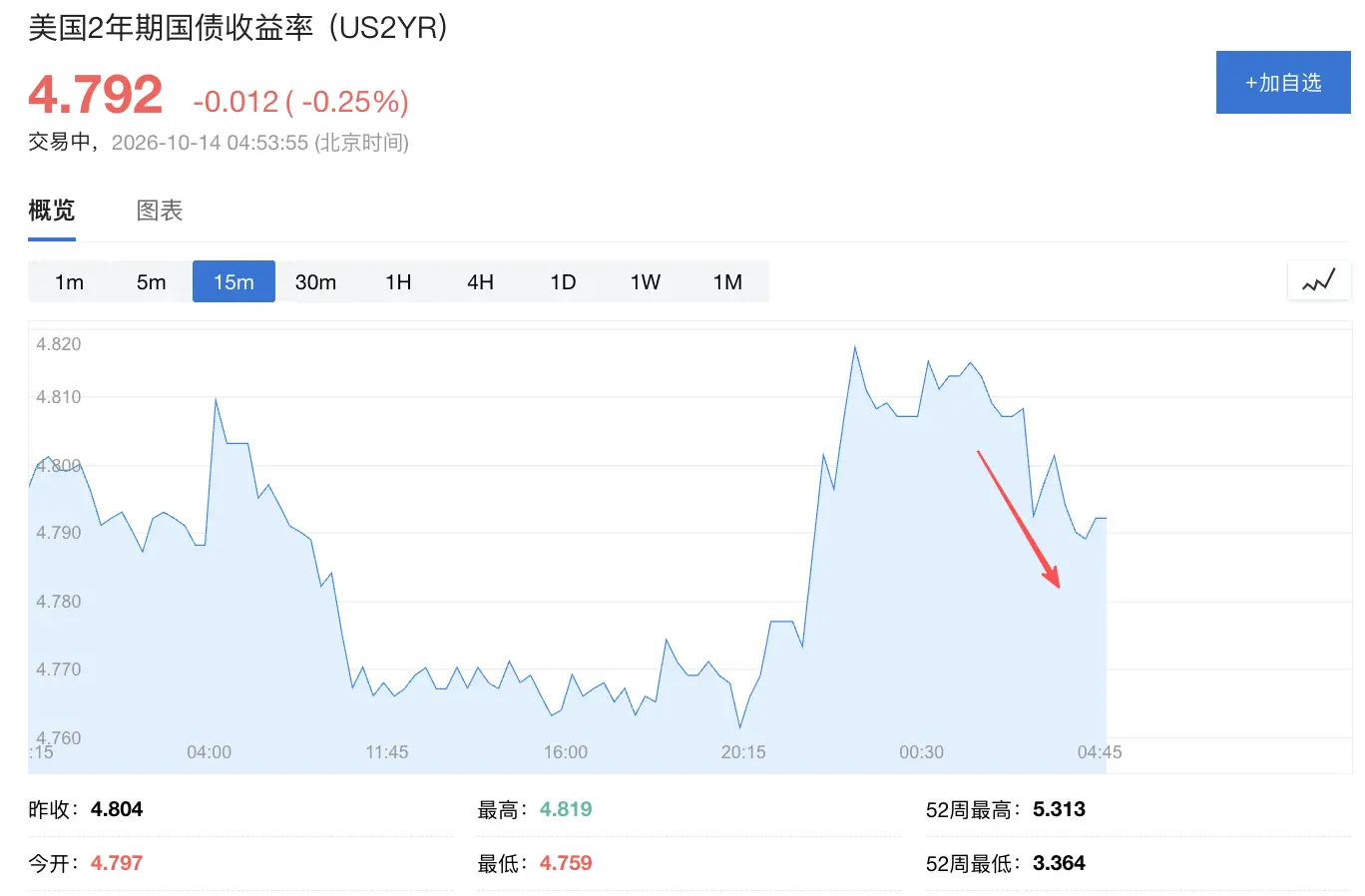
Before Williams spoke, the yield on U.S. two-year Treasury bonds rose by 2 basis points on Tuesday; after his remarks, the yield on two-year Treasuries fell, down 1 basis point to 4.792% as of the time of writing.
On the same day, Chicago Fed President Austan Goolsbee stated that price pressures have spread to areas beyond data centers and directly related industries, saying, "I am increasingly concerned that this is pure, old-fashioned demand overheating." Richmond Fed President Thomas Barkin pointed out that the Federal Reserve has been able to observe the impact of AI investment on U.S. inflation.
On Monday, Boston Fed President Susan Collins stated that rates may need to be further raised before the end of the year, but this still depends on subsequent economic data. The key is to observe whether inflation remains primarily concentrated in energy and AI infrastructure-related areas or spreads further to other aspects. She also mentioned that the Fed's economic model has taken government debt levels into account.
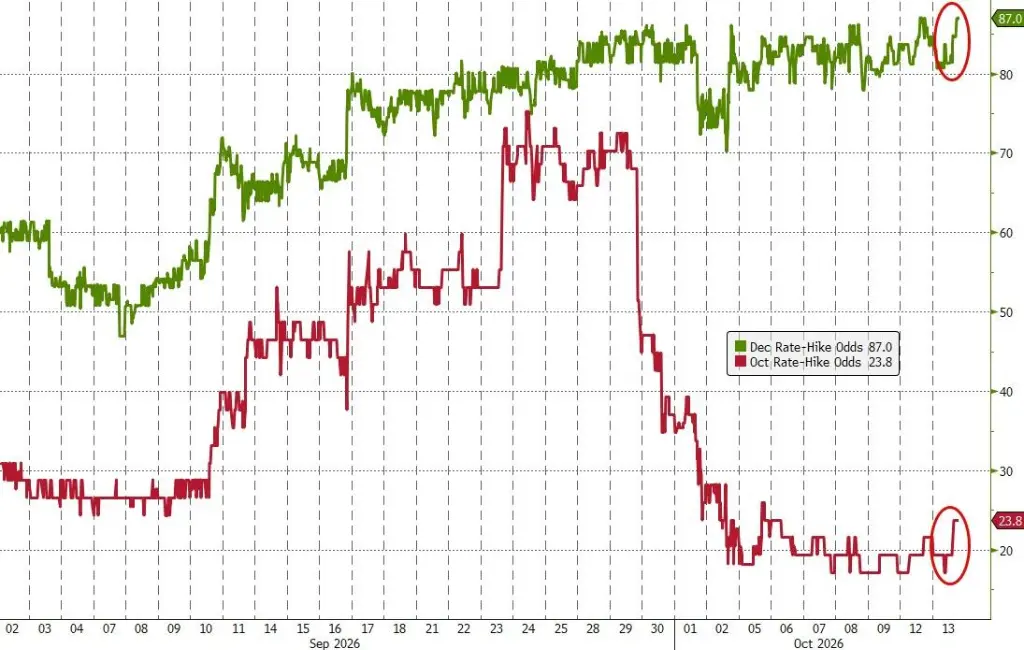
On Tuesday, the probability of a rate hike in December rose to near a high point of about 90%; the probability of a rate hike in September also rebounded to around 25%.
One More Rate Hike This Year, Slight Increase in Neutral Rate
Regarding the market's most concerned question about the endpoint of interest rates, Williams provided a relatively clear roadmap in the interview. He reiterated his views on recent monetary policy but also clearly released long-term "dovish" signals. Williams stated:
"I have not changed my view that one more rate hike may be appropriate. I do not believe I have any reason to think we need to do more after that at this time."
When asked about the rate hike path in the long term (such as in 2027), he believed that further hikes would not be necessary at that time. However, he emphasized the "data dependency" of monetary policy:
"It is only mid-October now. This economy is being influenced by many different factors, and we can only continue to observe the data."
The neutral rate (the actual interest rate level that neither stimulates nor suppresses the economy) that the market is highly concerned about was also a core topic of this interview. As a co-author of the classic estimation model for the neutral rate, Williams revealed that due to fiscal policy and strong economic growth, the neutral rate has gently risen by about 25 to 50 basis points over the past few years. "I believe the long-term neutral rate is still quite low, around 1% or slightly above that level. From this perspective, if the economy performs as I expect in the coming year, we are not far from the neutral rate."
AI Infrastructure is Raising Short-Term Costs, but Will Be a Deflationary Force in the Long Term
In this interview, Williams placed "AI" alongside tariffs and energy prices as the three core variables currently affecting the inflation path in the U.S.
Williams pointed out that the upward trend in goods and costs related to AI construction has already become apparent:
"We are indeed seeing rising costs and goods associated with AI construction: data centers, the huge demand for chips. Prices in AI-driven sub-industries have seen quite sudden and significant increases. We are also seeing some signs of spillover into construction labor costs."
In response to market concerns that overheating AI investment might lead to widespread inflation, Williams provided a reassuring judgment. He believes that while the AI sub-industry is operating at full speed, the U.S. has a massive economy of over $30 trillion, and tightening monetary policy and financial conditions are cooling other areas. Williams stated:
"This is an unusual situation where we have an economic sub-industry that seems to be operating at full capacity and will continue for some time. But I think what is really important is to look at the broader economy. I do not expect chip prices to decline. They may continue to rise. But we need to look not just at them, but at what is happening with overall inflation."
More importantly, Williams is optimistic about the positive role of AI on the supply side in the long term. He believes that while currently, in the short term, "demand is definitely winning," the extremely high profit price signals will drive capacity expansion, and the significant productivity gains brought by AI will "actually become a deflationary force."
Logic Behind the September Rate Hike: Energy Shock Changes Short-Term Inflation Outlook, Economy Not Overheating Overall
In the interview, Williams firmly defended the Federal Reserve's decision to raise rates in September. He stated, "I strongly supported that decision. I believe it was the right decision—absolutely the right decision."
The core reason supporting his decision was the recent unexpected volatility in energy prices caused by geopolitical events and the widening of refining margins. He pointed out that this led to a significant rise in fuel costs, creating an "additional shock." Coupled with the extra demand driven by AI, it indicates that the economy can withstand slightly higher rates.
Nevertheless, he remains confident about inflation returning to the 2% target. He used several core indicators to demonstrate the current health of the macro economy:
"This is not an overall overheating economy. This is not an economy that is increasing inflationary pressures beyond the specific shocks we are experiencing."
He noted that there are currently no signs that imbalances in the labor market will bring widespread cost pressures, while the U.S. economy's potential output and GDP growth remain at a healthy level slightly above 2%, showing strong resilience.
Does Not Endorse "The Market is Doing the Fed's Work," Speech Not Directed by Waller, Only Represents Personal Views
Recently, as the yield on the 10-year Treasury approached 5%, there have been voices in the market suggesting that "the surge in long-term rates is doing the Fed's tightening work," thus reducing the necessity for subsequent rate hikes. In response, Williams gave a straightforward reply.
"I personally do not like the phrase 'the market is doing our work,' because we must do our own work."
Williams emphasized that the 10-year yield reflects not only monetary policy but also various factors such as fiscal policy, productivity expectations brought by the AI boom, and energy uncertainties.
Williams also responded to the market's interpretation of his speech on September 29. At that time, he stated that the Fed does not need to rush to act again after the September rate hike, and this statement, combined with similar remarks made by Fed Vice Chair Philip Jefferson afterward, effectively lowered market expectations for an October rate hike. Some observers speculated that the two speeches were coordinated or communicated with Fed Chair Waller.
In this regard, Williams clarified that this only reflects his personal judgment:
"I speak for myself… I am expressing my own views. I am in regular contact with him (Waller). We meet often, but I will not say more about that."
Federal Reserve officials will hold a monetary policy meeting on October 27-28, during which they will reference the September CPI data released on Wednesday—this is the last inflation report before the meeting.
Two Fed Officials Emphasize AI Driving Short-Term Inflation, Boston Fed President States Further Rate Hikes Needed This Year
On Tuesday, Chicago Fed President Austan Goolsbee stated that if the path for inflation to return to the 2% target becomes clearer and the job market remains fully employed, there would be room to lower rates.
However, he also warned, "If service sector inflation continues to rise, and AI investment demand spills over and leads to broader economic overheating, the situation will become more complicated."
Goolsbee further pointed out, price pressures have spread to areas beyond data centers and directly related industries, saying, "I am increasingly concerned that this is pure, old-fashioned demand overheating."
Richmond Fed President Thomas Barkin noted that the Federal Reserve has been able to observe the impact of AI investment on U.S. inflation.
On Monday, Boston Fed President Susan Collins spoke at a banking conference, stating that to ensure inflation returns to the Fed's 2% target in a timely and sustained manner, rates may need to be further raised before the end of the year, but specific actions and timing still depend on subsequent economic data.
Collins expects the U.S. economy to continue growing, the job market to remain stable, and productivity improvements to help balance supply and demand and reduce inflation.
She emphasized, the key is to observe whether inflation remains primarily concentrated in energy and AI infrastructure-related areas or spreads further to other sectors of the economy.
Full Translation of Federal Reserve Williams' Interview with Bloomberg on Tuesday:
Bloomberg: President Williams, thank you for hosting us at the New York Fed. From your public speeches, it seems that your inflation forecast for this summer, at least for overall inflation, has shifted towards above 3%. I would like to know what the main driving factors are and whether your forecast for core inflation has also begun to shift significantly in the same way?
Williams: Yes, I believe a series of developments have influenced our view of the inflation outlook. I mentioned tariffs, then the Middle East conflict and broader energy price trends, and third is AI. I think over the past six months or so, we have seen that the tariff effects have essentially played out in the way I believe many models and analyses predicted. This means they have impacted the prices of imported goods but have not had spillover effects on broader prices in the economy. So we see that these effects have mostly become a thing of the past, but they have had a significant impact on core inflation over the past year or year and a half.
Regarding energy prices, I think this is a more important story for the near-term outlook for inflation this year because energy prices have risen significantly and remain high. This is even affecting inflation within the month. Then we see that this is transmitting from energy prices to core inflation as expected. The most obvious example is airfare prices, but there are many other examples, as energy is certainly an important input for many goods and services in the economy, including food and other things. So we have seen these effects, and they have influenced my overall inflation forecast and have also impacted core inflation to some extent, at least in the short term—considering 2026.
Finally, there is the story of AI, which may be the most recent part. We are indeed seeing rising costs and goods associated with AI construction: data centers, the huge demand for chips. So we see this reflected in specific categories, but prices in AI-driven sub-industries have seen quite sudden and significant increases. Similarly, so far, this mainly affects those goods and goods that use chips, including consumer goods. We are also seeing some signs of spillover into construction labor costs. So this is the third area—AI demand-driven inflation—that I am closely monitoring.
However, I believe there is good news in a broader picture. Some of the factors have led to inflation being slightly higher than expected this year, but we see that inflation expectations remain well anchored, and we see that wage growth continues to be moderate. Therefore, the growth of unit labor costs is slowing down, consistent with inflation at 2% or lower, and some indicators we use to measure underlying inflation have clearly declined. If you look at the New York Fed's multivariate inflation indicator or trend inflation indicator, it's around 2.3%. If you look at the trimmed mean from the Dallas Fed, it has also been roughly at the same level over the past six months.
So I think these indicators tell us that over time, we have indeed been affected by tariffs, energy prices, and now AI, but some of these do not indicate that underlying inflation is rising. In fact, these underlying inflation indicators have declined. No single indicator is perfect; these are just the indicators I am paying attention to. So the overall situation is that there are indeed some driving factors pushing up inflation this year, which has led to my inflation outlook being slightly higher. I think what I am currently watching most closely is AI-driven demand and how it may evolve. But I do not believe there are other inflation-driving factors emerging.
Bloomberg: We have been hearing from you for several months, and the main story seems to be: while there are risks, there is an anti-inflation narrative coming. In fact, after the July meeting until August, you were saying this, and we felt—perhaps we misread it—you were inclined to oppose a rate hike in September, but of course, you ultimately supported the hike. So I wonder, what data made you more concerned about upside risks, or do you feel the core of the committee is moving in that direction? And frankly, consensus within the FOMC is important. In your decision to support the rate hike, was there an element of conforming to the core direction of the committee?
Williams: Well, I firmly supported this decision. I believe it was the right decision—absolutely the right decision. I think the data you mentioned, the way the data has developed, makes me believe that decision was appropriate.
So I think the two pieces of data I have mentioned: one is the issue of energy prices. If you look earlier this year, the futures market indicated that oil prices would decline significantly, which may have been overly optimistic. At that time, there may have been more optimism that conflicts would be resolved, so I think that has changed. Currently, energy prices remain quite high. Futures still expect energy prices or oil prices to decline, but not by as much.
Secondly, I think a very important point is the spread we see from oil prices to other fuel costs (like gasoline, and of course diesel), which reflects not only that the Middle East conflict has reduced refining capacity but also the conflict between Russia and Ukraine. So we have seen additional shocks, if you will, or additional manifestations of these developments, namely that fuel costs have risen significantly. So I think this is a set of data: higher energy prices may persist longer, which aligns with my view that inflation will not decline as quickly as I previously hoped. Secondly, I still believe that energy prices will not push up inflation next year and beyond; I am just looking at the current situation.
I believe that the shift in AI demand is real, substantial, and likely to persist, and that the supply side will take some time to catch up with the demand side, which has become more evident from my perspective. To me, this is somewhat like the traditional issue of using monetary policy to balance supply and demand. With more demand-driven factors from AI pushing the economy to grow faster at least in the short term, it suggests that adjusting monetary policy not only helps with inflation but that the economy can clearly withstand slightly higher interest rates. So these are the factors influencing my thinking.
So in response to your premise, I still believe there are anti-inflation forces at play. I think these have not fundamentally changed. In fact, my forecast for inflation next year is that inflation will decline significantly—overall inflation for the year will be close to our 2% target, reflecting some of the factors I mentioned, namely that tariffs will be a thing of the past. Even looking at the 12-month change, energy prices are expected not to push up inflation next year—they may become an anti-inflation force. I do believe that the overall balance of supply and demand in the economy is expected to remain well balanced, and we will see inflation continue to decline.
Bloomberg: So in that sense, the minutes from that meeting also reflect that there is a group of people who believe that a rate hike is indeed necessary, while another group thinks that the rate hike is more of a risk management decision. I wonder which group you belong to. Do you think this is a truly necessary rate hike, or is it to guard against impending inflation risks?
Williams: Fundamentally, I believe monetary policy is always about risk management. It is always about assessing the economic outlook, the uncertainties surrounding it, and the risks to achieving our dual mandate goals (maximum employment, price stability). It is always a probabilistic question and perspective. So my answer is affirmative. Yes, I believe that given the downside risks to our maximum employment goal seem to be diminishing, a rate hike is appropriate. The economy has proven to be resilient. If there is any difference, the economy seems to have strengthened marginally, so the risks to maximum employment feel slightly lower, but the inflation risks, due to the factors I mentioned—particularly around energy prices and AI factors—indicate that inflation risks are slightly higher. I would use the terms "slightly higher" and "slightly lower."
I do not believe the data indicates a fundamental change in the economic outlook in any way, but rather a qualitative reassessment of where those uncertainties and risks lie. So from my perspective, the answer is to approach it from risk management, examining the risks to achieving our goals, and seeing what kind of monetary policy setting best achieves that, and that is the right decision.
Bloomberg: Tomorrow you will release the CPI, which is the last inflation data you can see before the next meeting. I wonder what you will focus on to assess whether your outlook still holds, and in your view, what kind of core data would meet your expectation of reaching 2%?
Williams: Well, I think the answer to your first question is that we will look at all the data. More importantly, my colleagues at the Federal Reserve will carefully analyze the data, understand all the details, seasonal factors, special factors—these are all factors that can cause data to fluctuate for different reasons in any given month. The second point I want to make is that I firmly believe in relying on data, but not on any single data point from a given month. Data can be influenced by various factors, including seasonal factors, which are somewhat special. So what you really want to look at is the underlying trend. That is my view.
You get another piece of data, which is part of the puzzle, that together with all the other information we have forms the whole. When I really look at the underlying trend of inflation, what am I looking for? Energy prices fluctuate for reasons we understand—conflicts. Some other factors regarding AI, I expect this trend to continue. But what is really important to look at more broadly—what do we see in services, housing, and goods, excluding some of those categories.
For me, it is important to continue to observe whether underlying inflation is moving towards the 2% target. I do not expect it to reach 2% immediately. But we are moving in a way that is potentially trending towards the right direction. I think that is actually what we have seen over the past few months. But we need to get more data and really try to interpret what it tells us about next year. Monetary policy does not take effect in a day or a week. It takes a year or two to have a full effect on the economy. So what is really important is what this tells us about what might happen in the next year or so.
Bloomberg: But do you have a core data point that would make you more concerned than other data?
Williams: Well, I would prefer lower rather than higher, but I do not have a specific number. Again, after adjusting for some of the factors I mentioned, looking at these potential trends.
Bloomberg: One more question about AI-driven inflation. You have again mentioned that this is a major driving factor you are focused on. What makes you believe that the supply-demand imbalance caused by construction will be resolved in the short term? The pace of investment has not slowed. It is unlikely to be affected by higher interest rates. Without a stock valuation adjustment (which could slow things down), why do you think supply can catch up to prevent broader inflationary pressures from potentially continuing to spread throughout the economy?
Williams: So that is exactly what I am focusing on and observing. I think there are several reasons. First, small adjustments in monetary policy will not change the underlying trends of AI in any way—absolutely not. I think investors there are relatively price insensitive. They see it as a huge opportunity that will bring significant productivity gains and transformative changes, and I think it is not completely unaffected by interest rates, but I do not expect monetary policy to have a profound impact on this.
But in the rest of the economy, I mean, I know we have been talking about AI. But the U.S. economy is over $30 trillion. Far beyond AI. So I expect to see, and I think we are seeing, the effects of changes in monetary policy and other financial conditions on the rest of the economy, whether in housing or in business investment outside of AI, other decisions that are more sensitive to interest rates, including financial conditions, including the impact on long-term interest rates and the value of the dollar. So I think all these other channels are certainly at play.
This is an unusual situation where we have an economic sub-sector that seems to be operating at full throttle and will continue for some time. But I think what is really important is to look at the broader economy. I do not expect chip prices to decline. They may continue to rise. But it is not just about them; it is about what is happening with overall inflation.
Let me give a few data points that I think may support this argument. First, there are indeed no signs that the overall labor market is imbalanced. The unemployment rate is just above 4% and has been quite stable. My personal view is that the labor market is a bit loose, but not much. Others would say we are roughly in balance. So I think we are not seeing an imbalance in the labor market that would impose additional cost pressures on businesses in the broader economy. We have also seen this from wage data. As I mentioned, if you look at ECI or hourly wages or other indicators. We are not seeing inflationary pressures from there.
So when I step back and think about what problems AI might pose in driving inflation, it is if there are other factors in the economy that are also increasing inflationary pressures at the same time. Whether it is high wage growth or wage increases exceeding productivity from the labor market, or other persistent and large-scale import cost pressures.
Of course, we have already seen this in energy. That is absolutely true. But apart from energy and AI, we are not seeing these widespread pressures pushing up business costs.
What we experienced in 2021 and 2022 was that businesses in the U.S. and other countries were essentially in a bind as they faced rising costs across the board, whether it was import costs, labor costs, or other input costs. They could not recoup costs by substituting one thing for another or adjusting production methods. So they essentially had to raise prices. So we are not seeing the same widespread inflationary pressures now.
Another thing I want to mention is GDP growth. As I mentioned regarding the labor market, GDP growth is growing, averaging slightly above what I consider potential output over the past four quarters.
For example, growth slightly above 2%, I think potential output may also be slightly above 2%. So the overall economy, despite AI having such a strong driving force and all of this, is not overheating. So I think these are the things I am looking at. Again, monetary policy will not change the relative prices or relative investments of AI compared to other things; it will affect the broader economy.
Bloomberg: So you are not saying that AI will no longer be a driver of some excess inflation, but rather that overall it will remain balanced.
Williams: That is exactly what I am thinking about when considering two things that are crucial to our monetary policy. One is to maintain the overall balance between supply and demand, and the other is to ensure that the price pressures we see—whether from energy, previous tariffs, or AI—do not spill over into broader or more persistent inflation.
So these are the things I am paying attention to, knowing that chip prices will be influenced by their market power.
Now, one thing you mentioned that I should add is that I do see that the ultimate AI build will bring two aspects of supply effects. One is that these are very, very strong price signals that will encourage an increase in supply. These prices are very high. Producing chips is very profitable. So clearly, there is a lot of investment in building factories to produce more chips. This takes time. It will take a while, but ultimately the supply will come online. The second is that ultimately I believe we will see greater supply-side effects from AI builds that lead to higher productivity. We are seeing this in individual companies and enterprises using AI. They are achieving huge productivity gains. I would say we have only seen a glimpse of this in the broader economy. So I feel that in the future, the challenge here is: how long will it take to get there? In the future, we will gain some positive supply-side effects from this, but what is really important is the competition—between demand and supply in AI. Currently, in the short term, demand is definitely winning, but I do expect that in the future, the supply side will not only respond but will actually become an anti-inflationary force.
Bloomberg: But even before you see those productivity gains—these gains can be said to be harder to pinpoint in terms of timing—in your model outlook, I believe inflation is still at 3.5% this year, then slowing to 2% and reaching the target by 2028, right? When do you actually see the supply and demand in AI becoming more balanced within this timeframe?
Williams: Within AI?
Bloomberg: Yes, within AI. Is it within the next two years, or longer?
Williams: I think it will take longer. Assuming the demand impulse continues as expected, that is a big assumption. It could change based on perceptions of the returns on these investments. But given my baseline expectations, I expect demand in the AI space to be very strong. I believe supply will respond, but it will take some time to catch up. But I think by then you would also want to see productivity tailwinds, if you will, starting to see that.
Now, productivity growth has been quite good. With the latest revisions to the national income accounts, I mean, productivity has certainly exceeded 2% since 2019. I am increasingly convinced that we are on a good or strong productivity path, and that may not primarily be due to AI. So I think that is also a factor that helps me have some confidence that anti-inflation dynamics are forming. We have good productivity growth. As I said, unit labor costs are quite moderate. So in the medium term, not the near term, but the medium term, I think these are good indicators that inflation should return to near 2% levels by the end of next year.
Bloomberg: Let’s talk about interest rates. From your speech in Buffalo, you said you still believe there will be one more rate hike this year, which would bring the target benchmark rate to between 4% and 4.25%. Is that enough to get the job done? Given what you said yesterday, there are some effects you can’t really control with interest rates—chip prices, chip supply, oil.
Williams: Well, again, we can’t control those, nor should we. I mean, I think these price signals from AI investments, in terms of AI, like chip prices or some others, we want those price signals to work, to encourage people to use them for their highest value, and producers to increase output. But if you look at what has happened to overall financial conditions, the stock market is still very active. People are very optimistic about the U.S. economy, and I actually am too, and very, very optimistic about AI investments. But we have seen long-term yields rise, so I think that means higher mortgage rates and higher borrowing costs for other businesses, including AI, and the rest of the economy.
So regarding whether we have done enough? Time will tell. We will get more data to assess. But my point is, this is not an overall overheating economy. This is not an economy that is adding inflationary pressures beyond these specific shocks we are experiencing, so I think that comes back to this risk. It is always about risk management, how we maintain a robust economy close to trend growth, and that inflation does not spill over into broader, more persistent inflation. So what is really important is to maintain the overall balance of supply and demand, and I think that relates to assessing whether the economy is overheating, and I don’t think it is.
Earlier this year, even recently, until the latest employment report, you would hear this argument about a re-acceleration, that the labor market is heating up again. I think the labor market is performing quite well overall. It is robust. It has been stable. It has been resilient, but we have not seen widespread overheating indicators. We have seen some in certain categories, and employers I have talked to have indeed said there are certain types of skills or supply tightness. But I think that just reflects that different sectors of the economy are running very strong while others are slowing down.
Bloomberg: So, again, trying to assess your outlook on interest rates. You still believe there will be one more rate hike sometime later this year. Is that enough? What about 2027?
Williams: I want to go back to data dependency. I feel that with strong demand, and I think the revisions to the national income accounts published since then reinforce that this is a pretty good growth economy. I think it also reinforces that this is a pretty good supply-side economy. So I have raised my view of potential economic growth by about a few tenths of a percentage point, so that is good news. I like a strong economy, especially a strong supply side. The labor market, I think, has again proven to be stable and robust. So the question is, as the data accumulates, does the story of a well-balanced supply and demand economy hold, with demand slightly strong, and frankly, supply also slightly strong? This is an assessment of what interest rates can maintain that balance, and then obviously ensure inflation…
Bloomberg: I understand you still rely on data, but you have to make a forecast for 2027…
Williams: If you fundamentally ask me if I have changed my view, that if the outlook is broadly in line with my expectations, I have not changed my view that it may be appropriate for one more rate hike. I currently have no reason to believe we need to do more. But you ask about 2027, we will have to see. I mean, it is only mid-October now. This economy is being influenced by many different factors, and we can only continue to observe the data. Again, the focus is not on individual data points or what you know, but really looking at the underlying trends we see in labor, employment, and inflation.
Bloomberg: Many of your colleagues also see this anti-inflation story unfolding, and even some more hawkish FOMC members to some extent as well. But they have differences on the appropriate interest rate path. I am not asking you to speak for any individual. Do you think these differences boil down to different expectations about how the economy will evolve, or different estimates of the neutral interest rate? In other words, what level of interest rates is needed to get us all the way down to 2%? Is it really a neutral interest rate issue?
Williams: Well, thank you for mentioning r-star—it took a while to bring that up. As you said, I won’t speak for my colleagues, but I do look very carefully at the SEP and obviously listen to my colleagues' comments. I think the most important thing is that we absolutely agree on our determination and commitment to achieve the 2% target and do so in a timely manner. There is absolutely no disagreement on that point, and clearly we are also committed to both aspects of our dual mandate.
So I think when you get 19 people together, and you start to reach consensus on the goals we are trying to achieve and the strategies for how to achieve them, that is a good starting point. Then comes the hard part. It is the execution of the strategy, how you assess the potential factors affecting inflation or inflation expectations, and weigh different pieces of information. How I view many, frankly, more hawkish arguments, as you said, is that there are some scenarios where the economy evolves in such a way that you need a higher interest rate path to best achieve our goals. There are also, I would say, similarly, scenarios where the future path of the economy suggests you do not need to do that. We do not know which scenario we are living in.
The big theme of global central banks and monetary policy is scenario analysis, and we do a lot of scenario analysis internally at the Federal Reserve. We do not publish these scenarios as part of our communication, but we do conduct this analysis. But I think my 18 colleagues embody this scenario analysis. They work with the team, through all the briefings, through all the materials and data, and then conclude, well, this is what I think my baseline scenario is, and these are the other risks. So I think that captures—my colleagues' comments capture—I think quite well captures a set of possible outcomes we need to think about and be prepared for. I have expressed my personal views and my baseline scenario. I think, again, not speaking for my colleagues, but I think we all have to watch how the data evolves and how these different risks evolve, and then make our best decisions.
Now, regarding the neutral interest rate, I can easily answer that question because my colleagues, or most of my colleagues, filled out the final rates in the SEP, and you can see there is a range of views there, and it has evolved over time. It has evolved from 2012 to 2020 as well. You know, when we first— they have come down as evidence showed they were below our neutral rate. We have seen them move up moderately to moderately over the past few years as the resilience and potential strength of the economy have emerged, along with other factors. So I think the differences in neutral interest rates play a role in how people are thinking about the overall interest rate path needed to achieve our goals, because that is the definition of the neutral interest rate or r-star. For me, it tells you how you view the ultimate path of interest rates, where they need to be in 2027, 2028, 2029, and beyond, rather than telling you what needs to be done at any given meeting.
Bloomberg: Do you still believe we are currently at a moderately restrictive level?
Williams: There are many different versions of that question, and you can look at different indicators. I think if you specifically ask me the r minus r-star question, not from the perspective of all the factors that might be included in assessing financial conditions. Based on my inflation forecast, assuming that holds true, I do believe we are in a—I would say a world where the neutral interest rate is not as low as it was in 2019. I think the neutral interest rate may have risen by a quarter to half a percentage point because either fiscal policy or fiscal factors or stronger growth have pushed it up a bit, which is good news. But I think my point is that the long-term neutral interest rate may still be quite low, around 1% or slightly above that, so from that perspective, if the economy performs as I expect over the next year, I think we are not far from neutral.
Bloomberg: I want to talk a bit about your recent speeches. Now, you hold a special position in the FOMC. Historically, there has been a so-called "three-legged stool," consisting of the President of the New York Fed, the Vice Chair, and the Chair. Most of the experienced Federal Reserve watchers and economists we talk to, some of whom have worked at the Fed, rarely say they think you and Vice Chair Jefferson received any instructions telling you what you should say, but at the same time, most assume you would each inform the Chair in advance of the messages you were going to convey, and the two speeches were two days apart. This is a fairly clear signal that both of you believe there is no urgency to raise rates again after September. So the question is: is it reasonable to conclude that the Chair was informed in advance, and he clearly did not intervene to stop this information from being conveyed?
Williams: So I speak for myself. I won't speak for others, but as I have done over the past years, I provide my own views on the economy, the risks of achieving our goals, and how I see monetary policy positioned relative to that. Now, clearly, I agree with my colleagues. This is not the time for us to try to say in the FOMC statement, well, this is definitely the path for future interest rates. That kind of forward guidance. But in terms of my remarks, my own view about where we are, and I think it’s very important to really look at the underlying trends in inflation, because we are being hit by these various shocks, whether it's energy prices, AI, or others.
So I am expressing my own views about how I think about data collection, and frankly, I am quite satisfied with how the committee has handled this in the past few meetings, collecting data and thinking seriously. In July, we did not take action. We wanted to get more evidence. In September, we had two months of data. This is an opportunity to assess and evaluate what potential trends are telling us, not relying on data points, but responding to those trends, which is exactly how I came out of the September meeting. Let’s do it again. Given our current situation, this is the right approach. The economy is proving to be resilient. I think the potential disinflationary trends, let’s observe how these continue, but also look at these other factors.
So that’s how I handle the comments in my speech. Regarding the Chair, clearly, I am in regular contact with him. We meet often, but I won’t say more about that.
Bloomberg: What does "regularly" mean? When was the last time?
Williams: We meet regularly, you can see it on my calendar, and I will meet whenever there’s an opportunity. This has been standard practice since I came here. It’s really about me expressing as effectively as possible how I view the economy and where monetary policy is.
Bloomberg: But can it be said that you are expressing your views, but at the same time, the wording you chose sends a clear signal to a market that seems inconsistent with its expectations? This is at least part of the point of your speech, to signal to the market, not about future meetings, but just about one meeting, you might be a bit off?
Williams: Clearly, an important part of my job is observing what the market is doing. We say the market, of course, we are talking about prices, with many people trading and thinking about these issues. So clearly, I am observing what the market pricing is, what information is there, and I have learned not to try to guess the market. The market comes to its own views, its own uncertainties about what will happen to the economy, and what that means for monetary policy. So I look at this and observe. I think this is useful information.
But when I give a speech, when I think about my remarks, they are not about the market. They are about my assessment of the economy, the risks of achieving our goals, and how monetary policy is positioned there. So I feel the best thing for me is to say again that this is my view and to be as clear as possible.
Bloomberg: So regarding the market, the 10-year yield is around 5%, I wonder how you view this. Is the market at this point at least doing part of the tightening work for the Fed, do these yield levels at least allow you to pause somewhat in the rate hike cycle? If we are indeed in a rate hike cycle, perhaps we don’t need to stack rate hikes meeting after meeting.
Williams: So personally, I don’t like the phrase "the market is doing the work for us," because we have to do the work ourselves. The market, as I mentioned, clearly market participants are observing all the data we are observing. They are looking at all the factors and making their own decisions. The 10-year yield is not just about monetary policy. The 10-year yield is about many long-term factors, about supply and demand and the AI boom and the resulting productivity. About fiscal policy, uncertainties around energy prices. So there are many factors affecting long-term yields beyond monetary policy.
From my perspective, clearly these affect real people's decisions. If you are trying to buy a house, if you are trying to invest, if you are a business trying to expand, these are the rates that affect your financing costs and other aspects. So these are important for understanding how financial conditions affect different parts of the economy.
The stock market tells us a very bullish economic story, but at the same time, borrowing costs have risen in terms of interest rates. These are the input factors I consider when thinking about the economic outlook and some risks of that outlook. But ultimately, we have to come together to discuss how we best position the economy in terms of monetary policy, which is part of the story, and manage risks. So I don’t think they are doing the work for us. I do believe that when monetary policy is communicated well, consistently, and focused on achieving goals, market participants understand that, so they will anticipate some of our actions.
I think this is a sign of how monetary policy works, but it really isn’t about them doing the work for us. We ultimately have to make the right decisions to do that. I also don’t like the word "pause." I feel like I have never paused. I am working every day. In the years I have been doing this job, I have never felt like I have paused, but I go back to what I said before, I see an economy that is actually proving to be resilient. I think we have to understand the different factors affecting supply, demand, and inflation, but that means carefully assessing, evaluating the incoming data, the data means all the information we have, getting that information, having good discussions, and making decisions. That’s how we do good monetary policy and lay the groundwork for our success in the future and next year.
Bloomberg: So about your work. This is your second term, you are almost 65, and there’s some time left. But I wonder if you have considered retiring early or if you plan to serve your full term?
Williams: Well, you can imagine from this conversation that my daily work involves a lot of things, the economy and monetary policy. This is 100% of my focus. Besides all the things we do at the New York Fed in executing monetary policy and other responsibilities, I absolutely love this job. I have always enjoyed working with the people I work with. So when I started here in June 2018, my intention was to serve my full term and continue to do so, that’s my attitude. I am not thinking about what’s next.
Bloomberg: To clarify, a full term is 10 years after June 2018.
Williams: Again, when I took this job, that was my understanding. That was my commitment to the bank's board, and it was my commitment when my family moved to New York that we would be here for 10 years.
 Risk warning