The Nasdaq gives the green light for SpaceX to join, but the S&P 500 shuts the door? — Unveiling the mystery of index compilation methodology

 According to the methodology for index compilation, the S&P 500 index undergoes quarterly adjustments on the third Friday of March, June, September, and December each year. On the designated effective date of the index adjustment, the index compilation rules trigger mechanical buy and sell orders, and passive funds tracking the index must buy or sell the companies that are newly added or removed. The measurable flow of real funds can often reach tens of billions or even hundreds of billions of dollars.
Source: BIT U.S. Stock Classroom
On July 7, 2026, SpaceX joined the Nasdaq-100 through the newly revised "15 trading day fast track" rule; however, the S&P Dow Jones Index Committee issued an announcement rejecting any proposals to create a fast track for SpaceX after conducting public market consultations, insisting on the hard standard of "positive GAAP net profit for four consecutive quarters," which means SpaceX may have to wait until 2027 to truly enter the S&P 500. The same company faces three completely different timelines from the three major index systems: S&P 500, Nasdaq-100, and FTSE Russell. How are indices compiled? What kind of companies can be included in the indices? Why does the market always show significant fluctuations when index constituents change? The following series of topics about indices and ETFs will gradually unveil the principles of passive investing.
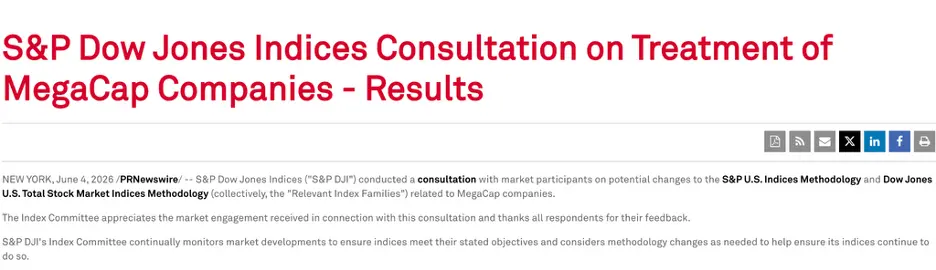
The "selection controversy" surrounding SpaceX is essentially not a divergence of market sentiment, but rather the different admission rules set by the three index systems—Nasdaq-100 opened the green light with the newly revised rules, while the S&P 500's rigid profit threshold pressed the pause button. To understand what is happening behind such hot news, one must also grasp the opportunities and risks that each index adjustment may bring. The first lesson that cannot be avoided is to understand the methodology of index compilation itself: what components does it consist of? Who decides whether a company can be included and when?
Is the methodology of index compilation the most core business secret?
The essence of an index is a product that requires "credibility." It must be recognized by the market, and fund companies must be willing to spend money to buy authorization and develop ETFs linked to it, which necessitates credibility. The methodologies of mainstream indices are publicly available materials, subject to supervision and scrutiny by everyone. This is why indices compiled by institutions like S&P Dow Jones Indices, Nasdaq, and FTSE Russell can occupy a mainstream position—their stock selection rules are transparent, historically established, and their sample representativeness has been repeatedly tested by the market. Before selecting an ETF, the first thing to confirm is not how much the fund has risen in the past, but whether the index it tracks can accurately reflect the target market and whether its methodology follows industry best practices.
Below, we have compiled the original texts of the methodologies for well-known indices such as the S&P 500 Index and S&P U.S. Index Series, Nasdaq-100 Index, Dow Jones Industrial Average, and Hang Seng Tech Index from the index companies' official websites (complete links can be found in the "References" section at the end), along with the methodologies of other ETFs linked to indices of interest.
The methodology of an index consists of four components:
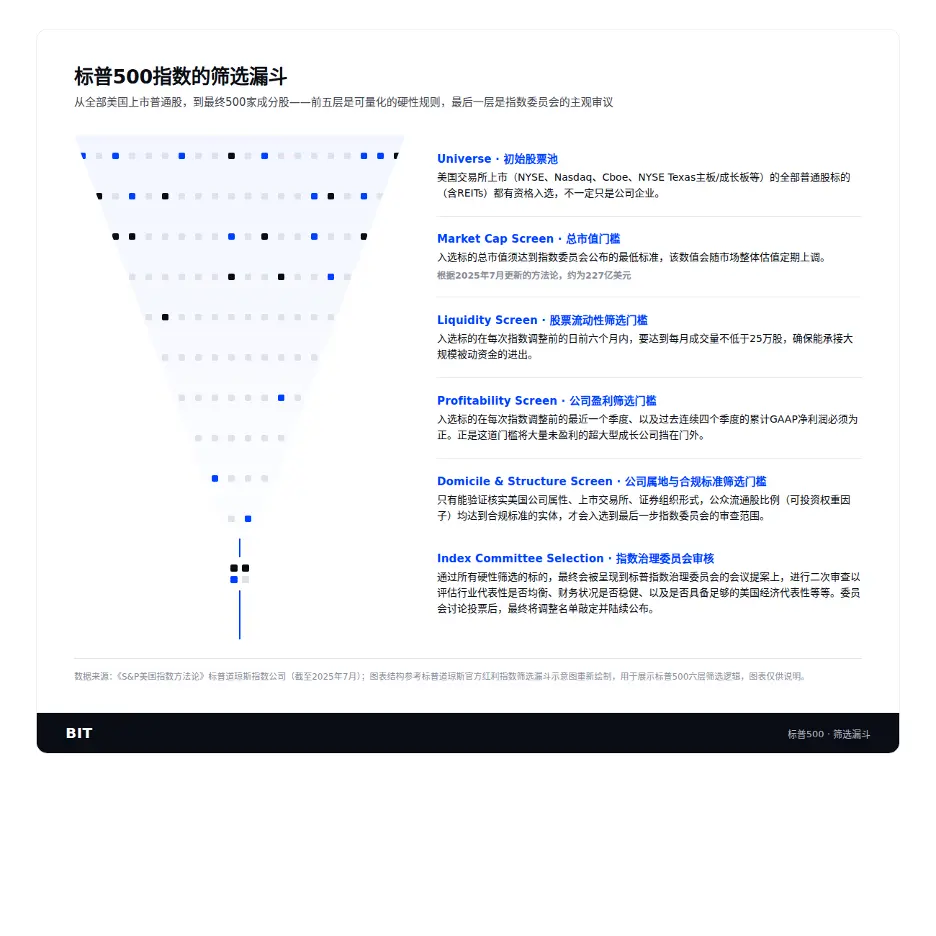
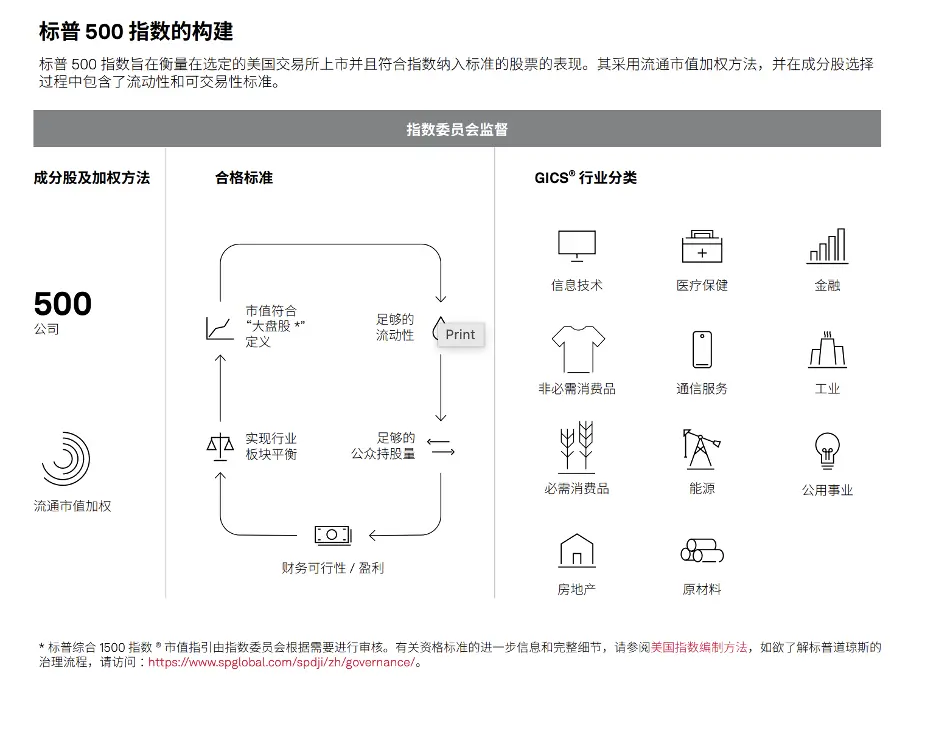
Construction: Determines which securities are included and which are excluded. Specific criteria may include market capitalization, company headquarters location, trading currency, liquidity, price-to-earnings ratio, or dividend yield, among other financial indicators. The selection method for the S&P 500 is shown in the figure below. SpaceX's failure to join the S&P 500 is precisely because it did not pass the fourth layer "Profitability Screen"—the hard standard that the most recent quarter and the cumulative GAAP net profit for the past four consecutive quarters must be positive.
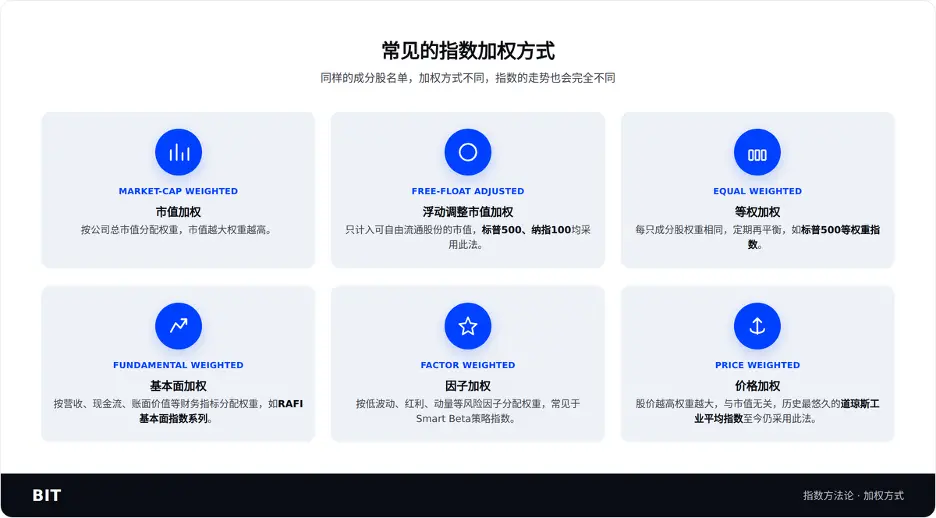
Weighting: Determines the influence of each constituent stock on the overall performance of the index. Common methods include market capitalization weighting, float-adjusted market capitalization weighting, equal weighting, fundamental weighting, and factor weighting. The list of constituent stocks and the index trend can differ significantly due to different weighting methods: for example, the S&P 500 Index uses float-adjusted market capitalization weighting, only accounting for the market value of freely tradable shares, so companies with larger market capitalizations and more tradable shares have higher weights; the S&P 500 Equal Weight Index, on the other hand, treats all 500 constituent stocks equally and rebalances regularly; while the historically oldest Dow Jones Industrial Average still uses price weighting, where higher-priced constituent stocks have greater weight, regardless of the company's market capitalization.
Calculation: Converts the data of constituent stocks into a specific index point. The basic logic is: single stock market value = stock price × number of shares outstanding, total index market value = sum of all constituent stock market values, index point = total index market value ÷ index divisor. The "divisor" is a technical parameter specifically designed to convert large market values into easily readable point numbers, which will be adjusted accordingly during major corporate actions such as stock splits, dividends, or spin-offs to ensure that these corporate actions do not cause artificial jumps in index points—adjustments usually occur after the market closes to maintain continuity between the closing value of the day and the opening value of the next day.
Rebalance Review: An index is not a static list compiled once and for all; it requires periodic (usually quarterly or annually) re-execution of the stock selection process to remove companies that no longer meet the admission criteria and add new companies that rank higher, while also updating the number of shares outstanding to accurately reflect the actual tradable share size. Common reasons for the removal of constituent stocks include no longer meeting qualification requirements, being replaced by higher-ranking companies, or encountering corporate events such as mergers, privatizations, or delistings. The final decision on this list is made by the S&P Index Committee—composed of full-time managing directors within S&P Dow Jones Indices, excluding any executives from listed companies or external independent individuals. The committee meets regularly to review according to publicly available rules, but the specific discretionary process for the inclusion or exclusion of individual constituent stocks is not disclosed, which is why the market pays special attention before the results of each adjustment are announced.
Why does everyone care so much about who can be included?
On May 12, 2025, the S&P Dow Jones Indices announced that Coinbase would officially be included in the S&P 500 on May 19, becoming the first cryptocurrency company to be included in the index. After the announcement, the stock price surged 8.8% in after-hours trading. For many entrepreneurs and investors, being included in the S&P 500 index has become a symbolic moment of formal recognition by the mainstream financial system.

Image source: Coinbase official X (Twitter) account @coinbase, May 13, 2025; caption: "First they ignore you, then they laugh at you, then they add you to the S&P 500."
However, at the same time, there was much discussion in the market about MicroStrategy, which held a large amount of Bitcoin and had similarly high market recognition, but failed to meet the S&P 500 index inclusion threshold due to a GAAP net loss of $4.2 billion in the first quarter of 2025. A closer examination of the financial performance of the two companies reveals that Coinbase's inclusion was not due to the "hype of the cryptocurrency concept," but rather a solid net profit of $65.6 million in the first quarter and a 24% year-over-year revenue growth; while no matter how much "cryptocurrency narrative" MicroStrategy had, as long as its financial statements showed a loss, the profit threshold in the index compilation rules still kept it out.
Does inclusion in the index guarantee a rise in stock price?
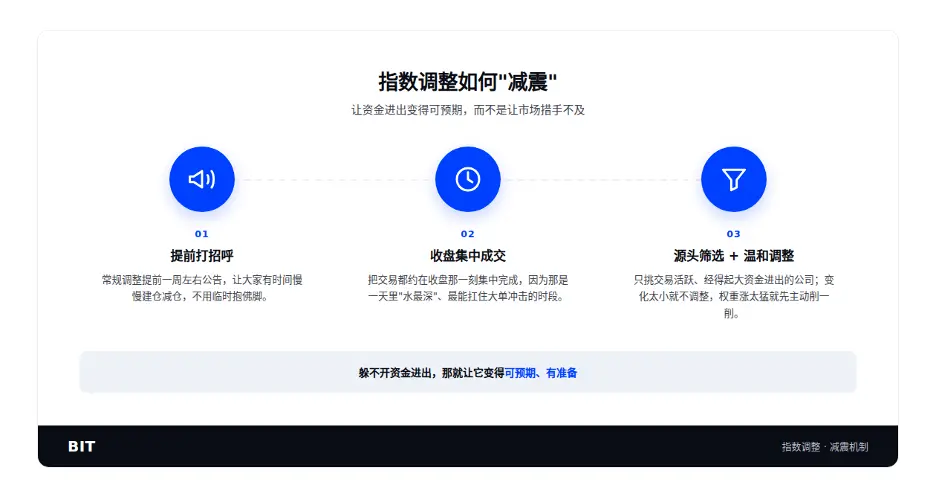
According to the methodology of index compilation, the S&P 500 index undergoes quarterly adjustments on the third Friday of March, June, September, and December. On the designated effective date of the index adjustment, the index compilation rules trigger mechanical buy and sell orders, and passive funds tracking the index must buy or sell the newly added and removed companies, with measurable cash flow often reaching tens of billions or even hundreds of billions of dollars. However, to turn the "whale" that is the S&P 500, the index adjustment mechanism is meticulously designed to avoid causing excessive market fluctuations. Yet, once the information about each adjustment is released, the market's attention and trading sentiment intensify the chase for "inclusion hotspots" for short-term trading, leading to the illusion that "inclusion in the index = stock price must rise."
Just two weeks ago (August 14, 2026), the S&P Dow Jones Indices announced that Reddit would officially be included in the S&P 500 index before the market opened on August 18. Upon the announcement, the stock price surged 15% in after-hours trading. However, the reality is much more complex. A significant portion of this 15% increase actually came from "short covering"—at the time, about 13% of Reddit's float was shorted, and after the announcement, these short positions were forced to cover, creating a technical rise unrelated to "passive fund buying"; additionally, active fund managers anticipated this adjustment and built positions in advance, so by the time passive funds entered on August 18, the price had already absorbed much of the reaction.

However, aside from short-term effects, inclusion in the index increases its long-term capital flow and liquidity. Moreover, the social recognition and attention brought by the S&P 500 serve as the most powerful endorsement of a company's overall strength! The New York Fed once pulled data from companies that joined the S&P 500 index from 1989 to 2009 for statistical analysis, revealing that companies included in the S&P 500 index had already shown stronger momentum before being added, and the price increase after inclusion largely continued this "stronger gets stronger" momentum rather than the index constituents themselves creating value out of thin air. This research has since been widely cited as the "S&P 500 Index Effect," becoming one of the most commonly referenced empirical evidence in academia and the market when interpreting whether index inclusion can truly create value out of nothing!
References
S&P Dow Jones Indices official announcement: S&P Dow Jones Indices Consultation on Treatment of MegaCap Companies -- Results
https://press.spglobal.com/2026-06-04-S-P-Dow-Jones-Indices-Consultation-on-Treatment-of-MegaCap-Companies-Result
S&P 500 Index and S&P U.S. Index Series methodology (Chinese version): https://www.spglobal.com/spdji/zh/documents/methodologies/methodology-sp-us-indices-chinese.pdf
S&P 500 Index and S&P U.S. Index Series methodology (English version): https://www.spglobal.com/spdji/en/documents/methodologies/methodology-sp-us-indices.pdf
Nasdaq-100 Index methodology (English version): https://indexes.nasdaq.com/docs/Methodology_NDX.pdf
Dow Jones Industrial Average methodology (English version): https://www.spglobal.com/spdji/en/documents/methodologies/methodology-dj-averages.pdf
Hang Seng Tech Index methodology (English version): https://www.hsi.com.hk/static/uploads/contents/en/dl_centre/methodologies/IM_hsteche.pdf
S&P Dow Jones Indices official announcement: Reddit included in S&P 500 (August 13, 2026): https://www.spglobal.com/spdji/en/documents/indexnews/announcements/20260813-1484396/1484396_avb54wbs.pdf
New York Fed research report: "The S&P 500 Index Effect" (Staff Report No. 484): https://www.newyorkfed.org/research/staff_reports/sr484.html
Disclaimer: This content is for informational and educational reference only and does not constitute investment advice, investment offers, or any invitation to purchase or sell financial products. The indices, ETFs, securities, and market views mentioned are for introducing index compilation and passive investment mechanisms and do not represent BIT's recommendations or endorsements. Historical performance and market reactions resulting from index adjustments do not represent future performance. Investing involves risks, and the prices of securities and ETFs may fluctuate, and investors may lose part or all of their principal, so they should make prudent judgments based on their own circumstances. Relevant services and products are subject to applicable laws, regulations, and regional restrictions of the jurisdiction.
 Risk warning



Popular articles