In 2021, Robinhood disabled the buy button for AMC, and in 2026 it issued unlimited AMC Stock Tokens
 Core Viewpoint

 The truly valuable asset on the tokenized stock line is not Meme coins, nor is it the token issuance platform, but the subscription and redemption channel.
Author: Mario Chow, IOSG
Three meme coins priced in tokenized stocks illustrate who truly controls a short squeeze. Data as of September 7, 2026, 02:15 UTC. Research discussion, not investment advice. Charts available in the English version.
Summary
In January 2021, retail investors were able to force the short sellers of GameStop to capitulate because the float was static, and short sellers could not create more shares to cover. Ultimately, it was Robinhood shutting down the buy button that ended the situation.
Five years later, Robinhood has launched a batch of meme coins on its own chain, with the priced assets not being dollars, but tokenized stocks of real publicly traded companies. $BONER is priced using Hims & Hers, $MEME is priced using AMC, and $AI is priced using Nvidia. The accompanying narrative is still about short squeezing: buying the coins drives up the price of the tokenized stocks, forcing the institution maintaining the peg to buy real stocks in the secondary market.
We have restored all the minting and burning records of tokenized stocks on this chain. To summarize:
On-chain prices can indeed be pushed up, and quickly. But the issuer will subsequently correct it, usually not lasting beyond a morning.
Here are four specific findings.
Money has indeed reached New York. That weekend for AMC, Robinhood's issuing agent bought and held about $7.6 million worth of real AMC stock in the secondary market, accounting for 7.6% of the pre-market trading volume at its busiest. So, it is incorrect to say that this system is completely disconnected from the real market.
However, the float is now dynamic, breaking the logic of the market makers. The same agent increased the supply of tokenized AMC by 19 times within three days, from 152,106 shares to 2,895,758 shares. Hims saw an increase from 468 shares to 130,876 shares. The issuer is continuously printing under your feet, and you cannot lock in any float. In 2021, Robinhood did not allow retail investors to buy; in 2026, it opened up sales while conveniently making a profit on the price difference. This defensive strategy is much more effective.
So what you get is a needle, not a short squeeze. This needle is not small: AMC pre-market peaked at +22%, Farmmi intraday at +321%, both essentially returned to their previous levels within a week. A short squeeze can persist because covering will force more covering. Both times fell back because the mechanism responsible for transmitting funds will naturally shut itself down.
There is also a scale issue that almost no one has calculated. Even if you pick the cheapest target, to truly execute a short squeeze requires a $3.4 billion meme coin, which is thirteen times the largest project in the history of this chain, resulting in about a 9% increase.
It must also be clarified what exactly you are buying when you purchase these coins. It is not the company's exposure. What these coins are truly pricing is whether the company will notice you. The largest price fluctuation in the entire affair came from a post made by a CEO on Thursday evening, and Adam Aron’s attitude at the time was not friendly: he said these tokens were disgusting and had hired a securities lawyer. The tokens still surged to seven times the stock price overnight. The real return here is the attention of the enterprise, and regardless of whether this attention is benevolent or hostile, it pays. The short squeeze is the return that is publicized, and that return mathematically does not reach.
The truly valuable assets on the tokenized stock line are not meme coins or issuing platforms, but the subscription and redemption channels. That is a whitelist.
1. The Weekend AMC Returned
On Thursday, September 3, at 5:18 PM New York time, 78 minutes after the market closed, AMC's CEO Adam Aron posted that Robinhood's tokenized AMC was "despicable, outrageous, and disgusting," and stated that he had hired an external securities lawyer.
Crypto Twitter saw something else. Within six hours, two meme coins named after this tweet, $CINEMA and $MEME, began trading in the pool priced in tokenized AMC. The New York Stock Exchange had already closed. The token that theoretically should equal one share of AMC hit $18.04.
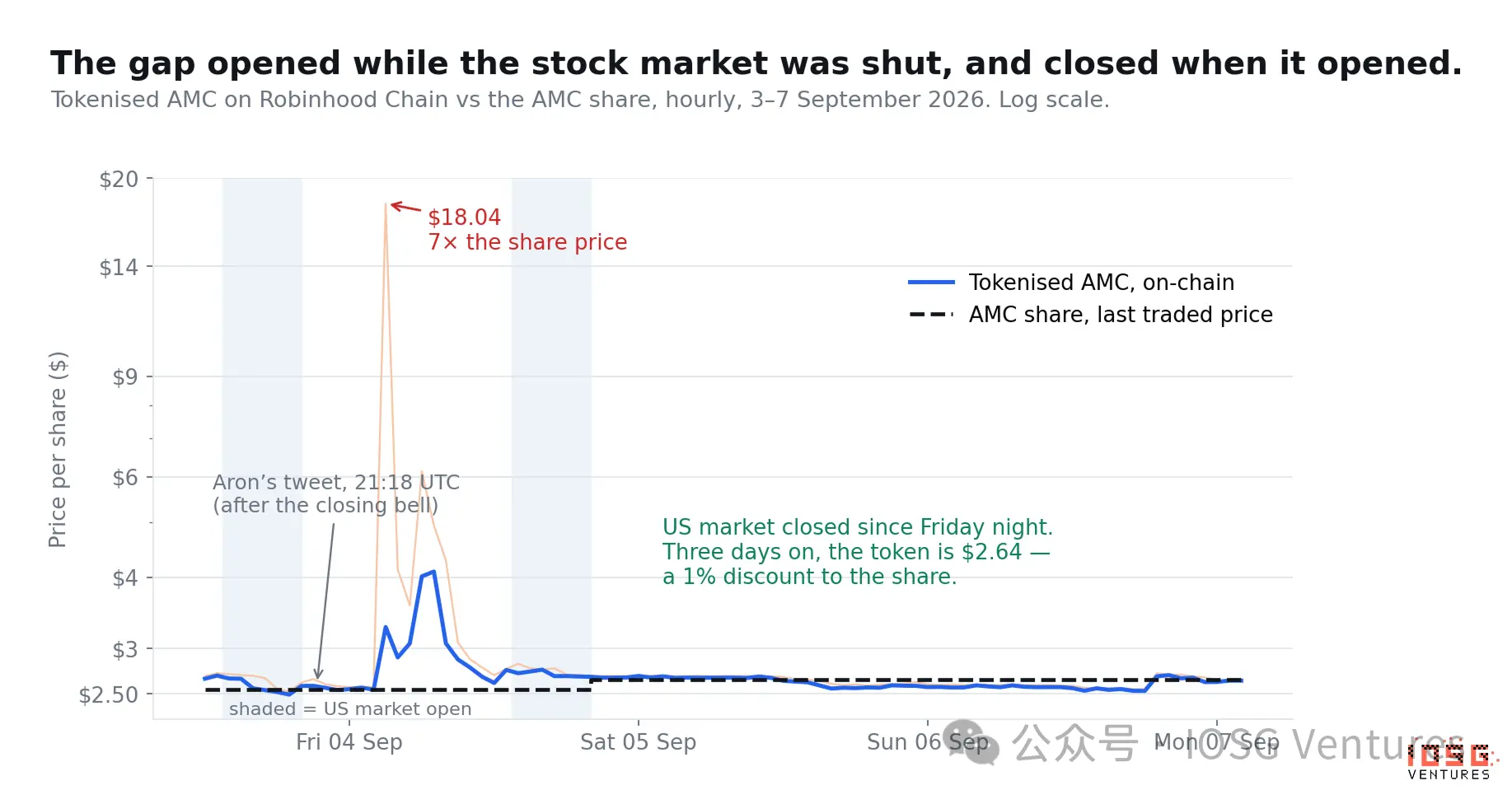
The real stock price closed that day at $2.54. Seven times, overnight. The target is still a company whose entire investment logic is "survived the last frenzy."
The next day, the price difference disappeared, but the process was different from what most people thought. This stock surged to $3.11 in the first fifteen minutes of pre-market trading, up 22%, then slid back down, closing at $2.65. Section 6 will break this down. The easiest part to misinterpret in the whole affair is this one hour.
For this reason, the AMC case is useful. Everything that the theory of short squeezing said should happen did happen: a real meme stock code, a real CEO, a real crowd, a real decoupling, and real buy orders hitting the market. The stock ultimately returned to its position from a week prior.
2. Stock Tokens on Robinhood
Three things need to be introduced first, as they did not exist eighteen months ago.
Robinhood Chain is a public chain operated by Robinhood itself. The top one hundred most active pools trade about $1.65 billion a day, most of which are ordinary crypto assets.
Stock tokens are issued by Robinhood Assets (Jersey) Limited, tracking individual U.S. stocks. Legally, they are not stocks but debt certificates, providing you with the economic return of one share of stock, backed by real stocks held in custody by a brokerage. In practical use, one token represents one share's exposure, and licensed intermediaries (Authorized Participants, AP) can subscribe and redeem at fair value. It operates under the same machinery as ETFs.
Issuing platforms refer to sites like long.xyz, where anyone can deploy a meme coin and a trading pool with one click. In August, the priced assets changed: previously, meme coins were priced in dollars, now they are priced in tokenized stocks. You are not buying $BONER with dollars; you are using tokenized Hims & Hers to buy it.
This replacement is where the entire story lies, as it means buying meme coins is equivalent to buying stocks. Your $ETH, $USDG will be converted into stock tokens on the way in, and the pool continuously accumulates stocks, with fees also settling in stocks rather than cash. A group of meme coin buyers, by mechanism, becomes a buying force for a publicly traded company's stock.
Currently, there are seven such stock-priced venues among the top one hundred most active pools on the entire chain, with a total daily trading volume of about $73 million. This is no longer a niche play.
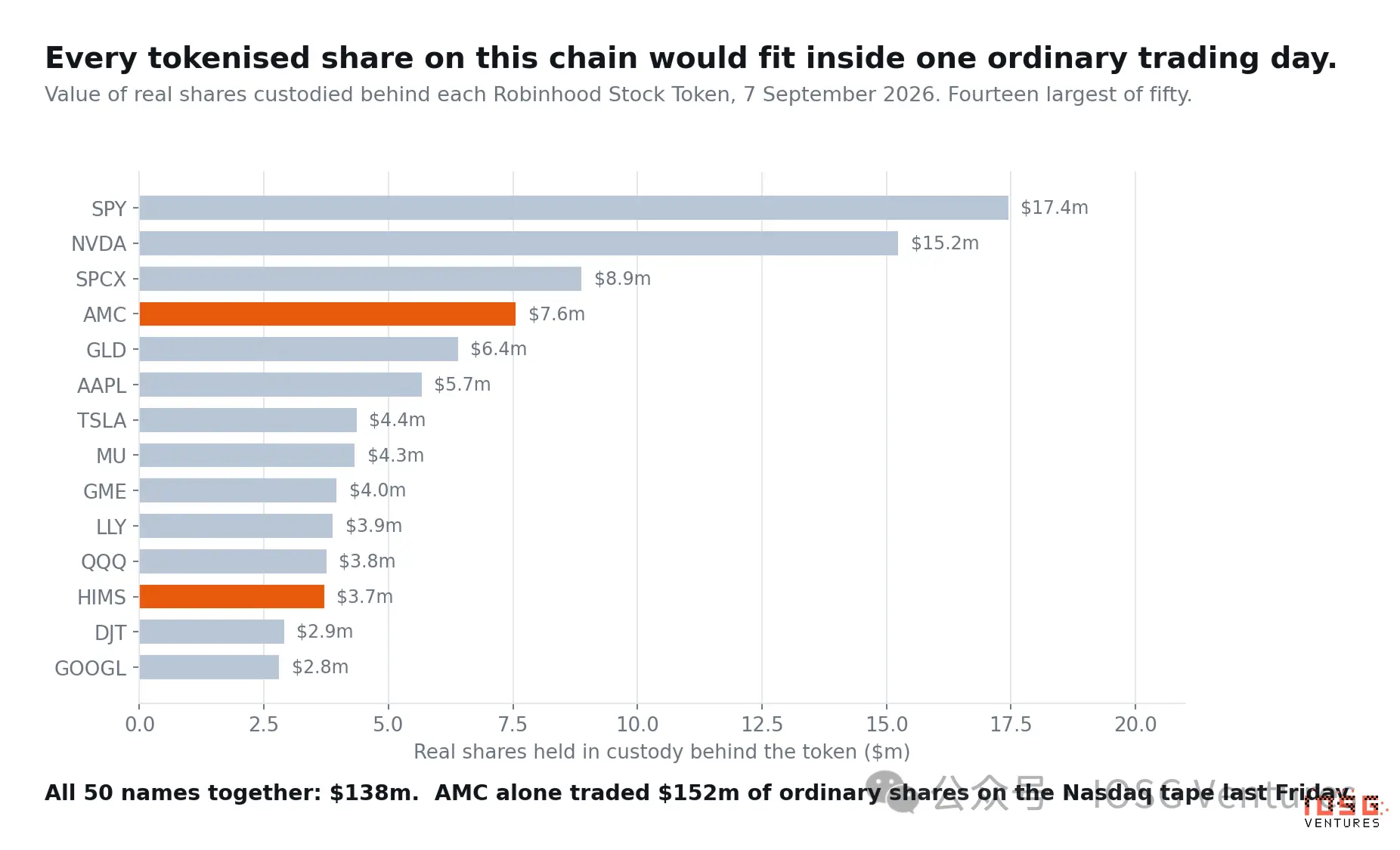
There is a number to remember, as most subsequent questions can be explained with it: all tokenized stocks on this chain, combined across fifty targets, represent about $138 million in real stocks. Meanwhile, AMC alone had about $150 million in trading volume on Nasdaq last Friday. The entire on-chain stock market does not match the busy afternoon of a mid-cap stock.
3. The Analogy with GameStop and Where It Fails
The narrative of short squeezing was originally modeled after GameStop, so let’s get the details right for 2021.
GameStop succeeded due to a hard constraint: the number of shares sold short was approximately 138% of the float, with more shares borrowed and sold than existed in the market. Retail investors bought in and held on, leaving short sellers with no place to buy back, and the stock price surged from $17 to $483 during intraday trading on January 28. It ultimately ended when brokers restricted buying, with Robinhood being the most famous among them, triggered by a $3 billion margin call from the clearinghouse. The float was static, and the only leverage everyone had was to shut the doors.
Now, let’s shift that scene to Robinhood Chain.
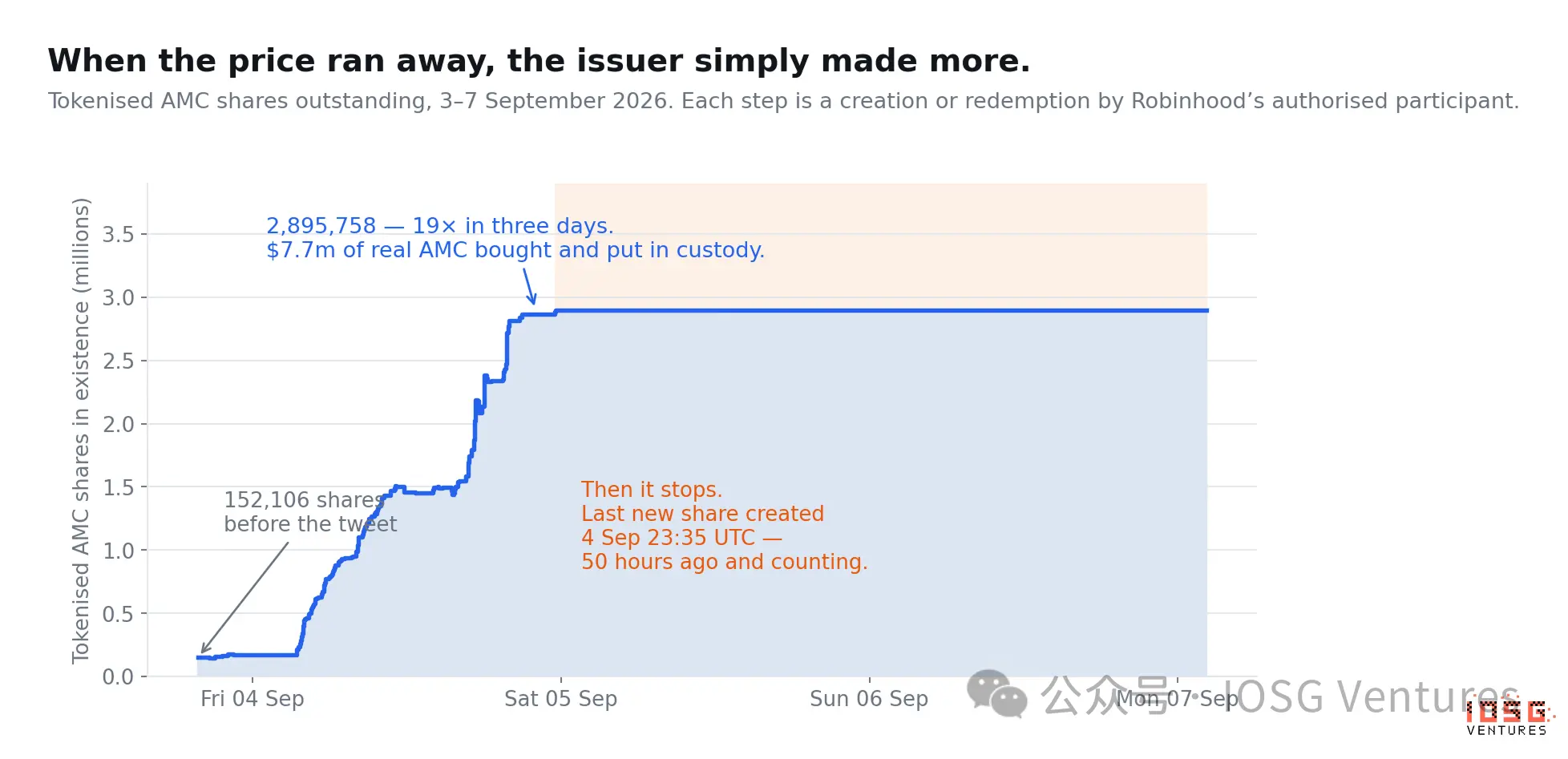
When tokenized AMC surged to seven times the stock price, Robinhood's issuing agent did not shut the doors. It went out and bought real AMC stock, placed it in custody, and then issued more tokens accordingly. In three days, it created 3.05 million shares, redeemed and destroyed 310,000 shares, increasing the tokenized float from 152,106 shares to 2,895,758 shares. Seventy-two hours, nineteen times.
Hims is the same story, albeit at a slower pace. When $BONER launched on August 20, Robinhood Chain's tokenized Hims had only 468 shares, now it is 130,876 shares, expanded by 280 times, corresponding to about $3.6 million worth of real Hims & Hers being bought and held. On September 3, we measured once: in four days, the proportion of $BONER in the tokenized supply dropped from 81% to 47%, while the actual number of tokens it held increased. It did not lose the float; the float was diluted around it.
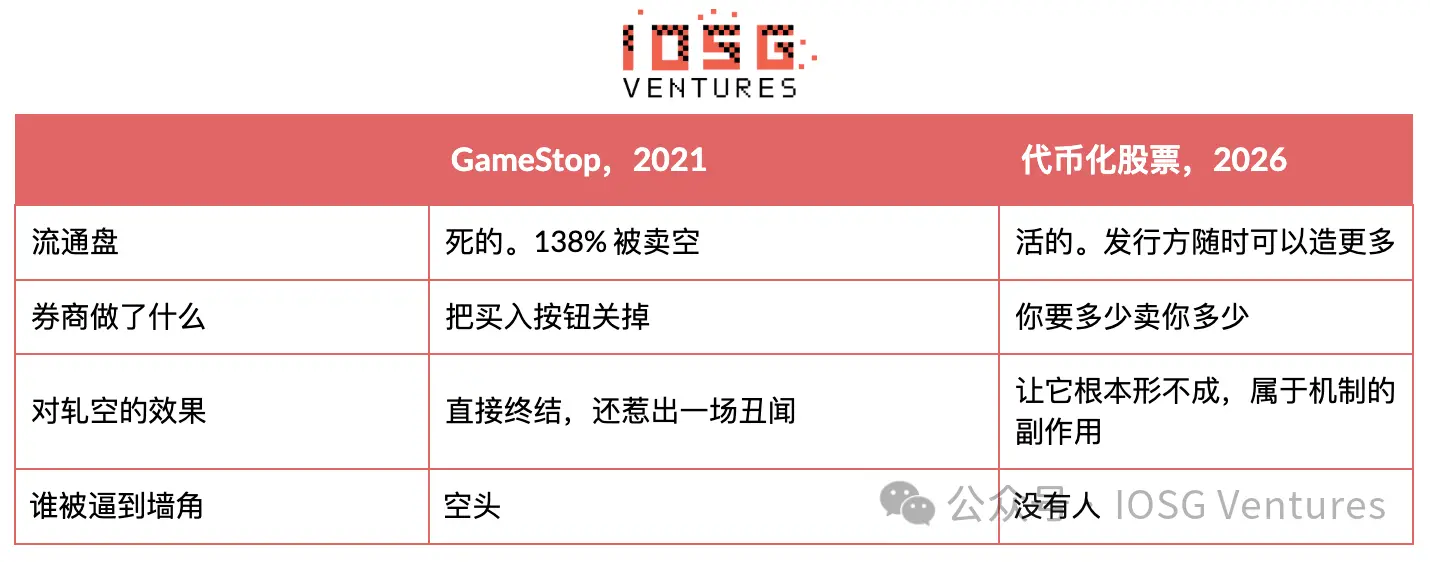 However, it must be clarified. The subscription and redemption channel was not created to prevent short squeezes. Its purpose is to keep the tokens aligned with the stocks, which is the entire reason for holding tokenized stocks instead of meme coins, and it uses the same machinery as all ETFs. It does not create market makers; it is just a side effect of a mechanism doing its job. Moreover, this result is much better than the closure in 2021 because no one is blocked from selling.
What are people betting on when buying meme coins?
Let’s walk through the chain from the retail investor's side. The first half is valid; skipping ahead would be dishonest.
However, it must be clarified. The subscription and redemption channel was not created to prevent short squeezes. Its purpose is to keep the tokens aligned with the stocks, which is the entire reason for holding tokenized stocks instead of meme coins, and it uses the same machinery as all ETFs. It does not create market makers; it is just a side effect of a mechanism doing its job. Moreover, this result is much better than the closure in 2021 because no one is blocked from selling.
What are people betting on when buying meme coins?
Let’s walk through the chain from the retail investor's side. The first half is valid; skipping ahead would be dishonest.
You buy $MEME with dollars. The router converts the dollars into stablecoins, then into tokenized AMC, and finally into meme coins. Your money, on the way in, is physically a buy order for tokenized stocks. As more people buy, the token price exceeds the real stock price, creating a premium, and the AP can profit: it goes to the NYSE to buy real AMC, hands it to the custodian, receives newly minted tokens, and then sells them back into the pool at the premium price.
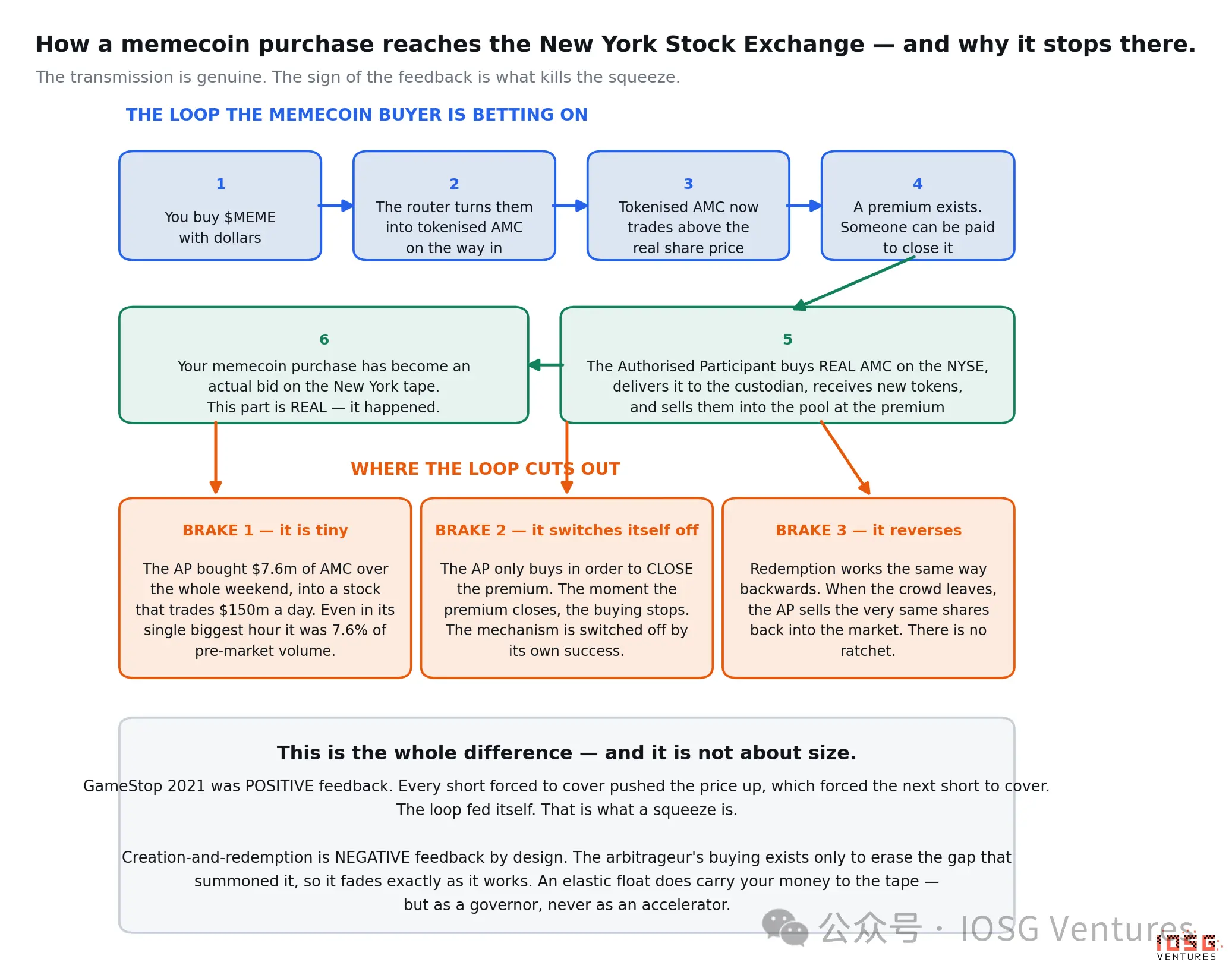 The core judgment of retail investors is correct. The money from the crowd has indeed manifested in the New York market in the form of real buy orders. This is not speculation; it is a weekend where $7.6 million of AMC was traded, accounting for 7.6% of the pre-market trading volume during the most intense period.
Next, the concept of the "flywheel" will add another layer: forced buying pushes the stock price up, the rising price confirms the narrative, more people rush in to buy the tokens, and the Authorized Participant (AP) has to buy more. This is the ideal scenario, but it will break down in three places.
First, the volume is too small. $7.6 million, against a stock that trades $150 million daily. In a steady state, the footprint of the AP probably accounts for one-thousandth of the trading volume.
The second and most critical point: this mechanism will shut itself down. The purpose of the AP's buying is to eliminate the premium; once the premium disappears, the reason to buy is gone. It is shut down by its own success.
Third, it is reversible. Redemption is the reverse of subscription; once the crowd disperses, the AP will sell the same batch of stocks back to the market.
Putting these three points together, what has changed from 2021 to now becomes clear. And it has nothing to do with size. GameStop is positive feedback: every forced short covering pushes the price up a bit, thus forcing the next short to cover. The cycle feeds itself. This is the definition of a short squeeze. The subscription and redemption mechanism, on the other hand, is designed as negative feedback: the arbitrageurs' buying only serves to smooth out the price difference that triggered its appearance, so it both takes effect and disappears. A living circulating supply will indeed send your money to the market, but it is a throttle, never an accelerator. A dead circulating supply will turn buying pressure into a spiral, while a living circulating supply turns the same buying pressure into a diminishing impact cost. Both can drive stock prices, but only one can keep pushing.
To put it more bluntly, this is the most important sentence to remember: A group of people can indeed drive the on-chain price up, and quickly. What they cannot do is keep it there, because as soon as the stock market opens, the AP will fill the gap back. The ceiling does not depend on how large the crowd is, but on how many hours until the channel reopens.
The only thing the issuer cannot print is time. This point is discussed in Section 7.
IV. Who is Sitting at the Table
Do not treat it as a machine; first ask who is sitting at the table, what money each seat is making, and it becomes much easier to judge.
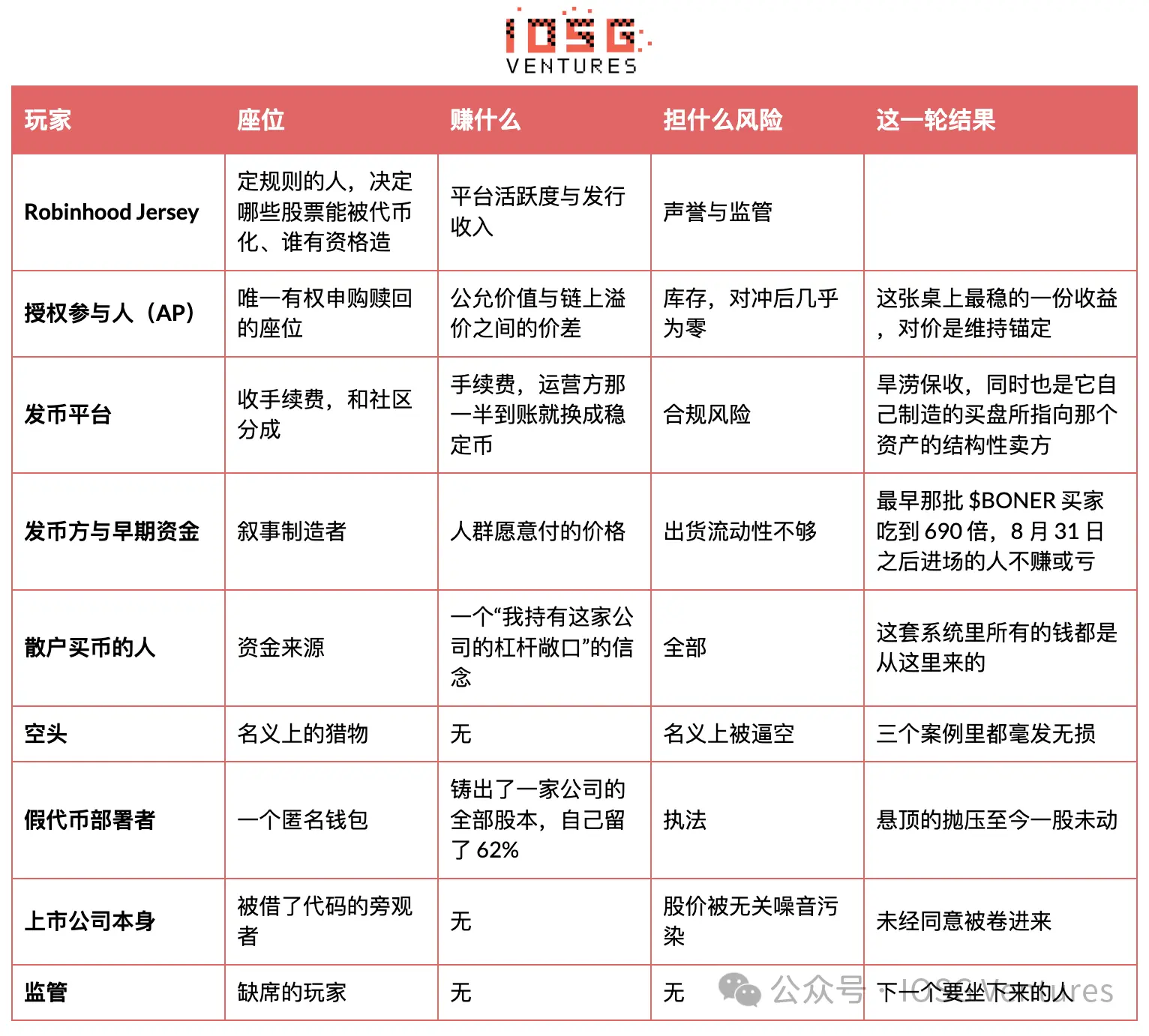
There is one thing worth stating directly: The authorized participants are the most stable earners at this table. They create tokens at fair value, sell them into the premium created by the crowd, and buy them back when the crowd disperses. That weekend with AMC, they bought and held about $7.6 million of real stocks at the price they chose, facing a market willing to pay seven times the fair value. There is nothing improper about this. This is a role with consideration, and it is this consideration that makes people willing to do this at four in the morning. The reason the anchor holds is that this transaction is profitable. What matters to us is one thing: where sustainable profits grow. They grow here, not on the token issuance platform, nor on the tokens themselves.
V. The Analogy of GameStop and Where It Fails
It is not "Is this a short squeeze?" but rather: Can the priced asset be subscribed and redeemed?
Everything else is determined by this, because it determines whether the premium is a temporary dislocation that can be smoothed out or simply the price of another asset.
The real Robinhood stock tokens have a prospectus from Jersey, a custodian holding real stocks, each asset has its own series and ISIN code, and there is a whitelist of intermediaries allowed for subscription. On the blockchain explorer, its name ends with • Robinhood Token, and the exchange rate field has a value.
The fake ones only require 63 lines of Solidity and about $400 in gas. Fixed supply, no issuer, no oracle; the so-called endorsement states "an operational obligation of the issuer," meaning there is nothing on-chain verifying it, nor could there be.
Both look identical on the blockchain explorer, quoted by the same platform, displayed in the same wallet. The only difference lies in a field that can be empty. So, has it ever pushed the real stock price? This section must be written carefully, as only looking at the closing price makes skepticism too easy. By closing price, AMC rose 4.3% that day, seemingly nothing happened. But if we calculate from the last price before the event to the highest price, including pre-market and after-hours trading, it tells a different story.
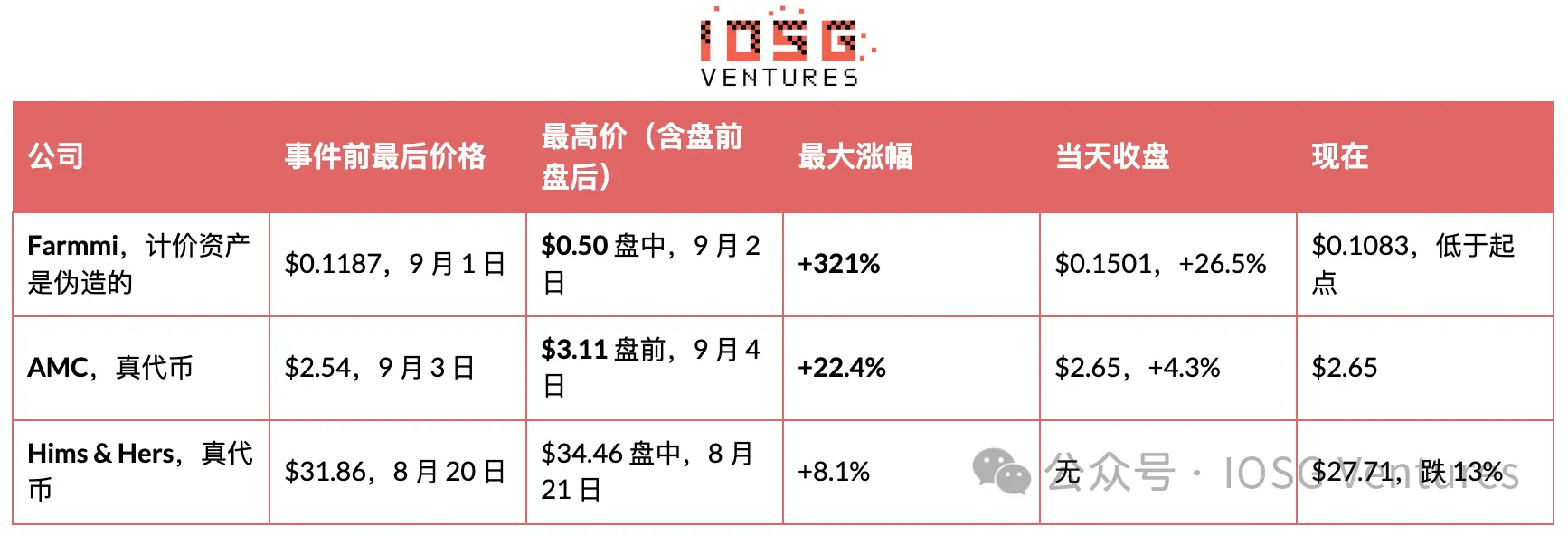 So the honest statement is not "Meme coins failed to push the stock price," but rather: They pushed very hard, but never held it.
The pre-market session on September 4 is the best time to see how this mechanism operates, worth watching minute by minute. Compare the on-chain price with the Nasdaq pre-market quotes, rather than the previous day's closing price: at 4:00 AM New York time, the token was $4.09, while the last real stock price was $2.54, a gap of 61%. Fifteen minutes later, driven by 8.35 million shares traded pre-market, the stock reported $3.11, while the token was already declining. About half of this convergence came from the stock price moving towards the token, rather than the token falling back to the stock price. This is precisely the transmission that the positive feedback cycle predicts will occur.
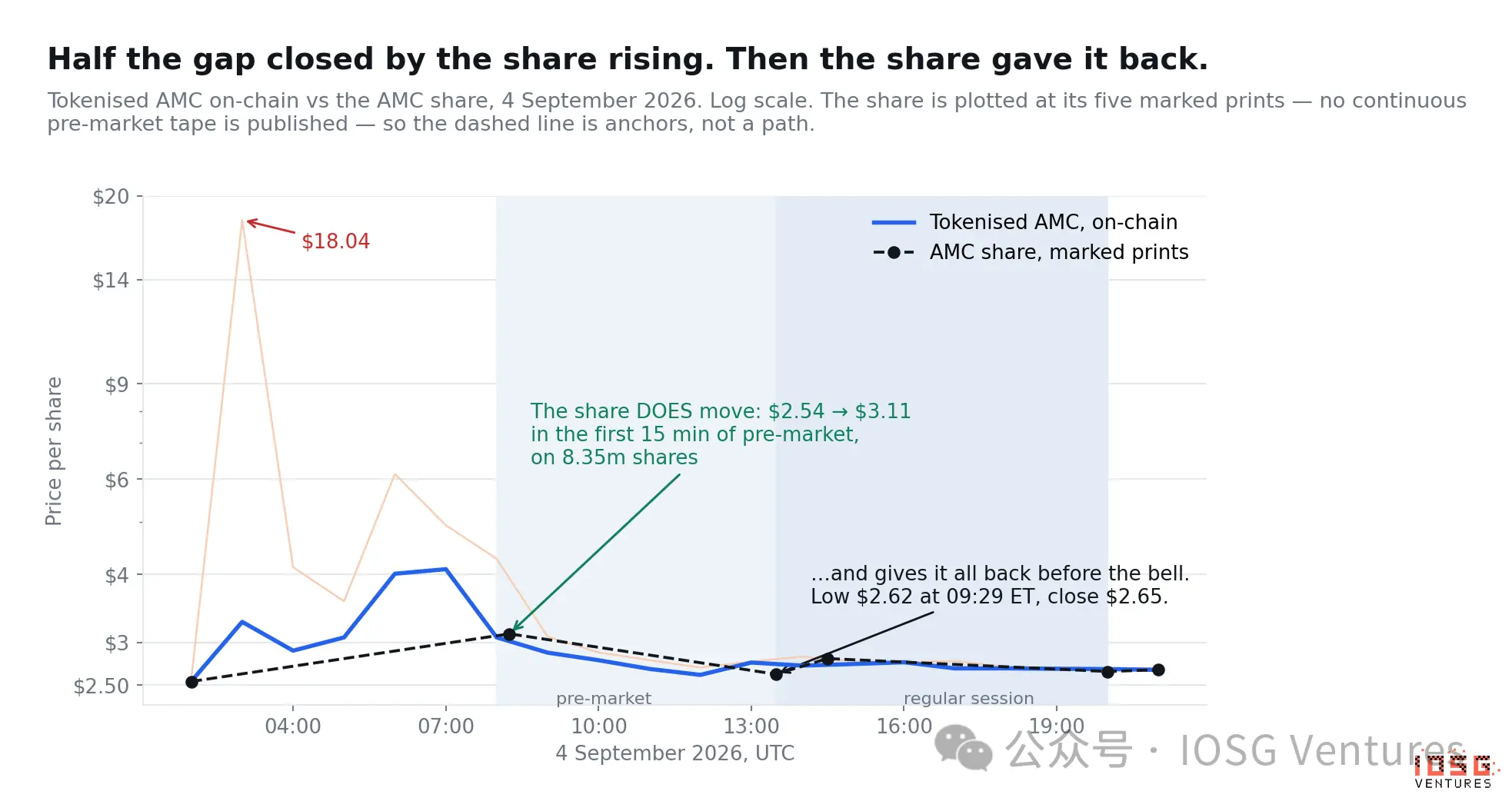 Then it stopped. By 9:29 AM Eastern Time, the stock had fallen back to $2.62, and the token was at $2.61. There was no second wave behind the buy order that appeared at 4:15 AM because the premium it was chasing was already gone. The stock ultimately closed at $2.65.
Looking at the three events in their respective histories: AMC traded 57.2 million shares that Friday, 1.9 times its daily volume, ranking only fifteenth in the past six months; on July 20, AMC traded 186.8 million shares, which had nothing to do with meme coins. Hims' trading volume never left its normal range. Farmmi, on September 2, traded 872.6 million shares, while its daily volume was only 45,000 shares, about nineteen thousand times.
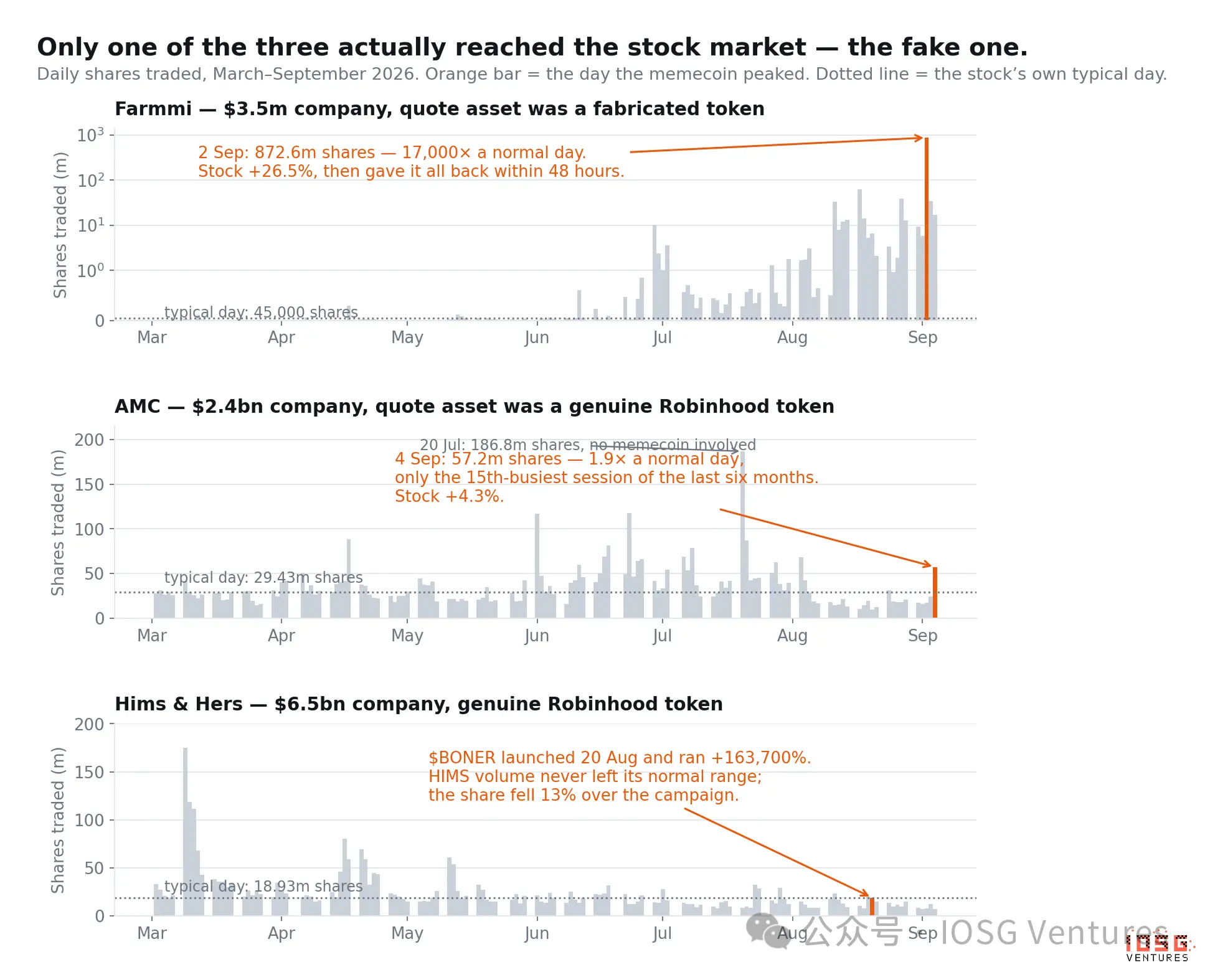
This model is exactly the opposite of intuition. The time when the on-chain market had the most impact on the stock market was precisely when the company was so small that the on-chain crowd was almost its entire market, and this situation only occurs when the priced asset is fabricated, because Robinhood does not allow tokenization for companies with a market cap below one billion dollars. The two real tokens correspond to companies that are too large; a buy of $3.6 million or $7.6 million cannot support the price.
As for the fate of these meme coins, it has nothing to do with the above: $CINEMA ignited the fire for AMC, now down 93%. $MEME arrived late, took over the crowd, and is now worth $102 million. $JINQIAN is tied to the only stock that has been genuinely pushed, down 98%. They are attention assets, and the companies printed on the labels are merely decoration.
VI. The Real Weakness is the Weekend, and On-Chain Short Squeezes May Happen There
The real structural weakness here is not on the stock side, but rather that the subscription channel operates on New York business hours, while tokens trade 24 hours.
This can be seen in real-time now. While writing this, any Robinhood stock token (AMC, Hims, GameStop, Nvidia, SPY) last had new supply added at 23:35 UTC on Friday, September 4, which was 50 hours ago. Monday is Labor Day, and the channel will not reopen until pre-market on Tuesday, creating an 80-hour window: tokens trade as usual, but no one can create a new one.
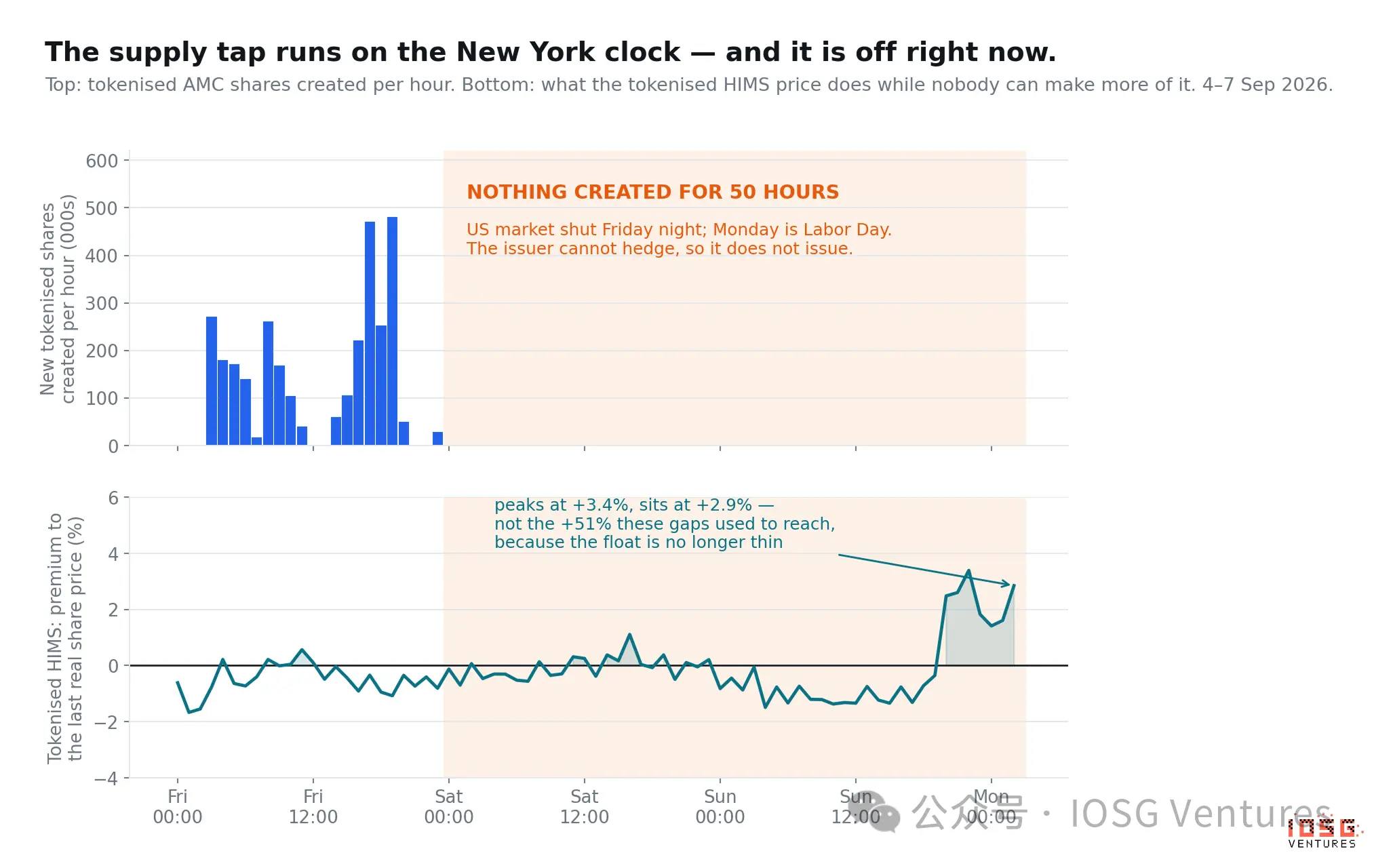 Reading this alongside Section 3, the previous conclusions need to be narrowed down a bit. All previous arguments stated that a short squeeze was impossible because the circulating supply is alive. But in this window, the circulating supply is not alive; it is dead. For three whole days, the supply of tokenized AMC was as frozen as the equity of GameStop in 2021, and no arbitrageur could loosen it no matter how much they offered.
So the honest conclusion is narrower than "nothing can be squeezed here." Listed stocks cannot be squeezed through this channel; the reasons are in Section 3. But the tokens themselves can be squeezed, and only during the market closure window. This is not a hypothesis: $18.04 to $2.54 is how it came about, and the +51% closing of tokenized Hims we measured in August also came this way. The short squeeze at the token level is a real, recurring phenomenon driven by the calendar.
This raises an obvious question: why is it not happening now?
It is indeed not happening, and the reason is crucial. Throughout the weekend, tokenized Hims fluctuated between -2% and +4%, now sitting at +2.9%. Tokenized AMC was discounted most of the time, dropping as low as -7%. The two combined traded about $40 million, and the anchor has not loosened.
Still the initial 19 times. After the panic, the issuer did not pull back the supply, so the frozen market is a deep one: 2,895,758 shares, not 152,106 shares. Thin circulating supply has always been a necessary condition; market closure is just an amplifier. The AP used three days of excess supply to pull the fuse for the next three days ahead of time. For an unintentional act, this is quite impressive.
For holders of such tokens, the practical interpretation is: The risk factor is the calendar, not the company. When a long weekend, public holidays, and a recently under-issued obscure asset come together, the relationship between the on-chain price and the real stock price is the weakest.
Stress Test: How big does this need to be to potentially work?
This is not a plan; it is a ruler used to measure how far this mechanism is from being "effective." First, let’s explain two terms, as the entire argument hinges on them.
Short Balance is the number of shares that have been borrowed and sold, with the sellers betting that the price will fall. These shares will eventually need to be bought back. This is the fuel.
Replenishment Days is the short balance divided by the average daily trading volume: if the shorts are the only buyers in the market, how many normal trading days will it take to buy everything back? This is the fuse. A high number indicates that the shorts are trapped; the normal trading volume is insufficient for them to exit without raising prices; a low number indicates they can slowly exit through the front door.
The number of shares sold short for GameStop exceeded the available shares, making it impossible for any normal trading volume to allow everyone to cover their positions, which is why the price skyrocketed. The replenishment days for tokenizing this batch of assets range from 3 to 9. Everyone can exit.
Thus, the ceiling is set: even if all the shorts for these assets were to cover simultaneously, the increase would only be 7% to 14%. None can double.
Let’s add two more metrics. The conversion rate of the channel: $BONER reached a peak value of about 85 million dollars, forcing about 3.6 million dollars of real Hims stock purchases and custody, which means that every 1 dollar of meme coin market value corresponds to about 4 cents of forced buying. The cost: to push the stock price to the extent of a complete short squeeze, the channel would need to buy almost the entire short position.
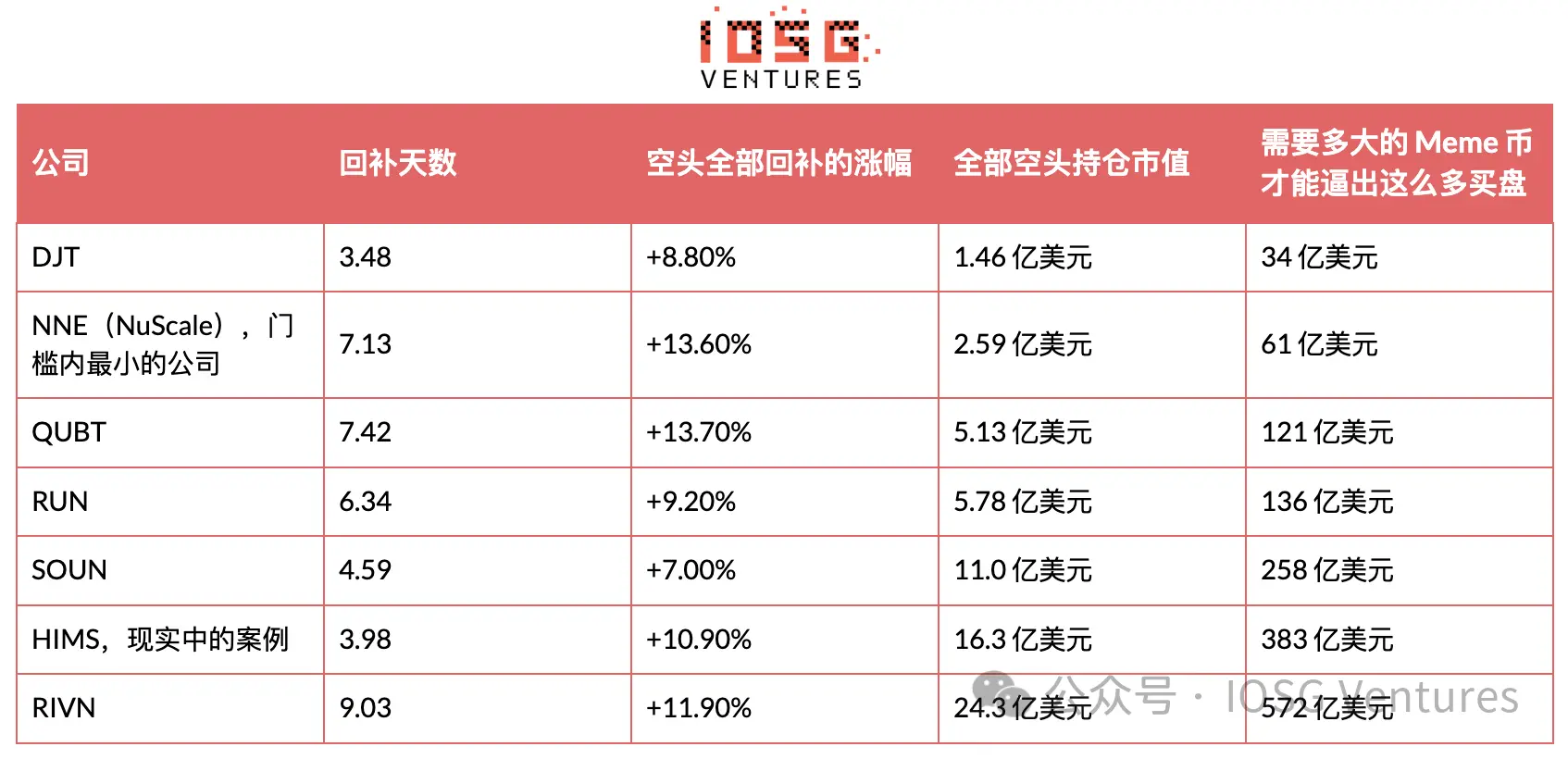
Here’s a scale: the largest meme coin in the chain's history is $AI, at 270 million dollars. The lowest threshold for the outer door requires thirteen times that, yielding about a 9% increase.
There are no cheap small stocks to choose from either. Among the companies tokenizing, the smallest is NuScale, at 951 million dollars, three orders of magnitude higher than Farmmi. This threshold is not a coincidence: the existence of pseudo-tokens is due to it, and the safety of real tokens is also because of it.
VII. Under what circumstances would we change our judgment
If Robinhood lowers the market cap threshold or issues a series for truly small companies. The entire safety margin here is that none of the assets that can be squeezed have been tokenized.
If a second authorized participant appears, or if the existing one speeds up. The ceiling of today’s premium is determined by how long the channel has been closed. A 7×24 subscription channel would erase the last real disconnection, while a slower or narrower channel would amplify it.
If U.S. stocks shift to 24-hour trading, it would directly eliminate price differences during non-trading hours.
An obscure asset collides with a long weekend. The loophole mentioned in Section 7 is now dormant, due to increased supply, not because someone fixed it. A newly launched or recently infrequently issued token coinciding with a public holiday market closure brings back that attribute from 2021.
Falsified priced assets have shifted from exceptions to the norm. Within a week, two clone contracts have aligned the equity table to five significant digits, and one counterfeit code has already squeezed into the most active venue on the entire chain. This area of diffusion requires no one’s approval.
VIII. What do we take away from this?
The throat of tokenized stocks is the subscription and redemption channel, not the trading venue. Everything downstream, including issuance platforms, meme coins, and liquidity pools, is replaceable and will ultimately lead to no profit. The irreplaceable seat is the one that simultaneously holds the issuance license, custody relationship, and AP whitelist. If we want exposure to tokenized stocks, it is here.
The discipline of premiums comes from a functioning primary market, which is an old lesson for ETFs, repeated again on-chain within a week. The median premium for tokenized Hims is less than 1%, as anyone can create more at any time. The counterfeit FAMI token lacks this foundation, so its premium has not converged but has instead directly crossed parity to a 10% discount and continues to decline. The same shaped curve, opposite mechanisms, and completely different risks.
Falsified priced assets are the next regulatory flashpoint and the real investor protection issue here. A token that imitates the entire equity of a company, has nothing behind it, does not disclose the issuer, and is sold alongside real securities to retail investors is not a fringe case; it has appeared twice and is spreading. It costs 400 dollars to create one, and it is indistinguishable from the real thing in any consumer-grade interface. This is worth asking Molly if we should say anything more.
This also changes what these types of coins really are. They are not leveraged exposure to a listed company. During trading hours, the underlying can only explain 1% of the coin's volatility, with almost no company involved. It is more akin to a bet on corporate attention: will the CEO notice, will the company respond, will this code be involved in a story so big that the headquarters must make a statement? This bet has been won. Aron’s post is the starting point for the largest price fluctuation in this article, and the CEO of Hims & Hers has also paid attention to the $BONER account. Neither of them is endorsing anyone; attention has still been paid for.
A short squeeze is another leg. It is the one that has been sold and the one that is invalid. Buyers of these coins should at least be clear about which one they are truly going long on.
Finally, there is the framework worth keeping. A short squeeze is not "a lot of increase," but "the increase feeds itself." Tokenization makes the circulating supply active, thus converting the spiral that should form into a one-time diminishing shock cost, real, measurable, and ending before noon. The characteristic that makes tokenized stocks good infrastructure is precisely the characteristic that makes them un-squeezable. This is a good outcome for Robinhood and an expensive lesson for everyone who bought into this narrative, while also reminding us: what we should focus on is the issuance layer, not the trading layer built on top of it.
 Risk warning


Popular articles