On the eve of the Apple launch event, a hundred billion in market value evaporated, yet the eight giants of the fruit supply chain surged against the trend?

 Fruit Chain concept stocks surged across the board: Corning rose 7.56%, Coherent increased by 7.10%, and Ekran Technologies climbed 6.18%. Tomorrow's press conference, in addition to the features of the new products being unveiled, what other information is worth paying attention to?
Source: BIT Securities
Tonight, the world's attention will be focused on Apple's "Surprise and Shine" fall event at 10 AM Pacific Time on September 9. However, on the last trading day before the event, the main character fell while the supporting cast rose: Apple closed at $316.22 last night, down 1.17% for the day, and combined with the previous trading day's decline, the total drop over two trading days reached 3.7%. Meanwhile, companies in the Apple supply chain saw significant gains: Corning surged 7.56%, Coherent rose 7.10%, and Aker Technology increased by 6.18%. This contrast perfectly illustrates the term "Surprise": besides the anticipated features of new products at tomorrow's event, what other information is worth paying attention to?
1. What hidden risks are in Apple's Q3 financial report? Memory costs are eating into profits.
At the end of July, Apple announced its Q3 results for the fiscal year 2026, ending June 27. The financial report itself was quite impressive: total revenue exceeded $109.4 billion, a year-on-year increase of over 16%, setting a historical record for the same period; iPhone revenue grew by over 20% year-on-year, and service revenue also reached a historical high, with paid subscription users surpassing 1.5 billion. However, a closer look at the data in the report reveals less obvious warning signs hidden in the gross margin and cash flow:
Tariff refund inflation: The Q3 gross margin reported was 50.1%, but this was boosted by a one-time tariff refund of about two percentage points. Excluding this one-time factor, the actual gross margin is about 48.1%, which is a decline from the previous quarter (Q2 was 49%). Although management clearly stated during the earnings call that the increase in memory costs has exceeded all reasons for the quarter's gross margin decline, this explanation has inadvertently increased market expectations that the prices of new product releases will rise across the board.
Supply constraints, not insufficient demand: For the upcoming September quarter (Q4 of fiscal year 2026), the guidance provided indicates a revenue growth range of 9% to 11%, clearly defined as "supply constrained" rather than "demand insufficient": iPhone sales set historical records in multiple regions, with active installations and upgrade numbers reaching new highs, indicating that the demand side remains solid while pressure is concentrated on the supply side.
Cash flow and services duality: It is worth noting that despite the pressure on product gross margins from memory costs, operating cash flow for the quarter still grew by over 23% year-on-year, and free cash flow increased by over 30% year-on-year, indicating that cash generation capability has not been significantly hampered; however, the service business, originally expected to perform well with a gross margin of 75.6%, has seen its quarter-on-quarter growth rate slow from 16% to 12%.
2. Apple concept stock list revealed: Why these 8 stocks continue to surge.
Apple products occupy the longest segment of the global consumer electronics supply chain, especially with the new industry chain integration of foldable screens. The revenues of dozens of publicly listed companies worldwide are tied to Apple's shipping rhythm to varying degrees. The core suppliers identified in Apple's "American Manufacturing Program" (AMP), a four-year domestic investment plan totaling $600 billion, have undergone multiple screenings for capacity scale, yield stability, and supply security, making it a commonly referenced authoritative list when the market selects "Apple concept stocks."
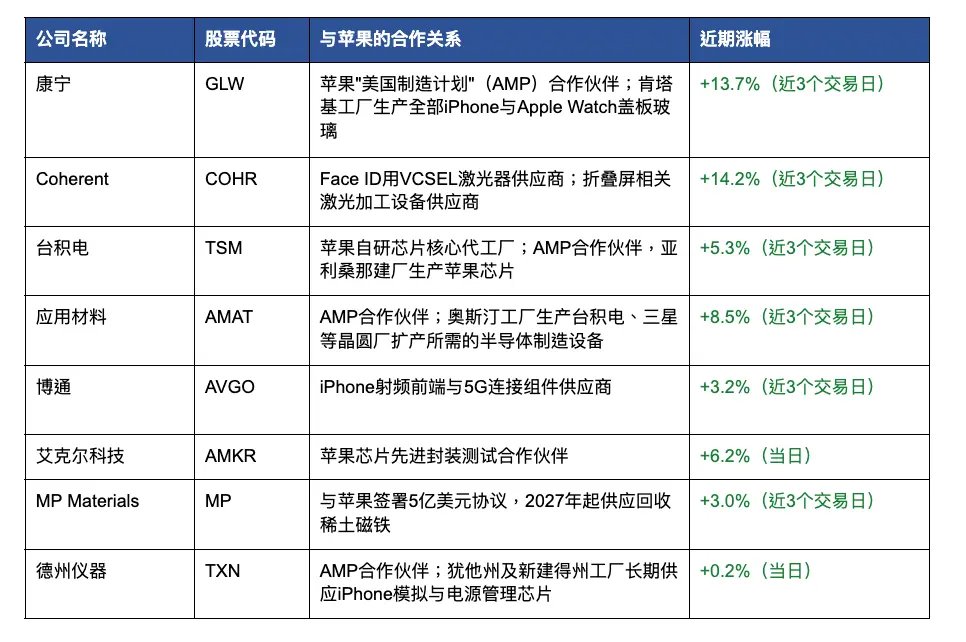
3. The surge in the Apple supply chain has dual clues: Nvidia's investment and Apple's own strategy.
The recent rise in the Apple supply chain is driven both by Apple's own strategic layout and the indirect influence of the AI capital expenditure wave.
Apple's collaboration with Intel: In June this year, Apple partnered with Intel to design and manufacture chips in the U.S., aiming to reduce reliance on TSMC and Asian foundry capacity, while locking in domestic advanced process capacity in advance to prepare for the AI-driven upgrade cycle over the next three to four years. This aligns with Apple's nearly $60 billion investment in domestic manufacturing, marking a key step in strengthening bargaining power and long-term supply security amid a shift towards AI data centers.
Coherent: The latest quarterly report significantly exceeded expectations and received approximately $2 billion in strategic investment from Nvidia, with orders for optical modules aimed at AI data centers scheduled for production until 2028, far exceeding its Apple Face ID laser business.
Corning: Nvidia has announced an investment of up to $3.2 billion for the construction of three AI fiber optic factories, while also securing orders from Amazon; the iPhone cover glass remains a traditional business, but its new identity as an AI data center fiber manufacturer is being repriced.
Broadcom: The latest quarter saw AI chip-related revenue soar by 221% year-on-year to $16.7 billion, with next quarter guidance increasing by another 236% to $21.7 billion, primarily from custom AI chip orders from cloud providers like Google and Meta, far exceeding its iPhone radio frequency front-end business.
TSMC and Applied Materials: TSMC raised its 2026 capital expenditure budget from about $56 billion to $60 billion to $64 billion, citing stronger-than-expected AI demand, with management stating that spending will significantly exceed the past three years over the next three years. Applied Materials, as an equipment supplier, directly benefits from the expansion of wafer fabs; Intel also raised its capital expenditure guidance to over $20 billion, echoing its collaboration pace with Apple—indicating that the semiconductor equipment industry is in a capital expenditure upcycle driven by AI, with Apple also involved.
Aker Technology: Entered into a $1.5 billion multi-year collaboration with Nvidia, with the latter providing upfront payments to support its expansion of advanced packaging capacity in the U.S., along with a $7 billion new factory plan in Arizona (expected to start production in 2028). However, its stock price has fallen by about 40% over the past month, with concerns about insider selling still present; the recent rebound appears more like a phase of repair rather than a trend reversal.
Texas Instruments: The smallest increase, with the most "traditional" logic: industrial customer demand grew by 30% to 35% year-on-year, automotive electronics grew by 12% to 15%, and consumer electronics grew by 6% to 8%. The analog chip industry is broadly recovering, with some product delivery cycles extending to over 16 weeks, allowing manufacturers to raise prices.
MP Materials: The rare earth and critical minerals sector has strengthened due to U.S. supply chain independence policies and defense orders, driving growth. The company also secured a multi-year rare earth contract worth nine figures in Q2, and it will deliver on Apple's recycling magnet agreement in 2027.
From these growth logic points, it is not difficult to see a common source: storage and advanced process capacity are being systematically reallocated. In Q2, DRAM contract prices rose over 40% quarter-on-quarter, and NAND prices increased over 60%, with supply tightness expected to persist through 2027 and even into 2028. In the face of this reallocation, Apple has chosen to take proactive measures by locking in domestic chip capacity through its collaboration with Intel. This same supply tightness is both the root cause of Apple's gross margin pressure and the fuel for these companies' stock price increases—Apple and Apple concept stocks are essentially on opposite ends of the same industrial upheaval.
4. Why is Wall Street skeptical about Apple? Rumors of an all-glass iPhone change, how will Apple solve the price increase dilemma?
What went wrong in the high-end strategy: Apple's original plan to hedge against this cost shock was an all-glass iPhone designed for its 20th anniversary, expected to be priced over $2,000, with plans to gradually extend this high-end design to future Pro and Pro Max series, thereby systematically raising the pricing center of the entire iPhone product line. However, supply chain inspections indicate that this model has likely been canceled due to yield issues. As of late August, the actual production of foldable screens remains at "a few hundred units per day," far from the target of nearly ten million units per year. Even though there are reports that the 20th-anniversary concept model may be postponed to 2027, a product with a starting price expected to exceed $2,000 can only naturally cover a small portion of users willing to pay for its form factor.
Multiple defenses, but no single card can solve the problem: In the face of a cost shock that cannot be resolved solely by its own strength, Apple is playing several cards simultaneously. In June this year, Apple signed an agreement with Intel for the latter to design and manufacture some chips in the U.S., aimed at diversifying reliance on TSMC and expanding advanced process capacity. However, this action occurred shortly after management publicly stated that "the situation is unsustainable" and "price increases are inevitable," interpreted as Apple paving the way for supply chain adjustments ahead of the September price increase and new product launch. In addition, pricing, product mix, and service revenue form three additional lines of defense: the risk of pricing lies in demand elasticity, with excessive increases directly impacting sales; product mix adjustments can only have marginal effects; while service revenue has a high gross margin of 75.6% (compared to a product gross margin of only 40.1%), its quarter-on-quarter growth rate has slowed from 16% to 12%, and App Store revenue has also seen its first year-on-year decline in many years.
The originally highly anticipated and most worry-free line of defense—stimulating upgrades through AI features—is currently also difficult to independently drive a new wave of upgrades solely through model capabilities: whether Siri can truly understand user intent and complete tasks across applications largely depends on Apple's control over the third-party application ecosystem and user data interfaces, which is particularly limited under the regulatory environment in the Chinese market. This is also an important reason why the AI narrative is unlikely to independently drive a new wave of upgrades in the short term.
5. Still worth looking forward to: New CEO's debut + foldable screen launch: The biggest highlights of tomorrow's event.
The new leader's first public appearance: Setting aside these pressures, tomorrow's event still holds enough suspense to warrant attention. This will be the first public product launch since John Ternus took over as CEO on September 1. He has overseen the iPhone, Mac, AI hardware, and other product lines that account for about 80% of the company's revenue for several years. The market has high expectations for how this engineer-turned-leader will find a balance between the AI wave, supply chain restructuring, and product innovation—this event is, in some ways, his first public opportunity to prove that the leadership transition will not interrupt Apple's execution rhythm.
Will the foldable screen deliver "Apple-style amazement": There is also real suspense on the product front. If the first foldable iPhone is unveiled, it will represent Apple's biggest design innovation since the introduction of the full-screen design, featuring a dual-screen design with an approximately 8-inch inner screen and a 5.x-inch outer screen, combined with a new generation 2-nanometer process chip. If the actual experience is sufficiently impressive, some institutions predict it could contribute significant revenue during the holiday season, even leading to a "hard-to-get" buying frenzy. The new generation iPhone Pro and Pro Max, with upgrades in imaging systems, performance, and battery life, as well as how the event packages the "value" of this round of price adjustments, will directly determine the market's acceptance of the price increase logic. In other words, the final meaning of the term "Surprise" will depend on whether it is the genuine product surprise brought by the foldable screen or the shock brought by capacity and pricing realities—the answer will only become clear at the moment the event reveals its content.
Disclaimer | This article is compiled and analyzed based on publicly available market information, industry rumors, and news reports, involving a large amount of predictive content and comprehensive judgments on the reasons for individual stock price fluctuations. The statistical ranges of stock price increases in the tables are not completely consistent (as noted in parentheses), and there is significant uncertainty regarding the actual published content, pricing, supply arrangements, and stock price performance, which should be based on official announcements and actual market trends. This article does not constitute investment advice, and the individual stocks mentioned do not represent any buy or sell recommendations. The market carries risks, and decisions should be made cautiously.
 Risk warning