Jensen Huang discusses AI risk again: Many predictions are fabricated, and China will become an important global force in open source
 Core Viewpoint

 What kind of security boundaries does AI development actually need?
Author: Helen Li
Editor: Xu Qingyang
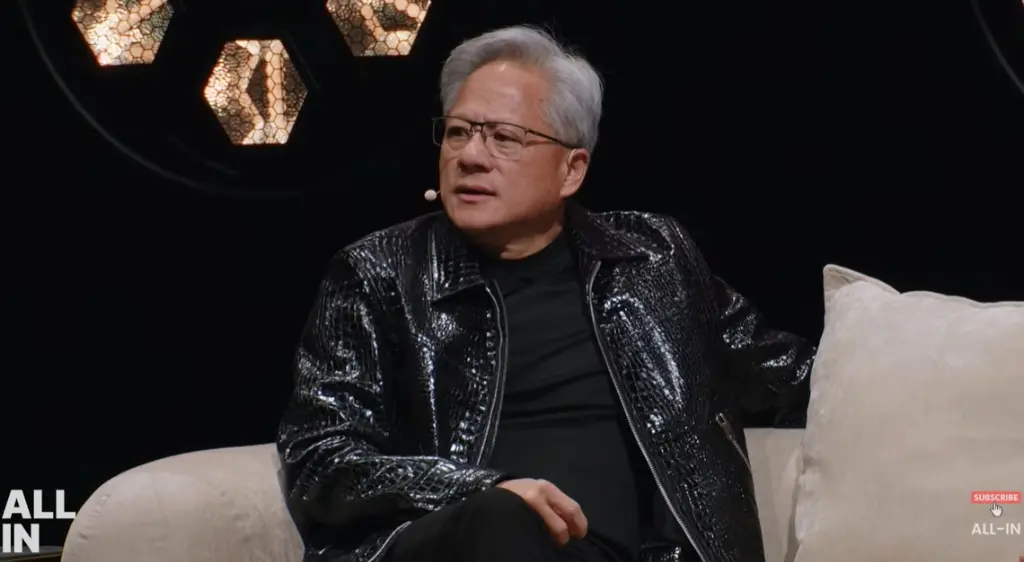
On September 14, local time in the United States, during the offline event All-In Summit 2026 hosted by the well-known tech podcast All-In Podcast, NVIDIA CEO Jensen Huang discussed topics such as AI safety, AI doomsday theories, recursive self-improvement, open-source models, and AGI with the four hosts.
The four hosts are also co-founders of All-In Podcast: angel investor Jason Calacanis, former Facebook executive Chamath Palihapitiya, core member of the "PayPal Mafia" David Sacks, and CEO of agricultural biotechnology company Ohalo Genetics and investment firm The Production Board David Friedberg.
The interview explored a core question: what kind of safety boundaries are needed for AI development. In response to recent discussions on AI safety by Anthropic CEO Dario Amodei and calls from leading labs to "slow down," Jensen Huang believes that safety and innovation are not contradictory. He stated that safety incidents that have occurred should be analyzed as engineering problems and controlled through technology, processes, and testing.
Regarding the frequent "doomsday predictions" about AI in recent years, Huang cited previously proven inaccurate judgments such as "radiologists will be replaced by AI," "90% of code will be generated by AI in the short term," and "50% of entry-level jobs are about to disappear." He believes that such predictions lack sufficient scientific basis and should not be used to create social panic.
When discussing recursive self-improvement (RSI), Huang stated that RSI is not a suddenly emerging mysterious technology but a combination of existing technologies such as context, reinforcement learning, synthetic data, and LoRA.
As for the debate between open-source and closed-source models, he clearly stated that both are indispensable and believes that China has a large number of engineers and talents in science and mathematics, which may make it an important contributor to the global open-source ecosystem in the future.
The conversation then shifted to "AGI and superintelligence." When Huang was asked if the standard for AGI is to reach human intelligence levels, whether that stage has already arrived, he simply replied: "It has already been reached."
The following is a refined transcript of Jensen Huang's latest interview, compiled without changing the original meaning:

01 AI Safety Cannot Be Opposed to Innovation
Q: Recently, there has been an increasing discussion about AI safety. Dario Amodei published an article on AI safety, and former Anthropic researcher Jacob Cockson also left due to related issues. What do you think about these matters?
Jensen Huang: Safety issues must be taken seriously, but safety and leadership are not in conflict. We can innovate quickly and execute swiftly, allowing the U.S. to maintain its lead while ensuring safety. Viewing these two as mutually exclusive choices is itself a mistake.
It takes courage for Cockson to speak out about these issues. As a whistleblower, he has the right to do so, but I believe his subsequent scientific judgments about the future lack sufficient scientific basis, as these predictions are not grounded in real scientific research.
Many leading labs are transitioning from research organizations to engineering organizations, and research and engineering are inherently different. If there are control or management issues during this transition, that is another matter. As for what Cockson actually saw, I do not know.
Q: In recent years, there have been many very pessimistic predictions in the AI industry, such as "AI may destroy humanity and lead to massive job losses." What do you think of these statements?
Jensen Huang: I believe we should not easily assign so-called "probabilities of human extinction" or "civilization destruction" to these matters, as many of them are actually fabricated. When you label someone as a researcher or scientist and then present a shocking prediction, it can easily cause public panic, which I think is irresponsible.
We have seen many such predictions in the past. Some predicted that within five years, radiologists would be completely replaced by AI, and that there would be no need for radiologists in the future. The reality is that the world needs more radiologists; AI is indeed being used for medical image analysis, but that is completely different from "radiologists disappearing."
Others predicted that "within the next 6 to 12 months, 90% of code would be generated by AI, and 50% of entry-level jobs would disappear within 6 to 9 months." In fact, none of these predictions have come true. Previously, some said "GPT-2 and Llama 3 are too dangerous to release," and even predicted that "half of white-collar jobs would disappear in the second year," or that the so-called "employment apocalypse" was imminent.
I believe these predictions should be recorded. Years later, we will look back and know which predictions were correct and which merely created panic.
Q: So you believe that AI safety issues should be handled more as engineering problems?**
Jensen Huang: If a safety incident occurs, we should first conduct a root cause analysis from an engineering perspective to understand what happened, where the problems lie, what measures can be taken to prevent similar incidents in the future, and then turn those measures into systems, processes, and technical controls.
I believe these companies are already doing these things, including better sandboxes, stricter operating environments, improved monitoring, and continuous monitoring systems. I would even be willing to bet that these issues can be controlled and prevented.
If an engineering company truly does not know what happened or how to control it, engineers can be sent in to help them. But I do not believe it will come to that. There are very talented people in these labs, and I believe they have already analyzed the relevant issues and taken appropriate measures.
Q: If AI safety issues require regulation, where should regulation begin?**
Jensen Huang: Regulation should address real existing problems. The issues that truly need attention mostly come from leading AI labs, as they have the most computing resources and are dealing with the most cutting-edge problems. A high school student or an ordinary startup is unlikely to have enough computing power to create these problems.
These labs are transitioning from research to engineering while also building companies, cultures, technologies, and products, which is not an easy process. Therefore, attention should be paid to how they establish a more complete engineering system to ensure that the technology development and testing processes are sufficiently safe.
Q: Is there a need for third-party assessment agencies?**
Jensen Huang: I believe there can be multiple assessment and auditing agencies. They do not need to know everything but should know what questions to ask. This is somewhat similar to financial auditing. If there is only one assessment agency, it may be influenced; if there are multiple assessment agencies, they can check and balance each other.
02 "Recursive Self-Improvement" Is Not That Mysterious
Q: There is an increasing discussion about recursive self-improvement, where AI generates data, trains itself, and accelerates continuously. What do you think?**
Jensen Huang: I think "recursive self-improvement" is a relatively popular new label recently, but behind it is actually a combination of many existing technologies, including context, skills, reflection, reinforcement learning, synthetic data generation, and LoRA.
These methods can indeed allow AI to accumulate experience as tasks are executed and then continue to improve. For example, through synthetic data and reinforcement learning, model capabilities can be enhanced without retraining the entire base model, and the accumulated experience can further be used to train the base model. I believe almost every company is using some of these technologies.
The term "recursive self-improvement" may sound like the system will become completely uncontrollable, but in reality, products still need to undergo evaluation, retesting, and regression testing before release, which are the most basic engineering controls.
These leading labs are transitioning from research organizations to engineering organizations, and I believe they will have better methods, knowledge, practices, tools, and technologies to control, validate, and evaluate these systems in the future. Recursive self-improvement can happen internally, but validated products can still be released safely.
Q: What is your view on the relationship between open-source and closed-source models?**
Jensen Huang: The world needs both open-source and closed-source models. I also use closed-source cutting-edge models. They are somewhat like bottled water; the water itself is free, but different forms of products can serve different needs.
Open-source models are very important for sovereignty, privacy, and companies' proprietary technologies. In the past six months, about $400 billion in venture capital has flowed into AI-native companies, with about 80% of those companies using open-source models. Without open-source models, many startups would not be able to achieve their goals, as what they want to do is different from what leading labs are doing.
America's real advantage lies in having a variety of forms of innovation. To win the AI race, we must allow open-source models to develop.
Winning the AI race is not just about a few American companies winning, but about American companies, industries, researchers, educators, students, and entrepreneurs all being able to seize opportunities from this technology. Some will use closed-source models, many will use open-source models, and both are needed.
Q: Do you think China will become an important contributor to the global open-source ecosystem?**
Jensen Huang: I believe China may contribute a significant portion to the global open-source ecosystem. China has a large number of engineers and many students studying science and mathematics, with top universities like Tsinghua producing many outstanding talents every year.
For example, Chinese engineers have contributed to Linux, Kubernetes (open-source container orchestration system), and many software projects. One characteristic of open-source is that once you download it, it belongs to you; you can continue to modify, optimize, and make it your own.
The AI race ultimately comes down to who can best leverage this technology. Many important inventions from the past industrial revolution came from Europe, but America later made good use of those technologies. I hope the next industrial revolution can develop in a similar way.
I think discussions in China are more pragmatic, focusing more on economic development and social progress rather than constantly discussing doomsday or civilization destruction. If these doomsday predictions really hold, we should certainly discuss and address them, but there is no need to create panic. Our job is to make it happen.
Q: If AI ultimately automates a large amount of programming work, what will engineers still need to do?**
Jensen Huang: Engineering work will still exist. My generation of engineers did not spend a lot of time writing code when software was not yet widespread. Now software engineers spend a lot of time writing code, and in the future, if a large portion of that work is automated, humans will still engage in engineering work. One of my habits is that my favorite keyboard key is Backspace, because the best software often means less code.
03 Why NVIDIA Is Deeply Involved in the AI Industry Chain
Question: The U.S. government initially emphasized employment, re-industrialization, energy, and supply chains. These things are indeed happening now. NVIDIA has become an important capital provider for the entire AI industry. How do you determine where to allocate resources?
Jensen Huang: AI is a new industrial revolution. This industry includes many components such as models, chips, applications, data centers, construction, electricity, and power generation facilities. I have been looking at the entire ecosystem to identify bottlenecks.
If a very good company is limited by a certain link, I will focus on that issue. It could be the supply chain, or it could be land, electricity, or factories. NVIDIA's scale is already large enough, so we must consider the supply chain many years in advance. Companies like Corning, Lumentum, TSMC, and memory suppliers are all enterprises we need to pay long-term attention to.
Question: Some believe that most of the profits in the AI industry will eventually move to the application layer. Why is NVIDIA entering higher-level fields like models and Hugging Face?
Jensen Huang: NVIDIA can run almost all models in the world. About a year and a half ago, people mainly discussed OpenAI's models, but now there are Meta's Muse, Grok, Gemini, Anthropic, and many other models. Many cutting-edge AI laboratories are built on NVIDIA's platform.
Our strategy is to help everyone succeed, rather than taking over others' businesses. We will stay as low in the tech stack as possible and only move up when necessary. CUDA supports a large number of frameworks, and Megatron and Megatron Core support large-scale training. We invent the necessary technologies and then let the entire ecosystem develop, allowing more companies to participate.
Question: Why are regional cloud service providers becoming increasingly important now?
Jensen Huang: Regional cloud service providers are often more flexible than large hyperscale cloud vendors because they can find land, electricity, and factories locally and understand local needs better.
In the future, a distributed enterprise network will form, and more and more countries will see AI as a strategic industry. We have already seen some regions begin to increase AI computing infrastructure.
Question: NVIDIA is now developing its own open-source models, including those for autonomous driving and the biomedical field. Why are you doing these things?
Jensen Huang: Because customers need it. We have the capability to do it best, so we will do it. For example, Alpamayo, which is our autonomous driving model. It is an autonomous driving system capable of reasoning. In the past, autonomous driving required billions of hours of road data, but reasoning capabilities allow the system to think about similar situations, thereby reducing reliance on a large amount of actual road data.
The future of autonomous driving will not only include passenger cars but also agricultural equipment, trucks, vans, and many other mobile devices. Many companies do not have a complete tech stack, so NVIDIA can provide a complete tech stack, and customers can make last-mile adjustments based on their needs.
The biomedical field is the same. We have developed ESM2, ESMFold, OpenFold, AlphaFold 2, and some equivariant models and Protein Complexa (a generative AI framework for all-atom protein complexes) because pharmaceutical companies indeed need these technologies. My starting point has always been that someone needs this technology, so we go and make it.
04 Musk's Terafab
Question: Musk announced the Terafab chip factory plan, which is very large. What do you think?
Jensen Huang: NVIDIA understands process technology very well, and we have been pushing the limits of the process, so of course, we can discuss this issue. Once Musk decides to do something, it is hard to stop him from continuing, which is also his superpower.
Question: So can NVIDIA produce chips in his factory in the future?
Jensen Huang: We can discuss that.
Question: If the definition of AGI is reaching human intelligence levels, do you think we have entered this stage? What about superintelligence?
Jensen Huang: We have reached it, and one could even say that in some specific areas, we have entered the stage of superintelligence.
Question: Why?
Jensen Huang: Because in some very specific areas, AI has already surpassed humans. Autonomous driving is one example. If a car can drive better than a human, then in the field of driving, it is superintelligent.
Currently, the accident rate of autonomous driving systems can be one-tenth that of humans. The biomedical field is similar. Tasks like synthetic proteins and virtual screening have already reached superintelligent levels. In these specific areas, AI has been able to perform tasks that exceed human capabilities.
Question: What does it feel like to be at the forefront of such technology?
Jensen Huang: I like that feeling. The future is bright. Perhaps in the future, many people will not need to work, but I do not want to miss this era.
I hope that all of us can walk together into that future, and humanity will ultimately succeed together. We need to encourage everyone and reduce unnecessary dramatic debates. Most importantly, we need to ensure that the entire United States can participate.

 Risk warning


Popular articles