Bank of Japan Governor: Does not rule out the option of consecutive interest rate hikes, must proactively curb inflation, with the Middle East, AI, and exchange rates as key variables
 Core Viewpoint

 Kazuo Uetani stated that the potential price trend is continuing to approach the policy target of 2%, and against the backdrop of increasingly positive corporate wages and pricing behavior, there is a risk that the inflation rate may exceed the target. No specific policy options will be ruled out before the policy committee meeting. There are no thoughts on specific interest rate hike steps; policies will be decided after thorough discussion at each meeting, considering the timing and pace of policy adjustments.
Author: Wall Street Insight, Dong Jing
On Friday (September 18), Bank of Japan Governor Kazuo Ueda stated at a press conference that with the increasing willingness of companies to raise wages and more active pricing behavior, medium- to long-term inflation expectations continue to rise, and there is an upward risk to Japan's potential inflation rate exceeding the 2% target. He emphasized that interest rate hikes will continue based on economic and price trends, while stabilizing price trends around 2% is regarded as a core policy goal.
Kazuo Ueda mentioned that the strong demand for artificial intelligence, the recent rebound in oil prices, and the continued weakness of the yen have collectively driven producer prices to remain high, providing support for the continuation of inflation. Analysts believe this further strengthens market expectations for subsequent interest rate hikes by the Bank of Japan. Ueda stated that it is necessary to take preemptive action to curb inflation.
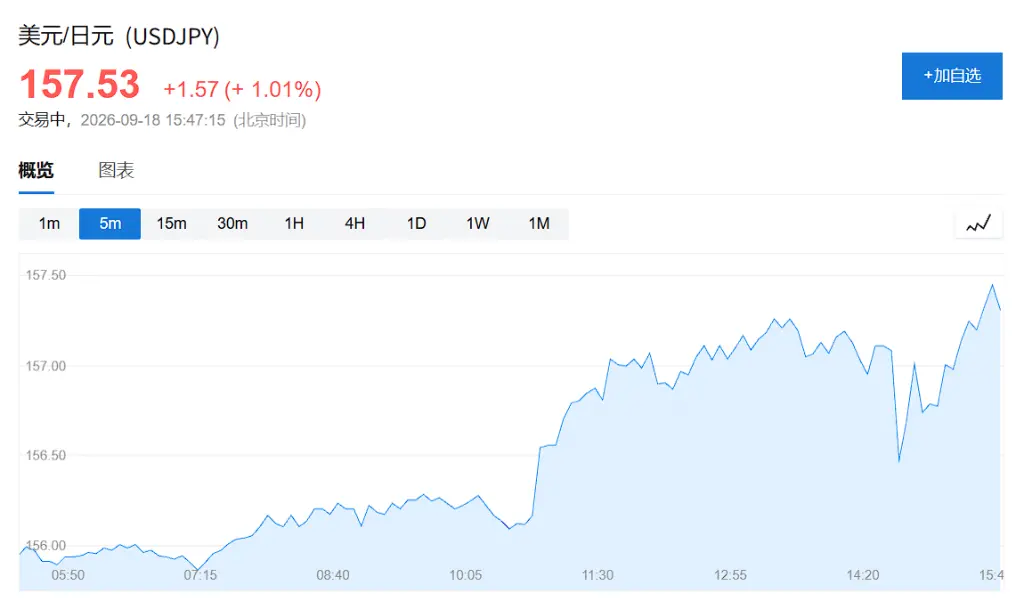
Regarding the pace of interest rate hikes, Ueda indicated that there are no specific thoughts on the exact pace of rate increases, and decisions will be made after thorough discussions at each meeting, considering the timing and pace of policy adjustments. When asked about the possibility of a 50 basis point hike or consecutive rate increases, he stated that no specific policy options would be ruled out in advance, and the pace and magnitude of rate hikes depend on price trends. A slow pace of rate hikes is not always a good thing. The dollar against the yen briefly fell about 50 points, returning below the 157 mark, and then continued to rise, currently up 1% for the day.
Ueda stated that it is difficult to determine whether the financial environment is too loose, and he committed to closely monitoring the cumulative impact of interest rate hikes on the financial environment.
The Wall Street Insight article stated that the Bank of Japan raised the benchmark interest rate by 25 basis points to 1.25%, the highest level since 1995, and this is the sixth rate hike since exiting the negative interest rate policy in March 2024. This rate hike is the fastest since 1990, marking a new phase in Japan's monetary normalization process.
The decision was not unanimous. Among the nine members, the two re-inflationist members appointed by Japanese Prime Minister Sanae Takaichi, Toyoshi Asada and Ayano Sato, voted against, reflecting ongoing divisions within the committee regarding further tightening.
Chidu Narayanan, Chief Strategist for Asia Pacific at Wells Fargo, believes this outcome "is not hawkish enough for the market and should drive the dollar against the yen higher while lowering short-end yen yields." Chidu Narayanan also stated, "Although two members voted against at this meeting, they are precisely the two most dovish members of the policy committee, which does not support market expectations for the Bank of Japan to quickly implement a series of rate hikes."
Inflation Approaching Target, Risks of Overshooting Cannot Be Ignored
On the inflation front, Ueda released a clearer warning signal. He stated that the underlying price trend is continuously approaching the 2% policy target, and against the backdrop of positive corporate wages and pricing behavior, there is a risk that the inflation rate may exceed the target.
He emphasized the need to avoid price deviations from the target that could harm the economy, and stabilizing inflation around 2% is an important consideration for current governance.
Additionally, Ueda pointed out that spring wage negotiations are an important factor influencing price trends.
Regarding rising inflation, Bank of Japan Governor Kazuo Ueda stated that the Bank of Japan needs to take preemptive action to ensure that inflation does not spiral out of control like it did in the U.S. and Europe a few years ago. He expressed the hope of avoiding prices exceeding the target to the extent that rapid interest rate hikes are needed.
Middle East Situation, AI Demand, and Exchange Rates Are Key Variables
Ueda identified three major external variables that will influence future interest rate directions: the situation in the Middle East, the expansion of artificial intelligence demand, and the trend of the yen exchange rate. He pointed out that due to the combined effects of these factors, Japan's producer prices are currently at a high level, and the recent rise in oil prices has further added inflationary pressure.
Analysts noted that the uncertainty of these external variables could either accelerate the pace of interest rate hikes by the Bank of Japan or serve as a basis for its cautious wait-and-see approach, with the final direction of the interest rate path largely depending on the evolution of these risk factors.
Kazuo Ueda: It Is Difficult to Predict the Appropriate Neutral Interest Rate Level
Bank of Japan Governor Kazuo Ueda stated that the stage of policy implementation has changed. The reason for the interest rate hike is the need to be vigilant about the risk of rising prices, and policies will be decided after thorough discussions at each meeting.
Regarding the pace of interest rate hikes, Ueda mentioned that there are no specific pre-set plans for the pace of rate increases. The current key is to stabilize prices around 2%. It is difficult to predict the appropriate neutral interest rate level, and the terminal rate is also hard to determine.
In response to questions about whether the central bank might implement consecutive rate hikes or larger hikes, Bank of Japan Governor Kazuo Ueda stated that the central bank will not rule out any specific policy options in advance before the policy committee meeting.
Moderate Economic Recovery, Monetary Conditions Still Loose
Ueda holds a cautiously optimistic view of the overall Japanese economy. He pointed out that the Japanese economy is on a path of moderate recovery, and although there are still some signs of weakness, it is expected to continue growing moderately.
In terms of monetary policy stance, Ueda stated that Japan's financial conditions are still loose, and it is expected that the loose monetary environment will be maintained and continue to provide strong support for the economy.

 Risk warning

Popular articles