Cryptocurrency concept stocks soared over 20% after a significant drop: The Clarity Act faced setbacks, and the SEC released major positive news to reverse the situation
 Last night, the U.S. Securities and Exchange Commission chose to bypass the congressional deadlock and took proactive measures. On September 17, it announced the "Innovation Exemption" policy, directly opening a 5-year compliance trial window for on-chain trading of tokenized U.S. stocks.
Just after the brutal drop following the failure of the CLARITY Act, U.S. cryptocurrency concept stocks staged a stunning comeback last night.
On September 15, the U.S. Senate held a procedural vote on the CLARITY Act, which ultimately failed with 49 votes in favor and 50 votes against. Eleven Republican senators switched sides, causing the crypto sector to crash. Within just two trading days, Coinbase fell over 10%, and Circle plummeted more than 11%.
However, just as the market fell into despair, the U.S. Securities and Exchange Commission (SEC) chose to bypass the congressional deadlock and took proactive measures. On September 17, it announced an "Innovation Exemption" policy, directly opening a five-year compliance trial window for on-chain trading of tokenized U.S. stocks. Under this significant positive news, cryptocurrency concept stocks surged collectively, with Securitize reaching a peak increase of over 20% during trading.
1. What Did the SEC Actually Approve?
On September 17, the SEC officially issued Order No. 34-106402, granting temporary conditional exemptions to qualified Tokenized Securities Venues (TSV). This order took effect immediately upon release and is valid for five years, while also publicly soliciting opinions for the formulation of subsequent formal rules. The core of this order includes two key exemptions:
Exchange Identity Exemption: Qualified TSVs can be exempted from being classified as exchanges under the definition of the Securities Exchange Act of 1934, thus avoiding the traditional cumbersome registration process of national securities exchanges.
Market Maker Identity Exemption: Liquidity providers supplying funds to Automated Market Maker (AMM) liquidity pools are exempt from the definition of dealers under Section 3(a)(5).
On-chain matching and on-chain market making have thus gained a temporary green light, marking a breakthrough that has been difficult to achieve under the U.S. legal system. SEC Chairman Gary Gensler positioned this as a transitional bridge to the establishment of lasting rules, rather than a final solution.
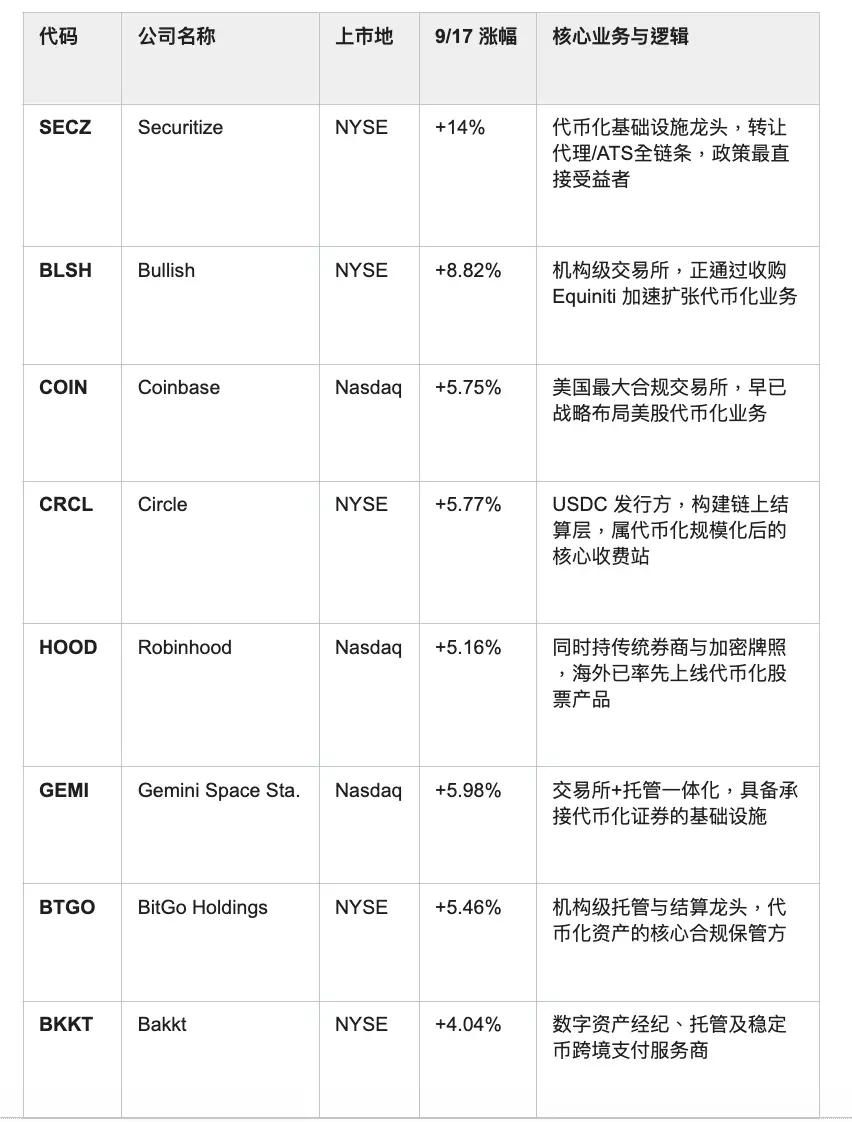
2. Which Cryptocurrency Concept Stocks Have Opportunities to Benefit?
In trading on September 17, the "cryptocurrency concept stocks" sector overall rose by 4.38%. The "on-chain financial infrastructure" sector, benefiting directly from the policy, performed particularly well.
The standout performer was Securitize, a leading tokenized infrastructure company listed on the New York Stock Exchange, which closed up 14% yesterday, with intraday gains nearing 24%, closing at approximately $9.36. Securitize provides a full range of services including transfer agency, brokerage, ATS trading, and fund management, with clients including BlackRock, Apollo, and KKR, making it the most direct beneficiary of this rule exemption. Its CEO stated that this framework finally paves the compliant path for trading truly tokenized stocks.
Overview of On-Chain Financial and Compliance Infrastructure Stocks
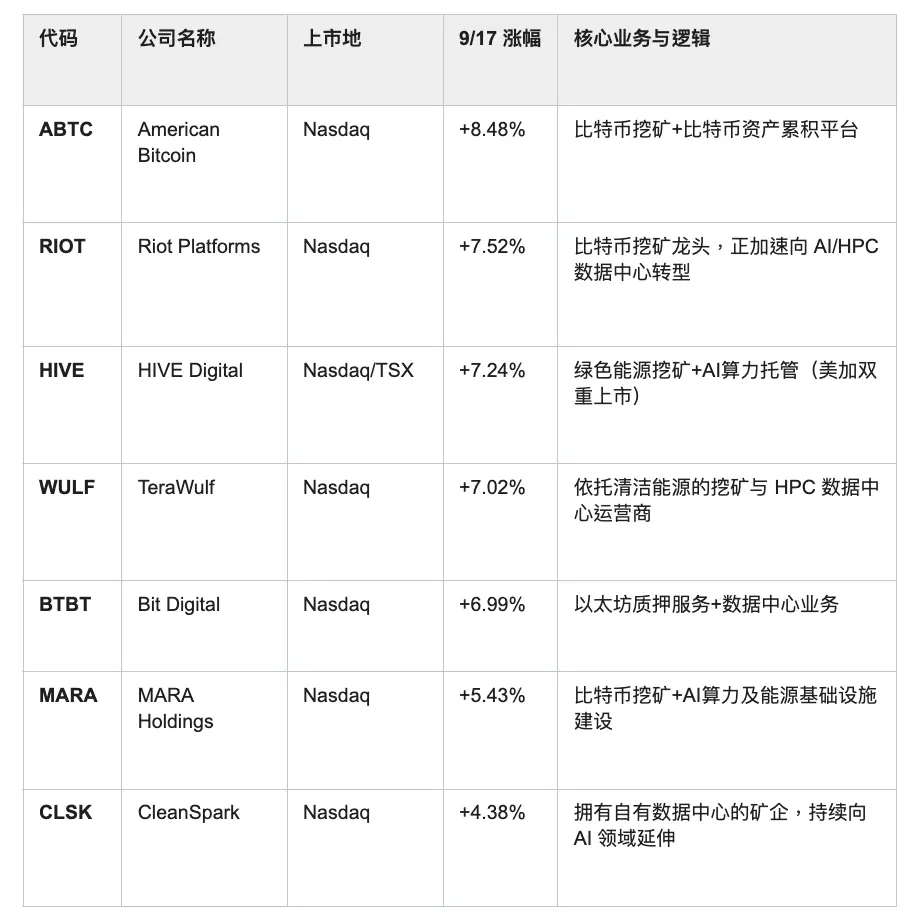
Overview of Bitcoin Mining Companies and Computing Power Transformation Stocks
Mining companies and computing power stocks rose across the board, not only due to policy benefits but also due to the rebound in Bitcoin prices and the dual narrative of AI and HPC high-performance computing power transformation.
3. Cryptocurrency Native Tokens Show Restraint, Digital Asset Treasury Stocks Experience Explosive Growth
Despite the policy benefits hitting the market, the mainstream tokens themselves showed relative restraint in their rebound on September 17. BTC was around $76,400–$76,600, with a daily increase of less than 1%, and ETH was at $2,444, up about 1.1%; mainstream tokens had previously reacted excessively negatively to the failure of the CLARITY Act, leading to a relatively smooth absorption of this positive news. In contrast, the altcoin market saw privacy coin Zcash (ZEC) surge by 17%–23% in a single day, reaching a historic high of $1,369. Paradigm co-founder Matt Huang publicly disclosed his holdings and referred to it as "Bitcoin's privacy supplement," stimulating a 37.8% surge in open contracts.
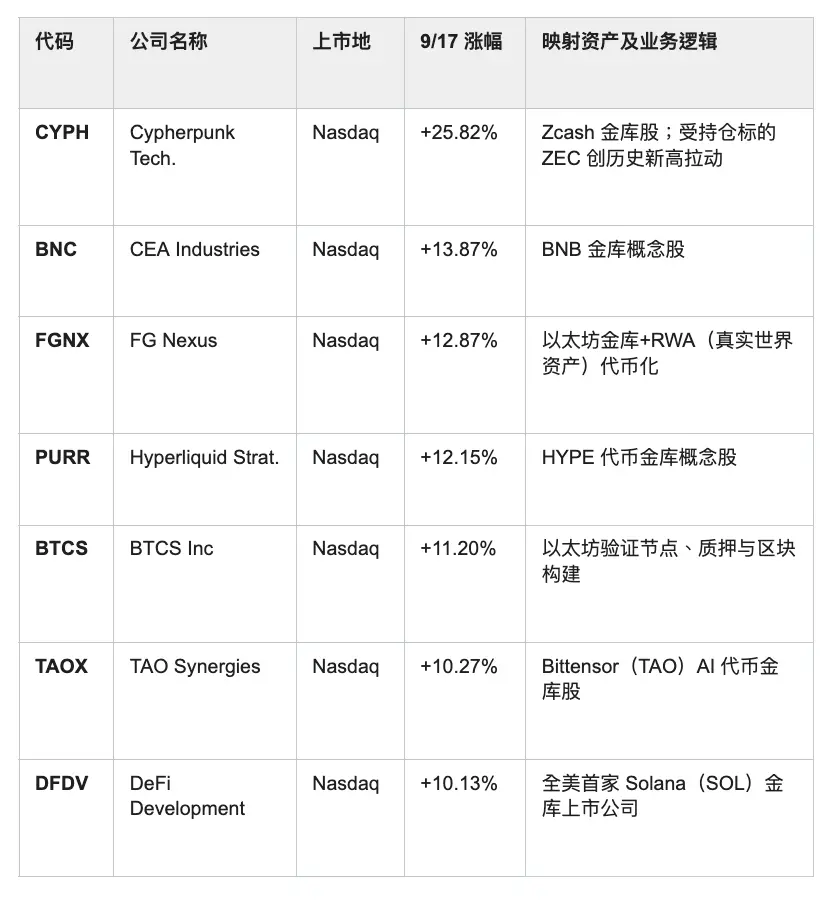
In this context, stocks of companies with digital asset treasury concepts also exhibited strong explosive potential. Since their stock prices essentially reflect a leveraged mapping of the held token assets, they experienced significant surges alongside the underlying tokens.
Overview of Digital Asset Treasury Concept Stocks
4. Global Coordination: Nasdaq's Entry and South Korea's Tokenization Roadmap
The exemption issued by the SEC is by no means an isolated policy event. If we broaden our perspective to the global dynamics of the past half month, two significant pieces of news with completely aligned directions are also noteworthy.
Nasdaq's Major Investment in Kraken: On September 10, Nasdaq invested $100 million in Payward, the parent company of Kraken, through its venture capital arm, raising its post-investment valuation to $21 billion, surpassing Citadel's $20 billion valuation given in November 2025. Nasdaq's move is not merely for financial returns but aims to secure key distribution channels. Nasdaq plans to officially launch tokenized stock trading in 2027, with Kraken as its core distribution platform. Nasdaq also insists on the route of "granting full shareholder rights, with traditional exchange shares being exchangeable one-to-one," strictly avoiding synthetic derivatives packaging.
South Korea Announces Three-Phase Securities Tokenization Roadmap: On September 4, the Financial Services Commission (FSC) and the Financial Supervisory Service (FSS) of South Korea jointly released a three-phase roadmap for tokenized securities: The first phase will start in February 2027, covering money market funds, institutional bonds, trust-structured unlisted stocks, and publicly issued fractional investment securities. The second phase will then expand comprehensively to all publicly offered stocks and bonds. Finally, the third phase will integrate on-chain payment and settlement infrastructure linked to stablecoins, gradually laying the groundwork for compliant and orderly trading in its market.
Risk Warning: This article is only a compilation of market information and policy interpretation and does not constitute any investment advice. The exemptions mentioned are temporary and conditional arrangements, with limitations on varieties and transaction volumes, and the direction of the system after five years remains uncertain; related individual stocks are highly volatile, please verify and make independent judgments.
 Risk warning
Popular articles