Midnight The real bottleneck of slow growth: it's not the product, it's market formation
 Core Viewpoint

 Midnight is not building another pool, but rather a set of on-chain term-credit infrastructure.
Author: Larry007_
1
The growth of Morpho's Midnight after its launch has not been rapid, but I don't think it's as simple as "the product is still early" or "the market doesn't like fixed rates."
Midnight has actually encountered a more interesting problem: the protocol can initially create fixed rates, fixed terms, and tradable credit, but a true term-credit market requires the simultaneous existence of borrowers, lenders, dealers, hedging, distribution, and collateral utility.
Contracts can go live, but that doesn't mean the market will automatically appear.
2
Let's first look at the current situation. The Midnight page currently has about $30M in deposits, $2.8M in outstanding loans, and $6.3M in cumulative originations.
$30M in deposits does not prove that supply has matured. Deposits may come from market making, experimental funds, or unexecuted quotes. It only indicates that at this stage, the most direct bottleneck is effective borrowing demand; funds are available but not being fully utilized.
Thus, the problem should be analyzed from the borrower side.

3
Crypto borrowers indeed need more predictable funding costs. Floating rates can quickly spike when utilization rises, making leverage strategies, basis trades, and treasury planning difficult to manage.
However, "the need for fixed or predictable rates" does not equate to "the need for fixed maturity."
Fixed terms also bring about repayment at maturity, rollover, and refinancing risk. For crypto borrowers with rapidly changing positions and uncertain holding periods, these constraints can sometimes be more troublesome than rate fluctuations themselves.
4
The @tydrohq v2 on Ink can illustrate this distinction, but it should not be understood as a direct competitor to Midnight, nor as a comparison of superiority.
Tydro is based on @aave-style pooled liquidity: borrowers pay a governance-set flat rate that does not automatically change with utilization, and loans do not have a fixed maturity date; lenders receive a supply APY that fluctuates with utilization.
It retains the usage habits of existing lending pools. Midnight, on the other hand, fixes both rate and maturity, allowing credit to be priced in the term market. The two address different problems.
5
Because of this, Tydro-style structures are more easily able to accommodate existing borrowing demand, while Midnight's goals are more forward-looking and harder to cold-start.
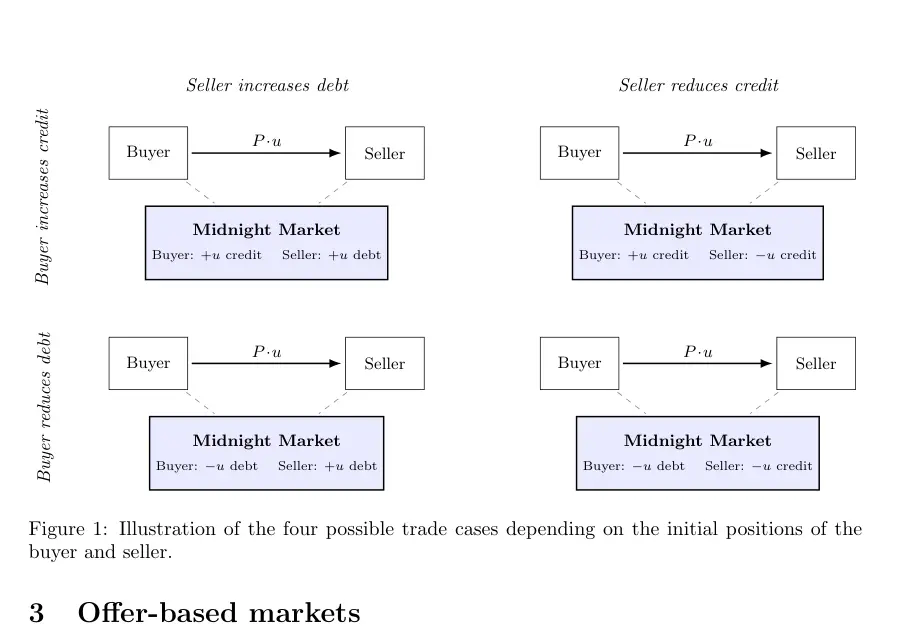
Midnight represents loans as tradable credit/debt units, forming prices and terms through offers and intents. It aims to establish not just a lending entry point but also a term structure, credit spread, and yield curve on-chain.
The value of such infrastructure could be significant, but it requires a sufficient and stable demand for debt issuance and holding in the market.
6
Here we encounter the first structural problem: Crypto lacks long-term, repeatable, and stable borrower demand.
On-chain borrowing mainly comes from leverage, arbitrage, market making, tax management, and short-term liquidity management. Demand is highly dependent on market conditions, funding, incentives, and arbitrageable spreads. Once carry decreases, borrowers can quickly repay or migrate to other protocols.
This is different from the structural demand formed by continuous government debt issuance, long-term corporate financing, mortgages, and consumer credit. Midnight needs not just more users but anchor borrowers capable of repeatedly issuing similar term debt.
7
The traditional zero-coupon bond and fixed-income market are large, but the scale is not created by the "zero-coupon bond" contract structure itself.
On one side are governments, corporations, and financial institutions that continuously issue debt; on the other side are pension funds, insurance companies, banks, and bond funds, which inherently need duration.
In between are primary dealers, repo funding, futures, interest rate swaps, clearing, and large balance sheets. Dealers can undertake issuance, hold inventory, finance, and hedge risks.
Bonds are just the surface. The real liquidity is created by the entire market network.
8
As DeFi develops, the boundaries between Crypto and traditional finance are actually becoming increasingly blurred.
Stablecoin reserves hold U.S. Treasuries, tokenized treasuries circulate on-chain, institutions use DeFi through qualified custody, credit platforms introduce underwriting and legal agreements, and on-chain assets begin to enter the balance sheets of traditional institutions.
Using TradFi as a reference does not mean requiring DeFi to replicate traditional finance. It is more like a functional map: which links are still missing, and which can be redesigned with on-chain transparent settlement, programmable collateral, and composability. The gaps themselves often represent the growth direction for the next stage.
9
Crypto also has an additional layer of risk compared to traditional fixed income: the vast majority of on-chain loans still rely on over-collateralization.
To borrow $100, one often has to lock up more than $100 worth of BTC, ETH, or other assets. A significant portion of debt in traditional finance is priced based on the borrower's credit, cash flow, balance sheet, and legal recourse.
Therefore, on-chain fixed-term credit must deal with collateral volatility, liquidation, oracles, stablecoins, smart contracts, and bad-debt risk, in addition to interest rates and duration.
10
This simultaneously limits demand and liquidity.
From the borrower's perspective, over-collateralization is more suitable for leverage, arbitrage, and holders who temporarily do not want to sell assets, but it is difficult to generate long-term sustainable financing demand like corporate credit, mortgages, or government debt.
From the lender's perspective, different collateral, loan-to-value ratios, and oracles create credit that is not entirely homogeneous. A claim backed by cbBTC and a claim backed by PT-USDe, even with the same maturity date, do not represent the same risk.
Thus, liquidity is not only split by maturity but will also be split again by collateral risk.
11
Fixed terms also impose new requirements on lenders.
Once a lender locks in a fixed return, rising market interest rates will reduce the relative value of old credit. Exiting early requires secondary market buyers; converting fixed exposure back to floating exposure requires interest rate swaps, @pendle_fi yield tokens, or other hedges.
These tools have begun to emerge, but the depth addressing lending-rate risk is still limited. Without a mature hedge layer, professional funds will demand higher spreads, shorter durations, or simply only participate in floating-rate pools that can exit quickly.
12
Then there is liquidity fragmentation.
For the same USDC loan, 1-month, 3-month, and 6-month loans will form different order books; adding different collateral, loan-to-value ratios, oracles, and chains will create a large number of independent markets.
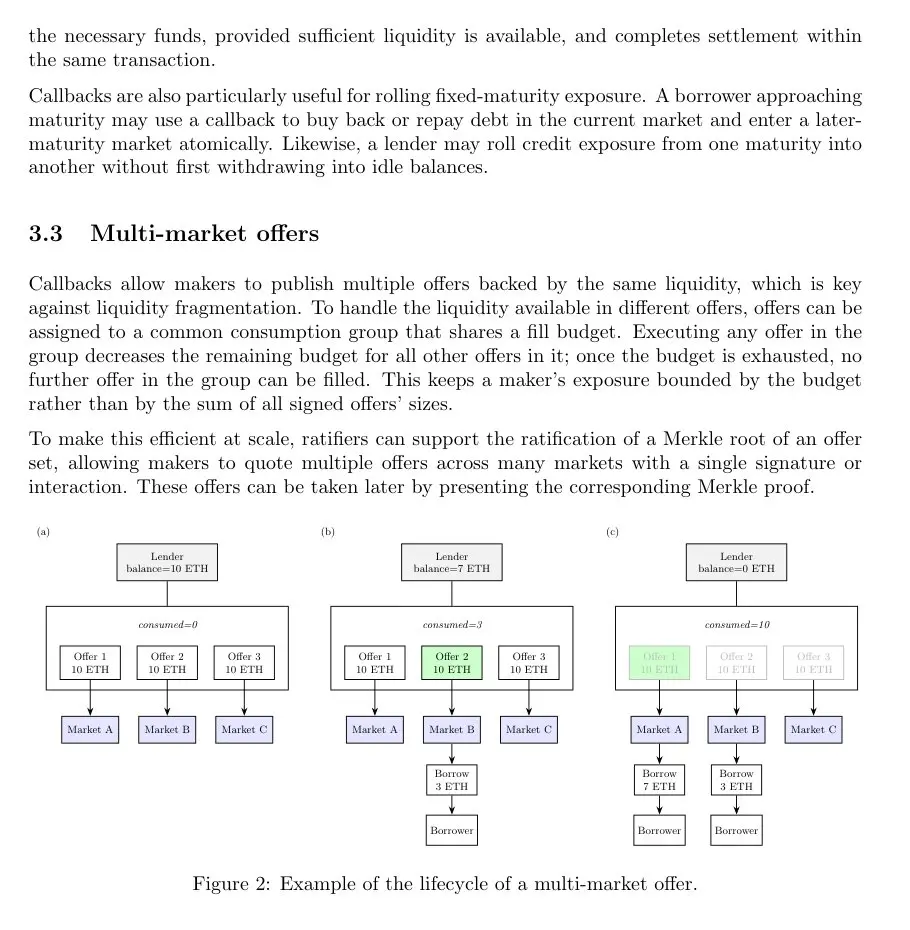
Midnight's multi-market offers and shared liquidity budget are already attempting to alleviate the issue of makers needing to repeatedly lock up capital, which is a valuable design.
However, the offered liquidity addresses capital efficiency but does not automatically create final borrowers, nor can it fully replace centralized benchmark maturities and continuous bilateral quotes.
13
@pendle_fi provides another important insight: for fixed-income assets to grow, they cannot only provide maturity yields; they also need to achieve "monetization" or collateral utility.
PT is essentially a zero-coupon-like claim, but PT can enter multiple major money markets as collateral. Pendle disclosed in March 2026 that over $1.3B in PT collateral has been deployed in these lending venues.
When PT can be collateralized, looped, financed, and combined, it is no longer just a token waiting for maturity but becomes an asset that can continue to be used in the DeFi balance sheet.

14
This may also be one of the most important directions for Midnight credit in the next stage.
If credit can only be held until maturity or wait for secondary buyers, it is a term asset that lacks liquidity for lenders.
If it can be held by a vault, serve as lending collateral, enter yield-tokenization markets, support repo-like financing, or be packaged into a maturity ladder, the demand will be completely different.
What truly determines whether fixed-income primitives can expand is often not the first transaction, but what can be done with the asset after the transaction is completed.
15
Maple provides another insight from the borrower side.
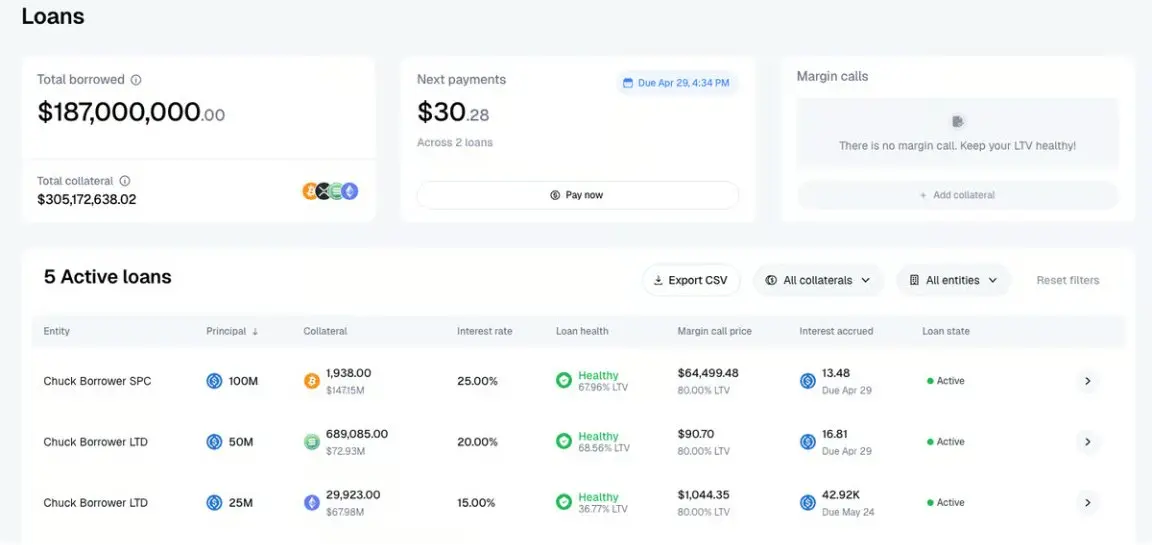
The borrowing demand on Maple does not entirely rely on a permissionless pool emerging naturally. It actively serves institutional borrowers, conducting KYC/KYB, credit review, term-sheet negotiation, and master lending agreements, then manages loan acceptance, interest payments, collateral monitoring, margin calls, and refinancing on-chain.
This is an on-chain + off-chain origination model. Maple currently discloses cumulative loans of approximately $25.7B, over 100 borrowers, and more than 400 loans.
16
The significance of Maple is not to suggest that Midnight should become a permissioned credit desk, but to illustrate that stabilizing borrower demand often needs to be actively organized.
Someone needs to find borrowers, understand the use of funds, negotiate terms, design collateral packages, establish legal recourse, and arrange refinancing. On-chain is responsible for transparent settlement and asset management, while off-chain handles part of underwriting, distribution, and relationship management.
Midnight provides a very general settlement layer, but it may still require originators, dealers, curators, and structured credit products above it.
17
Therefore, I am more inclined to understand Midnight's current limitations as a market formation and sequencing issue, rather than a product direction error.
What it needs most may not be more fragmented markets, but:
- Anchor borrowers that can sustain borrowing
- A few standardized benchmark maturities
- Dealers that can quote bilateral prices long-term
- Fixed-to-floating hedging and automatic rollover
- Collateral utility that can enter other protocols
- Originators and distribution that actively organize institutional demand
Midnight is not building another pool, but a set of on-chain term-credit infrastructure. It will form more slowly than a pool, but once formed, its value is not just a lending TVL.
 Risk warning