Meta and Alibaba are competing this week to "stuff" AI Agents into your eyes: an undercurrent in the AI glasses industry

 Alibaba's ambition is to turn glasses into a "portable AI Agent that can get things done anytime, anywhere"; Meta is betting on the evolution of hardware itself, aiming to make it a "next-generation terminal that helps you see the world clearly"; meanwhile, Apple, far away in Cupertino, is also rumored to be developing a new solution that uses "AI visual perception to replace traditional optical zoom."
This week, the Alibaba Cloud Summit and Meta Connect Developer Conference were held back-to-back, with both giants showcasing AI glasses at the center stage almost simultaneously. Alibaba's ambition is to turn the glasses into a "portable AI Agent that can get things done anytime, anywhere"; Meta bets on the evolution of the hardware itself, aiming to make it a "next-generation terminal that helps you see the world clearly"; meanwhile, Apple, far away in Cupertino, is rumored to be developing a new solution that replaces traditional optical zoom with "AI visual perception." This hardware form, once regarded as a sci-fi prophecy, is rapidly evolving into the core focus of competition in the capital market and tech circle.
1. Alibaba: Leveraging "Functional Mouths" to Drive Local Application Ecosystem
Alibaba's approach is simple and direct: to make AI glasses an assistant that can help you solve problems anytime, anywhere.
The Qoder glasses version launched in early September this year is a vivid example. Wearing glasses equipped with Qianwen or Leqi large models, you only need to say, "Help me see where this piece of code has an error." The camera on the glasses will follow your line of sight to the screen, identify the error, and even recognize handwritten sketches on a whiteboard, directly conveying the answer to your ear. This continuous questioning and conversational interaction completely discards the stiffness of traditional voice assistants that respond one question at a time.
At this week's Cloud Summit, Alibaba also launched the N1 series: the basic model features a 50-megapixel first-person snapshot; the more hardcore Pro version adds eye tracking and iris payment that can be completed just by using your eyes, with a rapid release date set for October 13. Supported by local super applications like Taobao, Amap, and Alipay, Alibaba's previously released G1 and S1 have quietly achieved the top spot in both AI glasses sales and online retail revenue in China.
2. Meta: Wearing a Phone on Your Eyes, Redefining Wearable Interaction
As the currently recognized player with the most mature experience, Meta has gone a bit further.
The Ray-Ban Display under Meta is most appealing not for the tiny screen that can display WeChat or text messages, but for the accompanying neural wristband. The wristband worn on your wrist can capture the subtle muscle signals from your arm, allowing you to change songs or adjust the volume with a simple thumb twist, without needing to lift your hand to touch the glasses or pull out your phone. In the future, it may even enable air writing. Coupled with real-time subtitle translation and first-person video call sharing, scenes from sci-fi movies a few years ago are becoming a reality.
At this week's Meta Connect conference, the next-generation product line has also surfaced: not only is there Luna, which is designed with privacy in mind and eliminates the camera in favor of microphone array interaction, but also an upgraded version of Ray-Ban Display that can display images in both eyes.
3. Apple is Not to Be Outdone: A Gamble on Screenless Form and Pure Visual AI
Compared to Alibaba's rapid deployment and Meta's high-profile appearance, Apple maintains a high level of mystery around its AI glasses codenamed N50, which are expected to be officially unveiled in 2027.
Apple's design philosophy is highly differentiated: it not only transforms the camera into an extremely low-profile vertical oval design but also completely discards the display, opting instead for a focus on Siri visual interaction—seeing what you see and asking what you ask, with AI responding in real-time via voice, emphasizing a screenless "seamless perception" experience. The method of zooming the camera is also unlikely to follow the traditional optical lens route used in smartphones; instead, it will rely on AI cropping and algorithmic enhancement for "digital zoom"—after all, the slender temple of the glasses cannot accommodate a complete set of zoom lenses that move back and forth.
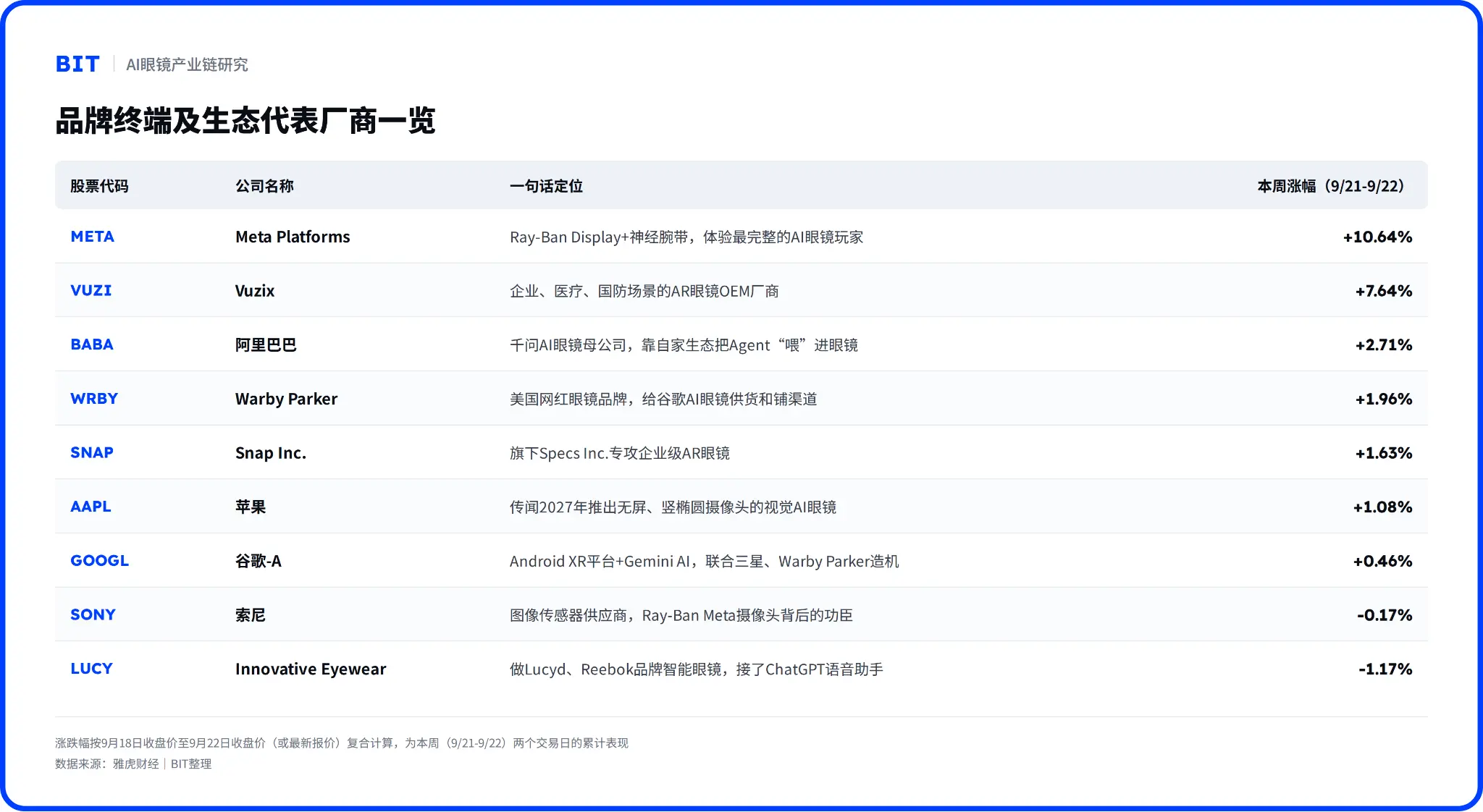
4. Behind the Cool Features: Who is Supporting Them?
If we break down the "show-off points" presented by these giants, we will find that each cool feature corresponds to a vast and intricate supply chain.
1. Chip Computing Power: Packing an Entire AI into a Few Grams of Small Box
For the glasses to understand speech and perceive the world in real-time, the underlying challenge is extreme computing power compression. Qualcomm is almost universally recognized as the industry standard; both Meta and Alibaba have extensively adopted Qualcomm's Snapdragon AR1 or the Reality Elite platform designed specifically for AI glasses. AMD and NVIDIA stand behind this hardware revolution, supporting the training and inference computing power of cloud-based large models and continuously delegating this capability to end devices.
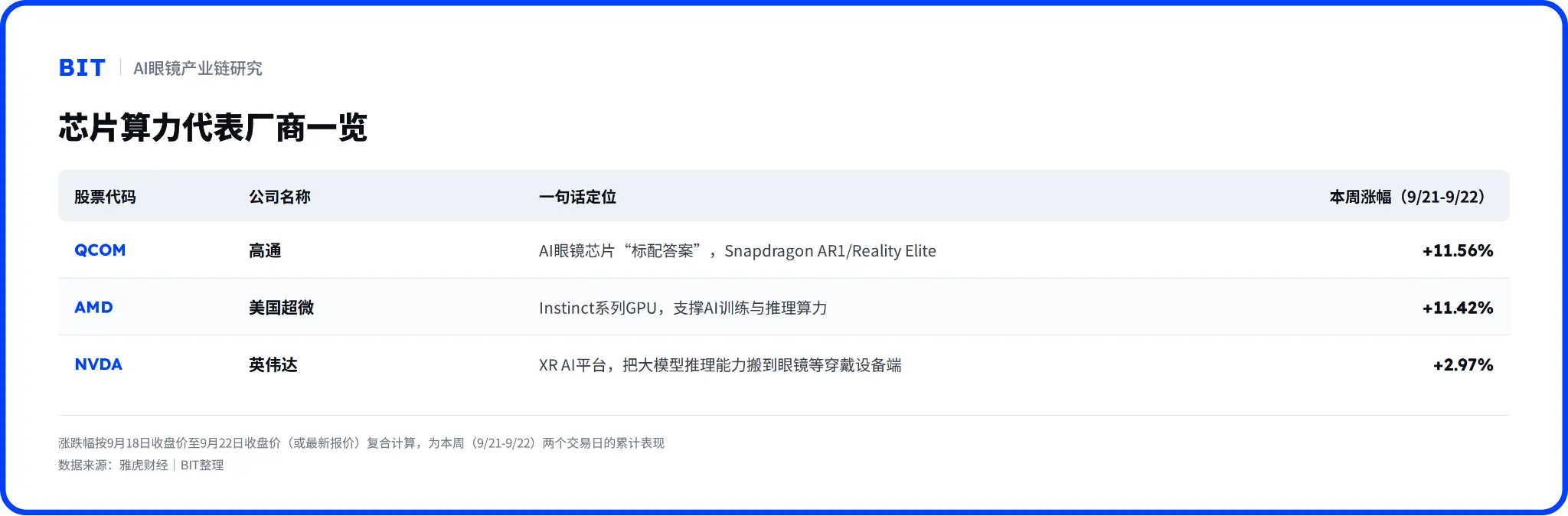
2. Display and Optics: How to "Pack" Images into Lenses?
How can a palm-sized lens clearly display images without obstructing your view of the real world? Himax's LCoS micro-displays are a common choice for mid-range solutions; Kopin is an "all-rounder" covering AMLCD, LCOS, and OLED; MicroVision takes a relatively niche laser beam scanning approach with a compact form factor. Whether these precise optical components can be reliably produced and their yield rates are satisfactory depends on semiconductor process control and inspection equipment providers like KLA.
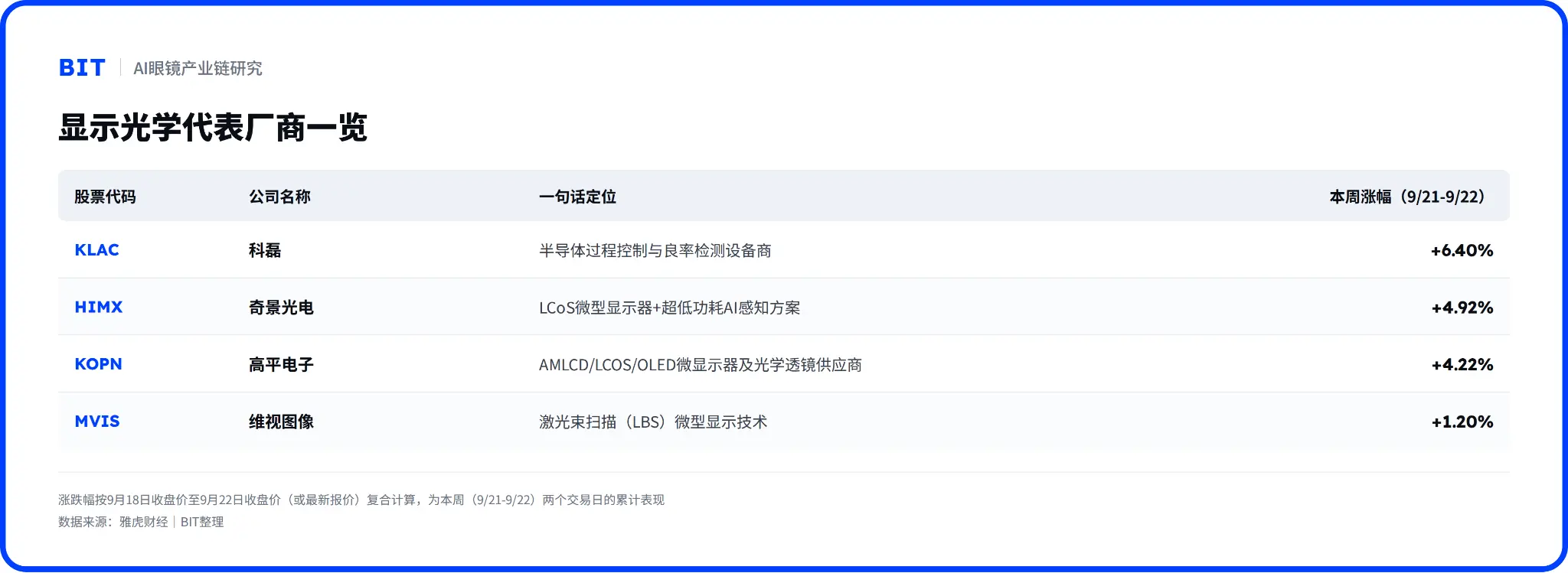
3. Application Ecosystem: From Metaverse Experiences to Naked-eye 3D Teaching
Having cool hardware alone is not enough; what ultimately retains users is a continuous stream of content and practical scenarios.
In this arena, Microsoft holds a large number of AR rendering patents while developing a dedicated operating system; Unity serves as the foundational base for the vast majority of AR applications; Autodesk brings AR glasses to construction sites, allowing architects to directly view 3D building models overlaid with reality.
In niche areas, Roblox is using AI-generated content to fill the metaverse, Etsy is exploring shopping scenarios, and Immersion is focusing on haptic feedback to create a sense of touch in the virtual world. zSpace specializes in "naked-eye 3D" teaching scenarios, allowing students to perform dissection exercises on a floating virtual heart without needing glasses.
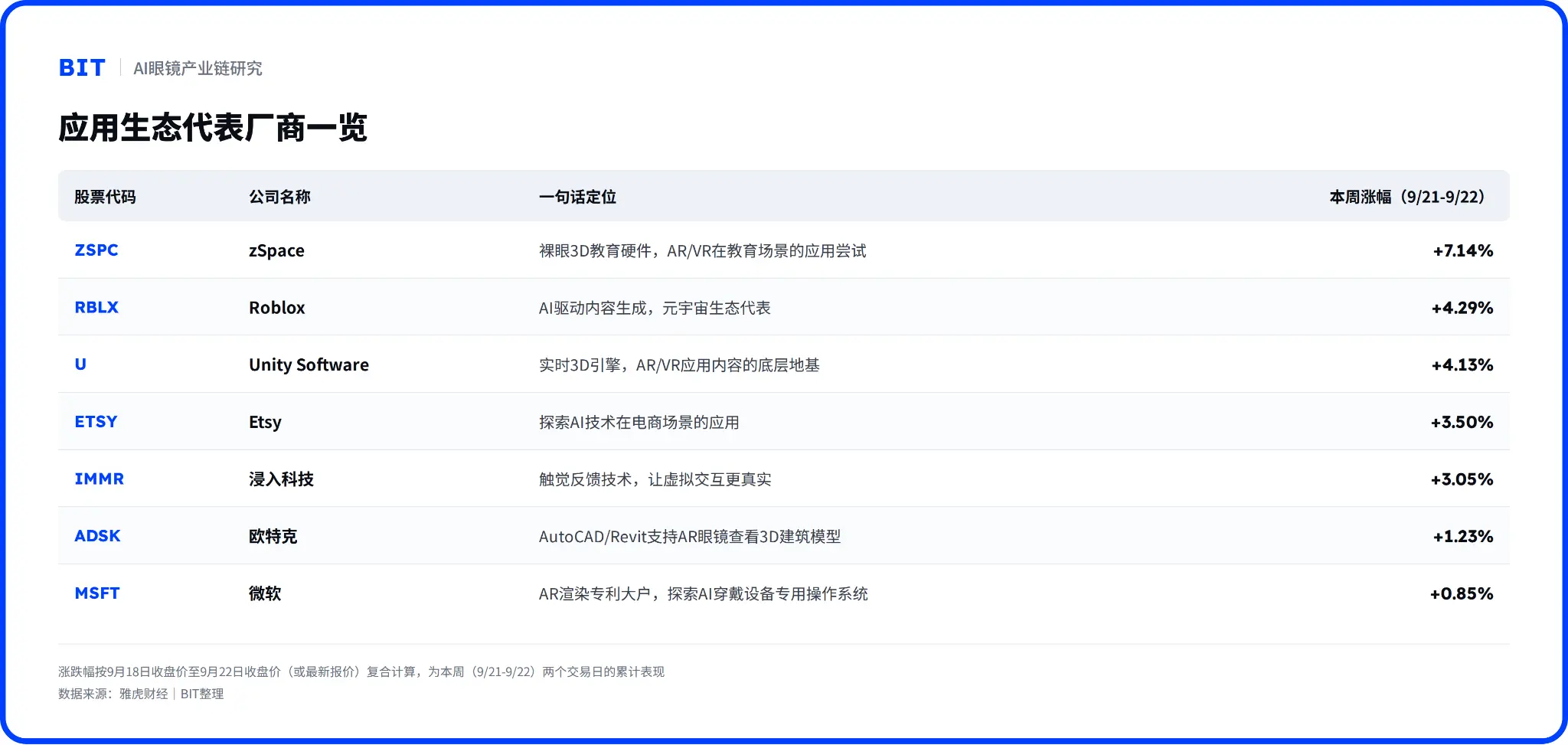
5. Soft and Hard Collaboration, Welcoming the Critical Point of Wearable Hardware
A thorough review of the entire industry chain reveals that terminal giants are responsible for telling the story and defining "what glasses can actually do"; while the three underlying lines of optical display, chip computing power, and content ecosystem are the true driving forces behind turning the story into reality.
As computing power bottlenecks are broken, perspective optics mature, and application scenarios gradually enrich, AI glasses may no longer just be a toy for geeks but the ultimate terminal that will take over our digital lives in the next generation.
Disclaimer: The company names, stock codes, and business descriptions mentioned in this article are compiled based on publicly available information and do not represent their real-time latest holdings, financial status, or operating performance; the data on price fluctuations in the text comes from Yahoo Finance historical data and may have delays or inaccuracies, provided for informational reference only. The content of this article does not constitute any investment advice, offer, or recommendation for trading specific securities, and BIT and the author bear no responsibility for any investment decisions made based on this content. The market carries risks, and investments should be made cautiously; specific investment decisions should refer to the latest announcements, prospectuses, and regulatory disclosure documents of listed companies, and it is recommended to consult a professional financial advisor.
 Risk warning